
What can turn a stressful bail bond transaction into a source of confusion? Often, it’s an expectation that was never made clear. The question “Why contract law important in the bail bonds industry?” points to more than paperwork: clear, fair agreements help agents and customers understand what they’re agreeing to and where accountability rests. It’s understandable that contract language can feel difficult to interpret, especially during an already demanding situation.
For Florida bail agents, thoughtful contract practices support informed decisions and trust. They also give both sides a clearer basis for discussing responsibilities, which can help reduce misunderstandings without promising that every disagreement will disappear.
This article explains what contracts contribute to bail bond transactions, why clarity and informed agreement matter, and which contract-law topics agents may want to study. It also explores when a question calls for qualified legal guidance, since education can build understanding but isn’t a substitute for legal advice. For aspiring and licensed agents, contract literacy is a valuable part of professional learning, alongside broader bail bond education.
Key Takeaways
- Understand why contract law important in the bail bonds industry, and how written terms can clarify expectations without replacing a court’s release decision.
- Learn how parties, obligations, payment terms, and signatures may shape an agreement, while recognizing that provisions can differ.
- Explore how transparent communication can support fairness and trust when contract terms feel complex.
- Use a practical approach to explain terms, pause for questions, clarify uncertainties, and document discussions.
- Build contract literacy through bail agent education, and recognize when a question calls for qualified legal guidance.
Why contract law matters in the bail bonds industry
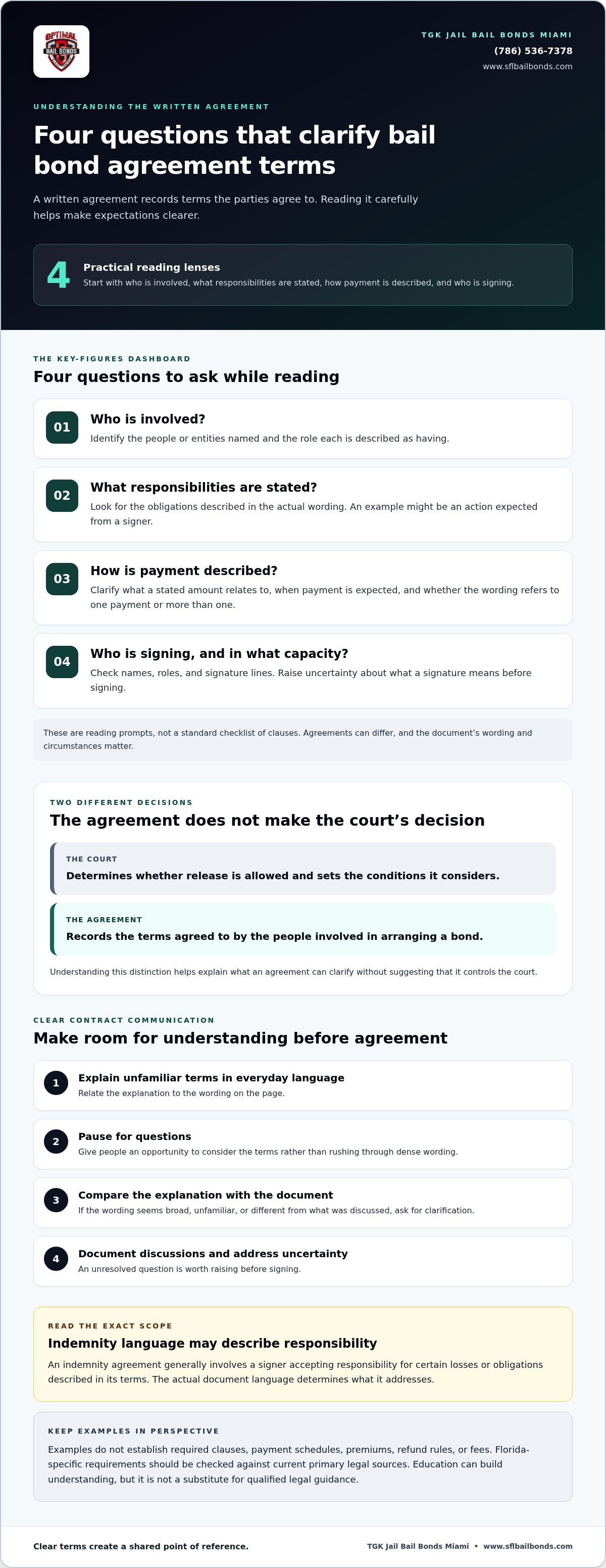
A bail bond transaction involves more than a court’s decision about release. The court determines whether release is allowed and sets the conditions it considers; an agreement between the people involved in arranging a bond records their own agreed terms. Those are different decisions, and understanding the difference helps agents explain what an agreement can clarify without suggesting that it controls the court.
For anyone asking, “Why contract law important in the bail bonds industry,” the practical answer is clarity. A written agreement can set out the terms the parties have agreed to, giving everyone a reference point during a process that may feel urgent and unfamiliar. Contract law principles provide a general foundation for understanding how agreements work, though the details of any particular bail bond arrangement depend on its actual terms.
For a brief introduction to the general concept, watch this video:
What does a bail bond contract do?
A bail bond agreement is a written record of terms that the parties agree to in connection with arranging a bail bond. It can help communicate what each person understands they are agreeing to, rather than leaving important expectations to memory or assumption. That description is general, not a claim that every agreement follows the same format or contains identical provisions.
Plain language matters. If a term is unfamiliar, a reader may not know what it means in practice or how it relates to their decision. Clear explanations and time for questions can help people understand the document before agreeing. Agents can also distinguish what the written agreement addresses from what remains a matter for the court. For a general overview of the foundations, see Contract law principles.
Why clarity matters to agents and families
Families may be worried about a loved one, trying to absorb unfamiliar information, and making decisions under time pressure. That does not mean they cannot make an informed choice. It does mean that rushing through dense wording or relying on an assumption can leave people unsure about what they agreed to. Clear communication gives them a better opportunity to pause, ask questions, and consider the terms.
For agents, careful explanations can support trust and reduce avoidable misunderstandings. If a family and an agent interpret an expectation differently, even a simple omission or unclear phrase may become a source of frustration. A calm discussion, paired with readable written terms, creates a shared point of reference. It also helps agents explain their role with care, a subject explored further in The Role of a Licensed Bail Agent in Florida. Clear agreements cannot prevent every disagreement, but they can make expectations easier to understand from the start.
Which contract terms shape expectations in a bail bond agreement?
A useful way to read a bail bond agreement is to look for the basic questions its terms answer: who is involved, what responsibilities are stated, how payment is described, and who is signing. These are reading prompts, not a claim that every agreement contains the same clauses or follows a standard format. The wording and provisions can differ, and examples here are general rather than statements of Florida legal requirements.
Understanding why contract law important in the bail bonds industry means paying attention to the practical effect of words on the page. A person should be able to identify what a term says, who it refers to, and what questions remain before deciding whether to sign.
Parties, responsibilities, and signatures
Start by identifying the people or entities named in the document and the role each is described as having. Then look for any stated obligations. For example, a term might describe an action expected from a signer or explain how the parties will communicate about a matter. Treat that as an illustration only, not a claim that a particular clause must appear in every agreement.
Signatures can indicate who is agreeing to the written terms, so names, roles, and signature lines deserve careful attention. If someone is unsure whether they are signing in a particular capacity, that uncertainty is worth raising before signing. The document’s language and circumstances matter; no general checklist can decide the legal effect of a signature.
How to explain payment terms and responsibilities
Payment language should be understandable to the person expected to pay. A reader might need to clarify what a stated amount relates to, when payment is expected, or whether a phrase refers to one payment or more than one. These neutral examples don’t establish a required term, payment schedule, premium, refund rule, or fee. They show why reading the exact wording matters.
Before signing, pause over terms that seem broad, unfamiliar, or inconsistent with what was discussed. Ask for the wording to be explained in everyday language, then compare the explanation with the document. A question left unresolved can become a misunderstanding later. Florida-specific requirements should be checked against current primary legal sources, rather than inferred from a general example or from another agreement.
What an indemnity agreement may address
An indemnity agreement is generally an agreement in which a signer may accept responsibility for certain losses or obligations described in its terms. In a bail bond setting, the document’s actual language determines what it addresses; its contents and effect shouldn’t be assumed from the label alone. A signer should understand any stated responsibility and the possible consequences before agreeing.
If a clause is unclear or a person wants to know whether it could be enforced in a particular situation, that’s a legal question for qualified counsel. Agents can support understanding by pointing to the relevant wording and explaining terms plainly, without predicting a legal outcome. Building this kind of contract literacy can also complement bail agent education resources.
Contract-law concerns: consumer protection, fairness, and trust
Public discussion of commercial bail often raises concerns about consumer protection, unequal bargaining power, and whether people can fully understand the commitments they make. Those concerns deserve a fair hearing. They also need to be distinguished from claims about every agent or every agreement: criticism of an industry or policy does not, by itself, establish how a particular transaction was handled.
The question of why contract law important in the bail bonds industry reaches beyond writing terms down. It includes whether people can understand what they are agreeing to and raise questions without feeling rushed or dismissed. Clear communication can support trust, but it cannot settle every legal or policy debate about commercial bail.
What consumer-protection critiques say
The Minnesota Law Review abstract frames its argument around unequal bargaining power and potentially confusing contract terms, contending that these conditions can expose consumers to harm. The Center for American Progress takes a broader policy perspective, criticizing commercial bail and characterizing industry priorities as favoring profit over people. These are arguments advanced by the authors and organization, not proof that every agency uses unclear terms or treats customers the same way.
The supplied Connecticut report extraction contains no accessible discussion of its findings or position. Its conclusions can’t be inferred from the report’s existence alone. Keeping that distinction clear helps readers assess what a source actually says instead of filling gaps with assumptions.
How transparent practices answer reasonable concerns
Responsible communication cannot answer every system-level criticism, but it can address a practical concern within an individual interaction: whether a person has a meaningful chance to understand what is being discussed. Agents can use plain language, invite questions, explain unfamiliar wording without pressure, and allow time to consider an answer. These steps make the conversation more open; they don’t guarantee agreement or eliminate every dispute.
Clarity is also distinct from legal compliance. A well-explained term does not replace applicable law, and a communication practice should not be presented as proof that every legal requirement has been met. Florida-specific requirements call for current, authoritative legal sources. A careful agent can be candid about that boundary while still responding respectfully to a person’s concerns.
| Concern | Why it matters | Responsible communication response |
|---|---|---|
| Unfamiliar or difficult wording | A reader may struggle to understand the meaning or practical effect of a term. | Explain the wording in plain language and invite follow-up questions. |
| Unequal bargaining power | A person may feel pressured or unsure about raising concerns. | Keep the discussion respectful, make room for questions, and avoid overstating what a term means. |
| Broader criticism of commercial bail | Policy arguments concern more than one agreement or interaction. | Address the specific conversation honestly without claiming that clear communication resolves the wider debate. |
For agents, this balanced approach matters. Taking criticism seriously does not require accepting every claim as universally true; it does require recognizing why understandable communication matters to people making consequential decisions. Trust grows through conduct that is clear and respectful, while legal questions and broader policy concerns remain distinct issues that deserve careful consideration.
How bail agents can approach contract communication responsibly
Clear contract communication is a professional practice, not a substitute for legal review. The question of why contract law important in the bail bonds industry connects directly to how an agent discusses an agreement: a person should have the chance to understand what the document says, ask questions, and decide without unnecessary pressure. The steps below are an educational communication framework, not a legal-compliance checklist.
A plain-language conversation before signing
Use a calm, consistent sequence. It helps keep the discussion focused, especially when someone is worried or unfamiliar with the process.
- Orient the reader. Explain what document you’re discussing and invite the person to follow along at their own pace.
- Explain the wording. Describe stated terms in everyday language, while keeping their meaning intact. Don’t paraphrase in a way that adds a promise or changes what the document says.
- Pause for questions. Give the person room to ask what a phrase means or how it relates to their decision. If they seem uncertain, slow down rather than treating silence as understanding.
- Clarify and check understanding. Restate a term or point to the relevant wording. You might ask, “Would it help if I explained that another way?” Avoid pressuring someone to sign before their questions are addressed.
- Document questions appropriately. Follow agency procedures and applicable rules for any record of the discussion. Don’t assume that a particular note, form, or recordkeeping practice is required or appropriate without checking.
Plain-language explanations help people make informed agreements by giving them a clearer basis for understanding what they’re considering. They don’t guarantee that a person will agree, remove all uncertainty, or replace the need to follow applicable requirements.
When a question needs legal interpretation
There’s an important boundary between explaining what words appear in an agreement and advising someone about the legal effect of those words. An agent can identify a clause and explain its ordinary wording, but should avoid predicting whether it’s enforceable or how it would apply in a disputed situation. Those questions call for review by qualified counsel.
Be careful with Florida-specific statements. Before including or relying on a claim about a required disclosure, a recordkeeping duty, or another regulatory obligation, verify it against current Florida primary sources. A familiar practice or an old reference isn’t enough to establish what the law currently requires. If the source or application is uncertain, mark the point for verification instead of presenting it as settled fact.
This approach supports a respectful exchange while keeping communication and legal interpretation distinct. It gives a person room to understand and raise concerns, and it helps an agent avoid overstating what a conversation or document can establish.
Building contract-law knowledge through Florida bail agent education
Contract literacy is one part of understanding the professional context of bail bond work. For aspiring agents, learning general contract concepts can help make unfamiliar terms easier to recognize and explain. For licensed agents, continued study can support a habit of checking how communication practices fit alongside current rules. Neither type of education guarantees a licensing or career outcome, and training isn’t a substitute for legal advice.
The question of why contract law important in the bail bonds industry is useful to explore as part of a broader learning path. Contract concepts help learners distinguish what an agreement says from other decisions in a case, identify where a question needs further attention, and communicate with care. Florida-specific law is a separate subject: requirements can change, so learners should verify legal and regulatory statements using current official Florida sources.
What aspiring agents can learn about contracts
Studying contracts can help aspiring agents become familiar with ideas such as agreement, stated responsibilities, and the importance of clear wording. These are general concepts, not a guide to deciding whether a specific document is legally effective. Training can build a foundation for recognizing questions and understanding the professional setting in which agreements are discussed.
Someone exploring the path into the field may also find it helpful to read How to Become a Bail Bondsman in Florida: The 2026 Career Guide. For structured pre-licensing education, the 120 Hours Bail Bonds Course Pre Licensing page is a relevant resource. Education can support learning, while questions about a particular agreement’s legal meaning or effect belong with qualified counsel.
Continue learning as the industry and rules change
Professional learning doesn’t end with an introductory course. Agents and aspiring agents can make a habit of separating broad contract concepts from Florida-specific requirements, then checking the latter against current official materials. If a rule, disclosure, or regulatory statement is unclear, don’t rely on an old summary or assume that a general explanation applies to every situation. Verify the point before treating it as current.
For licensed agents, ongoing education offers a way to revisit professional topics and stay engaged with changes that may affect their work. Bail Bond Continuing Education Florida: The 2026 Agent Renewal Guide provides a related place to continue exploring the education side of the profession. Reading guidance and formal learning can work together, but neither should be presented as legal representation or as a substitute for a current primary source.
If you’re building your knowledge of bail bond work, explore Optimal Bail Bonds’ education resources and take the next learning step at a pace that works for you.
Carry contract awareness into your next step
Why contract law important in the bail bonds industry is a useful professional question to keep revisiting as you learn and work. Contract literacy isn’t a one-time exercise. It means staying curious about how agreements are communicated, recognizing when a question goes beyond general explanation, and checking Florida-specific legal information against current official sources.
For aspiring and licensed agents alike, continued learning can help turn that awareness into a steady professional habit. You don’t need to resolve every legal question on your own. Knowing when to pause, seek clarity, and rely on qualified guidance is also part of responsible practice.
Each thoughtful step builds a stronger foundation for serving people with clarity, care, and accountability.
Frequently Asked Questions
Is a bail bond agreement a contract?
Generally, a bail bond agreement is a contract because it records terms that parties agree to in connection with arranging a bond. That general explanation is educational, not a legal opinion about a particular document or situation. Whether a specific agreement is valid or what effect a term has can depend on its wording and circumstances. For a Florida-specific legal question, consult qualified counsel.
Can bail bond contract terms differ from one agreement to another?
Yes. The terms and wording can differ, so don’t assume that one agreement’s provisions appear in every other document. For example, a signer reviewing paperwork in Miami may see terms arranged or described differently from a document they encountered before. Read the specific agreement carefully, note unfamiliar phrases, and ask for clarification. A prior agreement is not a reliable substitute for understanding the document in front of you.
What is an indemnity agreement in the bail bond industry?
An indemnity agreement is generally a document in which a signer may agree to take on certain responsibilities related to a bond. Its possible purpose and effect depend on the language and circumstances, so the title alone doesn’t establish what a person has accepted. Review the specific wording, and don’t assume that every indemnity agreement creates the same obligations. Seek qualified legal advice if you need an interpretation of your responsibilities.
Why should someone read a bail bond agreement before signing?
Reading the agreement helps a person understand what the document actually says before making a decision. Take time to consider how its wording applies to your situation, and raise questions about any phrase that feels unclear or differs from what you understood. A clear explanation can help identify a misunderstanding early. If you need to know your legal rights or the effect of a clause, ask qualified counsel for advice.
What happens if someone does not understand a bail bond contract?
If a term isn’t clear, ask for a plain-language explanation before signing and point to the exact wording that raises the question. For example, ask what a phrase refers to in the document rather than relying on an assumption. If the explanation still leaves a legal issue unresolved, pause and seek advice from qualified counsel. Don’t treat a general explanation as a decision about your specific rights or obligations.
Does Florida law regulate bail bond contracts?
Florida regulates the bail bond industry, but that broad fact doesn’t establish which requirements apply to every contract or clause. The answer to “Why contract law important in the bail bonds industry” includes recognizing that general contract concepts and Florida-specific rules are not interchangeable. For a current requirement, consult official Florida legal or regulatory sources, such as applicable statutes or Department of Financial Services materials. This overview is educational, not legal advice.
Can a bail bond agent explain a contract without giving legal advice?
An agent can explain what a particular phrase says in everyday language, while avoiding conclusions about a person’s legal rights or how a court might interpret the document. For instance, an agent can point out where a term appears, but a question about its legal effect may require a different kind of analysis. If interpretation or enforceability is at issue, seek guidance from qualified counsel rather than relying on an informal explanation.


