
In Miami, you can bail yourself out of jail by paying the full bail amount yourself, if the court has set bail and permits release. Cash bail may be returned if you meet all required court appearances.
Paying the full amount upfront can seem straightforward, especially if you want to avoid involving someone else. But the money remains tied to the case, and a separate hold may prevent release even after bail is paid.
This guide explains how paying your own bail works, what can happen to your money, and what may affect release in Miami. You’ll also learn how self-bail compares with a bail bond and when a bond from Optimal Bail Bonds may be useful.
Key Takeaways
- You may be able to post your own bail in Miami if release is allowed and you can provide an accepted payment method.
- Paying cash bail means putting the full amount up front; attending required court appearances affects whether it’s returned.
- The court sets bail and may impose release conditions, so the payment amount isn’t the only factor to consider.
- A bail bond can be an alternative when paying the full amount yourself isn’t practical, but its fee is generally nonrefundable.
- Understand the payment, collateral, and court obligations tied to each release option before deciding what may fit your situation.
Circumstances that may prevent self-bonding
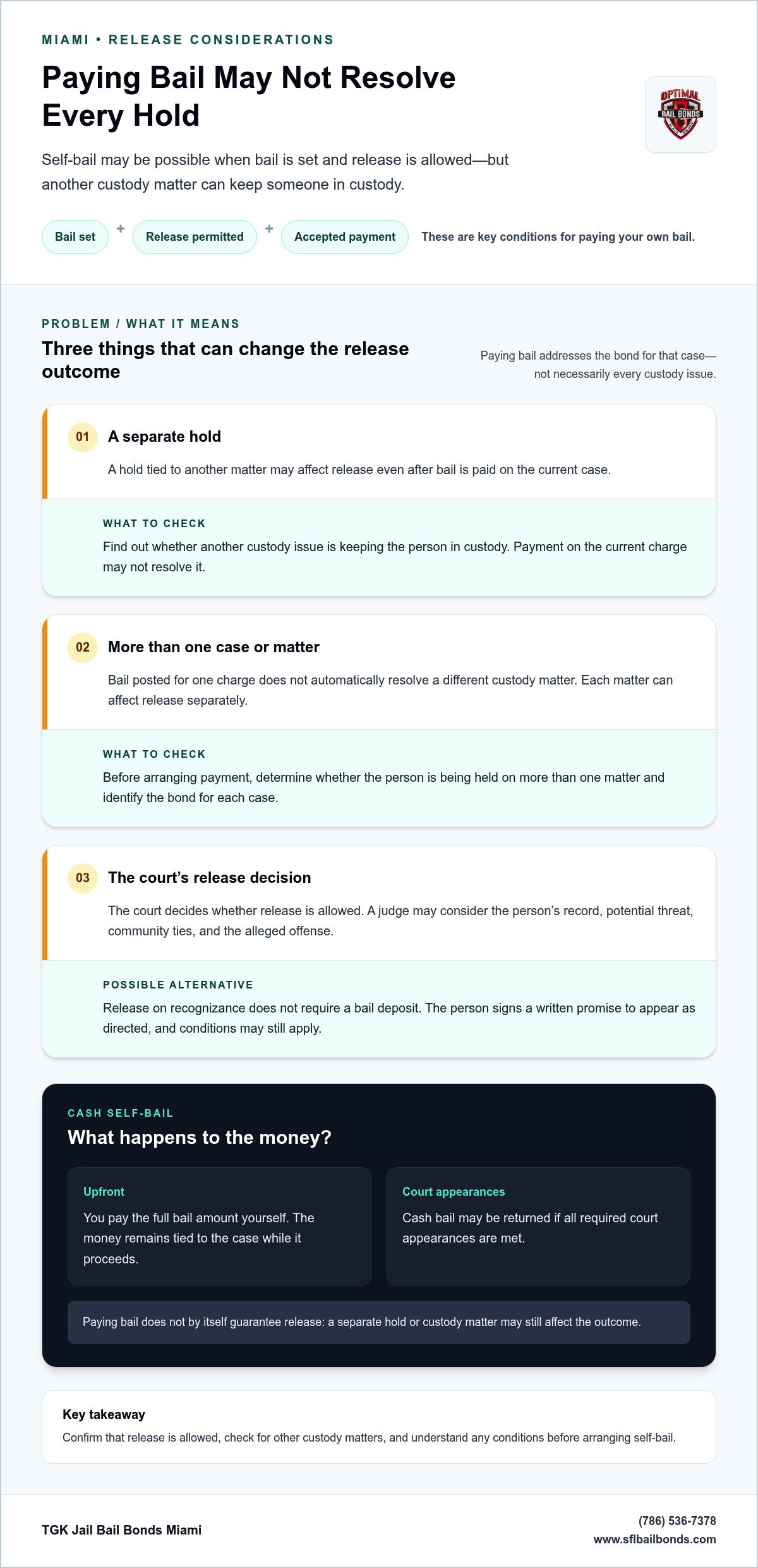
In Miami, paying bail for a case may not resolve every reason someone remains in custody. A separate hold or custody matter can affect release, even after bail has been posted on the current charge. Payment addresses the bond for that case, while another matter may require a separate release decision.
Before arranging payment, find out whether the person is being held on more than one matter. For example, someone booked on a new charge may also have a separate pending custody issue. Posting bail on the new charge doesn’t necessarily resolve the other issue, so the person could remain in custody while it is addressed.
The court’s release decision determines whether self-bail is an option. A judge may consider a person’s criminal record, potential threat, community ties, and the nature of the alleged offense when deciding whether to release them on their own recognizance. This option doesn’t require a bail deposit, but the person signs a written promise to appear as directed. Conditions may still apply.
- Separate hold: A hold tied to another matter may affect release even after bail is paid on the current case.
- Multiple cases: Bail posted for one charge doesn’t automatically resolve a different custody matter. Each matter can affect release separately.
- Release decision: A judge weighs the person’s record, potential threat, community ties, and alleged offense when considering release on recognizance.
When cash bail isn’t affordable, release on recognizance or other pretrial options may be considered. These differ from paying bail yourself: recognizance involves signing a promise to appear, while other options may carry conditions. The release arrangement affects both whether the person leaves custody and what they must do afterward.
So, can you bail yourself out of jail in Miami? You may be able to pay your own bail if bail is set, release is allowed, and you can provide an accepted payment. A separate custody issue can change the result. First, find out whether another matter affects release, then identify the bond and any conditions that apply.
Paying the full bail amount yourself
In Arizona, you can pay your own bail if you have an accepted payment method and release is permitted. The full bail amount must be deposited upfront for cash self-bail. Accepted forms include cash, a money order, or a cashier’s check. Confirm which form applies to the jail or court handling the case before arranging payment, since a payment method that cannot be accepted won’t secure release.
Paying directly means tying up the entire amount while the case proceeds. If the defendant attends every required court appearance, the full cash bail amount can be returned. The refund is connected to fulfilling those court obligations, not simply leaving custody. Plan around the possibility that the money won’t be available for other expenses during the case.
Missing court has serious financial and legal consequences. A missed appearance can lead to forfeiture of the full cash bail amount and an arrest warrant. If a bail bond was used instead, the person responsible may face the full bail amount and agency or court fees. A co-signer may also be responsible for the full amount if the defendant fails to appear.
A bail bond is a different arrangement from paying the court directly. In Arizona, a bail bond agent typically charges a nonrefundable fee of 10% of the total bail amount for a surety bond. That fee pays for the bond and isn’t the same as a cash deposit held by the court. Bailing yourself out through cash avoids an agent’s fee, but requires access to the full amount upfront.
- Cash, money order, or cashier’s check: Arizona self-bail requires an accepted payment method. The jail or court’s process determines how payment is submitted.
- Property: Some jurisdictions accept property as collateral, and its value may need to meet or exceed the bail amount. Property use can put an owner’s estate at risk if the bond obligations aren’t met.
- Bail bond: An Arizona agent’s typical 10% fee is nonrefundable, unlike eligible cash bail that can be returned after required appearances.
For example, someone arrested in Arizona with enough cash for the full amount may prefer direct payment, while a person without those funds may consider a surety bond. The choice depends on available funds, accepted payment methods, and the consequences of each arrangement. A bail bondsman can help arrange a bond, but the fee doesn’t replace the duty to attend court.
How bail works
Bail can be part of the process for seeking release from custody while a case is pending. The amount and payment method shape what happens next.
The Bail Process
The court sets bail, and a defendant who posts it is released until their court date, subject to any conditions. For a low-level offense, a bail schedule may list amounts by charge; a more serious case may require a hearing before a judge or magistrate decides whether to offer bail and sets its amount.
Courts consider the alleged crime, the accused person’s history, flight risk, and public safety. Those factors help determine the amount and whether release is available. Bail can reach thousands of dollars, and judges may set amounts in the millions for specific offenses. After posting bail, the defendant must appear as directed and follow any release conditions.
Using a Bail Bondsman
A bail bondsman can arrange a surety bond to help secure someone’s release without requiring the defendant to deposit the full bail amount with the court. In Arizona, a bail bond company guarantees the defendant’s court appearance in return for its fee. This option may help when the full amount is difficult to access, though the bond’s financial terms differ from a cash deposit.
A family member may help coordinate payment or a bond, but the defendant remains responsible for appearing in court. A co-signer’s obligations also matter if the defendant misses an appearance. A bond changes how release is secured, not the court’s expectation that the defendant appear.
Local Bail Rules and Payment Options
Bail rules and payment options vary by state and county, including which forms of payment a jail or court accepts. In Arizona, accepted self-bail options include cash, a money order, or a cashier’s check; acceptance of credit cards or personal checks varies by location and facility.
Local procedures can affect the practical next step. For example, a person with access to a credit card may still need another method if the facility doesn’t accept cards. A county’s payment process also determines where payment is submitted and how release is processed. Confirming the facility’s accepted method helps avoid arriving with payment it can’t take.
Release may also come with conditions, such as travel restrictions, law-enforcement check-ins, drug or alcohol testing, passport surrender, or no-contact orders. These conditions can shape daily choices after release. Understand the specific requirements and keep court dates accessible, because missing an appearance can put release and posted bail at risk.
Can you post your own bail in the United States?
In the United States, a defendant can generally post their own bail if they have access to the required funds or acceptable collateral. There’s no requirement to use a bail bondsman. The practical question is whether the person can meet the bond terms set for their case and whether the court permits release.
Paying your own bail means depositing the full amount directly rather than paying an agent to arrange a surety bond. A person who can afford the amount may pay it themselves, however high it is. But not every defendant can use this route: available funds, local payment rules, and the court’s release decision all affect the outcome.
For example, if the court sets a cash bond and the defendant can access the full amount, they may post it personally. A family member may also provide funds, but the defendant doesn’t have to rely on another person to post bail. In Georgia, defendants can generally post their own bond, and the law doesn’t require someone else to do it.
Property may be another possibility in jurisdictions that accept it. In the United States, property may be offered for release if its value meets or exceeds the bail amount. Some courts accept property as collateral, and its value typically must exceed the amount of bail. This may help someone whose available cash falls short, but it puts an asset at stake rather than providing a simple cash payment.
- Cash: Consider whether the full amount is accessible and whether depositing it would affect essential expenses while the case continues.
- Property: Determine whether the court accepts property and whether its value meets the bond requirement. Ownership and collateral arrangements matter.
- Bail bond: A bondsman may arrange a surety bond when paying the full amount directly isn’t practical, but using an agent isn’t mandatory.
Before choosing, identify the bond type and the payment or collateral the court will accept. A bond requiring cash can’t automatically be satisfied with property; each form of security follows its own process. Also account for the duty to attend every court appearance. A missed appearance can put the posted money or pledged property at risk, regardless of who arranged the payment.
Self-posting gives a defendant direct control over the payment decision, but it doesn’t override the court’s terms or guarantee release if another barrier applies. Compare the full amount tied up in a direct payment, the asset pledged as collateral, and the obligations attached to a surety bond. These differences can help defendants and families choose a workable route.
Can you use a bail bondsman to get yourself out of jail?
Yes. A defendant can use a bail bondsman to arrange a surety bond instead of depositing the full bail amount directly. In Arizona, a bail bond company guarantees the defendant’s court appearance in return for its fee. This may make release possible when paying the full amount upfront isn’t practical, but it doesn’t remove the obligation to attend court.
For an Arizona surety bond, a bail bond agent typically charges a nonrefundable fee of 10% of the total bail amount. That fee is different from cash bail paid to the court, which may be returned after required appearances. For example, someone with limited access to savings might choose a bond to avoid tying up the entire amount, while accepting that the fee won’t be refunded.
The bond process creates financial responsibilities beyond the initial fee. A co-signer may be responsible for the full bail amount if the defendant fails to appear. Before agreeing, the defendant and any co-signer should understand the payment obligations and what happens if court dates are missed. A bond is not a substitute for attending hearings.
Using an agent doesn’t guarantee immediate release. The court must accept the bond, and a separate hold may still affect whether the person can leave custody. A separate hold may prevent release even after bail has been arranged. The bond addresses the bail requirement, not a separate custody barrier.
- Compare the financial routes: Direct cash bail requires the full amount upfront; a surety bond involves a nonrefundable fee.
- Understand responsibility: A co-signer may face liability for the full bond amount if the defendant misses court.
- Keep the court schedule: Missing an appearance can put the bond at risk and lead to an arrest warrant.
A bondsman can help arrange the surety bond, but the defendant remains responsible for meeting court requirements. The choice depends on access to the full bail amount, comfort with a nonrefundable fee, and any co-signer’s willingness to accept financial responsibility. For Arizona readers, these are general bail-bond considerations; Optimal Bail Bonds provides bail-bond services in Miami.
Optimal Bail Bonds: Pre-Licensing Bail Bonds Class
Optimal Bail Bonds offers a Pre-Licensing Bail Bonds Class for people interested in entering the bail bond profession. If learning about bail has sparked a career interest, this class is a more relevant next step than arranging a bond for a current case. The company also offers a 120 Hours Bail Bonds Course and How to be a Bail Bondsman resources for aspiring bondsmen.
For help with a bond in Miami, Optimal Bail Bonds offers Bail Bonds Miami. Arizona’s rules differ from the process in Miami, so keep the location and applicable court requirements in mind as you consider your next step.
Contact Optimal Bail Bonds to discuss Bail Bonds Miami or learn about its classes.
Make your next move with a clear plan
Knowing whether you can bail yourself out of jail is only part of making a sound decision. Before acting, keep the case location, release status, payment arrangement, and court obligations together in one clear record. That gives you and the people supporting you a shared understanding of what’s been arranged and what still needs attention.
If the situation involves Arizona, keep its release process distinct from services in Miami. Optimal Bail Bonds offers Bail Bonds Miami and bail-bond education for people exploring the profession. Choose the next step that fits your location and reason for reaching out, whether that means discussing Miami bail bond assistance or learning about professional training.
Take the process one decision at a time. A clear plan can help you move forward with greater confidence.
Frequently Asked Questions
Can You Bail Yourself Out of Jail in Arizona?
Yes, you can post your own bail in Arizona if the court permits release and you can provide an accepted form of payment. Before arranging funds, find out whether a separate hold affects the person’s custody status. For example, posting bail on a new charge may not clear an immigration or probation-violation hold. That distinction can change what happens after payment.
Bailing Yourself Out: Is It Always an Option?
No. Self-bail may not secure release if another hold applies or the court hasn’t authorized release on bail. A judge may instead consider release on recognizance or options such as pretrial services or ankle monitoring. These routes have different conditions, so the key questions are whether the person qualifies for release and what obligations come with it.
Can you post your own bond before turning yourself in?
Posting bail requires an established amount and terms, so you can’t pay before those details exist. A low-level charge may have an amount listed on a bail schedule, while a more serious charge may require a hearing first. If you’re planning a surrender, the sequence matters: the court or schedule determines the bond, then payment or other security can be arranged.
First Things First: What is the Typical Bail Process?
The general sequence is arrest and booking, a bail amount or release decision, posting the required security, then release subject to court obligations. For example, a scheduled amount may apply to a lower-level offense, while a judge may decide bail after a hearing in a more serious case. After release, keep court dates and any conditions together so none are missed.
Is It Better to Bail Yourself Out or Have Someone Else Do It?
Neither route is automatically better; the right choice depends on who can provide the funds and who accepts financial responsibility. Self-payment avoids relying on another payer, while help from someone else can make arranging a bond possible. In Miami, families considering a bond can learn about Optimal Bail Bonds’ Bail Bonds Miami service. Compare who pays, whether collateral is involved, and the duties attached to the arrangement.
What Happens to Your Money After Self-Bail?
Cash bail may be returned when the defendant complies with required court appearances. The money isn’t a fee for release; it remains tied to the case and court obligations. Attending each scheduled appearance supports eligibility for a return, while missing court can put the entire cash amount at risk. Keep payment records and court notices organized throughout the case.
What If the Judge Has Not Set Your Bond Yet?
If a judge hasn’t set bail, you can’t pay an amount that doesn’t yet exist. In a more serious case, the person may remain in custody until a judge or magistrate holds a bail hearing and decides whether to offer bail and at what amount. Lower-level offenses may use a scheduled amount, so the next step depends on how bail is determined for the charge.
What is the Cash Bail System?
Cash bail is a release arrangement in which money is deposited as security for the defendant’s required court appearances. Unlike a surety bond, it involves paying the court directly rather than paying a bond agent’s fee. The amount remains connected to the case, and attendance affects whether it can be returned. Missing an appearance can lead to forfeiture and an arrest warrant.


