
Becoming a bail bond agent in Miami starts with a state-approved 120-hour course, but completing classes is only one step. The pre-licensing education requirements for aspiring bail bondsmen in Miami, Florida include passing the course with a grade of at least 80% before taking the state licensing exam. Your timeline also depends on eligibility, course scheduling, and exam completion.
It’s reasonable to want a clear plan before committing to training. This guide explains how the pre-licensing education requirements for aspiring bail bondsmen in Miami, Florida relate to course approval, eligibility, the exam, and choosing a provider. Use these steps to organize your path toward a bail agent career.
Key Takeaways
- Follow the licensing process in order: meet the eligibility criteria, complete approved education, then prepare for the state exam.
- Review age, education, residency, and background requirements before investing time in training.
- Plan exam preparation around the state test format: 60 questions, one hour, and at least 70% correct to pass.
- Keep application timing in view: education for a temporary bail bond agent license must be completed within four years of applying.
- Choose a provider whose course approval and completion-reporting process align with Florida’s requirements.
Florida Department of Financial Services course approval
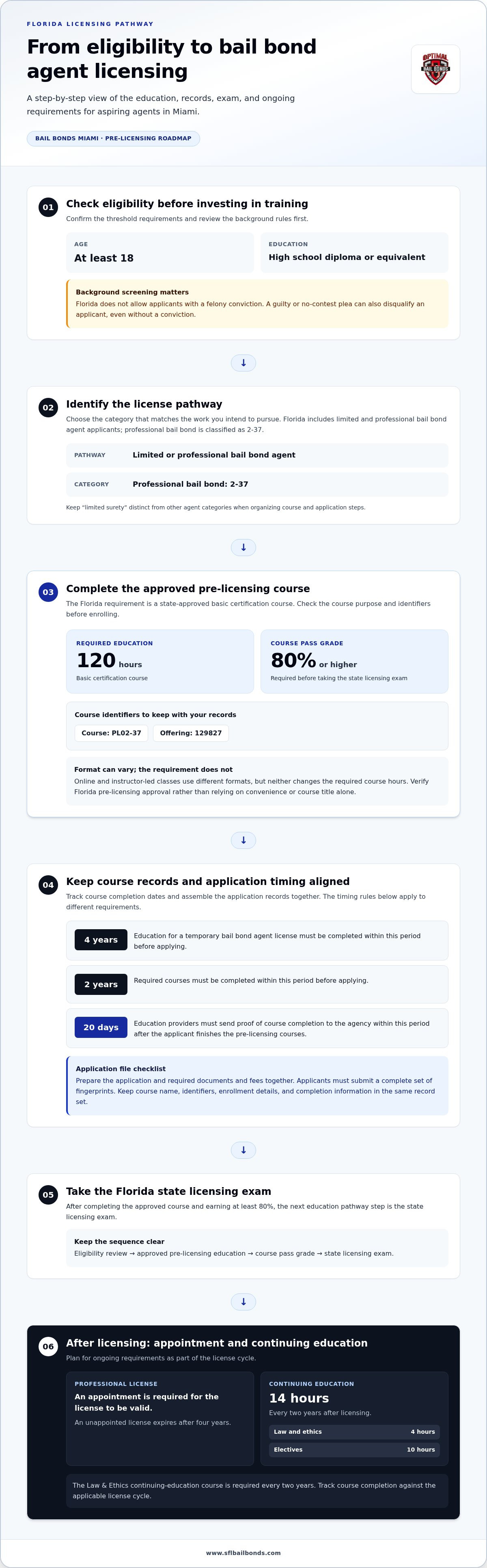
- Confirm that the course meets Florida’s pre-licensing education requirement. Aspiring bail bond agents must complete a state-approved 120-hour basic certification course. This applies to applicants in Miami as well as elsewhere in Florida. Treat the required course as a defined licensing step, not a general introduction to the profession. Before enrolling, compare the course’s stated purpose and total hours with the requirement you need to satisfy.
- Use the course identifiers to distinguish the right training. The Florida pre-licensing course is listed as PL02-37, with course offering number 129827. Keep these details with your enrollment records and make sure they match the course information you’re using. A course title alone may not tell you whether it serves initial licensing, continuing education, or another purpose. The identifiers help keep those education tracks separate.
- Evaluate the class format without confusing it with course approval. Online and instructor-led classes can organize learning differently, but neither format changes the required course hours. For online study, plan how you’ll track lessons and completion. For instructor-led classes, compare scheduled sessions with your availability. In either case, focus on whether the course is approved for Florida’s pre-licensing requirement, not just whether its format is convenient.
- Keep Florida’s course requirement distinct from a separate criminal justice add-on. The required basic certification course is 120 hours; the facts here do not establish additional Florida criminal justice course hours beyond that course. If you see a course described as criminal justice training, compare its purpose with the Florida bail bond agent licensing requirement. Avoid counting unrelated instruction toward the required course simply because its subject matter sounds relevant.
- Organize your course records before moving to the next licensing step. Keep the course name, PL02-37 identifier, offering number 129827, enrollment details, and completion information together. This creates a clear record of which training you completed and helps you distinguish it from continuing education. Miami applicants can use this recordkeeping approach to connect the state requirement with their own training plan. Reviewing 120-hour bail bonds pre-licensing course details can also help clarify the education step.
North Carolina bail bondsman license requirements are set out in Chapter 58 Article 71, while the North Carolina Department of Insurance regulates bail bondsmen and runners there.
Florida limited surety bail bond agent pre-licensing
Identify your license pathway before organizing training and application documents. Florida’s pre-licensing timelines, exam rules, and continuing education requirements apply at different stages.
-
Identify the License Type
Choose the license pathway that matches the work you intend to pursue. Florida’s licensing categories include limited and professional bail bond agent applicants, while professional bail bond is classified as 2-37. Don’t treat “limited surety” as interchangeable with every agent category. The license type affects which application and licensing steps apply, so organize your course and exam plans around the pathway you select.
-
Complete Pre-Licensing Education
Complete the required Florida bail bond pre-licensing courses within the applicable filing window. Education for a temporary bail bond agent license must be completed within four years of applying, and required courses must be completed within two years before applying. These are separate timing rules. Track course completion dates against your planned application date, rather than relying on enrollment dates or class schedules alone.
- Prepare the application, required documents, and fees together. Florida bail bond agent applicants must submit a complete set of fingerprints, according to the Florida Legislature. The available requirements identify an application and fingerprints, but do not establish a specific form name.
Course reporting is another part of the file. Florida education providers must send proof of completion to the agency within 20 days after an applicant finishes the pre-licensing courses. Keep your completion information and application records together so you can track the education and filing stages.
- Separate application costs from license appointment requirements. A Florida professional bail bond agent license requires an appointment to be valid, and an unappointed license expires after four years. Don’t mistake this for a recurring renewal charge.
After licensing, agents must complete 14 hours of continuing education every two years. That requirement includes four hours of law and ethics and 10 elective hours. The listed Law & Ethics continuing-education course is required every two years. Plan those classes around the applicable license cycle and track the completion deadline.
- Keep a simple timeline with course completion, application, appointment, and continuing education dates. For course planning, review the Florida pre-licensing course details alongside your intended license pathway. That practical step helps connect classroom requirements with the later application and renewal tasks.
Bail bondsman eligibility requirements
- Check the basic age and education criteria first. Florida applicants must be at least 18 years old and hold a high school diploma or its equivalent. These are threshold requirements, separate from course completion and the licensing examination. Gather education records before beginning the application process, so you can address both qualifications alongside training.
- Review your criminal history carefully before applying. Florida does not allow applicants with a felony conviction. The state also disqualifies applicants who pleaded guilty or no contest, even if no conviction was entered. A prior plea can matter independently of the final court record. Consider how each record relates to these eligibility rules before proceeding.
- Confirm residency and work authorization requirements for the professional pathway. A professional bail bond agent applicant must be a Florida resident and a U.S. citizen or legal alien with work authorization from the U.S. Immigration and Naturalization Services. Keep these criteria distinct from the temporary-agent experience requirement. The pathway you pursue determines which qualifications apply, so organize your records accordingly.
- Document the required experience if applying as a temporary bail bond agent. Applicants must have at least one year of full-time work experience, totaling at least 1,540 hours, before applying for a bail bond agent license. Build a clear record of the work period and hours. This gives you a practical way to compare your experience against the stated threshold before submitting an application.
- Prepare the professional application details for the county where you intend to work. A professional applicant must be vouched for and recommended by at least three reputable citizens residing in counties where the applicant proposes to do business. The place of business must be in Florida and in the county where the agent maintains records. The agent must actively engage in the bail bond business and maintain a public-accessible agency open during reasonable business hours.
- Gather the required supporting materials before submission. Applicants must submit a complete set of fingerprints with their application, according to the Florida Legislature. A professional applicant must also submit a proposed rating plan and detailed sworn financial statement; the Department must approve these before issuing the license. These are separate items, so track each one individually. Florida Statutes section 648.25 defines a professional bail bond agent by the security pledged for a bail bond in a judicial proceeding in exchange for money or things of value.
Florida state licensing exam
- Schedule your exam after completing the required education. Florida bail bond agent candidates must pass a final examination given by the state Department of Financial Services. Treat the exam as a separate licensing step, not a course-completion formality. Add it to your career plan after arranging the required training and application steps. A school or university background does not replace the state examination.
- Prepare for the actual test format. Limited and professional bail bond agent applicants face a 60-question licensing examination with a one-hour time limit. You must answer at least 70% of questions correctly to pass. Practice reading each prompt carefully and moving through questions at a steady pace. A simple timing exercise can help: divide the hour across the 60 questions, then leave time to review uncertain answers.
- Plan your attempts within the permitted window. Candidates may take the Florida bail bond agent examination five times within a 12-month period. Use each attempt as a reason to identify knowledge gaps, not as a substitute for structured preparation. Review course materials and focus on the topics behind missed questions. Bail bond agents need to understand the licensing material, including concepts involving bail, bonds, and collateral, rather than memorize answers alone.
- Know the additional course rule after repeated failure. Florida candidates who fail the examination three times must retake the 120-hour approved basic criminal justice certification course. A professional bail bond agent applicant who fails three times must retake the 120-hour course and earn a grade of 80% or higher before taking the examination again. Treat the third unsuccessful attempt as a clear trigger to return to coursework before scheduling another test.
- Build an exam plan that connects study, timing, and retakes. Start by reviewing the course content, then test yourself with timed practice that reflects 60 questions in one hour. Record subjects that need more attention and revisit them before the exam. If a result is unsuccessful, count attempts within the 12-month period and follow the course rule that applies after three failures. A focused plan keeps the examination tied to the training required for a bail bond career, rather than relying on unrelated university coursework or general study.
Approved pre-licensing education providers
Use a few concrete checks to assess whether a course fits Florida’s licensing process. Distinguish pre-licensing approval from continuing education credentials.
- Start by matching the provider and course to Florida’s pre-licensing requirement. The listed provider ID is 369590, a detail you can use when reviewing course information. Compare the course’s purpose, hours, and completion process with the licensing path you intend to follow. Don’t treat an insurance continuing education listing as proof of pre-licensing approval. Those credentials serve different education needs.
- Review the provider’s schedule before choosing a class. The institute lists a session from 11/02/2026 to 11/14/2026, running 8:30 AM to 6:00 PM. Those dates and hours give you a specific example for comparing class commitments with work or other responsibilities. Check the schedule’s actual dates and daily hours, then plan attendance around the full course period.
- Ask how the licensing course tracks learning and records completion. A clear course structure should let you follow lessons, identify completed chapters, and keep your own study notes. Use a statement or completion record to track your progress alongside enrollment details. Florida education providers must send proof of course completion to the agency within 20 days after an applicant finishes pre-licensing courses. That reporting deadline makes completion records a practical part of your application timeline.
- Distinguish pre-licensing education from continuing education. A course approved by the Florida Department of Financial Services for insurance continuing education credit serves that purpose. It should not be treated as interchangeable with approval for an initial bail agent licensing course. Compare the course’s stated purpose with the step you need to complete.
- Choose a format you can complete consistently. For an online class, consider when you’ll study and how you’ll track chapters and assignments. For instructor-led classes, compare the scheduled hours with your availability. A Florida resident preparing to apply can use these details to build a timeline from enrollment through course completion and examination. Keep provider information, schedule details, and completion records together for easier reference.
Review Florida pre-licensing course details
Optimal Bail Bonds: Pre-Licensing Bail Bonds Class
Optimal Bail Bonds offers a Pre-Licensing Bail Bonds Class for aspiring agents ready to begin their Florida training. Its 120 Hours Bail Bonds Course gives you a focused way to approach the education step before preparing for the state examination. Use the course alongside the eligibility and application requirements covered above, keeping your education timeline organized as you plan your next steps.
If you’re still learning what the profession involves, Optimal Bail Bonds’ How to be a Bail Bondsman can help frame the career path. Start when you’re ready to work through the required training and prepare for licensing.
Visit Optimal Bail Bonds online to explore your next step.
Take the Next Step Toward Your Bail Agent Career
Understanding the pre-licensing education requirements for aspiring bail bondsmen in Miami, Florida is a starting point. Your next task is to turn that information into a personal plan: identify the licensing path you’re pursuing, organize your study time, and keep your education and application steps moving together. A deliberate approach can make a complex process easier to manage.
Optimal Bail Bonds offers training resources for people exploring this career, including its Pre-Licensing Bail Bonds Class, 120 Hours Bail Bonds Course, and How to be a Bail Bondsman offering. These can help you focus on the education stage and learn more about entering the field.
Every professional journey starts with a clear next step. Keep building your knowledge, stay organized, and move toward your goal with confidence.
Frequently Asked Questions
How long does it take to become a bail bondsman?
There isn’t one fixed timeline, because course schedules, application timing, and exam results all affect the process. The required education itself is 120 hours, but completing it is only one step. For example, someone who meets eligibility requirements and passes the exam on the first attempt can move through the steps differently from someone who needs more preparation or retakes. Plan around the full licensing sequence, not classroom hours alone.
What Florida licenses are required to work as a bail bondsman in Miami?
You need the Florida bail bond agent license category that matches your intended role. Florida distinguishes limited and professional bail bond agent pathways, and the professional license is classified as 2-37 Professional Bail Bond. A professional license also requires an appointment to be valid. Before applying, identify the pathway you intend to pursue, because license classification affects which application requirements and eligibility details apply.
What pre-licensing education is required for a Florida bail bond agent license?
Florida requires a state-approved basic certification course for aspiring bail bond agents. Treat it as a licensing prerequisite, not optional career enrichment or continuing education. For example, a course intended for currently licensed agents may provide continuing education credit without fulfilling initial pre-licensing. Confirm that the course is specifically for initial bail bond agent preparation and retain its completion record for the application process.
How many hours of bail bond pre-licensing education are required in Florida?
Florida requires 120 hours of pre-licensing education. That figure describes the required basic certification course, not the time needed for exam preparation, application tasks, or licensing. As a practical planning step, separate your calendar into course attendance or study, review time, and the later exam stage. This makes it easier to estimate your personal schedule without confusing course hours with the entire licensing timeline.
Which Florida-approved schools offer bail bond agent pre-licensing courses in Miami or online?
Optimal Bail Bonds offers a Pre-Licensing Bail Bonds Class and a 120 Hours Bail Bonds Course for aspiring agents. For a Miami-area learner, these offerings connect directly with the required training stage. Course format can vary, so distinguish a course’s delivery method from its approval status. Choose training identified for initial Florida bail bond agent pre-licensing, rather than relying only on a school’s general insurance or continuing education courses.
What are Florida's age, residency, and background-check requirements for bail bond applicants?
Applicants must be at least 18 and hold a high school diploma or equivalent. A professional bail bond agent applicant must be a Florida resident. Florida disqualifies applicants with felony convictions and applicants who pleaded guilty or no contest, even without a conviction. Applicants must submit complete fingerprints with their application, according to the Florida Legislature. Review your records and eligibility before organizing the remaining application materials.
What exams must aspiring Florida bail bond agents pass, and what do they cost?
Limited and professional bail bond agent applicants must pass Florida’s 60-question licensing exam within one hour, answering at least 70% correctly. Candidates may take the exam five times within a 12-month period. Prepare with timed review and track each attempt; after three failures, additional course requirements apply before another examination attempt.
Does Florida require an apprenticeship or employment with a bail bond agency before licensing?
Temporary bail bond agent applicants must have at least one year of full-time work experience, totaling at least 1,540 hours, before applying. That requirement concerns work experience; it does not itself describe a formal apprenticeship program. If you’re considering the temporary pathway, document your work period and hours carefully so you can compare your experience with the stated prerequisite before submitting an application.


