
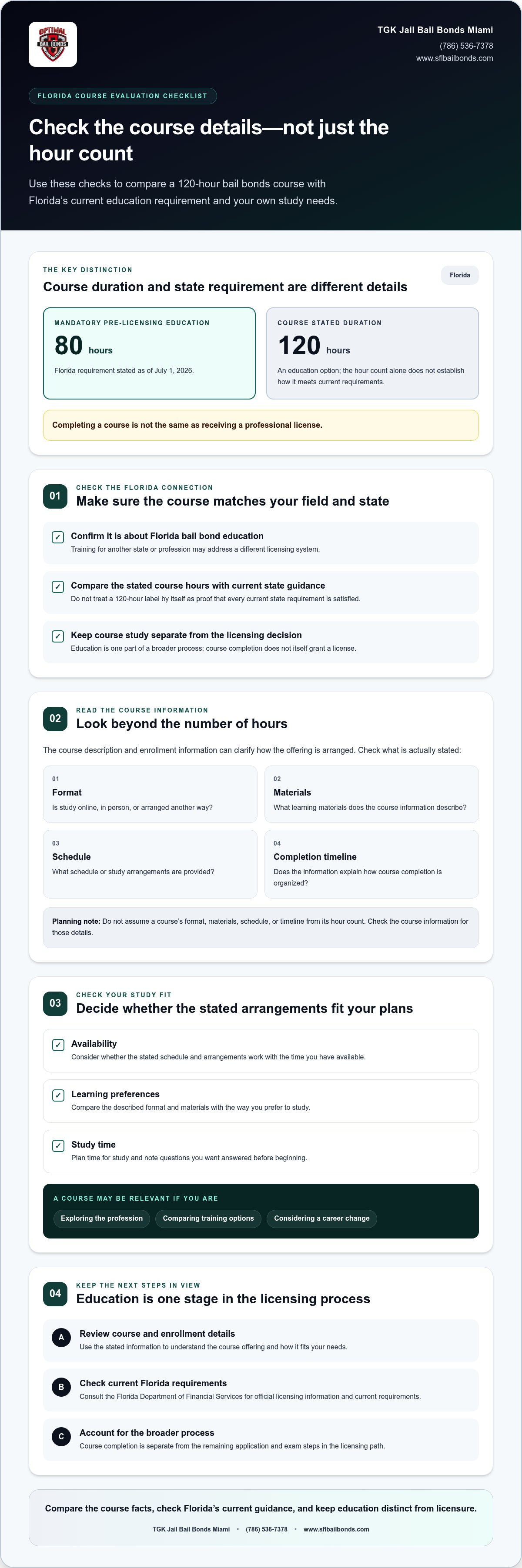
Does a course labeled 120 hours automatically match Florida’s current path to becoming a bail bond agent? Not necessarily. As of July 1, 2026, Florida’s mandatory pre-licensing education requirement is 80 hours. If you’re considering a 120 hours pre licensing course, understand how the course relates to current state requirements before enrolling.
It’s reasonable to want clear answers about course content, study fit, and what happens after you finish. Course completion is one step in a broader licensing process, not a license by itself. You’ll also need to understand how the education requirement connects to the remaining application and exam steps.
This guide explains what to consider when choosing Florida-specific bail bond education, how to assess a 120-hour course alongside the current 80-hour requirement, and where education fits in the licensing sequence. For prospective agents in Miami, Optimal Bail Bonds’ Bail Bond Education Center offers a 120 Hours Bail Bonds Course as a local starting point for exploring the profession.
Key Takeaways
- Before choosing a 120 hours pre licensing course, understand how its stated duration relates to Florida’s current licensing path.
- Compare the course scope, Florida relevance, study fit, and enrollment information to your needs.
- Plan time for study and organize your enrollment details and questions before you begin.
- Explore Optimal Bail Bonds’ Bail Bond Education Center and 120 Hours Bail Bonds Course as a Miami starting point for your next step.
What a 120-Hour Pre-Licensing Course Means for Florida Bail Bond Students
Taking a licensing course can be a major first step into an unfamiliar profession. You may be weighing what the course covers, how it fits into a career path, and what you’ll need to do after completing it. Optimal Bail Bonds’ 120 Hours Bail Bonds Course is an education option in Florida, but course study and earning a professional license are separate steps.
Pre-licensing education prepares you for a professional licensing process; completing a course is not the same as receiving a license. The 120 hours pre licensing course is an educational starting point, not a promise of licensure or employment. Keep that distinction in mind as you plan your next steps.
For a general introduction to the profession, the Bail bondsman overview provides background on the role and its history in the United States. Florida’s licensing path has its own requirements.
The video below is titled “120 Hours Pre-Licensing Bail Bonds Course: Florida Statute 648.24.” Use it as a supplemental introduction, while treating course study and the licensing process as distinct steps.
How the course fits into a Florida bail bond career path
Think of education as one stage in a broader licensing journey, not the finish line. A course can help you build your understanding of the profession, while the state process determines licensing requirements and decisions. Because requirements can change, use current Florida Department of Financial Services guidance for official details. For a wider overview, see the Florida bail bondsman career guide.
Who may be considering this pre-licensing course
This education may suit you if you’re exploring bail bond work for the first time, comparing training options, or considering a career change. You don’t need to have your entire career mapped out to begin learning about the field. Start by reviewing the course information and identifying what you want to understand before deciding on your next step.
Florida-specific context matters because a course for a different state or profession may address a different licensing system. Optimal Bail Bonds operates a Bail Bond Education Center in Miami and offers its 120 Hours Bail Bonds Course. Explore the 120-hour pre-licensing course in Miami as a local starting point. Review the course details, then keep course completion and the wider licensing process separate as you plan.
What to Understand About Florida's 120-Hour Bail Bonds Course
A course’s hour count tells you its stated duration. On its own, it doesn’t explain how lessons are delivered, what materials are used, or how the course relates to Florida’s current licensing requirements. Optimal Bail Bonds offers a 120 Hours Bail Bonds Course. Treat the stated duration as a course detail, not proof that completing the course alone satisfies every current state requirement.
A bail bonds training course is an educational step; Florida licensure is a separate process governed by current state requirements. Keeping these ideas distinct helps you evaluate the course without assuming that its hour count guarantees a particular licensing outcome. If you’re considering a 120 hours pre licensing course, review the course information and compare it with current state guidance.
Which course details should a prospective student understand?
Read the course description and enrollment information to understand the structure of the offering. The number of hours alone doesn’t tell you whether study is online, in person, or arranged another way. It also doesn’t explain the materials, schedule, or completion timeline. Use the course information to assess those details instead of relying on assumptions about what a course of this length usually includes.
As you review the description, note what it says about the course and how it fits your needs. The duration may be one detail, while the format and schedule are explained elsewhere in the course information. Consider whether the stated arrangements fit your availability and learning preferences. This gives you a practical basis for planning your study time.
How Florida requirements differ from other states and professions
Course information for one profession or jurisdiction can’t establish requirements for another. Real estate pre-licensing materials, for example, address a different profession and licensing system. Their course hours and learning arrangements don’t define Florida bail bond education. Keep your comparison focused on the subject you’re pursuing: bail bond licensing in Florida.
For current rules and licensing information, consult the Florida Department of Financial Services, the relevant state authority. Check regulatory details there rather than relying on general claims about bail bond training or materials written for another profession. For related background about the Florida pathway, the Florida bail bond pre-licensing guide offers another reference, while official state guidance remains the source for current requirements.
Once you’ve reviewed the course description and separated course facts from state requirements, you can make a more informed decision about your next step. Explore the 120 Hours Bail Bonds Course details as you consider whether the offering fits your plans.
Evaluating a 120-Hour Pre-Licensing Course Before Enrolling
Choosing a course is easier when you compare the details that affect your decision, not just the number of hours. Use this checklist to review the course and enrollment information, then consider how each point applies to your plans.
- Confirm Florida relevance. Make sure the course information is about bail bond education in Florida. Real estate training and licensing courses from other states address different professions or jurisdictions, so they aren’t a reliable guide to Florida bail bond requirements. For current licensing information, consult the Florida Department of Financial Services.
- Understand the stated course scope. Read the course description to see what the offering expressly covers. Don’t infer a curriculum or specific learning outcomes from the hour count alone. If you’re considering a 120 hours pre licensing course, distinguish the published course information from separate state requirements.
- Consider your available study time. Think about your existing commitments and how you can make room for the stated course duration. Review the course information for its format and pacing, then decide whether that structure suits your routine. Don’t assume a course is online, self-paced, or instructor-supported unless its details say so.
- Review enrollment information. Understand how enrollment works and what steps are described before study begins. Clear enrollment details help you assess the commitment you’re considering. Focus on information that will affect your decision, such as the stated course structure and enrollment steps.
- Separate education from licensure. Course completion and receiving a professional license are not interchangeable. Use course information to assess the education offering, and use current state guidance for licensing requirements. For exam-focused context, the Florida bail bond licensing exam guide can help you understand that part of the broader process.
Check that the training is relevant to Florida bail bonds
Keep your comparison specific to the profession and jurisdiction you’re exploring. A course for real estate agents, or for bail bond licensing in another state, can’t establish what applies to Florida bail bond students. Review current guidance from the Florida Department of Financial Services before relying on a regulatory statement as current or applicable to your situation.
Match the study commitment to your schedule and goals
Before enrolling, consider when you can realistically make time for study and what you want to learn about the course. Review the published information for its format, pacing, and enrollment details. For a Florida option, explore Optimal Bail Bonds’ 120 Hours Bail Bonds Course and weigh the stated details against your plans.
A careful review can help you move forward with clearer expectations. If you’re ready to explore the course, visit Optimal Bail Bonds’ course information.
How Miami Students Can Prepare for the 120-Hour Course
A substantial course commitment is easier to manage when you make a plan before you begin. For Miami-area students, preparation starts with reviewing the enrollment information, making room for study around existing responsibilities, and keeping course questions separate from questions about Florida’s licensing process.
Practical preparation helps you approach a substantial course commitment with clearer expectations and a study plan that fits your life. Use the steps below as a starting point, then adapt your plan to the course structure.
Set up a realistic study plan before beginning
Look at work, family, and other regular commitments before setting aside study time. Choose periods you can realistically protect instead of building a plan around an ideal week that may not reflect your routine. Once enrolled, use the course structure to track your progress and note what you’ve completed. This keeps your planning connected to the actual course details.
- Review the enrollment details. Gather the course information in one place so you can refer to its stated structure and enrollment steps.
- Map your existing commitments. Identify the times of day or parts of your routine when study is most realistic, while leaving room for work and family responsibilities.
- Set a repeatable study routine. Choose consistent periods that suit your availability. The right routine is one you can maintain, not a schedule borrowed from someone else.
- Track progress against the course structure. After you begin, use the course organization to record where you are and what remains. Plan around the stated pacing rather than assuming a particular weekly workload or completion deadline.
Keep course questions and licensing questions distinct
Sort your questions into two groups. Course questions may concern enrollment information or the course’s published structure. Licensing questions concern Florida’s current rules and process. Direct regulatory questions to the Florida Department of Financial Services, and use its guidance for current information rather than relying on general advice or details from another profession or state.
This distinction is especially useful if you’re considering a 120 hours pre licensing course while managing several responsibilities. Knowing which questions concern the course and which belong to the state process can prevent assumptions from shaping your plan. For course-specific information, review the 120-hour bail bonds course details, then use official Florida guidance for regulatory questions. Miami is your local context, while licensing guidance applies at the state level.
Before you start, write down what you need to know, organize your enrollment information, and choose study periods that feel manageable. A clear plan can make your first step more focused.
Explore Optimal Bail Bonds' 120-Hour Pre-Licensing Course
After considering what course information to review and how to make room for study, look at a Florida bail bond education option and decide whether its stated details fit your plans. Optimal Bail Bonds operates a Bail Bond Education Center in Miami and offers a 120 Hours Bail Bonds Course and pre-licensing classes. It’s a local starting point for people exploring bail bond education, not a promise of licensure or employment.
What the education center offers prospective bail bond students
The center offers its 120 Hours Bail Bonds Course and pre-licensing classes. If you’re new to the field, reviewing the course information can help you understand the offering and decide whether it belongs in your next steps. Base your decision on the course information, including its stated curriculum, format, tuition, schedule, and student outcomes where provided.
A course can be one part of professional preparation, while Florida licensing remains a separate process. As you assess your next step, you can focus on learning about the education option, reviewing its information, and identifying questions about the course. Enrollment is not a commitment to a particular career outcome.
For prospective students in Miami, a local education center is a relevant place to begin exploring bail bond training. Use the details for the specific course to assess whether its stated commitment and information suit your needs. If you’re comparing options, write down what matters to you, such as the course structure and enrollment information, and use those points to guide your review.
Take the next step toward your Florida bail bond career
Start with the 120-hour course information to review the offering directly. Keep course questions separate from regulatory questions. For current Florida licensing guidance, consult the Florida Department of Financial Services. You can also use the Florida bail bonds career guide for broader career-path context.
You don’t need to have every career decision settled before taking a next step. Review the course information, consider how it fits your plans, and use official state guidance when you need licensing details. That approach can help you move forward with clearer expectations.
Ready to explore? Review the 120 Hours Bail Bonds Course and take your next step with confidence.
Take Your Next Step With Confidence
A career decision doesn’t have to be settled all at once. Make your next move practical: decide what you need from your education, review the course information, and keep Florida licensing guidance close as you plan. This can help turn interest in bail bond work into a considered next step.
Choosing a 120 hours pre licensing course is part of exploring your path, not a shortcut to a guaranteed professional outcome. Take time to weigh the commitment and focus on the details that matter to you. A thoughtful decision can help you begin with realistic expectations.
When you’re ready, review the course information and take the next step toward your bail bond education in Miami.
Frequently Asked Questions
Is a 120-hour pre-licensing course required to become a bail bond agent in Florida?
No. As of July 1, 2026, Florida’s mandatory pre-licensing education requirement is 80 hours, not 120. Optimal Bail Bonds offers a 120 Hours Bail Bonds Course, but the course’s stated duration and the state’s current requirement are separate details. Before making enrollment or licensing decisions, review current Florida Department of Financial Services guidance to understand which education requirements apply to your situation.
What does a 120-hour bail bonds pre-licensing course cover?
Use the course’s published description to understand its specific subjects and lesson sequence rather than inferring them from the number of hours. Review the information to see the scope and learning materials described. The course hour count alone doesn’t explain its curriculum. If you’re comparing education options in Miami, focus on the stated course details rather than assumptions based on other professions.
How long does it take to complete a 120-hour bail bonds course?
A 120-hour course describes 120 hours of course time, but that number alone doesn’t establish how many calendar days or weeks completion will take. The elapsed time depends on the course’s structure and schedule. For example, if you’re balancing work and family commitments, use the published pacing information to plan instead of assuming a particular weekly workload or completion deadline.
Can I take a Florida bail bonds pre-licensing course online?
Whether a particular course is online depends on its stated format. Review the course details to understand how learning is arranged before planning around remote study. Keep course delivery separate from Florida licensing requirements, which you can review through the Florida Department of Financial Services.
What happens after I complete a Florida bail bonds pre-licensing course?
Course completion doesn’t by itself finish the licensing process. Florida’s process includes steps beyond education, such as an application and state licensing examination. The Department of Financial Services provides current requirements and instructions. Use its guidance to understand what applies after your course, including any required submissions, and keep your course completion information with your records as you organize the next steps.
How do I enroll in a 120-hour bail bonds course in Miami?
Start by reviewing the course information and enrollment details for the Miami education option. Optimal Bail Bonds offers a 120 Hours Bail Bonds Course through its Bail Bond Education Center. Read the published information to understand the offering and enrollment steps, then consider whether it fits your plans. Begin with the 120-hour course information.
Does completing the course guarantee a Florida bail bond license?
No. Completing a course doesn’t guarantee a Florida bail bond license or employment. Education is distinct from the state’s licensing decision and other steps in its process. Consult the Florida Department of Financial Services for current licensing requirements and application guidance. That distinction helps you plan realistically as you explore a bail bond career in Miami.


