

Strong community ties matter, but they do not decide an immigration bond hearing on their own. Proof of community ties for an immigration bond may include address records, sponsor statements, family documents, employment evidence, and letters from community groups. The detained person bears the burden of showing they are not a danger to the community or a flight risk, so each document should help explain why they can be safely released and are likely to attend future hearings.
It is understandable to focus on gathering documents when someone you care about is detained. Knowing what each record can demonstrate helps build a clearer picture of the person’s connections and support system. This article explains which address, sponsor, family, work, and community records may support a bond request, what a sponsor can document, and how the burden of proof shapes the judge’s assessment. It also explains how to organize evidence so it speaks directly to community ties, flight risk, and danger to the community.
Key Takeaways
- Use leases, utility bills, or landlord statements to help show where the person can live after release.
- Letters from family, employers, and community groups are more useful when they describe specific relationships, responsibilities, and support.
- A sponsor’s identity, address, finances, and practical plans can help explain how they’ll support court compliance.
- Organize evidence to address concerns about whether the person will attend future hearings and whether they pose a danger to the community.
- Prepare supporting documents carefully, including certified English translations when required, so the evidence is clear and usable.
Fixed-address evidence and sponsor statements
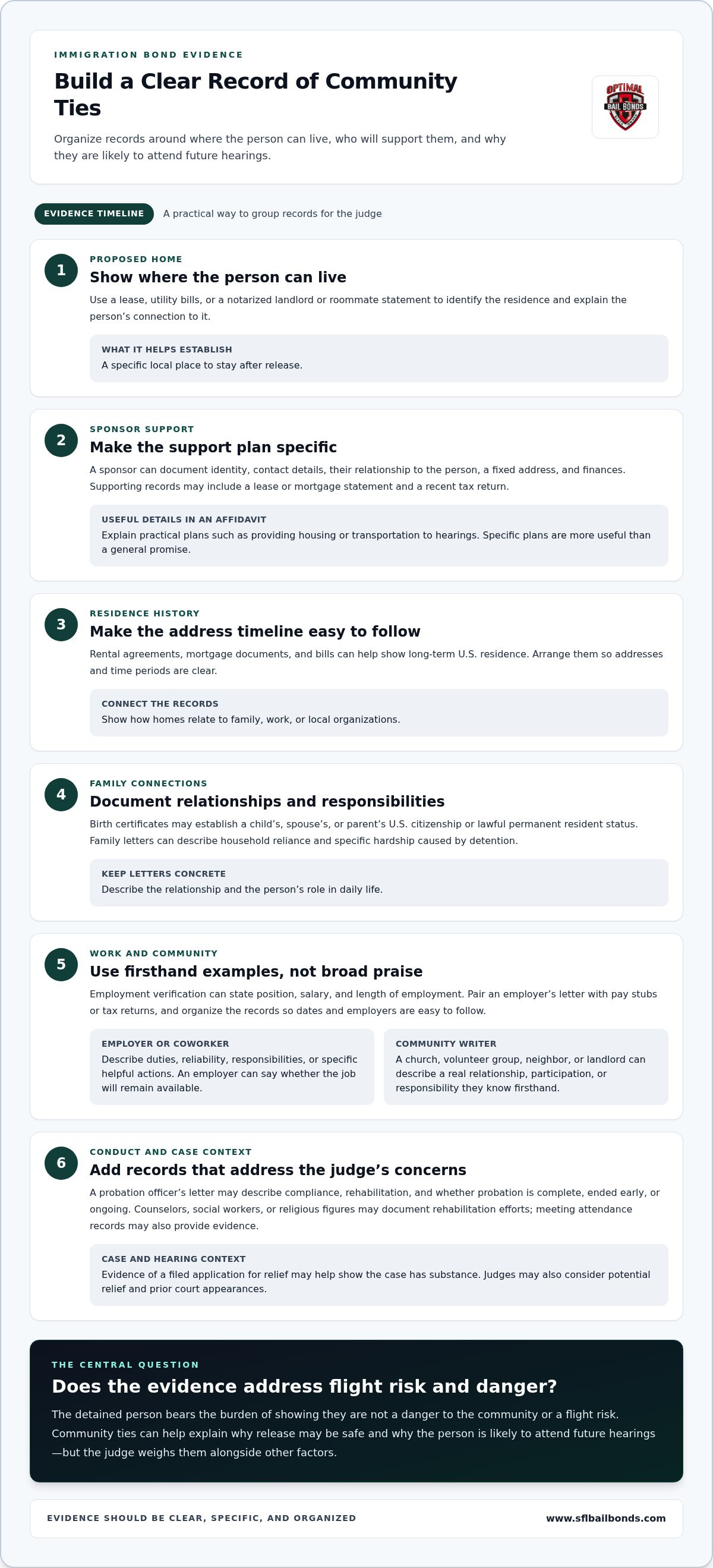
A dependable place to live after release gives the hearing a concrete connection to Miami. A lease, utility bills, or a notarized statement from a landlord or roommate can document the proposed address. The records should identify the residence and explain the person’s connection to it. For example, a landlord’s letter can state that the person may live at the listed home. These documents help show that the person would have a local place to stay if released.
A sponsor can provide details about housing and practical support. The sponsor may document a fixed address with a lease or mortgage statement and finances with a recent tax return. A notarized or sworn affidavit can identify the sponsor, provide contact information, explain their relationship to the detained person, and describe plans to support compliance with court requirements. Specific plans, such as providing housing or transportation to hearings, are more useful than a general promise of support.
Evidence of long-term U.S. residence can show that a person’s ties extend beyond a proposed address. Rental agreements, mortgage documents, and bills can help establish residence history. Arrange records to make the relevant addresses and time periods clear. A consistent sequence can help explain where the person has lived and how those homes connect to family, work, or local organizations. These materials can support proof of community ties for an immigration bond hearing, but the judge also considers other factors.
Evidence about relief from removal can provide context for why the person may remain engaged in their case. Immigration judges may consider whether relief is available, along with community ties and prior court appearances. Matter of Andrade, 19 I&N Dec. 488, 490, addresses the relevance of potential relief in bond proceedings. Evidence that a legal pathway is concrete and currently attainable is more useful than a remote possibility. A filed application for relief, including cancellation of removal where applicable, may help show the case has substance.
Probation and rehabilitation records can provide specific information about conduct and progress. A probation officer’s letter may describe compliance, rehabilitation, and whether probation is complete, ended early, or ongoing. Letters from counselors, social workers, or religious figures can document rehabilitation efforts. An AA or NA counselor may describe recovery and program participation. Confidentiality concerns may limit a letter, while meeting attendance records may provide another form of evidence.
Community letters can connect these records to a person’s daily life. A church, volunteer organization, neighbor, or landlord may describe a real relationship and the person’s participation or responsibilities. Ask writers for examples they know firsthand, rather than broad character claims. Together, address records, sponsor statements, residence history, and community evidence give the judge specific details to weigh alongside prior court appearances and the person’s circumstances.
Family, employment, and community ties
Family records, workplace documents, and community letters can show how a person is connected to life in Miami. An immigration judge may weigh these relationships when assessing danger and flight risk.
Employer and Coworker Letters
An employer’s or coworker’s letter can describe the person’s role, conduct, and workplace relationships. Specific details help explain what the person contributes and whether a job will remain available after release. An employer can describe the person’s duties, work ethic, reliability, and responsibilities, then say whether they would welcome the person back. A coworker can share concrete examples, such as helping colleagues or handling assigned tasks responsibly.
Keep each letter grounded in the writer’s firsthand knowledge. For example, a supervisor might explain how long they have worked with the person and describe a regular responsibility the person handled. A coworker could identify a specific helpful action instead of offering broad praise. These details connect employment to a real workplace and show the judge how release could restore an established routine.
Employment History and Financial Stability
Employment history records where a person has worked and how long each position lasted. An employment verification letter can state the person’s position, salary, and length of employment, while recent pay stubs or tax returns can document work and financial stability. These records give the immigration judge concrete information about employment instead of relying only on a general claim that the person has a job.
Organize documents so dates and employers are easy to follow. For example, pair an employer’s letter with pay stubs from the same job. A record of consistent work may help explain financial responsibilities and community connections, although it does not by itself resolve whether a person presents a danger or flight risk.
Family documents can show close relationships and the practical effect of continued detention. Birth certificates may establish that a detained person’s child, spouse, or parent is a U.S. citizen or lawful permanent resident. A family member’s letter can explain how the household relies on the person and describe specific hardship caused by detention. A child’s letter may state the child’s age and immigration status, relationship to the parent, and the parent’s role in daily life.
Community involvement can be documented through letters from a church, volunteer organization, religious group, neighbor, or landlord. A religious leader might describe the person’s participation and how their beliefs have influenced their life. A volunteer coordinator can identify duties the person performed or people they assisted. Each writer should give firsthand examples so the letter adds evidence rather than repeating a general character description.
Matter of Guerra, 24 I&N Dec. 37, 40, lists family ties and employment history among factors an immigration judge may consider in bond decisions. Together, family records, workplace evidence, and community letters can make those connections more specific and easier to assess.
Proof of a supporter’s lawful status
A sponsor’s immigration status can help identify who is offering support and how they know the detained person. A sponsor is commonly recommended to be a U.S. citizen or lawful permanent resident with a personal relationship to the detainee. Their status does not prove every detail of the person’s case. It helps establish the supporter’s identity and connection.
Documents can make the sponsor’s identity easier to assess. A sponsor may provide government-issued identification, such as a birth certificate, passport, or green card. A family member or friend writing a support letter may attach a copy of a permanent resident card or U.S. passport. Keep the name consistent across the letter and identification, and explain any differences clearly.
A useful support letter describes the writer’s relationship with the detained person, specific shared activities, and positive contributions the writer has observed. For example, a sibling might describe regular caregiving, while a longtime friend could explain how they have supported each other. The writer can also describe their knowledge of the person’s responsibility and any concerns about danger to others. Firsthand details matter more than broad praise.
Supporters can explain what practical help they can provide after release. A family member might offer a room, while a friend could arrange transportation to immigration court hearings. State the actual plan, including who will provide housing or rides and how the supporter knows the person. These details show how support could help the detainee stay connected to the community and attend required proceedings.
Community contributions add context beyond a sponsor’s formal status. A religious leader, volunteer coordinator, neighbor, or coworker can describe activities they personally witnessed. For instance, a volunteer coordinator might identify regular tasks the person performed, while a neighbor could describe ongoing contact. A letter should explain the writer’s connection and include concrete examples, rather than simply calling someone dependable.
Keep the supporter’s lawful status separate from claims about the detained person. A passport or green card identifies the writer. It does not establish the detainee’s immigration status or resolve any criminal history issue. The supporter’s letter should focus on what they know directly and can realistically provide. Accurate, specific statements help the immigration judge understand the available support without overstating the writer’s role.
Before including a letter, confirm that it names the writer, explains the relationship, and describes a clear form of help. A sponsor offering housing can identify the arrangement; someone offering rides can explain their transportation plan. Pairing these details with identification gives the court a clearer picture of who stands behind the commitment and what that support means in practice.
Burden of proof in bond hearings
Yes. A lawyer may request an immigration bond hearing before an immigration judge. Before the hearing, organize evidence of the proposed address, family and work ties, prior court compliance, and any available relief from removal.
The detained person carries the burden of showing they are not a danger to the community and are not a flight risk in bond proceedings under INA 236(a). That means evidence should address both concerns directly. A Miami address can show where the person would live, while records of past court appearances can help demonstrate willingness to attend future hearings. A support letter describing a real relationship adds context, but broad claims alone may leave important questions unanswered.
The immigration judge may deny bond upon finding either danger or flight risk; both findings aren’t required. The judge may also lower an amount set by ICE, leave it unchanged, raise it, or order detention without bond. Under Matter of Urena, 25 I&N Dec. 140, 141, the judge assesses flight risk only after determining the person isn’t dangerous or a threat to national security. These issues are distinct, so evidence should not focus on community ties alone.
For flight risk, connect each document to a reason the person is likely to appear. For example, a family member’s letter might describe regular caregiving responsibilities, while an employer could explain an established job and willingness to rehire. A sponsor’s plan to provide housing or transportation can show practical support for attending hearings. Prior compliance with immigration requirements can provide a direct record of past conduct.
- Address and residence records: Show the proposed home and the person’s history of residence.
- Family and community evidence: Describe close relationships, caregiving, religious participation, or volunteer work.
- Work records: Provide employment verification, pay stubs, or tax returns that document a job and financial stability.
- Case-related evidence: Explain prior court compliance and any concrete, currently attainable relief from removal.
Matter of Siniauskas, 27 I&N Dec. 207, 207, states that a person seeking custody redetermination under section 236(a) must establish they don’t pose a flight risk. Matter of Guerra, 24 I&N Dec. 37, 40, identifies factors including a fixed U.S. address, residence history, family ties, and employment history. These cases show why a clear record matters: the judge weighs personal circumstances against the specific concerns raised in the custody decision.
Prior criminal charges or convictions may also matter to the danger assessment, so relevant court dispositions can clarify the outcomes. Evidence of completed probation, dismissed charges, or rehabilitation may provide important context. Present accurate records alongside specific explanations. A letter about good character cannot replace documents that address the underlying concern.
What documents should be translated or notarized for an immigration bond hearing?
Prepare records so an immigration judge can read and understand them. Documents submitted to immigration court must be in English or accompanied by a certified translation. This may apply to a Spanish-language lease, a foreign birth certificate, or a medical record. Keep the translation with the original document so the connection between them is clear.
Whether a document needs notarization depends on the document and how the writer presents it. A sponsor can submit a notarized or sworn affidavit explaining their identity, contact details, relationship to the detained person, and plans to support court compliance. A landlord or roommate may provide a notarized affidavit confirming a proposed address. Support letters can also state that their contents are true and correct to the writer’s personal knowledge under penalty of perjury.
Not every item in an evidence packet is an affidavit. A lease, pay stub, tax return, or court disposition is a record that supports a specific point. For example, a lease may document residence, while a pay stub may support employment history. Do not treat notarization as a substitute for translation: a notarized Spanish-language letter still needs a certified English translation for court submission.
Other records may help explain circumstances relevant to release. Medical records can document a serious health condition affecting the detained person or a dependent family member. Court dispositions can clarify the outcome of prior arrests or criminal charges, and records may include proof of completed probation or dismissed charges. A probation officer’s letter can explain compliance or what remains in an ongoing term. Each record should clearly relate to an issue in the bond hearing.
Organization matters. Label documents by subject, such as residence, family, employment, or court history. Keep each translation beside its corresponding original, and make sure names and dates can be matched across records. For instance, a birth certificate and family support letter should make the relationship clear. Include evidence supporting release on the person’s own recognizance when relevant to the request.
Prepare at least 2 copies of the completed evidence packet. A clearly arranged set helps keep the original, translation, and supporting materials together. Review the packet for missing pages and legible copies. If a letter relies on personal knowledge, identify the writer and explain how they know the person. Clear organization helps the judge follow how each record supports the request.
Optimal Bail Bonds: How to be a Bail Bondsman
Optimal Bail Bonds offers How to be a Bail Bondsman for readers interested in learning about the bail bondsman profession. This educational option is separate from preparing evidence for an immigration bond hearing, where address records, support letters, and other documents help explain a person’s circumstances. If your questions have led you to consider a career in bail bonds, this course may be a relevant next step. It offers a way to explore the profession rather than seek help with immigration proceedings. For information about How to be a Bail Bondsman, contact Optimal Bail Bonds or visit sflbailbonds.com.
Make Your Next Step Clear
Use proof of community ties for an immigration bond to build a clear, truthful account of the person’s circumstances. Before moving forward, consider whether each document is easy to understand and supports a specific point in the request. A focused packet keeps attention on the information that matters.
Take the next step that fits your situation. For information from Optimal Bail Bonds, use the link below.
Careful preparation can make a difficult process feel more manageable. Move forward one clear step at a time.
Frequently Asked Questions
What documents prove community ties for an immigration bond hearing?
Useful records include family documents, employment records, residence evidence, and letters describing local relationships. In a Miami case, a packet might pair a child’s birth certificate with a caregiver’s statement explaining the person’s role in school pickups or appointments. Choose records that support different parts of the person’s life, and keep names and dates consistent across documents. This gives the immigration judge a fuller picture than a stack of unrelated papers.
How do family relationships and U.S. citizen children affect immigration bond decisions?
Family relationships can show meaningful responsibilities and the hardship detention causes, but they do not decide bond by themselves. A child’s birth certificate may document the relationship and citizenship, while a caregiver or family member can describe the parent’s regular role. For example, explain who manages a child’s daily care and what changes during detention. The immigration judge considers family ties alongside flight risk, danger to the community, and other relevant circumstances.
Can employment letters, pay stubs, or tax returns support an immigration bond request?
Yes, these records can document work history or financial stability. An employer letter can clarify whether a position remains available and describe the person’s responsibilities. Pay records can support the dates stated in that letter, while tax returns may add financial context. For a Miami worker with irregular shifts, ask the employer to explain the schedule clearly. Consistent, specific records are easier to assess than a general statement that the person is employed.
Do home ownership, a lease, or utility bills count as proof of community ties?
Yes. A mortgage statement can show a connection to an owned home, while a lease or utility bill can help document residence. Records are most useful when they connect the person to the address, rather than showing only another household member’s name. For example, pair a bill with a roommate’s statement explaining that the detained person lives there. A fixed Miami address can support the request, but it does not alone settle bond eligibility.
How can letters of support from family, employers, or community leaders be prepared for a bond hearing?
Ask each writer to identify their relationship, explain how long they have known the person, and give firsthand examples. A Miami pastor might describe regular participation, while a supervisor could confirm work conduct from direct experience. Writers should distinguish what they personally observed from what someone else told them. They can state that their account is true and correct to their personal knowledge under penalty of perjury, helping the court understand the basis of the letter.
What evidence shows an immigrant is not a flight risk in an immigration bond case?
Evidence can show why the person is likely to attend future hearings, including prior compliance with immigration requirements and ongoing family, work, or community responsibilities. For example, records of past appearances can document attendance, while a supporter’s transportation plan can address how the person will reach court from their Miami residence. Present specific documents and explanations tied to future attendance. The judge weighs flight risk separately from whether the person poses a danger.
What is the burden of proof for showing community ties at an immigration bond hearing?
The detained person must establish they aren’t a danger to the community or a flight risk in a custody redetermination under INA 236(a). Community ties can help address flight risk, but the evidence should also respond to any safety concerns relevant to the case. For instance, a residence record may show stability, while documented compliance can address court attendance. The judge may deny bond based on either danger or flight risk.


