
The Florida Bail Bonds Exam tests more than memorized definitions. It’s a 60-question Pearson VUE exam with a 2-hour time limit, and you need a score of 70% to pass. These study tips for the Florida bail agent test focus on the topics you’ll need to understand, including bail bond laws and procedures, licensing, forfeiture, exoneration, and ethical standards.
It’s understandable to feel unsure about what to prioritize when legal terms and practical decisions appear side by side. A steady plan can make the material easier to absorb and show you where more practice would help. This guide covers the exam’s main subject areas, how to use practice questions effectively, and ways to review ethics, risk management, and record-keeping. You’ll also find tips for organizing study time and learning from missed answers, so your preparation builds understanding instead of relying on memorization alone.
Key Takeaways
- Know the Florida exam’s format and passing requirement so you can prepare with a clear target.
- Use practice questions to find knowledge gaps, then review missed answers to understand the reasoning behind them.
- Build consistent study sessions around the exam’s core areas, including bail bond law, insurance principles, and procedures.
- Prepare for ethics and risk-management questions by thinking through professional decisions and their consequences.
- Learn how careful record-keeping and professional conduct support responsible bail bond work.
1. State Department of Financial Services final exam
Florida’s 2-34 bail bond agent exam is administered through Pearson VUE. The exam has a set format and passing standard, so use those requirements to guide your preparation. Knowing these details gives your preparation a clear target: practice answering exam-style questions accurately while managing your time.
The exam is multiple choice and tests knowledge of bail bond laws, regulations, and procedures. Some questions may use scenarios or case studies that ask you to apply a rule rather than repeat a definition. For example, a question about forfeiture may test your understanding of the process and an agent’s responsibilities.
To see how practice questions can resemble the exam, watch this video:
Florida’s exam differs from bail bond licensing exams elsewhere in its specific question count, time limit, and passing score. Exams across most states range from 50 to 150 questions and take 1 to 3 hours; passing scores are commonly 70%, though some states require 75%. Use Florida’s 60-question, 2-hour format as your practice benchmark, not a general national estimate.
The license exam covered here is Florida’s 2-34 bail bond agent exam. Eligibility facts include being at least 18, passing a background check, and completing the required pre-licensing education. Florida requires candidates to complete 120 hours of DFS-approved pre-licensing education. According to Florida Legislature, applicants must complete a basic criminal justice certification course of at least 120 classroom hours, passing with 80 percent or higher within the 2 years immediately before applying. Keep these education requirements distinct as you plan.
For a useful study sequence, review one subject, then answer questions on it. Mark each missed answer and identify whether the gap involved a rule, a term, or applying a procedure. Revisit the relevant material before trying a similar question. This turns the exam format into a way to find what needs attention, rather than just a score check.
On exam day, plan to arrive at the Pearson VUE testing center 30 minutes before your appointment. Bring valid identification, such as a driver’s license, passport, or state-issued identification card. During the 2-hour exam, pace yourself across all 60 questions. If a scenario takes extra thought, move on and return if time allows. If you don’t pass, wait 30 days before retaking the exam.
A focused study plan starts with the exam’s rules and format, then builds your ability to apply what you’ve learned. These study tips for the Florida bail agent test connect licensing material to the decisions exam questions may ask you to make.
2. Practice exams and reviewing missed questions
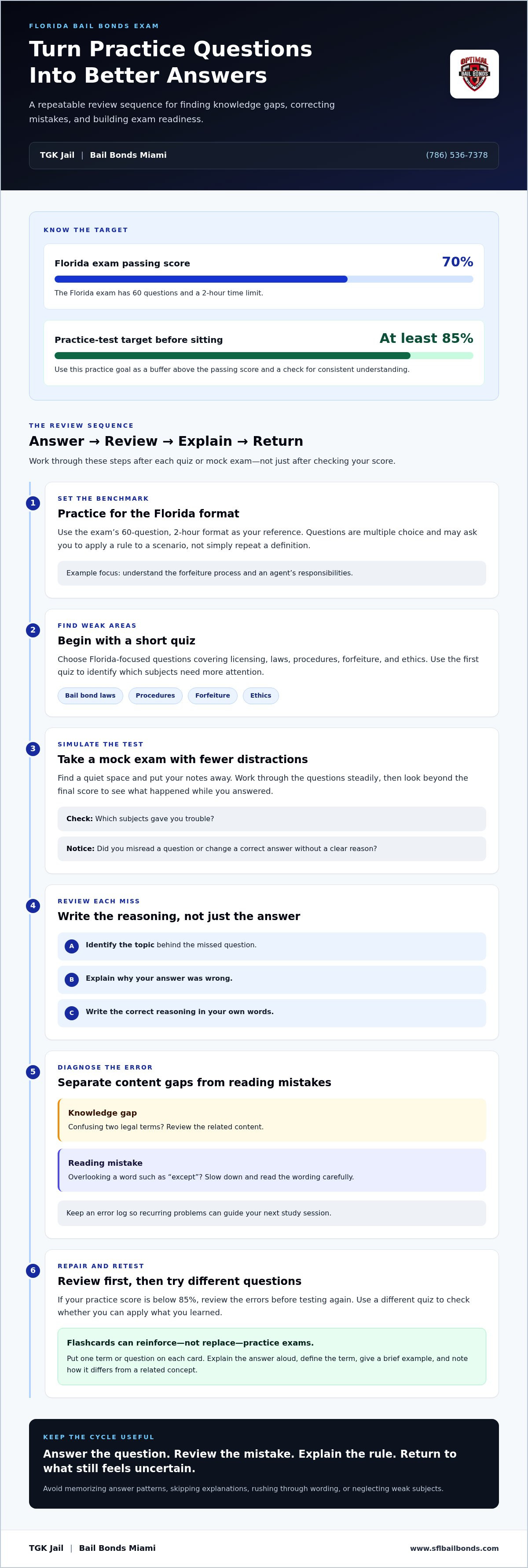
Practice questions help turn study material into decisions you can explain. The Florida exam has 60 questions, and candidates need 70% to pass. Use those figures to understand the test’s scale, then focus each practice session on accuracy, reasoning, and steady pacing. A practice score is useful only when you learn from the answers behind it.
Choose a Florida-focused study guide covering bail bond licensing, laws, procedures, forfeiture, and ethics. A digital guide may include multiple-choice questions. Start with a short quiz to identify weak areas, then use targeted questions to review them. If you miss a question about exoneration, for example, revisit the relevant material before trying another question on that topic.
Before a mock exam, find a quiet space and put your notes away. Afterward, look beyond the final score. Check which subjects gave you trouble, whether you misread a question, and whether you changed a correct answer without a clear reason. These patterns can show you what to adjust in your next practice session.
Review missed questions with a simple process: identify the topic, explain why your answer was wrong, and write the correct reasoning in your own words. Separate knowledge gaps from reading mistakes. Confusing two legal terms calls for content review; overlooking a word such as “except” calls for slower reading. Keep an error log so recurring problems can guide your next session.
Aim for at least 85% on a practice test before sitting the Florida exam. That target gives you a buffer above the passing score, while showing whether your knowledge is consistent. If your score falls short, don’t retake the same test immediately. Review the errors first, then use a different quiz to check whether you can apply the material.
Flashcards can reinforce definitions and key concepts, but they shouldn’t replace practice exams. Put one term or question on each card, then explain the answer aloud before checking it. Define the term, give a brief example, and note how it differs from a related concept. This helps you recall information instead of relying on recognition alone.
Common avoidable mistakes include skipping explanations, memorizing answer patterns, rushing through wording, and neglecting weak subjects. These habits can hide gaps that a score alone won’t reveal. Bail agent work requires applied understanding, so practice explaining why an answer fits, not just which option is correct.
Use these study tips for the Florida bail agent test to make each practice session purposeful: answer, review, explain, then return to concepts that still feel uncertain.
3. What topics are covered in the Florida Bail Bonds Exam?
A consistent schedule helps you cover exam subjects without leaving difficult areas until the end. Use a four-week study plan to rotate through bail bond law, criminal procedure, surety bonds, insurance principles, forfeiture, and recovery. The subject mix gives your sessions direction, while reviewing your own weak areas keeps the plan practical.
Topic percentages reported for most bail bond exams can help you prioritize, but they aren’t a confirmed Florida exam blueprint. Bail bond law and criminal procedure account for 30-35% of most exams. Surety bonds and insurance principles represent 20-25%, general insurance principles 10-15%, and bond forfeiture and recovery 15-20%. Treat these ranges as study guidance, not guaranteed Florida question counts.
Start by assigning a subject to each study session, then set aside time to revisit missed concepts. A focused session might cover one procedure, followed by questions that test its application. For example, review forfeiture, then explain how it differs from exoneration. Keep a short list of topics that still cause confusion, and use it to choose your next review session.
A four-week framework can organize the work:
- Week one: Map the exam subjects and begin with bail bond law and criminal procedure. Note unfamiliar terms and the questions that expose them.
- Week two: Study surety bonds and insurance principles. Compare related concepts in your notes, then test recall without looking at the answers.
- Week three: Focus on forfeiture, recovery, and any recurring weak areas. Connect each rule to a practical scenario instead of memorizing isolated phrases.
- Week four: Rotate through all major subjects and complete timed review sessions. Use results to direct final study toward missed concepts.
Make each study session specific. Before you begin, write down its subject, task, and next step. For example, “review criminal procedure, summarize one concept, answer related questions” is more actionable than “study law.” If you’re interrupted, record where you stopped so you can resume without repeating material.
After completing an approved course, balance broad review with targeted practice. A future bail bond agent needs to understand how legal rules, insurance principles, and procedures connect. If one subject continues to cause trouble, give it another session rather than letting the calendar dictate your preparation. A steady plan makes progress visible and keeps exam topics in rotation.
4. Ethics and risk management
Ethics questions test how a bail bond agent balances responsible conduct with pressure to act quickly. Study ethical standards alongside procedures, not as isolated vocabulary. A scenario may ask you to assess a proposed action involving a defendant, family member, or surety. Identify who is affected, which information is reliable, and whether the action follows the stated rules.
Risk management begins with careful decisions before problems grow. In a practice scenario, a cosigner might provide incomplete information or misunderstand a bond agreement. Consider what needs clarification, which facts should be documented, and how a clear explanation could reduce confusion. Since exam scenarios may test judgment, connect each answer to the facts given instead of guessing what the question implies.
Use a repeatable method for ethical questions: read the full scenario, identify the decision, then compare the choices against honesty, fairness, and sound procedure. Consider what each option could mean for the defendant, cosigner, and surety. An answer that seems efficient may create avoidable risk if it relies on assumptions or skips an important step. Practice explaining why your response is responsible.
- Accurate information: In a scenario with conflicting details, separate verified facts from assumptions before deciding what to do.
- Clear communication: If a family member misunderstands a bond term, consider how a plain-language explanation could prevent confusion.
- Consistent judgment: Compare similar scenarios using the same principles rather than changing your answer based on pressure.
- Risk awareness: Identify possible consequences for the people involved and the surety before choosing an action.
Flashcards can help you recall ethical concepts, while scenario practice shows whether you can apply them. Put a principle on one side and a short example on the other. For instance, pair “avoid assumptions” with a case involving inconsistent information. Explain your reasoning aloud, then check whether it addresses the facts and risks. This turns memorization into practical judgment.
Make ethics part of your career preparation, not just your final exam review. In each study session, examine a scenario and write a brief rationale for your choice. If two options seem plausible, identify the detail that distinguishes them. This habit supports exam preparation while strengthening the careful thinking expected in bail bond work. Treat ethical standards as decision tools, not just terms to recognize.
5. Professional conduct and record-keeping
Professional conduct is part of exam knowledge. It shapes how a bail bond agent handles information, communicates with people, and follows procedures. In a testing scenario, look for the specific facts, identify the decision, and avoid assumptions. If a question describes incomplete information, for example, consider what needs clarification before action. This disciplined approach connects ethical topics to real responsibilities.
Record-keeping deserves focused review because it combines accuracy with deadlines. Florida bail bond agents must keep records for 3 years. They must also return collateral within 21 days of bond exoneration. Remember both requirements and the event that starts the collateral-return period: bond exoneration. A question may test whether you can distinguish that trigger from another step in a bond’s timeline.
Practice applying the facts without inventing details about what each record must contain. Create a hypothetical timeline: note when a bond is exonerated, then identify the deadline for returning collateral. Separately, recall the record-retention period. This exercise tests the relationship between an event, a required action, and a timeframe, and helps keep different requirements distinct.
Use a study sheet to organize professional-conduct topics and record-keeping facts. Keep each entry short enough to review quickly, but specific enough to test recall. You might write “records: 3 years” on one side and “collateral: return within 21 days of bond exoneration” on the other. During testing practice, explain each answer aloud instead of relying on recognition.
For scenario questions involving several people or events, read the prompt twice. Mark the detail that changes the answer, such as whether a bond has been exonerated. Then eliminate choices that don’t address the stated event or timeframe. This can help reduce careless errors, especially when two options sound reasonable but only one fits the facts.
Build your final review around practical topics, not just definitions. Ask what a deadline is measured from, how long records must be kept, and what respectful communication looks like in a difficult interaction. Good judgment matters alongside recall. Reviewing these questions can help you connect exam topics with habits that support responsible work.
After each practice session, record the concept you missed and the reason. If you confused the 3-year record period with the 21-day collateral deadline, write both facts together and retest them later. That targeted correction is more useful than rereading every chapter. Keep your notes factual and distinguish listed requirements from personal examples.
Optimal Bail Bonds: Pre-Licensing Bail Bonds Class
Optimal Bail Bonds offers a Pre-Licensing Bail Bonds Class for people preparing to pursue bail agent licensing. If you need structured education before taking the exam, its 120 Hours Bail Bonds Course provides a focused next step for building your subject knowledge. You can also explore How to be a Bail Bondsman as you consider the profession and its requirements.
Use the exam topics you’ve reviewed to identify where formal coursework could support your preparation. Note which areas need more guided study, then choose an educational option that fits your learning goals. A clear plan can turn broad exam preparation into manageable steps.
Contact Optimal Bail Bonds or visit sflbailbonds.com to learn more.
Build a Strong Start to Your Bail Agent Career
Your preparation can shape how you approach the profession beyond the exam. Keep building habits that support careful decisions and thoughtful learning, especially when a situation calls for patience and clear judgment.
Use these study tips for the Florida bail agent test as a starting point for setting your learning goals. Choose one concept to strengthen, then revisit it until you can explain it clearly. Small, deliberate steps can help you move forward with purpose.
Stay curious, keep learning, and trust the steady work you’ve put into preparing for your next step.
Frequently Asked Questions
What topics are covered in the Florida Bail Bonds Exam?
The exam covers bail bond laws and procedures, licensing, forfeiture, exoneration, ethical standards, surety bonds, and insurance principles. Prepare to apply ideas to scenarios, not just recognize definitions. Make a comparison chart showing how forfeiture and exoneration differ, then explain each in your own words. This helps you connect related terms and identify which concept a question is testing.
What topics are covered on the Florida bail agent licensing exam?
The Florida bail agent licensing exam focuses on knowledge needed to understand bail bond work, including relevant laws, regulations, and procedures. Questions may use case studies or practical scenarios, so read each prompt for its specific facts. If a question describes a missed court appearance, identify the issue being tested before choosing an answer. This helps keep assumptions from steering your response.
What prelicensing education is required before taking the Florida bail agent exam?
Florida candidates must complete 120 hours of DFS-approved pre-licensing education. According to Florida Legislature, applicants must also complete a basic criminal justice certification course of at least 120 classroom hours, passing with 80 percent or higher within the 2 years immediately before applying. Keep course-completion records together, and compare the course requirements with your licensing timeline so you can plan education before submitting an application.
What are the best study guides, practice tests, and official resources for the exam?
Choose a Florida-focused guide that matches the exam’s bail bond laws, procedures, and insurance content, then use practice questions to check your understanding. The Florida Department of Financial Services and Pearson VUE are relevant names to look for when reviewing licensing and testing information. Study a topic with a guide, then answer questions without notes and mark any gaps in your reasoning for later review.
What Florida statutes and insurance regulations should bail agent candidates study?
Focus on Florida bail bond laws, regulations, and procedures, alongside surety and insurance principles. Include forfeiture, exoneration, licensing requirements, and ethical standards in your review. Organize each topic by its rule, the situation where it applies, and the action involved. Make separate notes for the forfeiture and exoneration processes instead of blending their meanings into one summary.
What are effective study plans and test-taking strategies for the Florida bail agent exam?
Schedule regular sessions that alternate between learning material and applying it through quizzes. After each practice set, classify missed answers as a knowledge gap, a misread question, or a rushed decision. On exam day, read every option before choosing an answer, and return to difficult questions after completing those you can solve confidently. This approach helps you use preparation time deliberately and avoid letting one challenging prompt disrupt your focus.
How many times can you retake the Florida bail agent exam, and what are the retake rules?
You must wait 30 days before retaking the exam. The material gives no limit on the number of retakes.


