
A focused four-week study schedule for the bail agent exam gives you a clear way to prepare without trying to learn everything at once. In Florida, the bail bond agent exam has 60 questions and requires a 70 percent passing score. Set aside dedicated study time each day, divide the exam topics into manageable sections, and build in practice questions as you go.
It’s understandable to feel unsure about where to begin, especially when the exam format and study materials can seem like another hurdle. A structured plan helps you see what to study, when to review, and how to use practice tests to spot gaps in your knowledge. This guide explains the exam format, where to find useful practice questions and materials, and how to organize your preparation across four weeks, including a final review before exam day.
Key Takeaways
- Confirm your state’s exam format and passing standard so your preparation matches the test you’ll take.
- Use practice questions to find knowledge gaps and get comfortable with the exam’s multiple-choice format.
- Build your study materials around your state’s exam outline, giving focused attention to bail laws, bond procedures, and ethics.
- Break topics into manageable study sessions and set aside dedicated time to review consistently.
- Review your state’s eligibility and pre-licensing requirements before planning your exam timeline.
1. Exam format, timing, and passing scores
Start by identifying the state and license type on your exam notice. Bail agent examinations are state-specific, so question counts, time limits, passing scores, and retake procedures can differ. Many use multiple-choice questions to test bail laws, regulations, and procedures. Across states, exams may contain 50 to 150 questions and allow one to three hours, but those ranges are not a substitute for your state’s exam instructions.
For Florida, the bail bond agent exam has 60 questions and requires a 70 percent passing score. Washington uses a separate bail bond recovery agent examination: applicants must correctly answer 85% of its questions to pass, according to the Washington State Department of Licensing. These examples show why studying another state’s rules can leave important gaps, even when the exam subjects sound similar.
For Florida-specific requirements, use the state licensing department’s official exam materials and instructions for your license type. Before setting your study plan, confirm the exam format, time limit, passing score, identification rules, and retake procedure. Requirements differ by state, so materials for another jurisdiction may not apply to a Florida exam.
Exam fees and related licensing costs depend on the state and application type. In Florida, review the applicable state licensing materials to distinguish exam charges from application or other licensing costs before budgeting.
After passing, follow the state’s licensing procedure and complete the next application steps listed for your license. Passing the test is an exam result, not a substitute for any remaining licensing requirements. If you fail, read the result notice, identify the topics needing review, and follow the jurisdiction’s retake process. Retake waiting periods in most states range from 24 hours to 30 days, but the state’s own rule controls.
Common trouble spots include confusing similar legal terms, overlooking state-specific procedures, and rushing through multiple-choice questions. Match each study session to the relevant exam outline, review incorrect answers, and practise reading questions carefully. When a question describes a procedure, identify the state and the action being tested before choosing an answer. This keeps your preparation focused on the license you intend to earn.
2. Practice exams and sample questions
Practice questions help turn course reading into active recall. They reveal whether you can apply bail bond concepts, not just recognize familiar terms. Choose questions that match your state’s exam outline and license type. For example, if a question describes a bond procedure, identify the issue and explain why each answer option does or doesn’t fit. Review the reasoning, not only the correct choice.
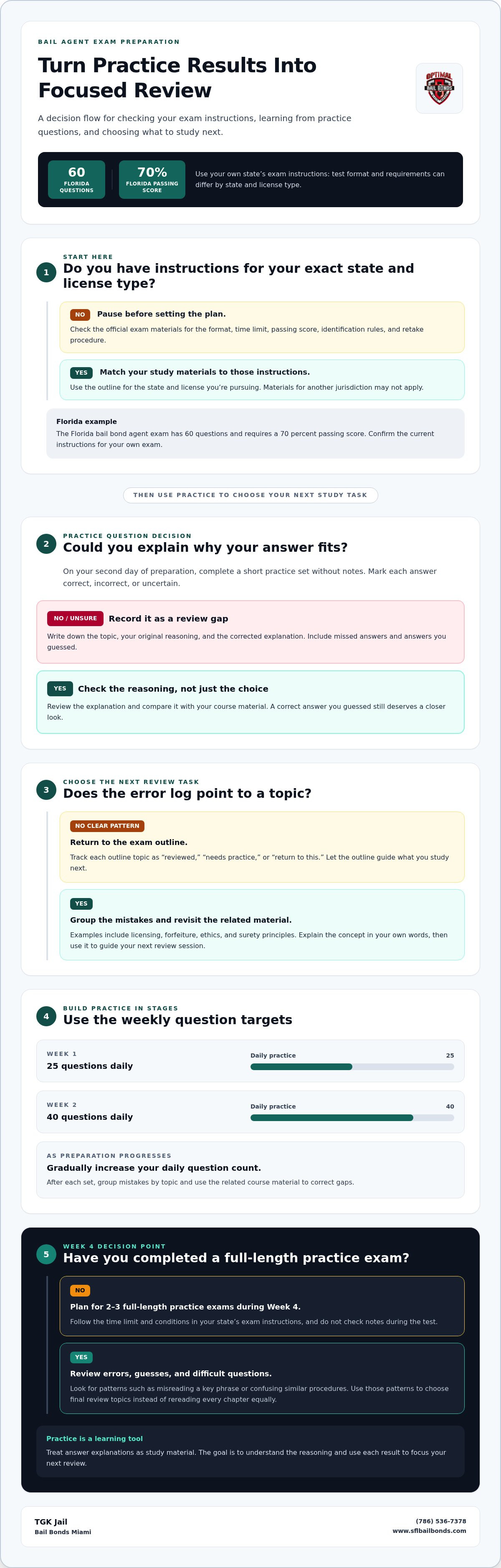
Make your second day of preparation a practice-test session. Complete a short set without notes, then mark each answer as correct, incorrect, or uncertain. For every missed or uncertain question, record the topic and the idea to review. Use the results to choose your next study task. A practice test is a learning tool, not a verdict on your readiness.
Increase your daily question target in stages:
- Week 1: complete 25 bail bond practice questions daily.
- Week 2: complete 40 bail bond practice questions daily.
- Gradually increase the number of bail bond practice questions you complete as your preparation progresses.
After each set, group mistakes by topic, such as licensing, forfeiture, ethics, or surety principles. Return to the related course material and explain the concept in your own words. Compare questions about credit or privacy with your exam outline before applying rules from another state. Keep an error log with the topic, your original reasoning, and the corrected explanation. Use it to direct your next review session.
In Week 4, take two to three full-length practice exams. Follow the time limit and conditions in your state’s exam instructions, and avoid checking notes during the test. When you finish, review incorrect answers and correct answers you guessed. Look for patterns, such as misreading a key phrase or confusing similar procedures. Use those patterns to select final review topics instead of rereading every chapter equally.
Practice tests help assess your knowledge and build familiarity with the exam format. Treat each answer explanation as study material. If you study in a classroom, compare your reasoning with the lesson material and note concepts that need clarification. Reviewing missed questions turns practice into a useful next step, especially when study time is limited.
The study plan recommends taking 2-3 full-length practice exams during Week 4. Space these attempts across your review period when possible, so you have time to learn from each result before the next one. After finishing an exam, revisit the questions that took the most effort, even if you answered them correctly. Write a brief explanation of the reasoning that supports the answer, then check it against your course material. On a later attempt, notice whether you can reach the explanation more confidently and without relying on guesswork. If the same uncertainty returns, make that concept a priority for review. This approach helps you use full-length exams to guide focused study, rather than treating completion as the only goal.
3. Exam outline and study materials
Build your study guide from the outline for the exact state and license type you’re pursuing. For a candidate in Miami, Florida materials should guide your preparation; Washington statutes apply to Washington’s recovery agent exam, not Florida’s. Keep the outline beside your notes and label each topic “reviewed,” “needs practice,” or “return to this.” This tracking system turns a broad syllabus into specific study tasks.
What laws and regulations should bail agent exam candidates study? Focus on the licensing requirements, bail forfeiture, exoneration, ethical standards, and procedures named in your state’s exam outline. For comparison, Washington’s recovery agent exam covers RCW 18.185, RCW 10.19, RCW 10.88, RCW 9.41, and civil procedure under RCW 4. Those Washington identifiers are not a substitute for Florida’s assigned materials.
Exam outlines can also help you prioritize subjects. Bail bond law and criminal procedure make up 30% to 35% of most bail bond exams. Surety bonds and insurance principles account for 20% to 25%, while bond forfeiture and recovery account for 15% to 20%. Use these broad topic weights to organize review, then follow your state outline for the precise scope and terminology.
What study materials and practice tests are available for the bail agent exam? Start with your state’s licensing department materials, then pair the exam outline with assigned statutes, course notes, a topic-based study guide, and practice questions. Florida candidates must complete a 120-hour prelicensing course, so use its materials to connect each outline topic with the relevant lesson. Practice tests can reveal which concepts need further review; write down the subject behind each missed question and return to that section.
Use a short source-checking routine for every topic. First, match it to the exam outline. Next, read the corresponding assigned law or course notes. Finally, explain the rule in plain language and create a sample scenario. After reviewing forfeiture, for example, describe what the term means in the context taught by your Florida materials. This checks your understanding without importing another state’s procedures.
Keep each resource in a separate, clearly labeled section: official outline, Florida course materials, law references, class notes, and practice questions. Add the source or lesson title beside each note so you can retrace an unfamiliar rule. A focused study guide is more useful than unorganized pages. It keeps your review tied to the license you plan to obtain and the topics your exam covers.
4. Four-week exam preparation schedule
A study schedule for bail agent exam preparation works best when each week has a clear purpose. Use four weeks to move from mapping the Florida exam outline to focused review and a final examination rehearsal. Plan the exam for the end of Week 4, and place study sessions around your existing work and personal commitments.
Give each study day one defined task. Review a topic, recall its main points without notes, then record anything that needs another look. This repeatable routine makes a busy week manageable and helps you resume after an interruption.
In Week 1, organize your materials and divide the state outline into smaller topics. Mark subjects you already understand and those needing more attention. For example, separate licensing topics from ethics and bond procedures, then assign each to a study session.
Use Week 2 to work through the assigned course materials and state-specific rules. After each session, explain the main concept in your own words. Keep a brief note about what remains unclear, so your next session begins with a practical task instead of rereading everything.
In Week 3, connect related topics through examples drawn from your Florida materials. Note how a procedure relates to licensing or ethical responsibilities. Return to earlier mistakes and record what led to each one, such as overlooking a key term or mixing up two concepts.
During Week 4, focus on applying what you’ve learned. Complete two to three full-length practice exams, review the answers, and use recurring errors to guide your final study sessions. Keep the last review tied to your state outline rather than adding unfamiliar material.
On a crowded day, choose one small task, such as recalling a topic from memory or reviewing a note. A study schedule for bail agent exam preparation can adapt when a session needs to move: keep the weekly priorities in order and continue at the next available study time.
Set aside dedicated study time each day for the bail bond license examination, and make that time a regular part of your routine. Choose a study period that fits your existing commitments, then protect it from avoidable distractions. A consistent appointment gives each session a clear place in the day and makes it easier to return to preparation after a disruption. Before you begin, decide what you intend to cover and what you want to be able to recall afterward. If the planned session becomes unavailable, move the task to another suitable study period rather than abandoning it. Keeping the daily commitment realistic can help you maintain momentum across the preparation schedule.
When organizing the material, break exam topics into smaller sections and assign specific study sessions to each section. This makes a broad subject easier to approach and gives every session a defined focus. You might identify the smaller pieces within a topic, then decide which one deserves attention during a particular study period. Keep the assigned task visible so you can begin without spending study time choosing what to do. At the end of a session, note whether the section feels clear or needs another pass, and use that information when planning later sessions. These simple choices turn preparation into a sequence of manageable tasks: dedicated time to study, a specific topic to address, and a clear next step when you finish.
5. What are the eligibility requirements to become a bail agent in the United States?
Eligibility depends on the state where you plan to obtain a bail agent license. Requirements can include minimum age, residency, prelicensing education, an examination, and application documents. Some states require 8 to 40 or more hours of prelicensing education. Treat national summaries as an overview, then organize your preparation around your state’s licensing requirements.
For Florida, a bail bond agent must complete a 120-hour prelicensing course. Keep this requirement distinct from exam preparation: course completion is part of the licensing pathway, while the examination assesses knowledge. Build your study calendar around the required course and its materials, then make space for topic review and practice questions before exam day.
Federal law also affects some applicants. Title 18 United States Code Section 1033 requires written consent from the Insurance Commissioner for a person convicted of a felony involving dishonesty or breach of trust to conduct the business of insurance. This provision concerns a specific conviction and type of conduct, so distinguish it from state education and examination requirements.
California provides a useful example of how state requirements can differ. An individual applicant must be at least 18 years old and a California resident, complete at least 20 hours of approved prelicensing classroom study, and pass the required examination. The applicant must also provide a bail agent bond with a penal sum of $1,000. These California rules should not be treated as Florida requirements.
Before choosing an exam date, make a state-specific checklist. Record the license type, required course, examination, and application documents from the relevant state materials. For Florida, note the 120-hour course; for California, note the residency and classroom-study requirements. This comparison helps prevent an applicant from importing another state’s rules into a Miami preparation plan.
Use eligibility research to set your study timeline, not to replace it. First, identify the license you intend to pursue. Then separate course completion from exam review and arrange study sessions around the subjects in the correct state outline. If a requirement involves residency, education, or a bond, put it in a separate checklist column. This keeps administrative steps visible while daily preparation stays focused on exam topics.
Explore the 120 Hours Bail Bonds Course
Optimal Bail Bonds: Pre-Licensing Bail Bonds Class
Optimal Bail Bonds offers a Pre-Licensing Bail Bonds Class for aspiring bail agents ready to move from independent exam preparation to structured education. If you’re organizing study materials and want a course as part of your preparation, this is a natural next step. The 120 Hours Bail Bonds Course also aligns with Florida’s prelicensing course requirement.
Use Florida’s licensing requirements to guide your next step, and connect course study to the exam outline and practice-question review. A clear structure can help you balance preparation with a busy week.
Visit sflbailbonds.com to learn more about the Pre-Licensing Bail Bonds Class.
Turn your preparation into a confident next step
A study schedule for the bail agent exam is more than a calendar. It helps you build a steady learning habit and make informed decisions about your professional path. As you move from exam preparation toward training, choose the next step that matches what you need to learn. Optimal Bail Bonds offers How to be a Bail Bondsman for people exploring the profession and its learning pathway.
You don’t need to have every detail figured out before continuing. Keep your state’s requirements central, use what you’ve learned to guide your choices, and seek education that supports your goals. A clear next step can make a demanding process feel more manageable.
Stay consistent, keep learning, and recognize each step forward.
Frequently Asked Questions
What topics are covered on the bail agent licensing exam?
Common topics include bail bond law, criminal procedure, surety bonds, insurance principles, forfeiture, recovery, licensing, and ethics. A sample scenario might ask you to apply a procedure rather than recall a definition. Use the outline for your state and license type to choose which subjects to review. For each topic, write a brief example in your notes and explain how the rule applies.
How many questions are on the bail agent exam, and what is the passing score?
The number of questions and passing score vary by state. Florida’s bail bond agent exam has 60 questions and requires a 70 percent passing score. Washington’s bail bond recovery agent exam uses a different standard. Check that your practice materials match the state and license type on your application, so you don’t prepare for a different exam’s format or requirements.
How much time is allowed for the bail agent exam?
Exam time limits depend on the state, with bail bond agent examinations ranging from one to three hours. Use the time limit in your state’s instructions when practising. Note how long a timed practice test takes, then identify questions that slowed you down. Reviewing those items can help you manage your pace and avoid spending too long on an uncertain answer.
How many weeks should you study for the bail agent exam?
A four-week plan offers a practical framework for preparation. Use the opening week to organize materials, the middle weeks to study topics and practise questions, and the final week to assess progress. A study schedule for bail agent exam preparation should reflect your available study time and state outline. Keep the plan flexible: if work interrupts a session, move it forward and continue with the next topic.


