
Bail bondsmen generally earn by collecting a premium for arranging a commercial bail bond, commonly 10% of the bail amount. That premium is separate from the bail set by the court and is typically nonrefundable. To understand how bail bondsmen make money, it also helps to know that the premium is revenue, not necessarily profit: underwriting costs and business expenses affect what the company keeps.
It’s natural to wonder how bail bondsmen make money when a bond can cover a much larger amount. A bail bond is an agreement in which an agent guarantees payment to the court if the defendant fails to appear. The premium compensates the business for arranging the bond and accepting financial risk.
This article explains what a bail bond covers, how premiums and other charges can contribute to an agent’s earnings, and what may happen financially when a defendant misses court. You’ll also see why collateral is mainly protection against loss, rather than the bondsman’s primary source of income.
Key Takeaways
- Separate the premium paid to the bondsman from the bail amount set by the court; they serve different purposes.
- Learn how a premium may be divided between an agent and a surety, and why the amount collected isn’t the same as net profit.
- Understand how a missed court appearance can expose the bondsman to the full bond amount and lead to efforts to recover losses.
- See how evaluating risk and keeping defendants engaged with their court obligations can help reduce forfeitures.
- Explore how premiums, business expenses, and risk management fit together in a bondsman’s earnings.
What is a bail bond?
A bail bond is a surety agreement that can help secure a defendant’s release while a case proceeds. The agent guarantees payment of the bond amount if the defendant fails to appear in court.
To understand how this guarantee connects to a company’s income, watch this explanation of the commercial bail bond business:
Premiums as Company Income
A bail bond premium is the fee a company collects for arranging a surety bond and accepting financial risk. It brings in revenue when a defendant or co-signer pays for the agent’s guarantee, but it is not automatically profit: underwriting and operating expenses reduce what remains. For families considering a bond in Miami, understanding the premium helps distinguish the service charge from the court’s bail amount.
Guaranteeing Court Appearances
A bail bond agent signs an agreement guaranteeing payment to the court if the defendant fails to appear. The defendant and co-signer accept contractual responsibilities, and the agent may require collateral to manage risk. The guarantee is financial, not a promise that the defendant will attend court. The defendant remains responsible for following release terms and appearing at every required hearing.
Bond Fees Compared With Court Bail
Court-set bail is the amount tied to release conditions; the premium is a separate charge paid to the bail bond company. State rules regulate bail bond charges and agent licensing, so requirements depend on where the bond is issued. In Miami, Florida, the bond agreement and local court conditions explain the obligations for that case.
Nonrefundable Fees and Collateral
A commercial bail bond premium is generally nonrefundable, even if the defendant later attends court or the case ends favorably. Collateral serves as security rather than the agent’s main income. It may help protect the agent if the defendant fails to appear. The agreement identifies the collateral and the conditions for its return, so families should understand those terms before signing.
State laws regulate bail bond fees and agent licensing, and requirements vary by jurisdiction. In Miami, Florida, the relevant rules depend on state law and the local court process. The bond agreement and release documents identify the fee, responsibilities, and appearance conditions that apply to the defendant’s case.
How much of the premium does the bail agent keep?
The agent’s share depends on the agreement with the surety or insurance underwriter. The premium collected is gross revenue, not automatically the agent’s take-home income. Part may go to the company backing the bond, while the rest supports agency operations. For readers in Miami comparing premiums, this distinction explains why the amount a family pays does not reveal the agent’s final earnings.
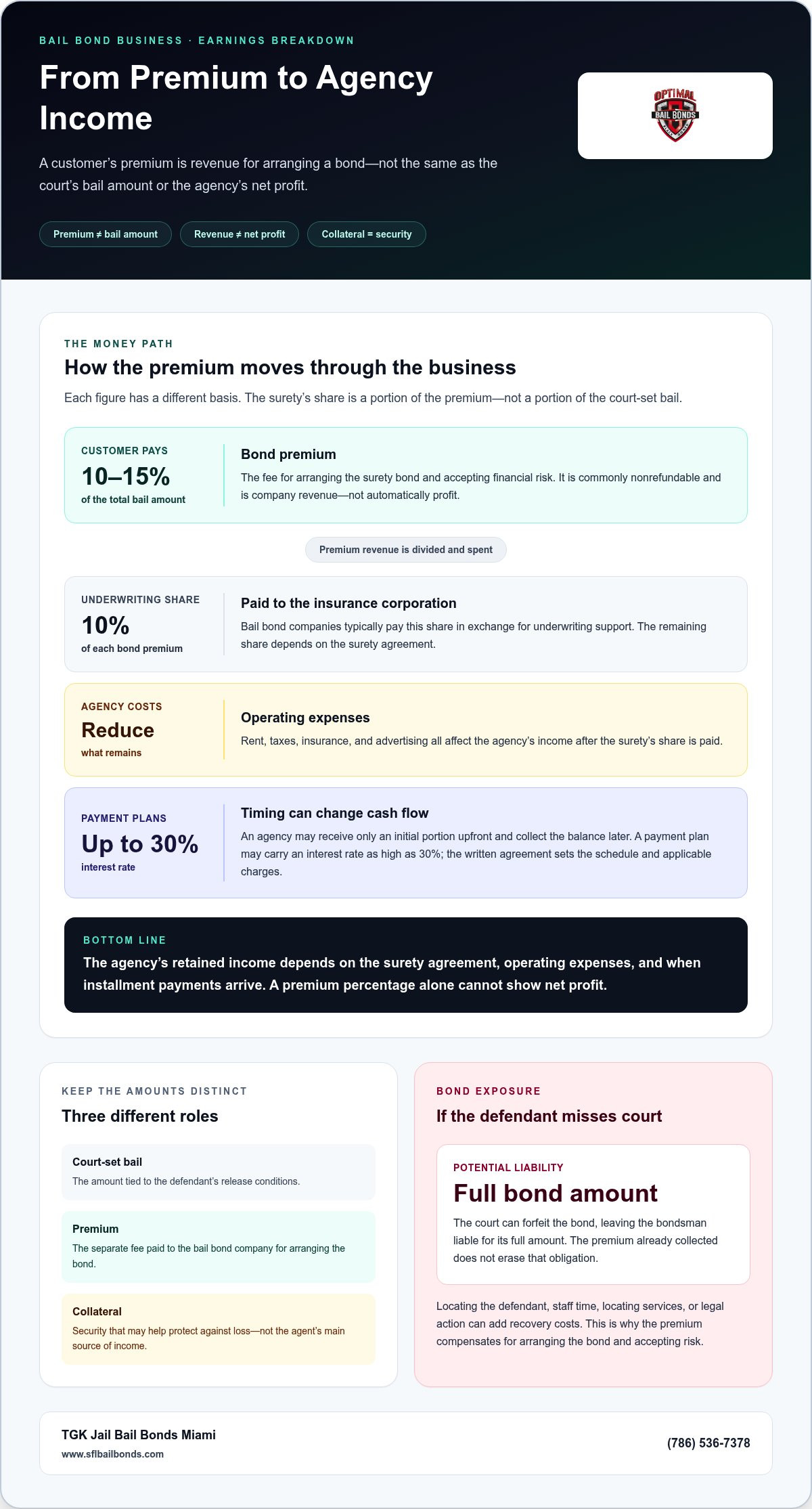
Bail bond companies typically pay insurance corporations 10% of each bond premium in exchange for underwriting support. That payment reduces the gross amount available to the agency before it accounts for its own expenses. The remaining share is shaped by the business’s agreement with its surety and the costs of running the agency. These are separate parts of the calculation, not percentages that should automatically be added together.
Premiums commonly fall between 10% and 15% of the total bail amount. That range describes what a customer may pay, not what the agent personally keeps. Rent, taxes, insurance, and advertising can reduce the agency’s income after the surety’s share is paid. So a premium percentage alone cannot show net profit. The bond agreement and operating costs complete the picture.
Family members may arrange payment when a defendant cannot pay the premium alone. A co-signer may sign the agreement and accept financial responsibility tied to the bond. That role differs from the agent’s relationship with the surety: the family pays the premium, the agent arranges the bond, and the surety provides underwriting support. The documents explain payment responsibilities and any collateral terms.
Installments can change when the agency receives premium income. A bail bond payment plan may have an interest rate as high as 30%, which can increase the total paid over time. Payment timing also affects cash flow: the agency may receive only an initial portion upfront and collect the balance later. The written agreement explains the schedule and applicable charges.
For Miami families, the key is to distinguish the customer’s premium from the agency’s retained income. The agency may share part of the premium with an underwriter, cover operating expenses, and receive installment payments over time. Interest may add revenue under a payment plan, but it does not remove the agency’s costs or bond exposure. The surety arrangement, payment schedule, and expenses together determine what the business keeps.
What happens to the bondsman if a defendant skips court?
If a released defendant misses a scheduled court date, the bond is exposed to forfeiture. In the United States, a missed scheduled hearing can lead to bond forfeiture and an arrest warrant. The court can forfeit the bond, leaving the bondsman liable for its full amount. The premium already collected does not erase that obligation: it pays for arranging the bond, not for every possible loss.
The next concern is locating the defendant and addressing the missed appearance. An agent may contact the defendant or co-signer, then pursue other recovery options if the person cannot be found. Some bondsmen hire bounty hunters to locate and return defendants who fail to appear. In some states, bondsmen who bring a defendant back to court can collect a portion of the forfeited bond.
Recovery efforts can carry costs of their own. Staff time, locating services, and legal action can consume agency resources before any recovery occurs. Pursuing a co-signer or defendant for repayment can involve additional work and expense. The size of the bond also shapes the financial exposure: a larger forfeited bond creates a larger potential obligation to the court.
Risk assessment starts before the defendant is released. An agent may consider creditworthiness and whether the defendant or co-signer can provide collateral. These details help the agent judge the financial risk behind the guarantee, but they do not remove the court appearance requirement. A defendant in a criminal case remains responsible for attending every required hearing.
After release, regular check-ins and third-party tracking services can encourage a defendant to appear. These measures help an agent stay informed and remind the defendant about court obligations. They are risk-management tools, not substitutes for attending court. If a defendant ignores a reminder and misses a hearing, the agent still faces the consequences tied to the bond.
Collateral can help recover losses after forfeiture. If the agreement pledges property, the bondsman may seize and sell it or sue to repossess it. The agent may also pursue recovery from the defendant or co-signers. These actions do not make a missed court date harmless; they are ways to address financial exposure after the court acts.
For families, the practical takeaway is to treat every court date as a firm obligation and keep communication open with the agent. If a defendant may miss a hearing, prompt communication gives the agent information to respond. Silence leaves the agent facing possible forfeiture and recovery costs, while the defendant may also face an arrest warrant.
Risk assessment and reducing forfeitures
A bail bond agent assesses possible forfeiture against the bond amount and available safeguards. Before accepting a case, the agent may review the defendant’s creditworthiness and whether collateral is available. These details help estimate the financial exposure attached to the guarantee. They do not replace the defendant’s duty to attend each hearing, but they inform the agent’s decision to take on the bond.
Risk management continues after release. Regular check-ins and third-party tracking services can help agents maintain contact and reinforce court obligations. Practical steps include recording upcoming hearings, keeping communication open with the defendant or co-signer, and responding when contact stops. For a Miami case, knowing the hearing schedule and maintaining reliable communication can help surface concerns before a court date passes.
Collateral and reserves serve different purposes. Collateral is security pledged for a particular bond; a reserve helps a business prepare for losses across its work. Neither is income from a premium. A reserve can help an agency manage financial exposure, while the bond agent still needs to monitor each case and account for the obligations tied to each agreement.
Reserve planning does not remove liability on an individual bond. If a defendant misses a hearing, the agent faces the consequences connected to that bond, even if the business has funds set aside for potential losses. Organized case records help distinguish one bond’s exposure from another and make it easier to track court dates and communication.
Underwriters also assess risk across the bonds they support. Bail underwriters pay less than 1 percent of their revenue in losses, according to records discussed in the article’s research. That figure describes underwriters’ losses across their business, not an individual agent’s earnings or the likely result of a particular Miami bond. Portfolio-level results and individual case risk are different measures.
If a defendant disappears, recovery efforts can add costs beyond the forfeited bond. A bondsman may hire a bounty hunter to locate and return the person. In some states, a bondsman who brings a defendant to court can collect a portion of the forfeited bond. The agent must weigh recovery expenses against potential recovery and follow the procedures that apply where the bond was issued.
Risk controls can support court appearances and limit avoidable forfeitures. For a bond agent, that means connecting screening, communication, collateral, and reserve planning to each case’s exposure. A well-maintained hearing calendar and prompt follow-up help keep obligations visible. These measures help the business manage risk while keeping the defendant’s court responsibilities clear.
How bail bondsmen earn money
Understanding how bail bondsmen make money starts with following the premium after a bond is posted. A commercial bail bond company collects a fee for arranging a guarantee tied to the bail amount. A typical premium is 10% of bail, while an agent may charge closer to 15% for a higher-risk defendant. The premium is revenue, not automatically profit: surety payments and business expenses reduce what the company ultimately retains.
At a 10% premium, the customer pays $500 for the bond service. The agent’s guarantee covers the full bail amount if the defendant fails to appear, so the fee compensates for taking on financial exposure. The premium and the court’s bail are separate amounts. If the defendant attends court, the company doesn’t keep the full bail as income.
Other charges may add revenue, depending on the agreement and applicable state rules. Bail bond agencies may charge interest on payment plans or apply late fees to overdue installments. These charges are separate from the initial premium. Collateral is different: property pledged for a bond protects against risk rather than serving as the bondsman’s primary income. It may be returned when court obligations are fulfilled.
Are commercial bail bonds legal in every U.S. state? No. Commercial bail bond rules vary by state, including whether commercial bonds are permitted and how agents may charge. State law also affects licensing and premium limits, so the same business model does not apply uniformly across the country.
The business still carries costs after collecting a premium. Rent, taxes, insurance, and advertising all affect net profit. An agency may also pay an insurance company or surety for underwriting support. That means a $500 premium doesn’t necessarily leave $500 with the agent. The surety agreement, payment timing, and operating expenses shape the final amount retained.
At industry scale, commercial bail bond companies in the United States earn about $2 billion in revenue per year. That figure describes revenue, not individual agents’ profits. Each agency’s earnings depend on the premiums it collects, its share after underwriting arrangements, and losses or expenses tied to its bonds. A missed appearance can turn one bond into a substantial liability.
The practical takeaway is to distinguish money collected from money earned. A premium brings in revenue when a bond is arranged; a surety share and ordinary expenses reduce the agency’s net income. Interest or late fees may contribute additional revenue, while collateral mainly limits risk. For an individual bond, the premium, contract terms, and court appearance outcome shape the financial picture.
Optimal Bail Bonds: Pre-Licensing Bail Bonds Class
Optimal Bail Bonds offers a Pre-Licensing Bail Bonds Class for readers interested in learning more about the profession after exploring how bonds, premiums, and forfeitures work. The class is a natural next step for aspiring bail bondsmen who want structured education alongside their understanding of the industry’s financial model.
Those considering a broader course of study can also explore the 120 Hours Bail Bonds Course or How to be a Bail Bondsman. Each offering connects to a different stage of learning about the field, from introductory interest to focused training.
If you’re ready to learn more about bail bond education, contact Optimal Bail Bonds.
Turn Industry Insight Into Your Next Step
Understanding how bail bondsmen make money can be a starting point for exploring the profession. Consider whether you are curious about the business model or ready to build knowledge for work in the field. That distinction can help you choose a learning path that fits your goals.
For aspiring agents, training offers a way to explore the responsibilities and decisions behind the industry, not just its financial mechanics. Optimal Bail Bonds offers a Pre-Licensing Bail Bonds Class, a 120 Hours Bail Bonds Course, and How to be a Bail Bondsman. Consider which option best matches where you are in your learning journey.
Keep asking thoughtful questions as you move forward. A clearer understanding of the work can help you take your next step with confidence.
Frequently Asked Questions
How do bail bonds work?
A bail bond involves an agreement among the agent, defendant, and court. The agent arranges a surety guarantee for the defendant’s release, and the defendant must follow release conditions and attend required court appearances. If the defendant misses a hearing, the court may seek the guaranteed amount. For a Miami, Florida case, the bond paperwork and court conditions explain the obligations tied to that release.
How do bail bondsmen earn money from bail bonds?
Bail bondsmen earn revenue primarily from premiums paid for arranging bonds. To understand how bail bondsmen make money, distinguish collected revenue from profit: a company may share part of a premium with its surety and cover operating expenses. A missed appearance can also create liability that outweighs revenue from an individual bond. The amount retained depends on the surety agreement, expenses, and the bond’s outcome.
What percentage of the bail amount do bail bondsmen charge?
Commercial bail bond companies typically charge 10% of the bail amount, but that figure is not universal. Rates and legal limits vary by state and may depend on the bond circumstances. Some states cap charges at different percentages, so a percentage used in one jurisdiction may not apply elsewhere. Before signing, read the premium terms and distinguish the agent’s fee from the court-set bail.
What is the typical bail bond premium in the United States?
A commonly reported premium range is 10% to 15% of the bond amount, with 10% often used as a typical example. The actual rate depends on state rules and the bond agreement. For instance, a percentage quoted in another state may not reflect the terms governing a Miami case. Treat the stated premium as a fee for the bond service, not as a deposit toward court bail.
Are bail bond fees refundable if charges are dropped or the defendant appears in court?
Generally, no. A commercial bail bond premium is nonrefundable, even if charges are later dropped or the defendant attends every hearing. The premium pays for arranging the bond, rather than for a particular case outcome. Collateral is different: it is security for the bond and may be returned after court obligations are fulfilled. Review the signed agreement to understand how each payment or pledged asset is treated.
What happens if a defendant misses court after using a bail bondsman?
A missed court date can lead the court to forfeit the bond and issue an arrest warrant. The bondsman then faces liability for the guaranteed amount and may seek recovery from the defendant or co-signers. Depending on the agreement, collateral may also be used to address losses. If a hearing is missed, the defendant or co-signer should promptly communicate with the bondsman about the situation.
How do bail bond companies make money beyond upfront premiums?
Some companies may earn additional revenue through interest on payment plans or late fees on overdue installments, where the agreement and applicable rules allow them. These charges are separate from the initial premium. Collateral is not usually the company’s primary income source; it protects against potential losses. Payment-plan terms can affect both the total amount paid and when the agency receives money.
How does the cost of a bail bondsman compare with paying bail directly?
Paying bail directly means arranging the court-set amount for release; using a bondsman generally means paying a premium instead, which is a smaller portion of that amount. The tradeoff is that the commercial premium is typically nonrefundable, while the bond also creates contractual obligations and may involve collateral. Consider the available funds, agreement terms, and release conditions when comparing the options.


