
Could a probation violation allegation put someone in jail even when there’s no new criminal charge? For families in Miami asking about a violation of probation bond Ft Lauderdale, the answer depends on the warrant, the court’s decisions, and whether a bond is set. The allegation and the question of release are related, but they’re not the same thing.
Posting bond may help with release only if a judge has set a monetary bond. It doesn’t resolve the alleged violation or determine what happens in court. If a warrant says “no bond,” a bondsman can’t secure release unless the court sets one.
This guide explains how an allegation, a warrant, and a possible bond may fit together. You’ll learn what details to gather, what to clarify before discussing bond, and why a probation violation is distinct from a new criminal charge. With a clearer picture of the next steps, you can focus on practical support for your family while the case moves through the court process.
Key Takeaways
- Gather key case details, including the person’s full name, date of birth, case information, and known custody location.
- Understand how an allegation, any warrant, and the court process can affect what happens next in Miami, Florida.
- Learn what a violation of probation bond Ft Lauderdale may address, and why bond support is separate from defending the probation case.
- Clarify the right questions before discussing bond assistance, so your next steps are based on the specific case.
What a Violation of Probation Bond in Ft. Lauderdale Actually Means
A violation of probation allegation is a claim that someone under court supervision didn’t follow one or more conditions of probation. A bond, if authorized in the case, is a financial arrangement that may allow a person in custody to be released while the case continues. These are separate questions: the allegation concerns what the person is accused of doing, while bond concerns whether release is available and on what terms.
The phrase violation of probation bond can sound like one automatic process, but it isn’t. An allegation alone doesn’t tell a family whether the person will be arrested, held, or allowed to seek release on bond. Those details depend on the case and decisions made by the court. The allegation also isn’t the same as a finding that probation was violated.
What counts as an alleged probation violation?
Probation conditions vary by case, so the allegation depends on what the court ordered and what conduct is reported. Broadly, claims may involve a technical condition or a new criminal offense. A technical allegation might concern a reported failure to meet a supervision requirement, such as attending a required appointment or completing a program, if that condition applies. A new offense allegation involves a claim of separate criminal conduct.
These are general examples, not a conclusion about any person’s case. The specific condition, available information, and circumstances matter. An allegation is a claim to be addressed through the court process; it doesn’t establish that a violation occurred. Families shouldn’t assume that every type of allegation leads to the same custody or bond decision.
What does a bond do in this situation?
Bond may provide a route to release when the court authorizes it for the case. The key question isn’t simply whether someone has been accused of violating probation, but whether release is permitted and what requirements apply. A bail bond agent can help with the bonding process when a monetary bond has been set, but can’t decide whether the court will authorize release.
Posting bond doesn’t erase the allegation, dismiss the case, or determine whether probation was violated. The court process addressing the claim continues, and any applicable bond terms still matter. Eligibility, amount, and conditions are case-specific, so a family shouldn’t treat bond as guaranteed or as a final resolution.
For a family in Miami, it helps to keep the questions separate: What conduct is alleged? What is the person’s custody status? Has the court authorized bond, and what terms apply? Clear answers make the next conversation more focused and reduce confusion during a stressful situation. Bond support can help with the release process, while decisions about the allegation belong to the court.
How a Broward County Probation Violation Case Can Move from Warrant to Court
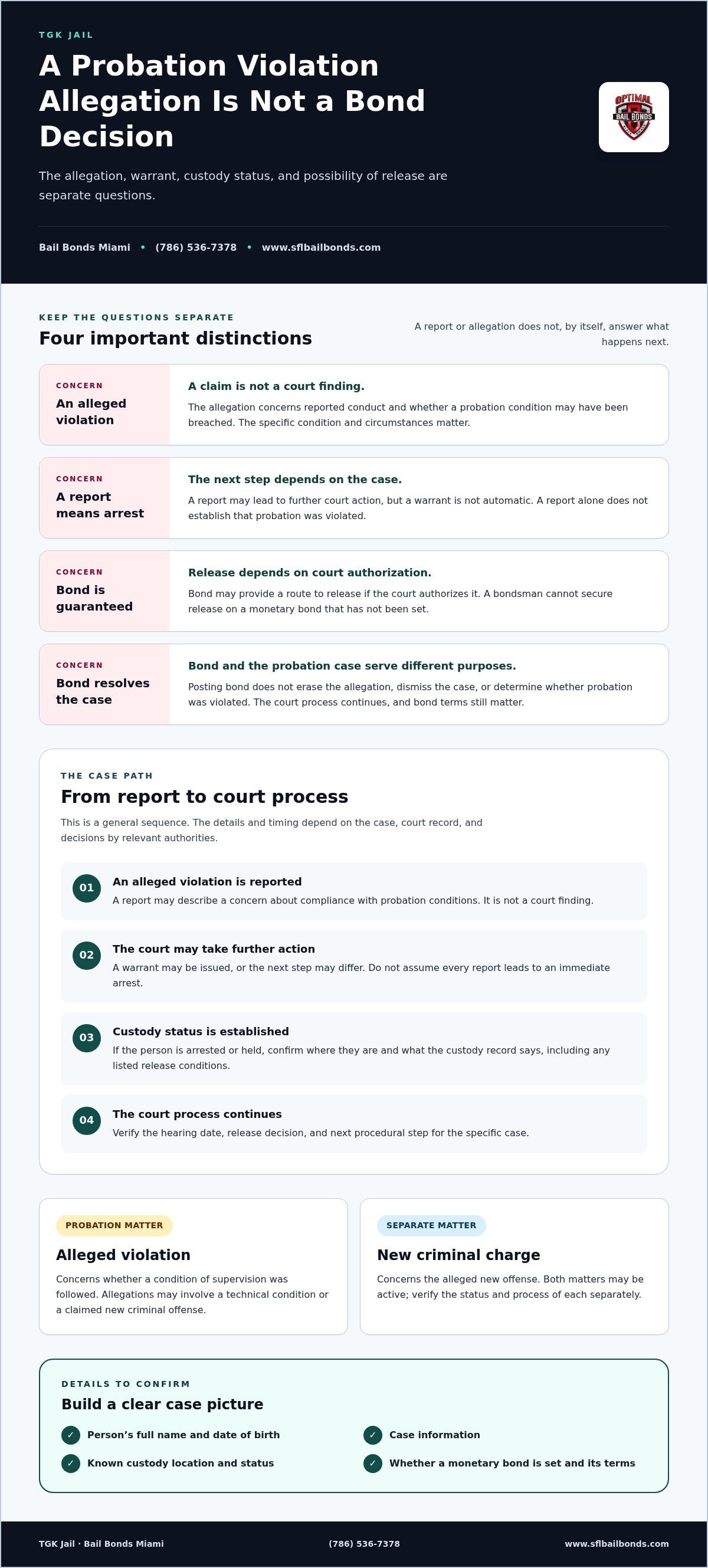
A probation violation case doesn’t always follow one fixed path. A report of an alleged violation, a warrant, custody, and a court hearing are separate events. One doesn’t automatically confirm what will happen at the next stage. The sequence depends on the case-specific facts, the court record, and decisions made by the relevant authorities.
Use this general sequence to organize what you know, while recognizing that the details and timing must be confirmed for the individual case:
- An alleged violation is reported. A report may describe a concern about compliance with probation conditions. A report alone isn’t a court finding.
- The court may take further action. Depending on the case and its record, a warrant may be issued, or the next step may differ. Don’t assume every report leads to an immediate arrest.
- Custody status is established. If the person is arrested or otherwise held, identify where they are and what the custody record says, including whether release conditions are listed.
- The court process continues. The alleged violation must be addressed through the applicable court process. Verify any hearing date, release decision, or next procedural step for that case.
What may happen after a probation officer reports an alleged violation?
A report raises an issue for consideration. It doesn’t establish that a violation occurred or determine whether a warrant will follow. The next step may depend on the reported conduct, the person’s probation record, and decisions made in the case. Check Broward terminology and procedures against current court records and reliable local information rather than assuming they match another case.
If the person may be in custody, first confirm their identity, location, case information, and any recorded release status. These facts help distinguish what has already happened from what a family fears might happen next.
How can a new charge affect the situation?
A new criminal charge and an alleged probation violation are related, but they aren’t identical. The charge concerns the alleged new offense; the probation matter concerns whether the person violated a condition of supervision. Both may be active, and decisions or scheduling in one matter may affect the other. Verify the status and process of each separately.
Don’t infer the outcome of either matter from the existence of the other. Specific court dates, custody arrangements, and how proceedings may be coordinated require current, case-specific legal verification. The Florida Bar’s Florida Legal System Overview offers general background on Florida’s legal system, but it doesn’t determine what will happen in an individual Broward case.
For families asking about a violation of probation bond Ft Lauderdale, understanding the sequence can make a bond conversation more productive. Bond assistance relates to release when a bond has been authorized; it doesn’t resolve the violation allegation or a separate criminal charge. Optimal Bail Bonds provides bail bond services in the Miami area. Once custody and case details are clear, families can discuss the bonding process with the team.
Bond vs. Probation Defense: What Each Can, and Cannot, Do
Families may hear “bond” and “defense” discussed in the same conversation, but they refer to different kinds of help. Bond support focuses on the release process when a bond is authorized. Probation defense concerns the allegation and the person’s legal position. Keeping those roles separate helps clarify what each conversation can accomplish.
| Role | What it may address | What it cannot decide |
|---|---|---|
| Bail bond agent | Practical guidance about the bonding process and steps involved when a bond is available. | Whether the court sets bond, whether a violation occurred, or how the case ends. |
| Probation defense attorney | Legal advice, case strategy, representation, and responses to the allegation. | The court’s ultimate decisions. |
| Court | Decisions assigned to the court, which may include bond availability or conditions and the outcome of the violation matter. | A bond agent or family member cannot make these decisions for it. |
Release on bond does not automatically end probation supervision or court proceedings. Bond addresses release, not guilt, dismissal, or the result of the violation case. The person may still need to address the allegation and comply with any applicable supervision requirements. Details depend on the case and the relevant decisions.
What can a bail bond agent help with?
A bail bond agent can explain practical bonding steps and help a family understand the process when bond has been authorized. Families can ask clear, logistical questions: what bond information is available, what steps are involved, and what details are needed to discuss the bonding process. An agent isn’t a lawyer and can’t provide legal representation, argue the violation case, or control court decisions, release timing, or case outcomes.
What requires legal advice or a court decision?
Questions about how to respond to the allegation, which legal arguments may apply, and who will represent the person require legal advice from an attorney. Bond availability and any conditions are decided by the appropriate authority, not by a bond agent. A bonding conversation shouldn’t be treated as a prediction about a hearing or a substitute for legal advice.
For families considering a violation of probation bond Ft Lauderdale, sort questions into two groups: those about the bonding steps and those about the legal case. That distinction keeps expectations grounded. Bond support can offer practical guidance through release-related steps, while the person’s legal rights, strategy, and response to the allegation remain separate matters.
Handling a Probation Violation in Ft. Lauderdale
When a family member may be facing a probation violation, reliable details are more useful than assumptions. Write down what you know, what remains uncertain, and where each piece of information came from. This gives you a clearer basis for checking custody status and discussing possible bond assistance.
Use this checklist to organize the facts:
- Record identifying details. Write down the person’s full legal name and date of birth. These details can help distinguish them from someone with a similar name.
- Gather case information. Note any case number, paperwork, warrant information, or court details available to you. Keep documents together and record where each came from.
- Confirm the known custody location. If the person has been detained, write down the facility they are believed to be at and when that information was received. Don’t assume the location or custody status based on an old message.
- Separate confirmed facts from reports. Record what the person or another source said about the alleged violation, but label it as reported information unless you have documentation. Avoid sharing sensitive personal or case details publicly.
What information should family members gather?
Keep a simple, private record of identity details, case information, known custody location, and anything you know about the allegation. Note whether each detail comes from paperwork, the person involved, or someone else. This doesn’t establish what happened, but it helps prevent conflicting accounts from being mistaken for confirmed facts.
Which questions help clarify the bond process?
Ask whether a bond has been set or whether a court decision is still pending. If bond is available, clarify what information is needed to discuss the bonding steps for that specific case. Don’t guess about the amount, conditions, or release timing. Those details depend on the case and relevant decisions. Questions about legal arguments or defense strategy belong with a licensed attorney.
Families looking into a violation of probation bond Ft Lauderdale can prepare for a bond conversation by having these details ready and being clear about what’s still unknown. Share case information privately and stick to facts you can identify. An organized account makes it easier to focus on practical questions without confusing bond assistance with legal advice or treating release as certain.
How to Discuss Probation Violation Bond Assistance in Broward County
A probation violation allegation, the court process, and the possibility of release on bond are connected, but they’re distinct parts of a case. The allegation is a claim to be addressed through the court process. Bond, if authorized, concerns release and its requirements. A bond conversation can help families understand practical bonding steps, but it can’t determine whether a violation occurred or replace legal advice.
Bond availability and any requirements depend on the specific case and decisions made by the appropriate authority. Begin with confirmed facts rather than assumptions about release, timing, or outcome. For families asking about a violation of probation bond Ft Lauderdale, a calm, focused conversation can help separate what is known from what still needs an answer.
What to expect in a bond-assistance conversation
Families can share known case and custody details, such as the person’s identifying information, case number, and current custody location. The discussion can focus on whether a bond has been set and what information is needed to understand the bonding process for that case. Optimal Bail Bonds offers compassionate guidance about bond-process questions to individuals and families in the Miami area. The team does not provide legal representation or decide bond availability.
If you don’t have every detail, be clear about what’s confirmed and what’s uncertain. That keeps the conversation grounded and focused on the practical next step instead of guesses about the court’s decision.
How to keep the next steps clear
Before reaching out, write down information you can verify and list the questions you still have. Keep bond-process questions separate from legal questions about how to respond to the allegation, what arguments may apply, or how the proceedings could affect probation. Those legal questions require advice from an attorney. A bond agent can explain bonding steps, but can’t advise on defense strategy or speak for someone in court.
- Confirmed: Record the person’s name, date of birth, case information, and known custody location.
- To clarify: Note whether bond has been set, whether a court decision is pending, and what information is needed to discuss bonding.
- For legal advice: Keep questions about representation, legal arguments, and case strategy for an attorney.
There’s no need to judge or make assumptions about the person accused. Focus on the information available and take the process one question at a time. To discuss bond assistance with Optimal Bail Bonds, call (786) 536-7378.
Take the Next Step with Clear Information
A probation concern can make everything feel urgent, but families don’t have to answer every question at once. Keep confirmed information close, identify what remains unclear, and decide whether your immediate need is bond-process guidance or legal advice. That distinction can help you approach violation of probation bond Ft Lauderdale concerns without expecting a bond agent to resolve the allegation or predict a court decision.
Optimal Bail Bonds offers compassionate, non-judgmental support to individuals and families discussing bond assistance in the Miami area. A conversation can focus on the bonding process and practical information, while legal questions remain with an attorney. You deserve clear communication and respectful support while you work through the next step.
Take things one step at a time. For bond-process guidance, call (786) 536-7378 or visit www.sflbailbonds.com.
Frequently Asked Questions
Is bond always available for a violation of probation in Florida?
No, bond isn’t automatically available for a probation violation in Florida. Some violation warrants are issued with no bond, while a judge may have authority to decide whether to allow release in a particular case. The warrant or court record can help clarify the current status, but don’t assume that a bond from another case applies. The person’s specific circumstances and court decisions matter.
Can someone be arrested for a probation violation in Ft. Lauderdale?
Yes, an arrest may occur if a warrant is issued, but a report of an alleged violation doesn’t by itself mean an arrest is certain or immediate. If you’re trying to locate someone, gather their full name and date of birth, then verify the custody location and case details through the appropriate Broward County records or facility. Don’t rely on old messages or information about someone with a similar name.
Does posting bond make a probation violation go away?
No. Posting bond, if permitted, doesn’t erase the allegation or decide the violation matter. For example, a person may be released while still needing to address a court date or comply with applicable supervision conditions. Keep paperwork related to release and court appearances together. Release doesn’t mean the case is closed or probation requirements have ended.
What happens if the alleged probation violation involves a new arrest?
A new arrest may lead to a separate criminal case as well as a probation violation matter. The cases can involve overlapping facts, but each has its own status and court process. A family may need to track separate case numbers or court dates. Ask an attorney how the matters relate and what legal steps may apply; don’t assume an outcome in one case resolves the other.
How can I find out whether a bond has been set in Broward County?
Check reliable, current custody or court information using the person’s identifying details and case number, if available. If the record is unclear, contact the relevant Broward County court or detention facility to ask how to verify the bond status and any listed conditions. Be precise: ask whether a bond has actually been set, whether a decision is pending, and which case the information refers to.
Can a bail bond agent represent someone at a probation violation hearing?
No. A bail bond agent isn’t a lawyer and can’t represent someone at a hearing or provide legal advice. The agent’s role relates to the bonding process when a bond is authorized. For families in Miami or Broward County, keep release-related questions separate from questions about legal arguments, court appearances, or defense strategy, which should be discussed with an attorney.
What information should I have before discussing bond assistance?
Have the person’s full name, date of birth, known custody location, and any case number or warrant information available. Write down what you’ve been told about the allegation, noting whether it comes from paperwork or a secondhand report. You can also note whether a bond appears in the record or whether that remains unknown. Share sensitive details privately, and separate bond-process questions from legal questions.


