
The option that costs nothing upfront isn’t simply a cheaper version of a surety bond. When a loved one is in custody, the terms can sound interchangeable, but the difference matters: ROR bond vs surety bond in Broward County involves two distinct paths to release, with different financial implications and decision-makers.
It’s understandable to focus first on how soon someone might come home and what the family may have to pay. Release on recognizance depends on court approval and generally involves a promise to appear. A surety bond uses a bail bond agent’s financial guarantee to meet a bond requirement. Neither option should be assumed before the court sets the release terms.
This guide explains what each option means, who determines whether ROR is available, and what to compare before agreeing to financial responsibilities or paperwork. It also explains how to read the court order and bond documents, so your family can distinguish the court’s requirements from the terms of a surety agreement. Optimal Bail Bonds serves individuals and families in North Miami-Dade, including Miami, Florida, and offers bail bond support and education.
Key Takeaways
- In the ROR bond vs surety bond in Broward County comparison, focus on who authorizes release and whether a financial guarantee is involved.
- Use the court’s release order to identify the approved release route and the conditions that apply.
- Before taking the next step, clarify who is responsible for paperwork and which obligations continue after release.
- Check current Broward County court and custody information for the specific case. Release decisions and processing depend on individual circumstances.
ROR Bond vs. Surety Bond in Broward County: What Each Term Means
ROR means release on recognizance. A surety bond, by contrast, is a financial guarantee connected to a bond requirement. The distinction is easy to miss: ROR describes a court-authorized release decision, not a commercial bond product someone purchases. A surety bond is a financial arrangement that may be used to meet the court’s bond requirement.
That distinction helps families separate two questions: what release the court has authorized, and whether a surety is involved in satisfying a bond requirement. The general overview of Bail in the United States also describes ROR and surety bonds as distinct approaches to release.
For a plain-language explanation of the ROR term, this video may help:
What does release on recognizance mean?
With ROR, the court releases a person based on its decision and that person’s commitment to return for required court proceedings. There is no surety bond product in the ROR decision itself. ROR also doesn’t mean release without rules: conditions may still apply, and the court’s order is the place to find the terms for an individual case. Eligibility and release conditions depend on the case and applicable Florida rules. A person should not assume that asking for ROR means it will be granted.
What makes a bail bond a surety bond?
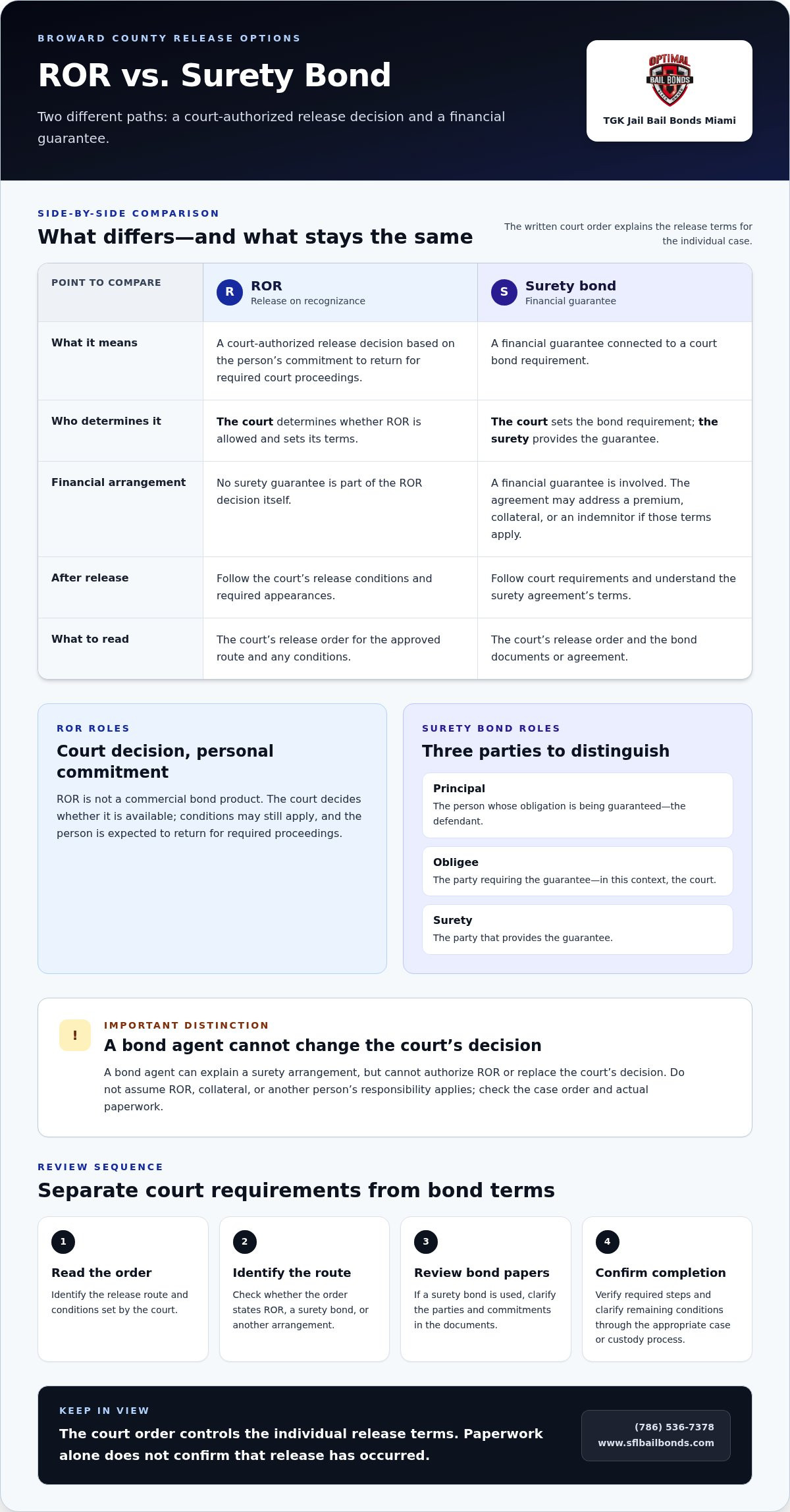
Florida Department of Financial Services terminology helps clarify the parties. The principal is the person whose obligation is being guaranteed. The obligee is the party requiring the guarantee, in this context, the court. The surety is the party that provides the guarantee. In a bail bond arrangement, the defendant is the principal, and the surety’s bond guarantees the required obligation to the court. The guarantee and the court’s release decision are related, but they aren’t the same action.
For families comparing ROR bond vs surety bond in Broward County, keep the roles separate. The court determines the release route and its terms. The surety bond is a financial guarantee, not a decision by the surety to release someone.
| Point to compare | ROR | Surety bond |
|---|---|---|
| Decision-maker | Court authorizes release | Court sets the bond requirement; a surety provides the guarantee |
| Financial arrangement | No surety guarantee is part of ROR | Financial guarantee is involved |
| Continuing obligations | Follow the court’s release conditions and required appearances | Follow court requirements and understand the bond arrangement’s terms |
Use the comparison as a starting point, not a prediction of what will happen in a particular case. The written order and its conditions explain the actual release terms. Read that order first, then compare it with any bond agreement. This helps distinguish what the court requires from what a surety agreement covers, including who is responsible for each commitment after release.
How Broward County Release Decisions and Surety Bonds Work
During the release process, keep two things distinct: the court determines the release terms, while a surety bond provides a financial guarantee if that is the authorized route. A bond agent can explain the bond arrangement, but cannot replace or change the court’s decision. The exact steps and outcome depend on the case and applicable rules.
Use this sequence to understand what has happened and what still needs confirmation:
- Court decision: The court determines whether release is allowed and sets the applicable terms. Don’t assume ROR or a particular bond option will be approved.
- Release terms: Review the order for the conditions that apply. The order, not a general description of the process, is the reference for the individual case.
- Release route: Identify whether the authorized route is ROR, a surety bond, or another arrangement stated by the court. The route must match the court’s terms.
- Paperwork: If a surety bond is used, review the bond documents and agreement to understand who is involved and what commitments are described. Don’t assume another person has a responsibility unless the paperwork says so.
- Confirmation: Verify that the required steps have been completed and clarify any remaining release conditions through the appropriate case or custody process. Paperwork alone does not confirm that release has occurred.
Who decides whether ROR is available?
The court determines the release terms. Whether ROR is allowed depends on the case and applicable rules, so eligibility can’t be predicted from a charge description or a family member’s circumstances alone. Because procedures and legal requirements can change, rely on the current order and verified Florida and Broward information for case-specific details. A bond agent can explain a surety arrangement, but cannot authorize ROR or substitute for a court decision.
What happens when a surety bond is used?
A surety bond is a contractual guarantee tied to the court’s bond requirement. The agreement explains the arrangement and identifies the parties’ commitments. It may address a premium, collateral, or an indemnitor, a person who agrees to take on responsibilities under the agreement, if those terms apply. Don’t assume collateral is always required or that every family member is responsible. Read the actual documents and clarify unfamiliar terms before signing.
A Broward County government page on Risk Management discusses insurance and contracts. It concerns county risk and contracting matters, so it should not be mistaken for instructions about criminal release or a specific bail bond case.
A Broward-focused legal result identifies a Nebbia hold as a possible issue in bond proceedings. That reference alone doesn’t establish whether one applies or what it means for a particular case. Review the case documents and current legal guidance rather than assuming it changes the release route.
If you’re sorting through bond terminology or paperwork, you can read more about bail bond services. Start with the court’s written terms, then make sure the agreement and any continuing responsibilities are clear.
How to Compare ROR and Surety Bonds for Your Situation
When comparing release options, focus on what the court authorized, whether a financial guarantee is involved, and what responsibilities continue afterward. This framework helps families understand the paperwork without assuming that one route is available or preferable. The court’s actual order matters more than a general description of the charge or what happened in another case.
The ROR bond vs surety bond in Broward County comparison is not simply “pay” versus “pay nothing.” ROR is a release decision with court-set terms. A surety bond is a financial guarantee connected to a bond requirement. Both routes can involve continuing obligations, though those obligations come from different sources.
Does ROR mean there are no costs or conditions?
Not necessarily. ROR means a surety bond isn’t the basis for release, but that alone doesn’t establish whether any other costs or requirements apply. Court-ordered conditions can still matter, including requirements to appear in court or follow release terms. Read the actual release order for the conditions in the specific case, and don’t treat “ROR” as shorthand for “no responsibilities.”
What responsibilities can accompany a surety bond?
A surety bond concerns the defendant’s obligation to appear as required by the court. Anyone signing or agreeing to indemnify should rely on the written contract to understand their specific commitments. Responsibilities vary with the agreement, so don’t assume a signer automatically has a particular duty or that every family member is financially responsible. A bond also doesn’t guarantee immediate release. Required paperwork and court or custody steps may remain.
Use this decision matrix to organize the comparison. It describes what to examine, not which legal outcome to seek:
- Who authorizes release? For ROR, look to the court’s release decision. For a surety bond, the court sets the release terms, and the surety’s guarantee relates to the bond requirement.
- Is a financial guarantee involved? ROR is not itself a surety bond. A surety route involves a bond agreement. Review its stated terms rather than relying on assumptions.
- What obligations remain? Check the release order for court conditions and the bond agreement for any signer’s commitments. These documents address different responsibilities.
- What confirms the route? Use the current order and case-specific paperwork, not a verbal summary or a broad label.
Charge labels may provide context, but they don’t substitute for the court’s decision. Similar labels don’t guarantee identical release terms, and a family shouldn’t infer ROR eligibility or a required bond route from a label alone. Case facts and applicable rules can affect the result.
For a careful comparison, read the order first, then review any bond agreement separately. Write down unclear terms, identify who each document names, and distinguish court conditions from contractual commitments. This keeps the focus on the actual responsibilities in front of you rather than assumptions about how release usually works.
Broward County Checklist: What to Clarify Before Taking the Next Step
Before anyone signs paperwork or makes plans around a possible release, get the case details straight. The release route, court conditions, and custody process can’t be reliably inferred from a charge label or a general description of how bail works. Use this checklist to focus on the documents and information that apply to this case.
- Confirm the court order: Check that the case information matches and review the current release terms. If details are unclear or appear to conflict, pause and seek clarification through an appropriate official channel.
- Identify the release route: Determine whether the order reflects ROR, a surety bond, or another route. Don’t assume an application, payment, or signed document changes the court’s authorization.
- Read every condition: Note required court appearances and any other conditions stated in the order. Keep a copy available so the person released and family members can refer to the same terms.
- Know the responsible parties: Separate the defendant’s court obligations from any commitments a signer may take on under a bond agreement. Use the written documents to identify who is named and what they agree to do.
- Verify local steps and timing: Confirm current Broward County court and custody procedures using official, case-relevant information. Processing and release timing can depend on the specific case and facility, so avoid relying on an assumed schedule.
Which Broward County details should families verify?
Match the court and case information on the order to the case at hand, then use current official records or channels to understand the release terms. Local custody and processing steps can change, so verify them before relying on a facility name or describing a location-specific procedure. TGK Jail should not be treated as a Broward County custody location. Information about TGK Jail does not establish where or how a Broward release is handled.
What paperwork and responsibilities should you understand?
Read the bond agreement before signing, including any listed financial obligations and the identity of each signer. An indemnitor is someone who agrees to take on responsibilities under a bond agreement; the actual responsibilities depend on the document. Collateral refers to property or other security pledged in connection with an agreement, if the contract provides for it. Don’t assume either term applies to every bond.
Before signing, confirm the court order, the authorized release route, all stated conditions, and each signer’s written responsibilities. If a term is unfamiliar, ask for a plain-language explanation and make sure it matches the agreement before proceeding. Keep copies of the documents so the family can refer to the same information.
The ROR bond vs surety bond in Broward County comparison becomes more practical when families verify the order and local process instead of relying on assumptions. Optimal Bail Bonds provides bail bond support to individuals and families in North Miami-Dade, including Miami, Florida. For general bond questions, a clear conversation can help make unfamiliar paperwork easier to understand.
Choosing Your Next Step After Comparing ROR and Surety Bonds
It’s understandable to feel unsure when release terminology and paperwork arrive during a stressful moment. Take the next step slowly and keep the court’s written terms at the center of your decisions. In the ROR bond vs surety bond in Broward County comparison, the court controls the release decision, and the outcome depends on the facts and requirements of the individual case. A bond team can help explain bond terms, but can’t determine whether ROR or a surety bond will be granted.
Use three calm steps to move from uncertainty toward clarity:
- Review the current order. Locate the release terms that apply to this case. Don’t rely on a general bond schedule, a charge label, or someone else’s experience as a substitute for the current order.
- Understand the obligations. Separate the person’s court-ordered conditions from any commitments written into a surety agreement. If another person may sign, make sure they understand which responsibilities the agreement assigns to them.
- Clarify unanswered terms. Write down what remains unclear and identify whether each question concerns the court’s release decision, local processing, or bond paperwork. Direct legal-eligibility questions to an appropriate legal resource. Get a plain-language explanation of bond terms before proceeding with an agreement.
What should you do when the release option is unclear?
Start with the latest court order and the exact release terms it states. If you don’t have the order or its wording is unclear, use official case information or an appropriate court channel to understand what has been authorized. Keep questions about legal eligibility separate from questions about a surety agreement. Neither a family’s expectations nor a bond agent’s explanation can predict the court’s decision.
How can a bail bond team help explain the process?
A bail bond team can explain surety terminology and general paperwork steps, including what a document says about the bond arrangement. That guidance can help when several unfamiliar terms appear at once. Read every agreement carefully and seek qualified legal guidance for legal advice or questions about eligibility.
Families don’t need to understand every term immediately. Focus first on what the order says, then take time to understand any separate agreement and who is named in it. Keep copies of documents and note any questions that need an answer before signing. That simple approach helps reduce confusion without assuming a particular release result or timeline.
For help understanding bail bond terminology and paperwork, call (786) 536-7378 or visit Optimal Bail Bonds.
Take the Next Step With Clear Information
When decisions feel urgent, make sure the next step is based on the actual case documents, not assumptions or pressure. The ROR bond vs surety bond in Broward County comparison can help explain the terminology, but it can’t predict what the court will decide. For legal-eligibility questions, seek qualified legal guidance. If a question concerns a bond agreement, make sure its terms are clear before proceeding.
Families deserve patience and respect while they work through an unfamiliar process. Optimal Bail Bonds provides bail bond services to individuals and families in North Miami-Dade, including Miami, Florida, and offers immigration bail assistance. The company also runs a Bail Bond Education Center with pre-licensing and continuing-education classes.
You don’t have to make sense of every term at once. Take one careful step at a time, and keep asking for clarity where you need it.
Frequently Asked Questions
Is an ROR bond the same as a surety bond?
No. ROR refers to a court’s release decision, while a surety bail bond is a financial guarantee involving a surety and other parties. The terms describe different parts of the process, so treating them as interchangeable can create confusion about what has actually been authorized. Check the current court order for the release route and applicable conditions, rather than relying on informal descriptions or labels.
Can you get released on recognizance in Broward County?
Possibly, but only the court can determine whether ROR applies to a particular case. The ROR bond vs surety bond in Broward County distinction doesn’t predict which option the court will approve. Check the current release order for the decision and conditions, and verify local process details through official Broward County information. If the order hasn’t been issued or is unclear, don’t treat general guidance as a decision about eligibility.
Does release on recognizance mean you do not have to appear in court?
No. A person released on recognizance should not treat release as the end of the case or assume court dates are optional. Use the case’s official notices and written terms to track required appearances, and keep the information somewhere accessible. For example, record each date in a calendar and confirm any uncertainty using an appropriate official channel. Missing a date can create additional complications.
What happens if someone misses court after a surety bond is posted?
A missed required appearance can have serious consequences, and the response depends on the case and applicable rules. Florida Department of Financial Services materials describe bond forfeiture in connection with failing to appear or comply with bond conditions. Don’t assume the issue can be resolved informally or that the same steps apply in every case. Review the bond documents and current court information promptly, and seek qualified legal guidance about case-specific consequences.
Can a surety bond guarantee immediate release from Broward County custody?
No. A surety bond doesn’t guarantee a specific release time. After a bond is arranged, the court’s terms, completion of required paperwork, and custody processing may all affect what happens next. Avoid making travel or pickup plans based on a general estimate. Use current case-specific custody information to understand whether release has been confirmed and what practical steps remain.
What does an indemnitor do on a bail bond?
An indemnitor is a person who agrees to responsibilities under a surety bond agreement. The document should identify whether someone is signing in that role and describe the commitments involved. Before signing, check the agreement for terms about payment, collateral, or other obligations, and ask for plain-language clarification of anything unfamiliar. Don’t assume that being a relative or helping with paperwork automatically makes someone an indemnitor.
Is collateral always required for a surety bond in Florida?
Don’t assume collateral is required in every arrangement. Whether it applies depends on the specific bond terms and written agreement. In Miami, Florida, as elsewhere, families comparing paperwork should look for any section describing property or other security, who provides it, and what the agreement says about its handling. If the document is unclear, get an explanation before signing rather than relying on examples from another case.


