
When someone you care about doesn’t appear in the first search results, it’s unsettling. A missing name alone doesn’t explain what has happened. Start with the official Miami-Dade County custody tool, then check the search details carefully.
This guide walks you through the miami dade inmate search, including how to enter a name and review possible matches. The county portal requires at least three characters in both the first and last name fields. Results may show a person’s custody location, booking details, charges, and bond information. These entries can help you understand what the county search displays, but they are not legal advice.
If the search is inconclusive, check your spelling and use the official resource that fits your question. If a result raises questions about bond, Optimal Bail Bonds can explain the bail bond process for families in the Miami area. Bail bond guidance is separate from legal advice and does not guarantee release.
Key Takeaways
- Start with the official county custody lookup to check whether someone appears in Miami-Dade’s current custody results.
- The miami dade inmate search may show custody and booking details, but it does not replace a court case search or legal advice.
- If no match appears, check the spelling and try a known name variation before drawing conclusions about someone’s custody status.
- A listed bond amount is information to review, not a decision about release or a substitute for legal advice.
- Optimal Bail Bonds provides bail bond guidance to individuals and families in North Miami-Dade, not legal representation.
What the Miami-Dade inmate search can, and cannot, tell you
The Miami-Dade Corrections and Rehabilitation Department (MDCR) search is an in-custody lookup. It helps you check whether a person appears in the county’s current custody results. For families in Miami-Dade, it’s a useful first step, but it is not a complete record of every law-enforcement contact, court proceeding, or detention setting.
The county describes the service as a way to find people currently in custody. That focus matters: a result can help answer whether someone appears in the county’s custody listings, but it does not provide a full account of a case or a person’s history. The Miami-Dade County Corrections and Rehabilitation Department operates county correctional facilities, while the lookup has the narrower purpose of showing custody information.
This video offers another look at the county lookup process:
When to use the Miami-Dade County search
If your immediate question is whether someone is currently held in Miami-Dade County custody, begin with the official county search. The miami dade inmate search is designed for a local custody check, not to determine what happened in court or explain a case’s legal status. Treat it as a focused source of information, then use another official resource if you have a different question.
How county custody differs from a state search
The county lookup and the Florida Department of Corrections offender search are separate resources. The state tool is a statewide offender-search resource, while MDCR’s tool focuses on people in county custody. Each has a different scope, so a missing result in one system does not prove that someone cannot be found in another setting. Use the county tool for questions about Miami-Dade custody.
A custody search is also different from a court-record search. Court dates, filings, and other judicial information are separate from whether someone appears in the county’s current custody results. A result, or no result, should not be treated as legal advice or a complete account of someone’s circumstances. Keeping the question in view helps prevent a custody listing from being mistaken for a case update or a search of every record and facility.
How to use the Miami-Dade inmate search step by step
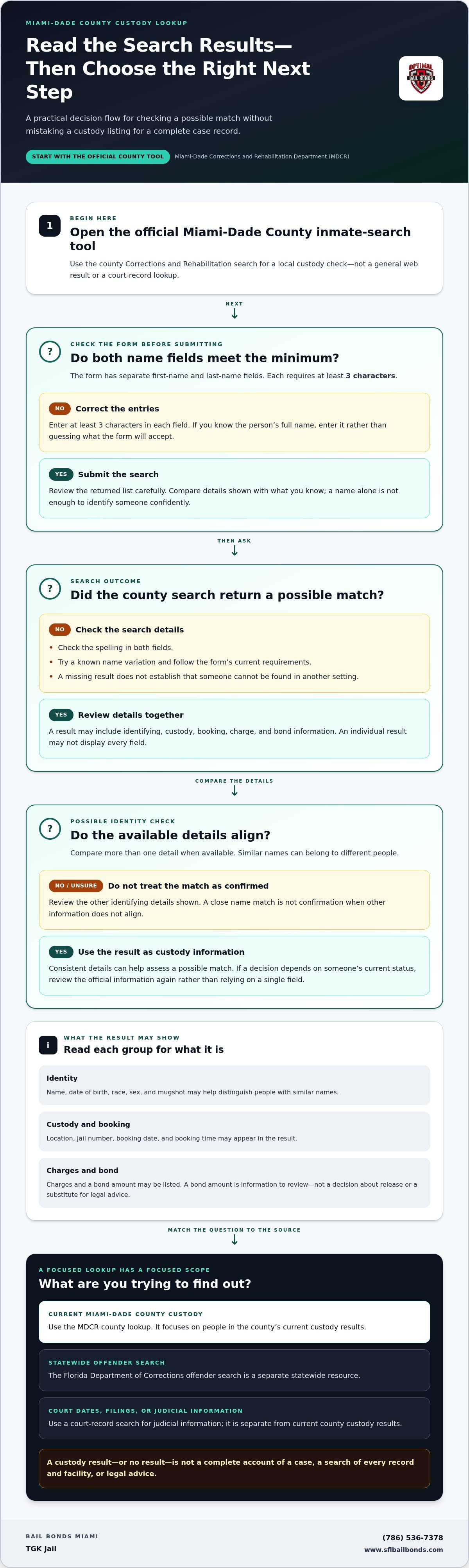
Start with the county’s own search tool and enter the name carefully. The Miami-Dade inmate search is intended to return a list of people in custody. Review possible matches against the details shown rather than relying on a name alone.
- Open the official Miami-Dade County inmate-search tool. Use the county’s Corrections and Rehabilitation search rather than a general web result or court-record lookup.
- Enter the person’s name in the fields shown. The county search has separate first-name and last-name fields and requires at least three characters in each. Follow the instructions on the live form if its labels or requirements change.
- Submit the search and review the returned list. The county service describes its results as a list of people in custody. Compare any possible match with other identifying details shown before deciding it is the person you’re looking for.
- Try a known name variation if needed. Search a different spelling or another name the person uses, following the form’s current requirements. A search may not return every possible match.
Entering a name in the official search
The county service description says a search can use a last name with a first initial or a first name. The search form has separate first-name and last-name fields with a three-character minimum. If an initial does not satisfy the form, enter at least three characters in the first-name field and follow the instructions displayed there. When you know the person’s full name, enter it rather than guessing what the form will accept.
What to do after submitting a search
Review each result carefully. Two people may have similar names, and a name by itself is not enough to identify someone confidently. Compare the available details, and do not treat a close match as confirmation if other information does not align. If nothing appears, check the spelling, try a known name variation, and make sure both entries meet the form’s current minimum. For more family-focused lookup context, see this Miami-Dade jail inmate search family guide.
If a result raises questions about the bond process, Optimal Bail Bonds can provide practical guidance to families in North Miami-Dade. The team can explain bail-related steps, but does not provide legal representation or guarantee release.
How to read Miami-Dade inmate search results
Read the details together instead of relying on a name alone. Miami-Dade County says a result may include a person’s name, date of birth, race, sex, location, charges, bond amount, jail number, booking date, booking time, and mugshot. These are fields the county says may appear; an individual result may not display every detail.
Use the information to see whether a possible match is consistent with what you know. A shared name does not establish identity. If a decision depends on someone’s current status, review the official information again rather than relying on a single field.
Details the county says may appear
The listed fields fall into several practical groups. Each can help you interpret a result, but none provides a complete explanation of a person’s circumstances.
- Identity: Name, date of birth, race, sex, and mugshot may help distinguish people with similar names. Compare more than one detail when available, and do not rely on a single identifier.
- Custody: Location and jail number can help identify the custody entry shown. They do not answer questions about other facilities or records.
- Booking: Booking date and time identify the booking details displayed by the county. They are not a full timeline of events or a prediction of what will happen next.
- Charges and bond: The result may list charges and a bond amount. Treat them as information shown in the county result, not as a finding about the case or legal advice.
Why an online result needs careful interpretation
Use the details as a cross-check. If a name matches but the date of birth or another identifying detail does not, pause before deciding that the result belongs to the person you’re seeking. A mugshot may provide another point of comparison, but one image or field alone may not resolve an uncertain match.
Pay particular attention to how you interpret a bond amount. It is a listed amount, not an explanation of every condition that may apply, a decision about release eligibility, or a guarantee of release. The miami dade inmate search provides custody information; it does not replace legal advice or explain a court case’s outcome. A charge entry is not proof of guilt or a final case result.
Online information can be time-sensitive. If your next step depends on someone’s current status, review the official county information again before acting. When a result is unclear, note the exact details displayed and use an appropriate official resource for the question you need answered.
What to do if a Miami-Dade inmate search finds no match
A blank result can be worrying, but one unsuccessful search does not settle every question about someone’s custody. The county lookup focuses on people shown in its current in-custody results. A missing name is not, by itself, a complete answer about the person’s situation. Check the search carefully before deciding what it means.
Check the search details before drawing conclusions
Return to the official Miami-Dade County tool and review what you entered. A spelling difference, hyphen, middle name, or alternate version of a person’s name can affect the results. Change one detail at a time so you can keep track of the versions you have tried.
- Check spelling: Compare the first and last names with a reliable source and correct any typo.
- Try a known variation: If the person uses another first name or spelling, search that version rather than guessing at unfamiliar names.
- Recheck the form’s instructions: Use the live interface’s current field labels and minimum character requirements. The county search requires at least three characters in each name field, so follow the instructions displayed on the official tool.
Use a booking number or another identifier only if the current official form provides a field for it. Entering information in a field that is not available will not make the search more complete.
Choose the next official resource carefully
If careful name checks still produce no match, choose a resource that fits your question. For Miami-Dade County custody, return to the county search rather than treating an unverified third-party listing as confirmation. For decisions that depend on someone’s current status, rely on official information.
The Florida Department of Corrections also provides a separate statewide offender search. It is not the same as the county custody lookup, and neither resource covers every detention setting or type of record. Use the state search when a statewide offender lookup is relevant, while keeping in mind that a result in one system does not automatically resolve a local custody question in another.
If your concern shifts from locating someone to understanding a possible bond process, keep those questions separate. A missing search result does not establish whether bond applies or what action is appropriate. This Florida bail rules guide for Miami may help explain the process, but it is not a substitute for legal advice.
For questions about the bail bond process, families in North Miami-Dade can get practical guidance from Optimal Bail Bonds. That guidance is separate from legal representation and does not guarantee release.
After a Miami-Dade inmate search: practical next steps for families
A custody result answers one question: whether someone appears in the county’s current in-custody search. It does not decide what a family should do next. Review the details, identify what you still need to know, and avoid treating one result as a complete explanation of the case or possible release process.
When a search result raises bail questions
A bond amount displayed in a result is useful to note, but it does not fully explain release. It does not establish whether someone is eligible for release, what conditions may apply, or what steps are appropriate in a particular case. Those questions cannot be answered by reading one field on a custody listing.
For a plain-language overview, see how Florida bail bonds work. Families looking for Miami-specific context can also review this Miami bail bonds guide. These resources explain general process concepts; they do not determine what will happen in an individual situation or guarantee a release time or outcome.
Keep custody information and legal decisions separate. For legal advice about a case, speak with a qualified legal professional. For questions about the bail bond process, a local bail bond team can explain process steps without acting as legal counsel.
Local support for families in North Miami-Dade
Families dealing with an arrest may feel pressure to make decisions before they understand the options. A calm, non-judgmental conversation can help clarify the process and the information to gather. Optimal Bail Bonds provides bail bond guidance to individuals and families in North Miami-Dade. The team can discuss process questions with care, but does not provide legal representation or promise a particular release result.
If you’re preparing to ask about the bail bond process, keep the county result available, including the person’s name and any listed bond details. Share only what’s needed to explain your question. This can help keep the conversation focused while leaving decisions about legal strategy to an attorney.
The miami dade inmate search is a starting point for checking county custody, not a substitute for professional guidance about what to do next. For Miami bail bond process questions, contact Optimal Bail Bonds at (786) 536-7378. The team can provide clear, respectful process guidance so you can consider your next step with better information.
Take the Next Step With Clearer Information
After checking the miami dade inmate search, focus on the question that remains. For a court matter, seek legal advice from a qualified attorney. For help understanding bail bond process steps, keep that separate from legal decisions and from any assumption that release is assured.
Optimal Bail Bonds provides non-judgmental bail bond guidance to individuals and families in North Miami-Dade, including support related to immigration bail matters. The team can explain the process, but does not provide legal representation. You can ask questions without judgment and make your next decision with a clearer understanding of the steps involved.
Take one informed step at a time. For bail bond process guidance in Miami, call Optimal Bail Bonds at (786) 536-7378.
Frequently Asked Questions
Is the Miami-Dade inmate search free to use?
Use the official Miami-Dade County website for the county’s own search instructions. Avoid relying on unofficial directories, and review any access terms displayed on the county site before proceeding. Be cautious about entering payment details unless you have verified that the page is an official county resource.
Can I search the Miami-Dade inmate database using only part of a name?
The county search fields require at least three characters in both the first and last name fields. The service description also refers to searching by last name with a first initial or by first name, so follow the live tool’s current instructions if they differ. A short name fragment may not meet the form’s requirements or return a useful match.
What does a Miami-Dade inmate search result include?
Miami-Dade County says results may show identifying details, custody location, charges, bond amount, jail number, booking date and time, and a mugshot. For example, compare a name and date of birth before treating a result as a possible match. Not every result displays every field, and the details do not explain the full status of a court case.
Is TGK Jail part of the Miami-Dade jail system?
Yes. Turner Guilford Knight Correctional Center, often called TGK, is part of Miami-Dade County’s corrections system and serves as its primary intake and processing facility. If a county result lists TGK Jail as a person’s location, that identifies the facility shown in the result. It does not provide a full explanation of the person’s case or predict what will happen next.
Is the Miami-Dade inmate search the same as the Florida Department of Corrections search?
No. The county tool checks Miami-Dade custody information, while the Florida Department of Corrections provides a separate statewide offender search. They are different resources, so a result in one should not be treated as a substitute for the other. Choose the search that fits your question: county custody or the state offender records covered by the Florida tool.
Can an online inmate search confirm that someone is eligible for release?
No. A search result can display custody details and may show a bond amount, but it does not determine release eligibility or explain every condition that may apply. Do not treat a displayed amount as a decision or as legal advice. For questions about legal rights or case strategy, speak with a qualified attorney. For bond process questions, contact a local bail bond team.
How current is the information shown in a Miami-Dade inmate search?
The search is a lookup for people currently in county custody, but the county service information does not state an exact update interval. For a time-sensitive question, review the official county search and contact Miami-Dade’s inmate information service at 786-263-7000 with questions about bond or release. Treat a result as the information displayed when you check, not as confirmation of a later status.


