
A $10,000 bond doesn’t necessarily mean your family has to pay $10,000 to arrange release. If you’re asking how much does a $10,000 bond cost in Florida, start by separating the bond’s face amount from the premium paid to a bail bond agency.
It’s understandable to want a clear number quickly, especially when someone is being held at TGK Jail and you’re trying to help from Miami-Dade. The amount paid through an agency is a premium, and the applicable rules and bond type affect how it is calculated. Collateral, additional charges, and payment responsibilities are separate terms to understand before signing. The bond amount alone doesn’t show the full financial commitment.
This article explains what a $10,000 bond amount means, how the premium differs from cash bail, and what to review before arranging release. You’ll also learn why the circumstances of the case and the bond type matter. For local help, Optimal Bail Bonds provides bail bond services and compassionate, non-judgmental guidance for families in Miami-Dade, including those dealing with a situation at TGK Jail.
Key Takeaways
- Learn how much does a $10,000 bond cost in Florida by distinguishing the bond amount from the premium paid for a surety bond.
- Understand how collateral, additional charges, and agreement terms affect the financial commitment a family needs to plan for.
- Compare cash bail and a surety bond to understand their different financial arrangements and avoid assuming they require the same payment.
- Gather the bond amount and jail or case-location details to organize a Miami-Dade bond inquiry involving TGK Jail.
- Learn how Optimal Bail Bonds provides local, compassionate guidance and bail bond assistance for families.
What Does a $10,000 Bond Mean in Florida?
A $10,000 bond amount isn’t automatically the amount your family pays to a bail bond agency. If you’re asking, “how much does a $10,000 bond cost in Florida,” first separate the amount set as a condition of release from the cost of arranging a surety bond. They’re related, but they describe different parts of the process.
In plain English, bail refers to financial conditions that may allow someone accused of a crime to be released while the case proceeds. The bond amount is the amount associated with those conditions. A surety bond is an arrangement in which a bail bond agent provides a bond to the court on the defendant’s behalf. The premium is the charge for arranging that bond. For a general overview of how these arrangements work, see What is a bail bond?
Bond amount versus bond premium
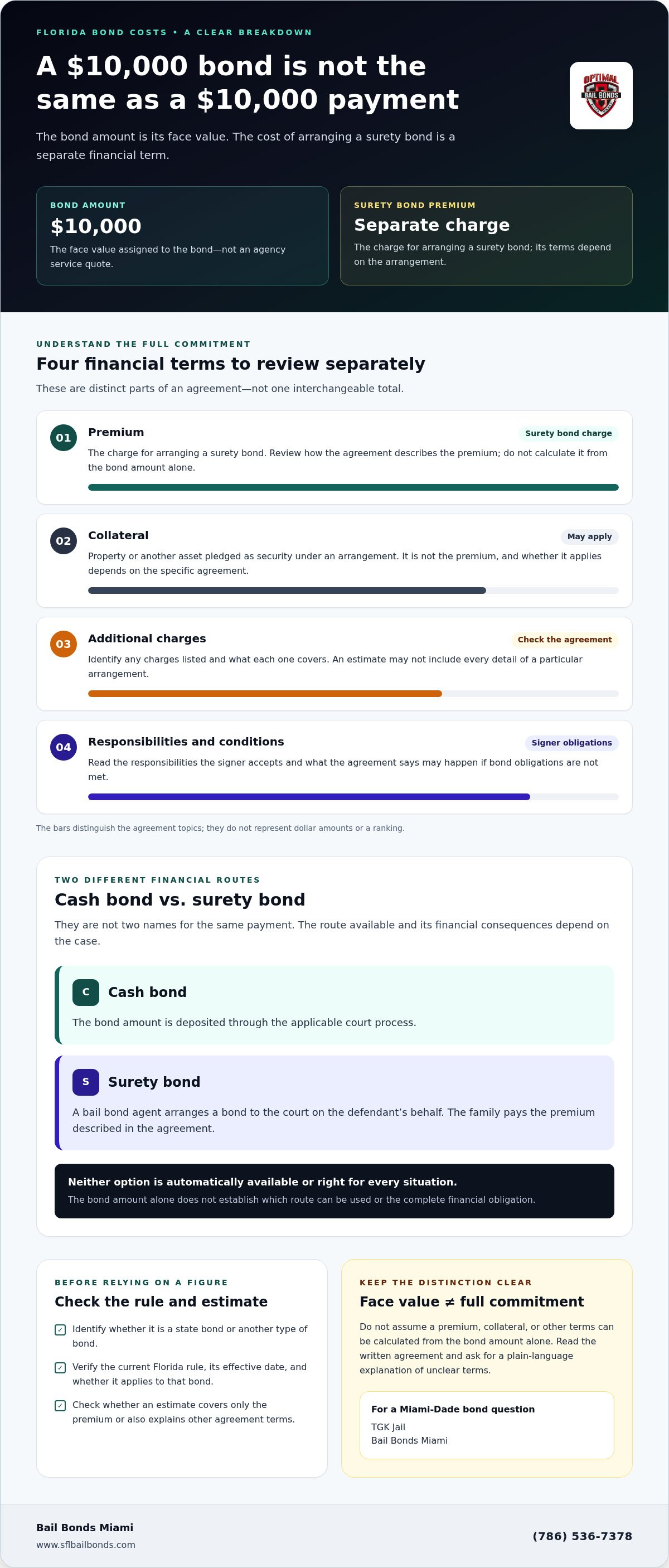
The bond amount is the face value assigned to the bond, not a quote for an agency’s service. A premium is a separate charge for arranging a surety bond. The amount your family pays depends on the bond type, applicable rules, and agreement terms, not on the face amount alone.
The bond’s face amount is its value, while the premium is the charge for arranging a surety bond.
So, a $10,000 figure tells you the bond amount, but it doesn’t show every amount your family may need to arrange. Don’t assume the premium, any collateral, or other terms can be calculated from that figure alone. Premium rules should be checked against current Florida requirements, and the written agreement should explain the financial terms for the specific arrangement.
Cash bond versus surety bond
With a cash bond, the bond amount is deposited through the applicable court process. With a surety bond, a bail bond agent arranges a bond instead, and the family pays the premium described in the agreement. The route available and its financial consequences depend on the case. Neither option is automatically available or right for every situation.
Before making plans, identify which type of bond has been set and review the agreement’s terms for the premium and any other financial commitments. The bond amount alone doesn’t establish whether a cash or surety bond can be used in a particular case, or what the complete obligation will be.
These terms can be difficult to sort out under pressure. Write down the stated bond amount, then review each financial term in plain language before signing. This gives you a clearer basis for understanding the arrangement and planning your next steps.
What Can Affect the Cost of a $10,000 Florida Bond?
The bond amount is only one part of the financial commitment. For a surety bond, the premium, any collateral arrangement, and the agreement terms are separate items to understand. A headline estimate may offer a starting point, but it isn’t necessarily a case-specific quote or a complete explanation of what signing the agreement involves.
Premium, collateral, and other agreement terms
The premium is the charge for arranging a surety bond. Collateral is property or another asset pledged as security under an arrangement; it isn’t the premium, and whether it applies depends on the specific agreement. Other terms may describe payment responsibilities or what happens if obligations under the bond aren’t met. Review each item separately instead of treating them as one total.
Before signing, make sure you can identify:
- The premium and how the agreement describes it.
- Whether collateral is part of the arrangement and what asset is involved.
- Any additional charges listed in the agreement and what they cover.
- The responsibilities and conditions the signer is accepting.
Before signing, distinguish the premium, any collateral, additional charges, and the obligations stated in the agreement. If a term is unclear, pause and request a plain-language explanation of that specific term. An advertised estimate may not account for the details of a particular case, so don’t treat it as a complete explanation of the contract.
Which Florida rules need checking before quoting a figure?
Premium rules are subject to Florida law and may depend on the bond being discussed. Before relying on a rate, verify current guidance from the Florida Department of Financial Services and the applicable statutes. Check the rule’s effective date and whether it applies to the particular bond, rather than assuming a figure from an older article or estimate applies today.
To answer how much does a $10,000 bond cost in Florida, don’t simply multiply the bond amount by a percentage unless that rate has been verified for the bond in question. A careful review should establish:
- Whether the matter involves a state or another type of bond.
- Which current rule applies and when it took effect.
- Whether the estimate covers only the premium or also addresses other agreement terms.
This distinction can make a stressful decision easier to organize. Keep the estimate and agreement together, and compare the stated premium with the contract terms before signing. For a local conversation about a Miami bond question, Bail Bonds Miami offers a place to begin with compassionate, non-judgmental guidance.
Cash Bail or a Bail Bond: Which Financial Route Is Different?
Once the bond type is clear, the next question is how the money is handled. A cash bond and a surety bond aren’t two names for the same payment. They involve different recipients, arrangements, and possible financial consequences. Which route applies depends on the case and the conditions set for release.
How the two routes differ financially
| Route | What the family may need to arrange | What to understand |
|---|---|---|
| Cash bond | A deposit through the applicable court process. | Whether funds may be returned, and any deductions or conditions that apply. |
| Surety bond | A premium paid under an agreement with a bail bond agent, along with any other terms stated in that agreement. | The premium and any separate obligations are governed by the agreement and applicable rules. |
With a cash bond, funds are deposited through the court process. With a surety bond, the family pays a premium under an agreement with a bail bond agent. A deposit and a premium aren’t interchangeable: they are handled through different arrangements and may have different financial consequences.
Don’t assume a cash deposit will always be returned in full, or that the same refund conditions apply in every case. Whether funds are returned, and whether deductions apply, depends on applicable rules and circumstances. The surety agreement describes the premium and any other obligations. Read those terms carefully before deciding what your family can manage.
Questions to understand before choosing a route
Before making a decision, get a clear explanation of the amount due at the outset. Identify whether that figure includes only the immediate payment or also reflects separate obligations. Ask how the agreement describes collateral or other commitments, if any, and what conditions may affect funds or property later. These details matter as much as the headline bond amount.
- Which route applies to this case, and what amount must be arranged now?
- Are any other financial obligations separate from the initial payment?
- What does the agreement say about the premium, collateral, and the signer’s responsibilities?
- What rules and circumstances may affect the return of a cash deposit?
If the paperwork is confusing, take it one term at a time and ask for unclear language to be explained before signing. For families in Miami-Dade, including those dealing with a situation involving TGK Jail, a $10,000 bond alone doesn’t determine which financial route is available. Understanding the case-specific conditions helps make the next step more manageable. The question “how much does a $10,000 bond cost in Florida” can’t be answered responsibly without distinguishing the route and reviewing its terms.
What Should Miami-Dade Families Clarify Before Arranging a Bond?
When someone is in custody, it can be hard to know what information to gather first. A few clear details can make a bond cost discussion more focused and help you understand the agreement before committing. For families in Miami-Dade, note the jail or case location accurately, including whether the person is at TGK Jail.
Information to have ready for a cost discussion
Start with the basics you can verify. You don’t need to share sensitive personal information publicly to prepare a useful list of questions. Keep your notes private and focus on details that identify the bond and the financial terms you need explained.
- Confirm the bond amount and the jail or case location from reliable case information.
- Write down whether you’re discussing a cash bond or a surety bond.
- List questions about the premium, collateral, payment terms, and any separate obligations.
- Keep a copy of the written agreement and note any terms you want explained before signing.
This sequence helps separate what’s known from what still needs clarification. If the amount or location is uncertain, avoid relying on a guess or an old message. Having the correct basics at hand can keep the conversation practical, especially when several family members are coordinating support.
How to avoid misunderstandings about the agreement
Read the written agreement before signing, even if the situation feels urgent. Make sure you understand what the document says about the premium, any collateral, payment responsibilities, and other obligations. Don’t treat a verbal estimate as a replacement for the written terms. Ask for unclear wording to be explained in plain language before you agree.
Be especially careful with statements about refunds, collateral, or payment arrangements. Their consequences can depend on the agreement, applicable rules, and circumstances of the case, so don’t assume a general explanation settles the details for your situation. Check current Florida requirements against authoritative sources before relying on a legal or regulatory claim. A bail-bond discussion can clarify the agreement’s terms, but it isn’t legal advice about the case.
Families often ask, “how much does a $10,000 bond cost in Florida,” but the bond amount alone can’t answer every question about what must be arranged. Get a clearer picture by confirming the location and bond type, then reviewing each financial term in writing. Take a breath, work through one question at a time, and keep the signed documents accessible.
How Optimal Bail Bonds Can Help With a Florida Bond Question
A bond question can feel urgent and confusing, especially when someone close to you is in custody. Optimal Bail Bonds provides bail bond services in the Miami area, including North Miami-Dade, and supports families with compassionate, non-judgmental guidance.
A supportive local conversation about the bond
Bring the bond amount and the questions you’ve gathered. Optimal Bail Bonds can help you understand the bond-related information and the steps involved in arranging a bail bond. If your family is dealing with a situation at TGK Jail, mention that location so the discussion is grounded in the details you have. There’s no need to feel embarrassed about asking for an explanation. Clear answers can help make a difficult moment more manageable.
Families often want a straightforward answer to “how much does a $10,000 bond cost in Florida?” The bond amount alone doesn’t describe every financial term. The type of bond, applicable rules, and written agreement all matter. Optimal Bail Bonds provides local guidance as you work through the bond question and understand the terms being discussed. This is bail-bond assistance, not legal representation or advice about the criminal case.
What to do next
Before reaching out, keep any available bond details nearby and jot down the questions you want answered. For example, ask which bond amount is being discussed, what the agreement says about the premium, and whether it includes separate obligations or collateral terms. If you have a written document, keep it on hand so you can point to language that needs a plain-English explanation.
You can also note the jail or case location and any information needed to identify the bond inquiry. Share only what’s necessary during a private conversation, and avoid posting private case details publicly. If a term about payment, collateral, or a possible refund is unclear, ask for the agreement’s wording to be explained. For questions about legal rights or the criminal case, consult a qualified attorney.
It’s normal to feel under pressure. Take the discussion one question at a time, and make sure you understand the written terms before signing. For a bond question in the Miami area, call (786) 536-7378.
Take the Next Step With Greater Clarity
In a stressful moment, you don’t need to solve every question at once. Start by writing down what you know, what still feels unclear, and which details need an explanation before anyone makes a commitment. That simple step keeps conversations focused and makes it easier for family members to coordinate without adding pressure.
The question of how much does a $10,000 bond cost in Florida may be why you started reading, but your next step is to get clarity on the specific situation in front of you. Keep your notes nearby and take time to understand the information being discussed. If you’re helping someone else, a calm, organized conversation can make a difficult day more manageable.
You can move forward one clear question at a time. For bail bond assistance in Miami, call (786) 536-7378.
Frequently Asked Questions
How much does a $10,000 bond cost in Florida?
The bond amount alone isn’t enough to calculate the full amount a family may need to arrange. The cost depends on the type of bond, applicable current rules, and the written agreement. For an accurate answer to how much does a $10,000 bond cost in Florida, identify whether the case involves a state or another type of bond, then review the applicable premium requirements and agreement terms.
Is a $10,000 bond the amount I pay a bail bondsman?
No, the bond amount isn’t automatically the payment made to a bail bond agent. It describes the amount associated with the bond, while the agency’s premium is a separate charge under a surety agreement. For example, seeing a $10,000 bond amount on case information doesn’t tell you the premium or any other financial commitments. Review the written terms for the specific arrangement before signing.
Can I get a $10,000 bond without paying the full bond amount upfront?
A surety bond may provide a route that doesn’t involve depositing the full bond amount yourself, but the arrangement still has financial terms. The premium and any collateral or other obligations depend on applicable rules and the agreement. A surety bond also may not be available in every situation. First establish which bond type applies, then review the complete payment responsibilities in writing.
Is the bail bond premium refundable in Florida?
A bail bond premium is generally non-refundable, unlike a cash deposit, which may be handled under different rules and circumstances. Don’t assume every payment connected to a bond follows the same refund terms. Check the current requirements that apply to the bond and read the agreement’s language about the premium. If the document uses unclear wording, request a plain-language explanation before signing.
What happens if I cannot afford the premium for a $10,000 bond?
If the premium feels out of reach, don’t sign an agreement until you understand what it requires and what you’re accepting. Ask for a clear explanation of the amount due, any separate obligations, and the payment terms written into the agreement. Don’t assume an installment arrangement or another option is available unless it’s expressly explained. If the terms don’t work for your situation, pause and consider the choices available in the case.
How do I arrange a bond for someone at TGK Jail in Miami-Dade?
Start by confirming the person’s bond amount and that the location is TGK Jail in Miami-Dade. Then gather the case details you have and make a list of questions about the bond type, premium, and agreement. Share relevant information directly during a private conversation, not in a public post. Optimal Bail Bonds provides bail bond assistance in the Miami area. Release timing depends on case-specific circumstances.
Does collateral mean the same thing as the bail bond premium?
No, collateral and the premium are different parts of a possible surety-bond arrangement. The premium is the charge under the agreement; collateral refers to an asset pledged as security when the agreement calls for it. Don’t assume collateral is always required or that its terms match the premium’s. Read the contract language about any pledged asset, its conditions, and the signer’s responsibilities before agreeing.


