
When someone is in custody, it’s natural to feel pressure to act quickly. But before making a decision, find out what is confirmed and what still needs clarification. This guide to Bail Bonds Miami: Common Mistakes Families Should Avoid explains how to organize the details, understand the agreement, and take a clear next step.
Start by confirming the person’s current custody location and status, especially if you’ve heard they may be at TGK Jail. Gather the identifying and case details you have, then ask clear questions about the bond, payment, paperwork, and responsibilities before signing or paying. A calm, organized approach can help your family avoid mix-ups.
In this article, you’ll learn what to collect before taking action, what to clarify during the bail bond process, and what to keep in mind after release. Optimal Bail Bonds provides bail bond support to individuals and families in North Miami-Dade, including guidance related to TGK Jail. You don’t have to sort through every detail alone.
Key Takeaways
- Bail Bonds Miami: Common Mistakes Families Should Avoid include making decisions before understanding the facts and responsibilities involved.
- Use a simple process to organize documents, prepare questions, review bond terms, and keep useful records.
- A city name alone does not confirm where someone is being held or what information applies to their case.
- After a bond is arranged, keep important communications and instructions organized. The underlying case continues.
- Bail bond guidance can help families understand the bond process, but it is not legal representation.
Bail Bonds Miami: Why Stress Can Lead Families Into Avoidable Mistakes
When someone you care about is in custody, waiting for reliable information can feel unbearable. Details may be incomplete or come from different people, but urgency doesn’t make an assumption more accurate. The goal is not to delay a decision. It is to make the next one with a clearer picture. Bail Bonds Miami: Common Mistakes Families Should Avoid focuses on choices families can prevent by confirming key facts and understanding their responsibilities.
This section offers general information, not legal advice. Arranging a bail bond cannot guarantee someone’s release. For background on the process and its role, read this overview of understanding bail bonds. For now, separate what you know from what you still need to clarify.
For an additional perspective on the bail bond system, watch this discussion:
Common missteps include treating an early report as final, skimming paperwork, overlooking payment terms, or losing track of follow-up information. These are understandable under pressure. A short pause to verify details and clarify responsibilities can help prevent confusion from carrying into the next conversation with Optimal Bail Bonds.
Mistake one: treating early information as confirmed
Custody and case details may change as records are updated. A report passed along by someone else may not reflect the latest information. Write down what you hear, who shared it, and when. Keep confirmed details separate from secondhand reports and assumptions. If you do not know an answer, label it as a question rather than filling in the gap or repeating it as fact.
Mistake two: letting urgency replace a clear plan
Stress can make it harder to compare details, remember questions, and track conversations. Choose one family point person to collect updates and share consistent information with others. That person can keep a brief list of what is confirmed, what needs clarification, and what has already been discussed. One organized record is more useful than scattered texts or relying on memory when discussing Miami bail bond questions.
Before proceeding, understand the paperwork and payment terms, including the premium and the responsibilities stated in the agreement with Optimal Bail Bonds. Take notes during conversations, ask for unfamiliar wording to be explained in plain language, and keep copies of documents and communications. These steps give your family a record to refer to if details are discussed again or an assumption needs correcting.
Miami Bail Bond Mistakes to Avoid When Sharing Details and Reviewing Terms
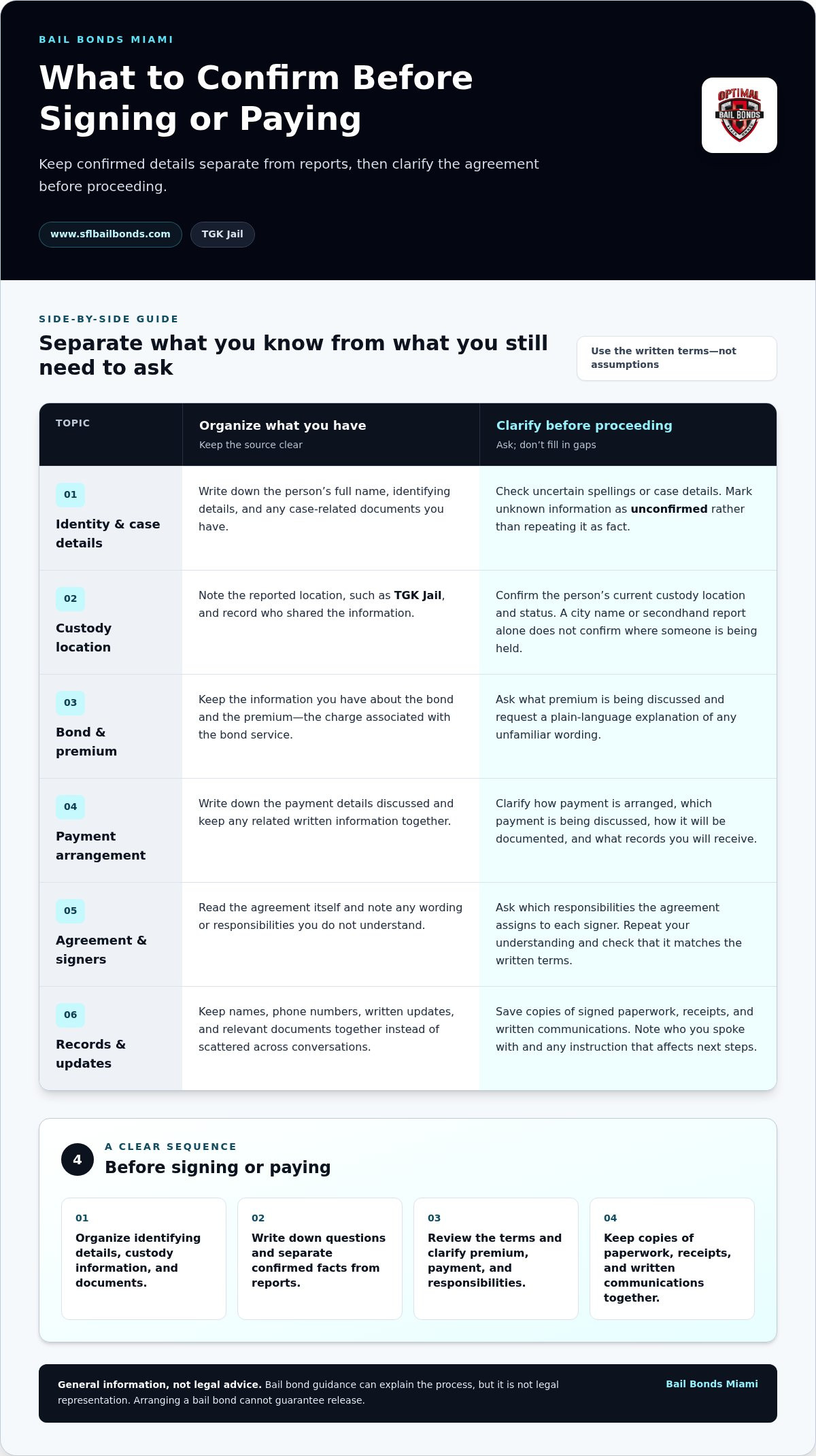
Once you have initial information, keep it organized and review the agreement carefully. A practical sequence is to confirm what you know, gather relevant documents, write down questions, review the terms, and save copies. You do not need legal expertise to follow this process. It helps your family work from the same information and identify unanswered questions before proceeding.
For families considering Bail Bonds Miami: Common Mistakes Families Should Avoid, a key mistake is assuming the premium and agreement responsibilities are self-explanatory. The premium is the charge associated with the bond service. The agreement may also describe responsibilities for the people who sign it. Read the specific terms and ask for a clear explanation instead of guessing what they mean.
What information should families organize first?
Before discussing paperwork, gather the information available to your family. Write down the person’s full name and any other identifying details you have. Note the reported custody location, such as TGK Jail if applicable, but mark it as reported until confirmed. Keep case-related documents, names, phone numbers, and written updates together instead of leaving details scattered across messages and conversations.
A dated note can help you keep sources straight. Record whether a detail came directly from someone handling the matter or was relayed by a relative. If you do not know an answer, write “unconfirmed.” This simple distinction can help prevent an incorrect spelling, location, or case detail from being repeated as fact.
What should families understand before signing or paying?
Read the agreement rather than relying only on a verbal summary. Mark unfamiliar wording and ask for a plain-language explanation before deciding what to do. Clarify the premium, how payment is arranged, and which responsibilities the agreement assigns to each signer. If the explanation is still unclear, repeat your understanding and ask whether it matches the written terms.
Before signing documents or making a payment, compare the paperwork with the information you have gathered. Confirm which payment is being discussed, how it will be documented, and what records you will receive. Do not rely only on a rushed conversation or a relative’s recollection. Clear answers can help prevent later disagreements about what was discussed or agreed to.
- Organize identifying details, custody information, and relevant documents.
- Write down questions and separate confirmed facts from reports.
- Review the agreement and clarify the premium, payment arrangement, and stated responsibilities.
- Keep copies of signed paperwork, receipts, and written communications together.
After a conversation, note the date, who you spoke with, and any answer or instruction that affects your next steps. Keep receipts and signed documents in the same digital or paper folder, and make sure the family point person knows where they are. For calm support understanding the bail bond process, explore Miami bail bond guidance from Optimal Bail Bonds.
TGK Jail and Miami-Dade: Avoid Assuming Every Case Follows the Same Path
Hearing “Miami” does not tell you where someone is being held or which case information applies. A family may hear a city, neighborhood, or facility name secondhand and mistake it for confirmation. Treat a location as a lead to verify, not a conclusion. TGK Jail is a useful local reference point, but not every arrest connected with Miami means the person is there.
Check custody and bond information against the specific case instead of inferring it from a city name or another person’s experience. Custody location, case details, and bond terms are separate pieces of information. Confirm each one independently before relying on facility-specific details or making plans based on them.
Mistake three: assuming the arrest location identifies the custody location
The place where an arrest occurred does not, by itself, establish where the person is currently being held. Verify the person’s custody location through a reliable, case-specific source before relying on information about a facility. If a relative says the person is at TGK Jail, record it as a report until it is confirmed. Do not guess about booking, visitation, processing, or release timing.
Keep location information with the related case details, and note when and how each item was verified. This gives your family a clearer basis for the next conversation, especially if information changes or relatives have heard different things.
Mistake four: assuming bond availability or terms are identical
A friend’s or relative’s experience can suggest questions to ask, but it does not establish what applies in another case. Do not assume a bond is available, that the terms will match someone else’s, or that the outcome will follow the same pattern. Treat the bond decision, the terms stated for this case, and the individual circumstances as separate facts. General guidance can help you prepare, but it does not replace case-specific information or legal advice.
For broader local context, families can explore Miami bail bond services and support while keeping in mind that each situation must be understood on its own terms.
| Confirmed detail | Unverified assumption |
|---|---|
| A custody location verified for this person and case | “The arrest happened in Miami, so they must be at TGK Jail.” |
| Bond information tied to the specific case | “The same terms will apply as they did for someone I know.” |
| A detail recorded with its source and time of confirmation | A secondhand report treated as current fact |
Use the table as a quick check before passing information along. If a detail belongs in the assumption column, keep it there until it is verified. The key is to distinguish what you know about this person’s case from what merely sounds familiar, then let confirmed information guide the next step.
After a Miami Bail Bond Is Arranged: Prevent Missed Messages and Obligations
Release can bring relief, but it does not mean the underlying case is over. A bond arrangement is not legal advice. As your family moves from arranging the bond to tracking later information, keep those distinctions clear. For questions about the case, legal options, or the meaning of a court document, speak with the person’s attorney. A bond agent can explain the bond process but does not replace legal counsel.
Mistake five: assuming release resolves every responsibility
Release and resolution of the case are separate matters. Keep official documents together and note any dates or instructions they state. Do not guess what applies or add responsibilities that are not written there. If an instruction is unclear or appears inconsistent with other information, record the question and raise it with the appropriate legal professional. Do not treat a family member’s recollection as a substitute for the document.
A simple follow-through routine can help everyone stay aligned:
- Save bond and case documents where the family point person can access them.
- Record important communications, including who shared the information and when.
- Write down questions that need an answer, then note the response and its source.
- Refer to official documents for stated dates and instructions rather than relying on memory.
Mistake six: losing paperwork or relying on verbal recollections
After a stressful call, small details are easy to forget. Store the signed agreement, receipts, and written instructions together in a clearly named digital folder or a physical folder kept in a known place. If someone shares an important update verbally, write a brief note with the date, the person’s name, and what was said. This creates a useful record without treating informal notes as official documents.
Keep the record practical. Separate bond paperwork from case documents, and make sure the family point person knows where each is stored. If an answer changes or a new instruction arrives, add the update rather than deleting the earlier note. Keeping the sequence of communications makes it easier to recognize an outdated recollection and share current information.
Avoid thinking that arranging the bond is the only detail your family needs to manage. Keep legal questions with the attorney and bond-process questions with the bond professional. If your family needs help understanding the bond paperwork or process, Optimal Bail Bonds offers calm, non-judgmental guidance.
How Miami Families Can Take a Clear Next Step With Bail Bond Support
When a loved one is in custody, even a short conversation can feel overwhelming. You do not need every answer before asking for help. A simple plan can make it easier to share what you know, identify what is uncertain, and understand the next step without rushing into assumptions. That is the practical takeaway from Bail Bonds Miami: Common Mistakes Families Should Avoid.
What to have ready when asking for help
Before discussing a bond, gather the identifying details available to your family and any confirmed custody or case information. If you have heard the person may be at TGK Jail, distinguish that report from verified information. A city or facility name alone does not establish where someone is being held, so be clear about what you know and what still needs confirmation.
Prepare questions in advance so you can use the conversation well. Ask for an explanation of the bond terms, payment arrangement, and responsibilities described in the agreement. You might write down questions such as:
- Which details are confirmed for this specific case?
- What does the agreement say about the bond terms and payment?
- What responsibilities are described for the people signing?
Be direct about uncertainty. Saying “I’ve heard this, but I haven’t confirmed it” gives everyone a clearer starting point than presenting a secondhand report as fact. When you receive an answer, write it down so the family can refer to the same information instead of relying on different recollections.
Get calm, local guidance for the next step
Asking questions is reasonable, especially when the situation feels urgent. Optimal Bail Bonds provides compassionate, non-judgmental bail bond process guidance for individuals and families in Miami and North Miami-Dade, including support involving TGK Jail. The team can help families talk through the bond process, understand what the paperwork says, and organize the next action. Custody information should still be specific to the person and case, since not every Miami-area case involves TGK Jail.
Keep the roles clear: bail bond assistance can explain the bond process and agreement, but it is not legal representation. Speak with the person’s attorney about legal questions. For bond-process questions, bring your notes and ask for clear explanations before deciding how to proceed.
A steady next step is simple: organize the details you have, list your questions, review the terms, and save the records. Clear communication can turn a stressful conversation into a more manageable plan, without promising a particular outcome or release time.
For Miami-area bail bond process guidance, call (786) 536-7378 or visit www.sflbailbonds.com.
Move Forward With Clearer Questions
A stressful situation can make every decision feel urgent. Focus on the next useful step rather than every possible outcome at once. The guidance in Bail Bonds Miami: Common Mistakes Families Should Avoid can help you ask clearer questions, keep better records, and understand what you are agreeing to.
You deserve to have bond-process questions met with patience and respect. Optimal Bail Bonds provides compassionate, non-judgmental guidance to families seeking bail bond support in Miami and North Miami-Dade, including assistance related to TGK Jail. For legal questions about the case, speak with the person’s attorney.
Take the next step one conversation at a time. With clear information and supportive guidance, your family can move forward with greater confidence.
Frequently Asked Questions
Can a bail bond guarantee that someone will be released from TGK Jail?
No. Arranging a bail bond cannot guarantee release from TGK Jail or another facility. Whether a bond can be used and what happens next depend on the specific case and applicable decisions. A bond agent can explain the bond process but cannot promise an outcome or release time. Base your expectations on information for that case, and do not treat signing paperwork as confirmation that release has occurred.
What information should I have before calling about bail bonds in Miami?
Gather the person’s full name and any identifying or case details you have, such as a booking or case number if one has been provided. Note where you believe they are being held and how you learned that. You can still call if some details are missing. Being clear about what is known and what is uncertain helps keep the conversation focused and avoids treating a report as confirmed fact.
Does arranging a bail bond end the criminal case?
No. Arranging a bond does not resolve the criminal case. The bond process concerns release, while the case itself remains separate. A family may complete bond paperwork and still need to pay attention to case-related communications. Keep bond documents and case notices organized separately, and direct questions about case status, legal options, or court documents to the person’s attorney.
What should I do if my family is unsure where someone is being held in Miami-Dade?
Do not assume the arrest location or a city name identifies the current custody location. Check official Miami-Dade custody information channels using the person’s identifying details as available, and note when you checked. TGK Jail is a local reference point, but it should not be assumed to be the location for every arrest. If information conflicts, keep each report separate until you can verify the person’s location.
Should I sign a bail bond agreement before I understand its terms?
No. Take time to understand the written agreement before signing or paying. If a term is unfamiliar, ask for a plain-language explanation and make sure you understand the premium, payment arrangement, and responsibilities described in that document. Do not rely only on a relative’s interpretation or a quick verbal summary. If a question concerns the legal effect of a term on the case, raise it with the person’s attorney.
Can a family member ask a bail bond agent to explain the bond paperwork?
Yes. A family member can ask the bond agent to explain what the paperwork says about the bond process, payment, or stated responsibilities. It is reasonable to ask for unfamiliar wording to be explained in plain language before proceeding. Explaining bond paperwork is not the same as providing legal advice about the criminal case. Direct questions about legal rights or case strategy to the attorney.
Who should answer legal questions about a Miami-Dade criminal case?
The person’s attorney should answer legal questions about a Miami-Dade criminal case. Ask the attorney about case documents, legal options, or what to expect in the case. A bail bond agent can provide guidance about the bond process but is not a substitute for legal representation. If you are unsure whether a question concerns the bond or the case, write it down and direct it to the appropriate professional.


