

Bail is a release decision, not a verdict. The bail hearing process in Miami-Dade courts gives a judge a chance to review the alleged charges and decide whether someone can be released, on what conditions, or must remain in custody. An arrested person must see a first-appearance judge within 24 hours.
When someone is in custody, it’s understandable to want clear answers. This guide to the bail hearing process in Miami-Dade courts explains what bail means, where and when hearings take place, and what may shape a judge’s decision, including whether the person may be considered a flight risk. It also covers how travel history and release conditions can matter, and what may happen after the hearing. Understanding what the hearing decides can help you prepare for the next step.
Key Takeaways
- Understand what a bail decision can determine, including release, conditions, or continued detention.
- Learn where Miami-Dade first appearances and bond hearings take place and how schedules differ by case type.
- See how bond posting, release on recognizance, and pretrial release can affect what happens after a hearing.
- Understand how evidence and testimony may inform a pretrial detention decision.
- Learn why travel history and ties outside Florida may factor into concerns about appearing in court.
Where does first appearance happen in Miami-Dade?
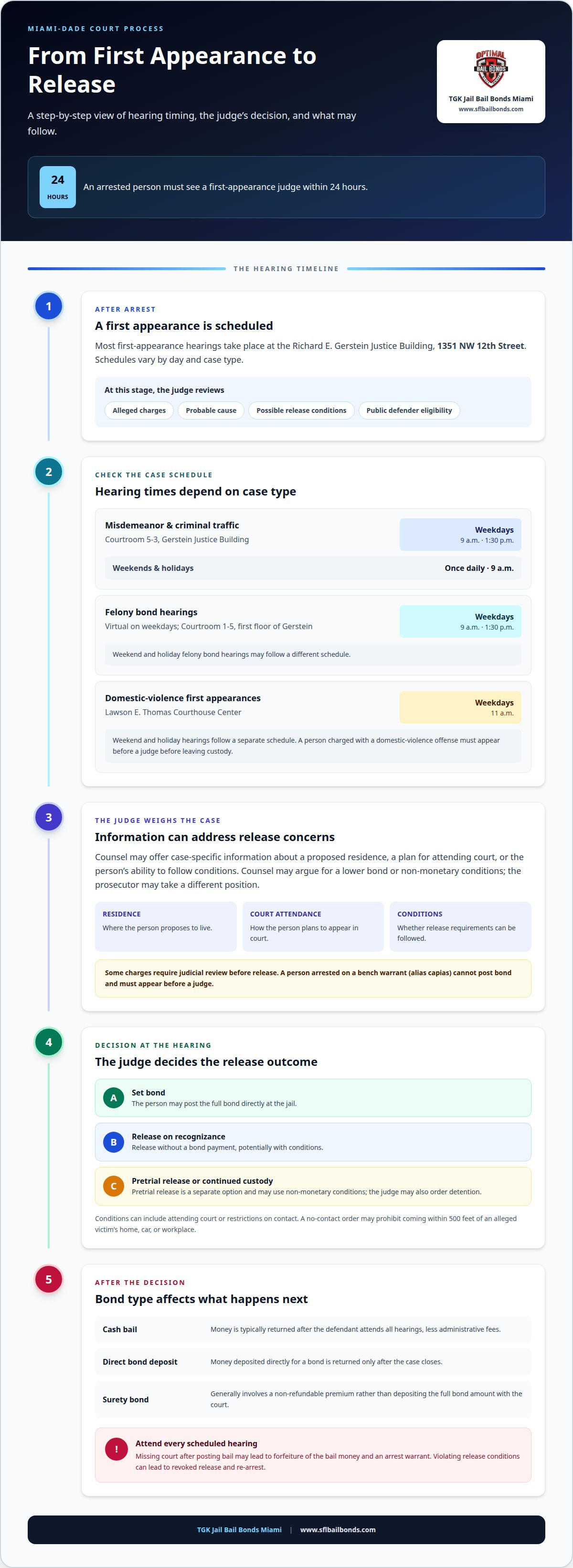
After an arrest in Miami-Dade, most first-appearance hearings take place at the Richard E. Gerstein Justice Building, 1351 NW 12th Street. First-appearance schedules can vary by day and case type. A judge reviews the alleged charges, probable cause, possible release conditions, and whether an eligible person qualifies for a public defender.
Domestic-violence cases follow a different schedule. On weekdays, first appearances for domestic-violence cases take place at 11 a.m. at the Lawson E. Thomas Courthouse Center. Weekend and holiday domestic-violence bond hearings follow a separate schedule. A person charged with a domestic-violence offense must appear before a judge before leaving custody.
Miami-Dade felony bond hearings are conducted virtually on weekdays at 9 a.m. and 1:30 p.m. The weekday hearings are held in Courtroom 1-5 on the first floor of the Gerstein building. Weekend and holiday felony bond hearings may be scheduled differently from weekday hearings. These schedules help explain where a felony appearance hearing occurs, but the judge still decides the release outcome.
At first appearance, the judge may set bond, order release with conditions, or keep someone in custody. The person may post the full bond directly at the jail. Alternatively, the judge may release them on recognizance, meaning without a bond payment, potentially with conditions. Pretrial release is a separate option. Miami-Dade Pretrial Services is relevant to understanding this local process, which may involve non-monetary conditions instead of a cash bond.
Conditions depend on the case. They can include requirements such as attending court or restrictions on contact. A no-contact order may prohibit coming within 500 feet of an alleged victim’s home, car, or workplace. Violating release conditions can lead to revoked release and re-arrest under §903.047, Fla. Stat. Florida’s pretrial-release rules include Fla. R. Crim. P. 3.131 and §903.046, Fla. Stat.
Some charges require judicial review before release. A person arrested on a bench warrant, also called an alias capias, cannot post bond and must appear before a judge. Florida law generally bars release before first appearance for specified charges, including capital, life, first-degree, or second-degree felonies. The judge must decide whether to set bond. Florida law also presumes release on nonmonetary conditions for many people, but not for those charged with a dangerous crime.
At the hearing, counsel can address the judge’s concerns with information specific to the case. For example, counsel may explain the proposed residence, plan for attending court, or ability to follow release conditions. Counsel may also argue that a lower bond or non-monetary conditions would address the court’s concerns. The prosecutor may take a different position. The judge weighs the circumstances and may set bond, impose conditions, or order detention.
Misdemeanor and criminal traffic bond hearing schedule
Miami-Dade misdemeanor and criminal-traffic first appearances are held in Courtroom 5-3 at the Richard E. Gerstein Justice Building. Weekday hearings take place at 9 a.m. and 1:30 p.m.; on weekends and holidays, they’re held once daily at 9 a.m.
Hearing Schedule and Timing
The schedule lists the times for misdemeanor jail arraignments and related first appearances in Miami-Dade County. Knowing the session times helps families understand when a judge may review someone’s custody and release status.
On weekdays, misdemeanor jail arraignments occur at 9 a.m. and 1:30 p.m. in Courtroom 5-3. Weekend and holiday arraignments occur once daily at 9 a.m. in the same courtroom. Misdemeanor and criminal-traffic first appearances are also held in Courtroom 5-3 at the Gerstein building. A hearing calendar is available immediately before each session, with copies outside the courtroom every day. Weekday copies are also available at the Suite 8100 information window.
Bond Schedules and Judicial Decisions
A bond schedule lists standard amounts for certain charges, but the judge can determine bond based on the case. Use the schedule as a reference, not a substitute for judicial review.
The Florida Supreme Court adopts a uniform statewide bond schedule every year, and Miami-Dade’s chief judge adopts it by administrative order. For example, the standard bond amount for a DUI arrest in Miami-Dade County is $1,000. A judge may still make a case-specific decision, considering factors such as whether the defendant may endanger the community or flee. The charge alone doesn’t explain every release decision.
Bond also affects what happens financially after the appearance. With cash bail, the depositor’s money is typically returned after the defendant attends all hearings, less administrative fees. Money deposited directly for a bond is returned only after the case closes. These are different points in the case timeline, so the return may not happen immediately after a hearing.
A surety bond works differently from a cash deposit. It generally involves a non-refundable premium paid to secure the bond, rather than depositing the full bond amount with the court. The amount and arrangement are separate from a judge’s decision about whether release is appropriate. A bond agent from Optimal Bail Bonds can explain the bond-posting process in the context of Miami bail bond information.
Missing a court appearance after posting bail can have serious consequences in Miami-Dade. The court may forfeit the bail money and issue an arrest warrant. Attending every scheduled hearing is central to preserving the release arrangement, whether the defendant used cash bail or a surety bond. A missed appearance can affect both the case and the bond.
Arthur hearings and pretrial detention
An Arthur hearing addresses whether a defendant facing serious charges may be released before trial. In Miami-Dade, the judge considers whether release conditions can address concerns raised by the case or whether pretrial detention is appropriate. The hearing is separate from deciding guilt. A warrant or arrest begins the custody process, but detention decisions require judicial review.
Pretrial detention is not simply a higher bond amount. It asks the court to decide whether the person should remain in custody while the case proceeds. Florida rules identify particular crimes relevant to detention, including manufacturing controlled substances in violation of Chapter 893, Florida Statutes. The charge matters, but the hearing focuses on the legal basis for detention and the circumstances presented to the judge.
Timing is important. In Florida, a defendant may be detained for no more than 24 hours without an order from the state attorney legally mandating pretrial detention. When a detention motion is required, the hearing must occur within 5 days after first appearance. If the state attorney files the motion on its own, the hearing must occur within 5 days of that filing.
The parties may seek limited additional time. A defendant may request a continuance, which generally cannot exceed 5 days. The state attorney is entitled to one continuance for good cause. After the hearing, the court must issue its detention order in writing or orally on the record within 24 hours. These deadlines help define the steps between an initial appearance and a detention decision.
At the hearing, the prosecutor presents the basis for detention, while the defense attorney responds to the charges and proposed custody decision. A lawyer can explain the person’s circumstances and why release conditions may address the court’s concerns. The judge then decides whether to order detention or allow release under conditions. The Eighth Amendment prohibits excessive bail, but that protection does not itself determine the outcome of a detention hearing.
Witnesses may be relevant when their accounts relate to the allegations or arguments before the court. Their role depends on what the parties present and what the judge needs to decide. This is not a full trial: the judge decides pretrial custody, not whether the defendant is guilty. Someone in custody should speak with a lawyer about the charges and hearing process, and avoid discussing the case with potential witnesses.
For families, the practical distinction is clear: posting a bond is possible only when the court authorizes release on that basis. If the judge orders pretrial detention, paying a bond does not replace that order. The court’s written or recorded decision within 24 hours of the detention hearing explains whether the person remains held or may be released under specified conditions.
Evidence and testimony at a detention hearing
A detention hearing focuses on whether a person should remain in custody before trial. The judge’s decision turns on information connected to the detention request, not on a final finding of guilt. Under Fla. Stat. § 903.046(2), judges consider bond factors that include whether the defendant may endanger the community or flee. Evidence and testimony help explain those concerns.
The prosecutor can present information supporting detention, while the defense can respond with evidence supporting release. For example, a claim that someone poses a danger is more specific when tied to alleged conduct. A lawyer can explain what the available record shows, identify disputed details, and connect proposed release conditions to the concerns raised.
Witness testimony can describe events, but the hearing remains focused on pretrial custody. A witness’s account of an alleged incident might relate to a claimed risk to the victim or community. The defense can address what that account does and does not establish about the need for detention. The judge evaluates the information presented to decide custody.
A defendant’s record can provide context for arguments about release and court attendance. Counsel can distinguish the current charges from prior events and explain the proposed plan for complying with court requirements. For instance, a specific residence and support from someone responsible for helping the defendant comply can make a release proposal concrete. The prosecutor can challenge whether that plan addresses the stated concerns.
Specific, relevant details matter more than broad assurances. If the prosecutor argues that release creates a safety concern, the defense can address it directly and explain possible conditions. If the concern is failure to appear, counsel can describe practical arrangements for attending hearings. The judge’s decision reflects the evidence and arguments related to those issues.
Information involving a victim or witnesses requires care. Contact restrictions can form part of release conditions, and a no-contact order can bar someone from coming within 500 feet of an alleged victim’s home, car, or workplace. A detention argument should distinguish the need to protect a person from assumptions that do not address the particular case.
Financial information can also matter to a bond decision. Florida law directs judges setting bond to consider the source of the money used to post it. This is separate from testimony about danger or court attendance. A bail bondsman can help with posting an authorized bond, but cannot decide detention or replace the judge’s review of evidence.
After hearing the parties, the judge decides whether detention or release conditions are appropriate. The ruling concerns custody while the criminal case proceeds, not guilt or innocence. A lawyer can explain how the decision applies to the specific charges and what conditions follow. Knowing the distinction helps families focus on the court’s immediate decision.
Out-of-state defendants and flight-risk concerns
An out-of-state address can raise questions about whether a defendant will return for court, but location alone does not explain the full risk. In Miami-Dade, judges consider whether a defendant may flee or endanger the community when setting bond. Travel history can provide context, especially when counsel explains how the person will attend required court dates.
The key is how the information presented relates to the risk the court must assess. A history of frequent travel, for example, might prompt questions about availability, but does not by itself establish an intention to leave. Counsel can clarify the purpose and timing of travel, then explain how the defendant plans to attend court and follow release conditions.
Under Fla. Stat. § 903.046(2), judges consider bond factors that include whether a defendant may flee or pose danger to the community. The court can also consider the seriousness of the alleged offense. Those factors guide a case-specific decision; an out-of-state residence doesn’t replace the judge’s review of the charges and circumstances.
A clear release proposal can address practical concerns. Counsel might present a stable place to stay in Florida, explain arrangements for appearing in court, and identify how the defendant will follow restrictions. If the person expects to travel, counsel can address that directly rather than leave the court to draw conclusions from incomplete information.
Travel details should be accurate and specific. A planned trip, a pattern of past travel, and an intention to relocate are different circumstances. Counsel can explain which applies and how it relates to court attendance. The prosecutor may argue that particular facts indicate flight risk or danger, and the judge weighs those arguments against the proposed release plan.
Release conditions can address concerns without relying only on a higher monetary bond. Depending on the judge’s decision, conditions may limit travel or require the defendant to follow other court-ordered restrictions. A defendant released with conditions must comply with them; violating release conditions can lead to revocation and re-arrest under §903.047, Fla. Stat.
Families can help counsel communicate clearly by sharing accurate details, including the defendant’s current residence and known travel plans. They should not contact witnesses or the alleged victim about the case. For a serious offense, counsel can explain how concerns about flight risk and community safety relate to the proposed release terms.
Optimal Bail Bonds: Bail Bonds Miami
Optimal Bail Bonds provides Bail Bonds Miami and information about TGK Jail for people dealing with a local arrest or an authorized bond. A bail bondsman can assist with the bond process after the court sets release terms; only the court decides whether someone may be released and what conditions apply. If the judge orders pretrial detention, posting a bond does not override that decision. Understanding the distinction can help families see when bond assistance is relevant and when the immediate issue remains a court decision.
For questions about bail bonds or TGK Jail, contact Optimal Bail Bonds.
Take the Next Step With Clarity
A court’s release decision can leave families weighing practical choices under pressure. Focus on the next steps: understand the judge’s conditions, follow every court requirement, and seek guidance that fits the situation. The bail hearing process in Miami-Dade courts can be difficult to navigate, but knowing which decisions belong to the court clarifies where bond assistance may help.
For readers interested in the bail-bonding profession rather than help with a current arrest, Optimal Bail Bonds also offers a Pre-Licensing Bail Bonds Class, a 120 Hours Bail Bonds Course, and How to be a Bail Bondsman. These educational options serve a different purpose from assistance with an active bond matter.
Choose the next step that fits your situation, and move forward with a clearer understanding of what comes next.
Frequently Asked Questions
What Is Bail?
Bail is a court-approved way for a defendant to be released from custody while a criminal case continues. Depending on the judge’s decision, release may involve money, conditions without payment, or another arrangement. Bail is not a finding of guilt or a punishment. A person released before trial, for example, must still attend court and follow every condition set by the judge.
How Long Does It Take?
After bond is posted following a Miami-Dade first appearance, release commonly occurs the same day, but jail processing can add hours. Posting bond does not mean the person walks out immediately. The jail must complete its release procedures, and other holds or court orders may affect the process. The hearing’s result and completion of processing are separate steps, so families may need to account for both.
How long can you be held after an arrest in Miami?
In Miami-Dade, an arrested person must be brought before a first-appearance judge within 24 hours. A separate rule applies to probable-cause review after an arrest without a warrant: the review generally must happen promptly and within 48 hours. These are different judicial requirements, not a guarantee of release by either deadline. A judge may order release, set conditions, or keep the person in custody.
What happens if I'm arrested?
After an arrest, the person is taken into custody, and the alleged charges enter the court process. They should remain silent about the incident and ask for a lawyer. At first appearance, the judge reviews the charges and probable cause, then addresses release conditions. For example, a person should avoid discussing case details over recorded jail calls because those conversations may become part of the case record.
What is first appearance?
First appearance is an early court hearing where a judge reviews a person’s custody after arrest. It is not a trial and does not decide guilt. The judge addresses the alleged charges, probable cause, release terms, and appointment of a public defender when the person is eligible. The hearing allows the court to make an initial decision about custody and conditions.
How does the bail hearing process work in Miami-Dade County courts?
After an arrest, the person appears before a judge, who reviews the alleged charges and probable cause. The judge then decides whether to set bond, release the person under conditions, or continue detention. For example, a defendant may be released without a monetary bond but still face travel or contact restrictions. A bond hearing addresses release, not the final outcome of the criminal case.
What factors do Miami-Dade judges consider when setting bail?
Under Fla. Stat. § 903.046(2), judges consider factors that include whether the defendant may endanger the community or flee. The seriousness of the alleged offense can also affect the court’s assessment. For example, the judge may weigh the risk of missing court against whether proposed release conditions address that concern. The bond amount and conditions depend on the judge’s review of the circumstances presented.
How can someone find the bond amount and charges for a Miami-Dade arrest?
Start with the person’s arrest and court information, then compare any listed bond amount with the judge’s latest order. A bond schedule is a reference, but a judge may set a different amount or impose non-monetary conditions. Miami-Dade hearing calendars are available immediately before sessions; felony bond calendar copies are available at the first-floor security desk. A calendar identifies hearing information, not necessarily the final release decision.


