
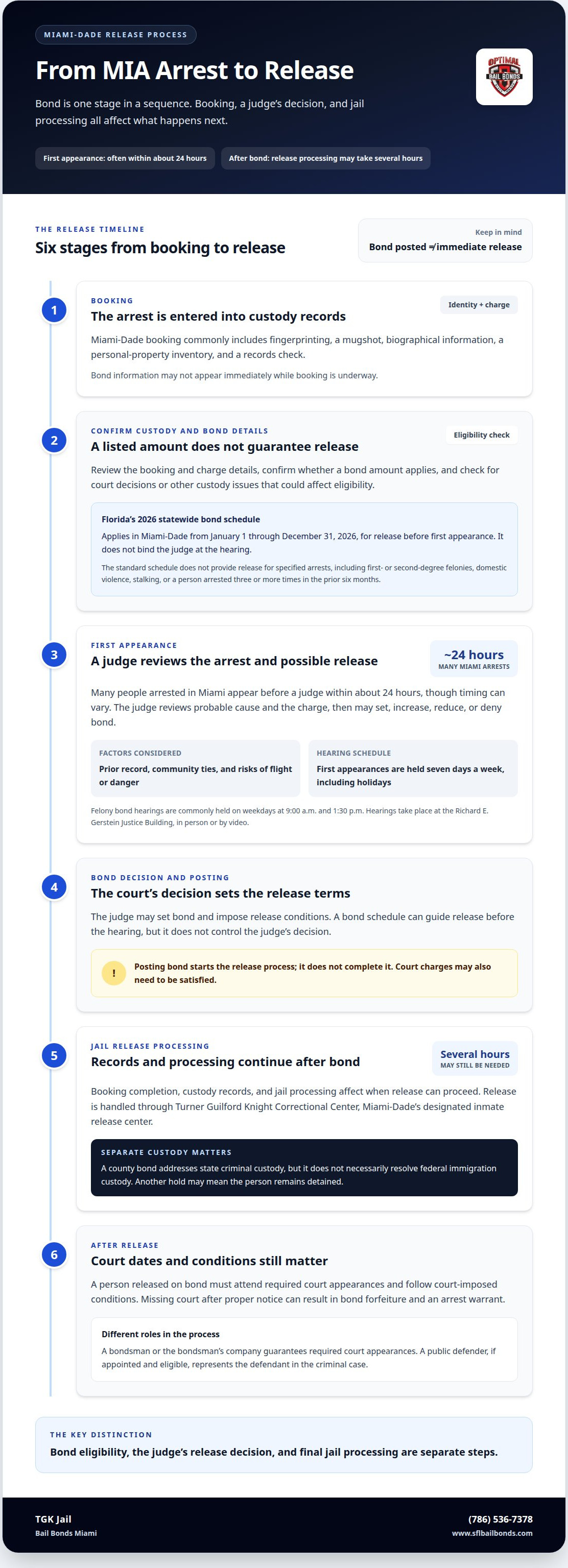
Posting bond doesn’t necessarily mean immediate release. Bail release procedures for arrests at Miami International Airport can involve a first-appearance hearing, a judge’s decision on bail and release conditions, and separate jail processing. Many people arrested in Miami appear before a judge within about 24 hours, though timing can vary.
It’s understandable to want a clear answer about how long release will take. The timeline depends on more than the bond amount: booking must progress, a judge may set conditions or deny bond, and release processing can continue after bond is posted. A first appearance addresses issues such as probable cause and release, not guilt at trial.
This guide explains what happens from booking through release, how a Miami-Dade first appearance affects bail decisions, and what conditions may apply. It covers how to confirm custody and booking details, why posting bond may not lead to immediate release, and how bond processing fits into the timeline. Understanding these steps can help you see what may be happening and what comes next.
Key Takeaways
- Bond being posted doesn’t mean release is immediate; booking, other holds, and jail processing can affect the timeline.
- At first appearance, the judge considers the charge and relevant risk factors before setting bail or release conditions.
- Confirming booking and custody details helps clarify whether bond information and release processing are ready to move forward.
- Cash and surety bonds work differently, so understanding how each is processed can help you anticipate the next steps.
- Release conditions remain important after someone leaves custody, including attending required court dates and following any court-imposed terms.
What Happens After the Bond Is Posted?
Posting bond starts the release process, but it doesn’t complete it. In Miami-Dade, jail processing can continue for several hours.
Bond Information and Release Eligibility
A bail professional reviews the booking and charge details, then confirms whether a bond amount and release process apply. Bond information may not appear immediately while booking is underway. Reviewing the charge and available bond information can also reveal whether a court decision or another custody issue affects release eligibility. A listed amount alone doesn’t mean release can proceed.
Florida’s 2026 statewide bond schedule applies in Miami-Dade from January 1, 2026, through December 31, 2026. It sets bond amounts for release before first appearance, but it doesn’t bind the judge at that hearing. Florida law bars release under the standard schedule for specified arrests, including first- or second-degree felonies, domestic violence, and stalking. The bar also covers a person arrested three or more times in the prior six months. In those situations, the scheduled amount does not create an automatic route to release.
Initial Appearance and Bond Deadlines
Initial appearance is a hearing where a judge reviews the arrest and makes early release decisions. Many people arrested in Miami appear before a judge within about 24 hours, although timing can vary. The hearing matters because the judge can set, increase, reduce, or deny bond, and can impose release conditions. The statewide schedule may guide release before this hearing, but it doesn’t control the judge’s decision there.
After bond is posted or court charges are satisfied, release may still take several hours in Miami-Dade. Booking completion, custody records, and jail processing all affect the next steps. Release is handled through Turner Guilford Knight Correctional Center, Miami-Dade’s designated inmate release center. A posted bond is an important stage, not a precise estimate of release time.
Airport arrests can also involve immigration detention. A county bond addresses state criminal custody, but it does not necessarily resolve federal immigration custody. A person may meet the county bond requirements and still be detained in a separate federal immigration matter. Bond eligibility for a Miami-Dade charge does not confirm that every hold has ended.
A plea or guilty verdict can change the bond picture before sentencing. Effective July 1, 2026, Florida law requires a court to remand a person to custody without bond after a guilty or no-contest plea, or a guilty verdict, for a dangerous crime while sentencing is pending. Missy’s Law applies even if the person intends to appeal. This is different from ordinary pretrial release: the case has reached a plea or verdict, and the court must address custody while awaiting sentence.
Miami-Dade first appearance and bail-setting procedures
After an airport arrest, booking and the first court appearance shape what happens next. In Miami-Dade, a judge reviews probable cause, considers release, and may set bond or other conditions. Understanding the bail release procedures for arrests at Miami International Airport means recognizing that the arrest record, court review, and bond decision are distinct parts of the process.
Booking records identify the person arrested and the pending criminal charge. Miami-Dade booking commonly includes fingerprinting, a mugshot, biographical information, a personal-property inventory, and a records check. These details link the arrest record to the correct person and charge before the court considers release.
At first appearance, the judge reviews the charge and probable cause, then decides whether release is appropriate. The judge may consider prior record, community ties, and risks of flight or danger. A bond schedule can inform release before the hearing, but it does not bind the judge. The judge may set, increase, reduce, or deny bond. These decisions are central to the bail release procedures for arrests at Miami International Airport because the schedule alone cannot guarantee release.
Miami-Dade holds first-appearance hearings seven days a week, including holidays, at the Richard E. Gerstein Justice Building, in person or by video. The judge typically addresses the alleged charge, probable cause, release conditions, and appointment of a public defender if the defendant is eligible. Felony bond hearings are commonly held on weekdays at 9:00 a.m. and 1:30 p.m.
At Miami International Airport, the Transportation Security Administration (TSA) handles security screening and does not typically make arrests. If screening reveals suspected illegal activity, TSA usually refers the matter to law enforcement. The agency involved can depend on the allegations and whether the case proceeds federally or under Florida law.
A person released on bond must attend required court appearances. Missing court after proper notice can result in bond forfeiture and an arrest warrant. If someone misses court after returning home, an out-of-state defendant may also face potential extradition.
A bondsman or the bondsman’s company guarantees the defendant’s required court appearances until the case is resolved. A public defender has a different role: at first appearance, the judge may appoint one if the person is eligible. The defense addresses the criminal case, while the bondsman handles the bond arrangement and its appearance guarantee.
These roles matter after an MIA arrest because bond processing and defense are separate parts of the case. A Miami-Dade bondsman can assist with a surety bond, while a public defender may provide representation to an eligible defendant. For help with the bond process, see Bail Bonds Miami.
Does posting bond guarantee immediate release?
No. Posting a cash or surety bond meets the financial requirement, but booking and jail processing still have to be completed. Separate holds, another case, or incomplete records can delay release after a bond is accepted. A lawyer may address legal issues, while bond processing covers a separate part of the case.
A cash bond means paying the full bond amount directly to the court. In Miami-Dade, someone who pays the full amount directly may receive the money back only after the case closes. Cash bail is typically returned, minus administrative fees, when the defendant attends all hearings. Because the money remains tied to the case, the payer should understand that it may not be returned immediately after release.
A surety bond works differently. A licensed bail bond agent posts the bond for a fee, rather than the defendant paying the full amount directly to the court. The premium is separate from the bond amount and is not refundable when the case ends. Additional permitted charges or collateral requirements may apply to a Florida state surety bond, depending on the circumstances. Property may be used as collateral, but requirements depend on the bond arrangement.
At Turner Guilford Knight Correctional Center (TGK), a bondsman can post a surety bond after confirming the bond information and release eligibility. The jail then continues its processing; posting the bond does not release the person immediately. When someone is in booking, it is important to distinguish the bond process from the jail’s release process.
The cost structure also differs. With a cash bond, the payer provides the full amount and may recover it after the case closes, subject to applicable administrative fees and court appearances. With a surety bond, the bondsman’s premium pays for the bond service and is not returned when the case ends. A surety bond’s price depends on the case and is provided after a quote request; the bond amount and any collateral requirements affect the arrangement.
Before choosing a route, the person arranging release should know whether the judge has set bond and whether another hold exists. A bond schedule may not settle the issue if a judge must first decide release eligibility. Even after payment or a surety bond posting, processing continues. A lawyer can address legal questions about the charge or court conditions, but a bail bond does not replace legal representation.
The practical takeaway is simple: paying or posting bond meets one requirement, not every one. Release timing still depends on the booking record, accepted bond, other custody matters, and completion of jail processing.
Confirming booking details and custody location
After an airport arrest, confirming the correct custody record helps clarify which booking and bond details apply. In Miami-Dade, booking can take several hours, depending on intake volume and individual circumstances. During that time, a search may not show complete bond information. A delay in finding a record does not by itself determine whether someone is eligible for release.
Miami-Dade booking commonly includes fingerprinting, a mugshot, collection of biographical information, a personal-property inventory, and a records check. These steps create the information used to identify the person and connect the arrest with the relevant case. The property inventory is separate from the bond amount and release decision. People in booking may have access to phone calls.
Miami-Dade’s inmate search requires at least three characters in both the first-name and last-name fields. Entering too few characters in either field won’t meet that search requirement. If a record hasn’t appeared, booking may still be underway, or the available details may not yet match the search. Miami-Dade Corrections lists 786-263-7000 as its county inmate-information phone number, according to the Miami-Dade Corrections and Rehabilitation Department.
The custody location also matters. Miami-Dade County identifies Turner Guilford Knight Correctional Center (TGK) as its designated inmate release center. Inmate release hours are listed as 6 a.m. to 9 p.m., according to the Miami-Dade Corrections and Rehabilitation Department. Knowing TGK is the release center helps distinguish where someone is booked from where release processing takes place.
When a bondsman reviews a case, accurate booking details help link the person, charge, and bond information. A bond amount may not be available immediately while intake continues, so posting arrangements depend on the custody record. A bond reduction requires a court decision, not a change to the jail’s booking record. The custody search shows where someone is held; it does not authorize release.
Once booking is complete, confirm the person’s identity and custody record before relying on a bond amount or release status. If the search returns no match, check the three-character minimum for each name field. If booking is still underway, later records may provide a clearer picture. Release still involves processing at the designated center after the applicable bond or court requirements are met.
Setting bail and release conditions
In Miami-Dade County, a judge decides whether release requires money, supervision, or specific conditions. The decision weighs the charge, prior record, community ties, and risks of flight or danger. A bond schedule can provide an initial amount, but it doesn’t prevent the judge from adjusting bail or choosing non-monetary release.
Florida’s pretrial-release rules are cited as Fla. R. Crim. P. 3.131 and §903.046, Fla. Stat. The judge considers these release factors at the hearing, rather than treating the charge alone as the answer. For example, strong local ties and a limited record differ from circumstances suggesting a person might leave the area or pose a danger. The court’s decision sets the conditions that govern release.
Release without paying money is possible. A Miami judge may release a person on recognizance, often with conditions, while Miami pretrial release programs may use supervision instead of a higher bond. Conditions can include regular check-ins, testing, travel restrictions, or electronic monitoring. These requirements are separate from the bond amount. A person released under supervision must follow each court-imposed condition.
The practical distinction is between paying to secure release and complying with court conditions afterward. A cash bond is paid in full, while a surety bond uses a bail bond agent. Non-monetary release can avoid a financial bond but still impose supervision. Florida pretrial-release eligibility and conditions depend on risk factors and the judge’s decision under Fla. R. Crim. P. 3.131 and §903.047, Fla. Stat.
For someone arrested at Miami International Airport, out-of-state ties can factor into the court’s assessment of flight risk. A judge may impose stricter conditions, such as passport surrender or electronic monitoring. Federal custody is separate: a county bond does not necessarily resolve federal immigration custody. State criminal release and federal immigration detention involve different matters, so resolving one does not end the other.
If the bond amount creates a barrier, a reduction or modification can be requested later under Fla. R. Crim. P. 3.131. The judge considers the release factors and the circumstances presented, rather than treating a schedule amount as fixed. Criminal defense counsel addresses legal arguments about the charge and release terms; a bondsman handles the bond transaction, not legal representation. The key takeaway: compare both the financial requirement and every release condition before planning for someone’s return.
Optimal Bail Bonds: Bail Bonds Miami
Optimal Bail Bonds provides Bail Bonds Miami for people seeking help with the bond process after an arrest. For someone held at TGK Jail, a bondsman can help with the surety-bond process once bond information and release eligibility are established. Bond posting is separate from court decisions and jail release processing, so it does not replace those steps.
After an airport arrest, this support can help clarify the bond process while a family member navigates uncertainty about custody and release. Bail bond services do not replace criminal defense or resolve separate federal immigration custody. Knowing what a bondsman can assist with helps set clear expectations and focus on the next step.
For help with a Miami bond, contact Optimal Bail Bonds.
Take the Next Step With Confidence
After an airport arrest, focus first on the immediate need: understanding the bond process and who can help. The bail release procedures for arrests at Miami International Airport may involve separate questions about bond, court requirements, and other custody matters. Keeping those issues distinct can make the next conversation more focused. Direct legal questions to a lawyer.
For readers exploring a career in the bail bond field instead, Optimal Bail Bonds offers a Pre-Licensing Bail Bonds Class, a 120 Hours Bail Bonds Course, and How to be a Bail Bondsman. These educational offerings address professional learning, not release from an active arrest. Identifying whether you need bond assistance now or career information later helps you choose a relevant next step.
For support with the bond process, reach out when you’re ready to discuss the situation.
Frequently Asked Questions
How Long Until They Are Released?
Release can take several hours after bond is posted or court charges are satisfied. The wait depends on whether booking is complete, release paperwork has been processed, and another custody hold exists. For example, someone whose bond is accepted may still wait while jail staff finish processing. In a Miami airport arrest, the bond transaction and the jail’s release work are separate stages.
Will I get a bond automatically?
No. Bond is not automatic for every arrest in Miami-Dade County. After considering the charge, prior record, community ties, and risks of flight or danger, a judge may set, raise, lower, or deny bond. Some eligible defendants may instead be released on recognizance or through supervised pretrial release. An arrest alone does not establish the person’s release terms.
Can someone be denied a standard bond release even for a lower-level charge?
Yes. Florida law bars release under the standard bond schedule for specified arrests, including domestic violence, stalking, and first- or second-degree felonies. It also applies to a person arrested three or more times in the prior six months. As a result, a lower-level charge may not qualify for schedule-based release if the arrest history triggers the restriction. The court must address eligibility through the applicable process.
Where are people booked after being arrested at Miami International Airport?
People arrested at Miami International Airport may be transferred into Miami-Dade custody and booked at the facility handling the arrest. Turner Guilford Knight Correctional Center (TGK) is Miami-Dade County’s designated inmate release center, though booking and release are distinct functions. TSA handles security screening, while suspected illegal activity is usually referred to law enforcement. The agency and custody path depend on the allegations and circumstances of the case.
What is the Miami-Dade County bond schedule for common criminal charges?
Florida’s 2026 statewide schedule lists a $500 bond for a first-offense DUI charged as a second-degree misdemeanor, and $750 for a second-offense DUI with that charge level. It lists $1,000 for a DUI charged as a first-degree misdemeanor. A third-degree felony involving force or threat of force has a $5,000 bond; one without force has a $2,500 bond. The judge isn’t bound by the schedule at first appearance.
How does first appearance and bond setting work in Miami-Dade County?
Many people arrested in Miami appear before a judge within about 24 hours, though timing varies. At first appearance, the judge reviews the charge and probable cause, then considers bond and release conditions. Miami-Dade holds first-appearance hearings seven days a week, including holidays, at the Richard E. Gerstein Justice Building, in person or by video. The hearing addresses release, not a trial deciding guilt.
What payment methods and fees are accepted for posting bond in Miami-Dade County?
A cash bond is paid in full to the court; an eligible person in Miami-Dade can pay in person through Touch-Pay at the facility. A licensed bail bond agent posts a surety bond for a separate, nonrefundable premium; permitted charges or collateral may also apply. Optimal Bail Bonds accepts checks and credit cards for its bail bond services. These payment methods are distinct from cash paid directly to the court.
How can you contact a Miami-Dade bondsman or public defender after an MIA arrest?
At first appearance, a judge may appoint a public defender if the person is eligible. A Miami-Dade bondsman can help with a surety bond. The bondsman handles the bond arrangement, while the public defender handles the criminal case.


