

A bail agreement can raise concerns when an older person feels pressured, confused, or unsure what signing means. Protecting elderly cosigners from financial exploitation in bail agreements starts with taking those concerns seriously, without assuming every family disagreement or signature is abuse.
It’s understandable to want to help someone after an arrest while protecting an older loved one’s finances. Elder financial exploitation means the illegal, unauthorized, or improper use of an older person’s money, property, or assets. Recognizing possible warning signs can help families respond calmly and promptly.
This article explains what exploitation may look like in a bail agreement, what to review before an older adult cosigns, and how to report concerns to a bank, Florida Adult Protective Services, or police. It also explains how to distinguish a troubling pattern from a situation that may simply need a clearer conversation.
Key Takeaways
- Look for patterns such as unexplained withdrawals, unpaid bills, or sudden changes in financial behavior. One warning sign alone doesn’t prove exploitation.
- Before an older adult cosigns, make sure they understand the agreement and can make the decision without pressure.
- Keep relevant records and explain specific concerns when reporting suspected exploitation.
- Learn how a bank, Florida Adult Protective Services, or local police may respond to different concerns.
- Recognize common forms of financial exploitation and understand what the term means in the context of an older adult’s assets.
1. What is Elder Financial Exploitation?
Elder financial exploitation is the illegal, unauthorized, or improper use of an older person's money, property, or assets. In a bail agreement, concern arises if someone uses pressure, deception, or unauthorized access to involve an older adult’s funds. Protecting elderly cosigners from financial exploitation in bail agreements starts with noticing changes and understanding what the document puts at risk.
Warning signs in bank accounts include large, frequent, or unexplained withdrawals. An older person who has never used an ATM but suddenly starts making withdrawals may need support. New non-sufficient-funds activity, unpaid bills, or unexplained transfers can also be concerning. One sign alone doesn’t establish exploitation, but a sudden change or pattern deserves attention.
Caregivers and relatives can watch for sudden changes in who manages accounts, missing financial documents, or transactions an older adult can’t explain. For example, an unfamiliar person may start accompanying someone to the bank or answering questions about their money. These details don’t prove abuse, but they give family members concrete reasons to ask what has changed.
Pressure around a bail bond can also be a warning sign. Watch for rushed signing, threats, withheld information, or requests for a Social Security number or account access without a clear explanation. A person who says “sign now” but won’t explain the agreement deserves careful scrutiny. If the older adult doesn’t understand the obligation or hasn’t chosen freely, pause the decision.
A cosigner’s obligations come from the signed bail agreement. It may make the cosigner responsible for specified payments or collateral under stated conditions, so read the terms instead of assuming the role is only a reference.
Federal and state protections may address financial abuse and exploitation; Florida law specifies conditions under which exploiting a person 65 years of age or older is a crime. The exact protection depends on the conduct and applicable law, so don’t assume every dispute over a bail agreement is automatically a crime.
An older cosigner could risk savings or a home if those assets are pledged as collateral and the agreement allows them to be used. Before signing, identify exactly what property is at risk and what event could trigger a claim against it.
Agreements may identify cash, property, or another asset as collateral; the document must show what is pledged. Review every payment obligation, collateral term, release condition, and signature page. Ask the signer to explain each term in their own words, and consult a financial advisor or attorney before signing anything they don’t understand.
A cosigner shouldn’t assume they can cancel a bond or immediately recover collateral after signing. Review the agreement’s cancellation and collateral-release terms, then contact the bail bond company about the steps connected to the bond’s status.
2. Reporting suspected exploitation to banks and authorities
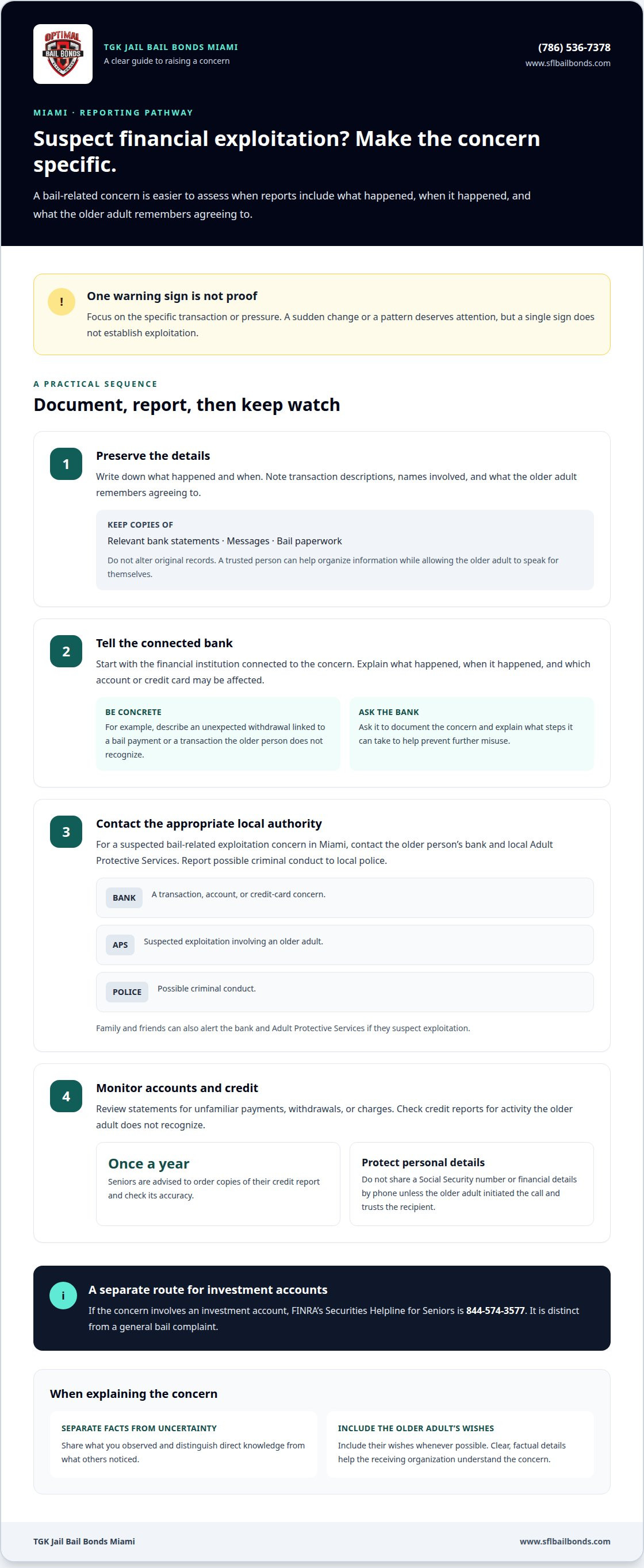
When a bail agreement raises concerns, report the specific transaction or pressure, not just a general suspicion. An older adult can contact their bank, local Adult Protective Services, or local police. Family and friends can also alert the bank and APS if they suspect exploitation.
Start with the financial institution connected to the concern. Tell a banker what happened, when it happened, and which account or credit card may be affected. For example, describe an unexpected withdrawal linked to a bail payment or a transaction the older person doesn’t recognize. Ask the bank to document the concern and explain what steps it can take to help prevent further misuse.
Preserve useful details before making a report. Record dates, transaction descriptions, names involved, and what the older adult remembers agreeing to. Keep copies of relevant bank statements, messages, and bail paperwork, and don’t alter original records. If the older person feels confused or struggles to explain their wishes, a trusted support person can help organize the information while allowing them to speak for themselves.
Monitor accounts and credit reports for activity the older adult doesn’t recognize. Review statements for unfamiliar payments, withdrawals, or charges. Seniors are advised to order copies of their credit report once a year and check its accuracy. Don’t share a Social Security number or financial details over the phone unless the older person initiated the call and trusts the recipient. A credit report can reveal unfamiliar credit activity, while account statements show transactions.
New York residents have specific reporting contacts. They can report abusive financial products or services targeting older people to the New York Department of Financial Services at 1-800-342-3736. Potential criminal conduct can be reported to the New York Attorney General’s Office at 1-800-771-7755. These contacts apply to New York, not Miami.
For a suspected bail-related exploitation concern in Miami, contact the older person’s bank and local Adult Protective Services. Report possible criminal conduct to local police. If the concern involves an investment account, FINRA’s Securities Helpline for Seniors is 844-574-3577; it is distinct from a general bail complaint.
An attorney can help the older adult understand the agreement and consider legal options. That support doesn’t replace reporting urgent suspected financial abuse to the bank or authorities. Share what you observed, distinguish direct knowledge from uncertainty, and include the older adult’s wishes whenever possible. Clear, factual details help the receiving organization understand the concern and decide what to do next.
Share what you observed, distinguishing what the older person remembers directly from what others noticed. Ask the banker what practical steps could stop the suspected misuse and help prevent it from happening again. Continue checking the older person’s credit report for activity they don’t recognize, and discuss concerns in a way that supports their own account of events. If anyone calls asking for personal or financial information, don’t provide it unless the older person initiated the call and trusts the other party. Keep the report focused on what is known.
3. Contacting banks, Adult Protective Services, and police
Choose the first contact based on the immediate risk. If money has moved from an account without permission, call the bank handling that account. If someone faces immediate danger, contact local police. For suspected elder financial exploitation in Miami, report the concern to Florida Adult Protective Services as well.
When speaking with a bank, identify the account holder and describe the specific activity. Mention the transaction date, amount, recipient, and whether the older adult authorized it. Ask the bank to record the concern and explain what steps it can take for that account. A bank can address account activity, while APS and police handle different kinds of reports.
Prepare a short timeline before calling. Include when the older adult was asked to cosign, when money or property changed hands, and when anyone noticed a problem. Statements, transfer records, messages, and a copy of the bail agreement can help explain the sequence. Separate what the older person remembers directly from what friends or relatives observed.
Friends and family can report concerns, too. Whenever possible, let the older adult’s wishes guide their involvement. A relative might say, “She found a transfer she didn’t authorize after signing the bond paperwork,” rather than assume who caused it. Clear examples help the receiving agency understand what needs attention.
When contacting APS, describe the older adult’s situation, the suspected financial activity, and any immediate safety concern. Provide the person’s location and a reliable way to follow up. If the older adult has difficulty speaking, a friend can help provide details while clarifying which information came directly from the older adult.
For police, explain why the concern may involve criminal conduct, then provide relevant records and names. Keep any report information or reference details you receive. If you contact the bank, APS, and police, note each organization and the contact date so you can direct later updates to the right place.
For elder-protection help, the practical reporting resources are the older adult’s bank, Adult Protective Services, and local police. These channels address financial or safety concerns; an attorney can separately explain the cosigner’s obligations under a bail agreement. This distinction helps families seek appropriate support without expecting one agency to handle every issue.
Ask the older adult what outcome they want before sharing personal details, unless immediate safety requires urgent action. A calm, factual report can respect their wishes while documenting the concern. For example, a friend can help organize account statements and transfer dates, then let the older adult describe the event to the bank or APS in their own words.
Older adults who suspect someone close to them is trying to take control of their finances can contact local Adult Protective Services and tell someone at their bank. Family and friends who suspect elder financial exploitation are advised to report it to the older person's bank and contact Adult Protective Services. Seniors can also report suspected financial abuse to Adult Protective Services or local police for help.
New York Adult Protective Services is available to adults aged 18 and older. New York residents can call 1-800-342-3009 and press 6 to find the telephone number for their local Adult Protective Services unit. The local-unit phone-number line is available 24 hours a day.
4. Common forms of financial exploitation
Financial exploitation can involve taking money, misusing property, or using an older adult’s assets without proper authority. Stealing or misappropriation accounted for approximately 77.8% of financial exploitation cases reported by older adults. In a bail-agreement situation, a concern might arise if someone uses an older person’s money or property without their informed permission.
Misappropriation may be direct, such as taking funds from an account, or indirect, such as using someone else’s access to move money. Consider a hypothetical case: an older adult agrees to help with a bail bond, but another person transfers additional funds without explaining why. The key question is whether the older adult authorized the activity and understood its purpose.
Property can be involved, too. For example, someone might pressure an older adult to pledge an asset while withholding what the agreement says about that property. A signature alone doesn’t show whether the person understood the document or chose freely. Review the written agreement for the asset named, the obligation attached, and the conditions that apply.
Deception can also target identity and account access. A person might ask for a Social Security number, account credentials, or a signature while concealing the request’s purpose. In a hypothetical bail-related example, someone presents paperwork as a routine form but includes a financial authorization the older adult didn’t expect. Compare the explanation with the written terms before assuming the request was understood.
Pressure is another behavior to watch for. A relative or acquaintance might insist that an older person sign immediately, discourage questions, or keep them from discussing the agreement with trusted friends. Urgency alone doesn’t prove exploitation. A pattern of pressure combined with unexplained financial activity deserves attention.
Misuse of authority can be less obvious. For instance, someone who helps manage an older adult’s finances may use that access for a purpose the older person never approved. A new power of attorney the older adult doesn’t understand is a warning sign. The document’s existence alone doesn’t establish wrongdoing; the concern is whether authority or assets are being used improperly.
Unpaid bills can show the effect of financial misuse, especially if the older adult’s usual expenses were previously handled. Other examples include sudden account changes or unfamiliar transfers. Look for connections between those changes and bail paperwork, requests, or people involved. A dated record helps distinguish a single misunderstanding from repeated conduct.
To assess a concern, preserve relevant statements and agreements, then write down who requested money or property, what they said, and what the older adult agreed to. This record helps clarify whether the issue involves authorized help, pressure, deception, or possible misappropriation. Focus on observable actions instead of making accusations before the facts are clear.
5. Definition of elder financial exploitation
Elder financial exploitation means the illegal, unauthorized, or improper use of an older person’s funds, property, or assets. Each part matters. A transaction may be unauthorized even if a relative handles the paperwork, while improper use may involve assets entrusted for a different purpose.
In a bail agreement, the central question is whether the older adult understood and freely agreed to the financial commitment. For example, someone may knowingly cosign after reviewing the document, while another person may use their information to pledge property without permission. Those situations differ in authorization and understanding.
“Illegal” points to conduct prohibited by applicable law. Florida law specifies conditions under which exploiting a person 65 years of age or older is a crime. That statement does not mean every disagreement about a bail bond qualifies as a crime; the conduct and circumstances matter.
“Unauthorized” means use without the older adult’s permission. For example, someone could move funds from an account without consent or sign the older adult’s name without authority. A valid signature on one document doesn’t automatically authorize separate transfers or other financial activity.
“Improper” can involve misuse of access or trust, even when someone initially had a legitimate role. Imagine someone helping organize bail paperwork who redirects money intended for a stated purpose. The key is to examine what the older adult authorized, what the helper did, and whether the actions matched.
A sudden financial change is a reason to ask questions, not proof by itself. Compare the transaction with the older adult’s past activity and stated wishes. For instance, unexplained checks or a new payment they can’t explain may call for a calm review of statements and paperwork.
To assess a specific concern, identify the older adult, the asset involved, the person who acted, and the permission given. Then compare that account with the agreement and transaction records. This step-by-step review helps distinguish authorized assistance from possible misuse without treating age or family disagreement as evidence of wrongdoing.
The practical takeaway is simple: focus on authorization, purpose, and the older adult’s understanding. A person may choose to help a relative with bail, but that choice should be their own. If someone used funds or property without permission, preserve the relevant document and report the specific conduct through appropriate channels.
For bail-related information, review bail bond guidance.
Optimal Bail Bonds
Optimal Bail Bonds can help people dealing with an arrest in Miami or North Miami understand their bail-related next steps, including when the situation involves TGK Jail. If an older adult is being asked to cosign, take time to understand the agreement and report suspected exploitation to the appropriate bank or authorities. Bail bond assistance and reporting financial abuse are separate needs, and one doesn’t replace the other. For families working through the arrest process, Optimal Bail Bonds offers compassionate bail bond support and handles the related paperwork and procedures.
Make the Next Decision With Care
After a stressful arrest, families may feel they need to decide everything at once. Make space for the older adult to participate without pressure. Before any future financial commitment, discuss how they want explanations and who they want beside them. That conversation can help preserve their independence while keeping relatives aligned.
Protecting elderly cosigners from financial exploitation in bail agreements also means respecting a clear “no” or a request for more time. The goal isn’t to prevent an older person from helping someone they care about. It’s to ensure their decision reflects their wishes and understanding, not urgency or someone else’s expectations. Each family can set a pace that allows for thoughtful choices.
If an arrest creates an immediate need for bail-related guidance, contact Optimal Bail Bonds with a clear account of the situation and the questions your family needs answered.
Steady, informed decisions can help your family move forward with greater confidence.
Frequently Asked Questions
What is Elder Financial Exploitation?
Elder financial exploitation is the improper, unauthorized, or illegal use of an older adult’s money, property, or other assets. In a Miami or Fort Lauderdale bail situation, concern may arise if someone uses an older person’s funds or identity for a bond-related commitment without informed permission. An older adult choosing to help a relative is not, by itself, exploitation; the circumstances and the person’s consent matter.
What federal and state laws protect older adults from financial exploitation in bail agreements?
Federal and state protections may address financial abuse and exploitation. Florida law specifies conditions under which exploiting a person aged 65 or older is a crime; the applicable protection depends on the conduct and law involved.


