
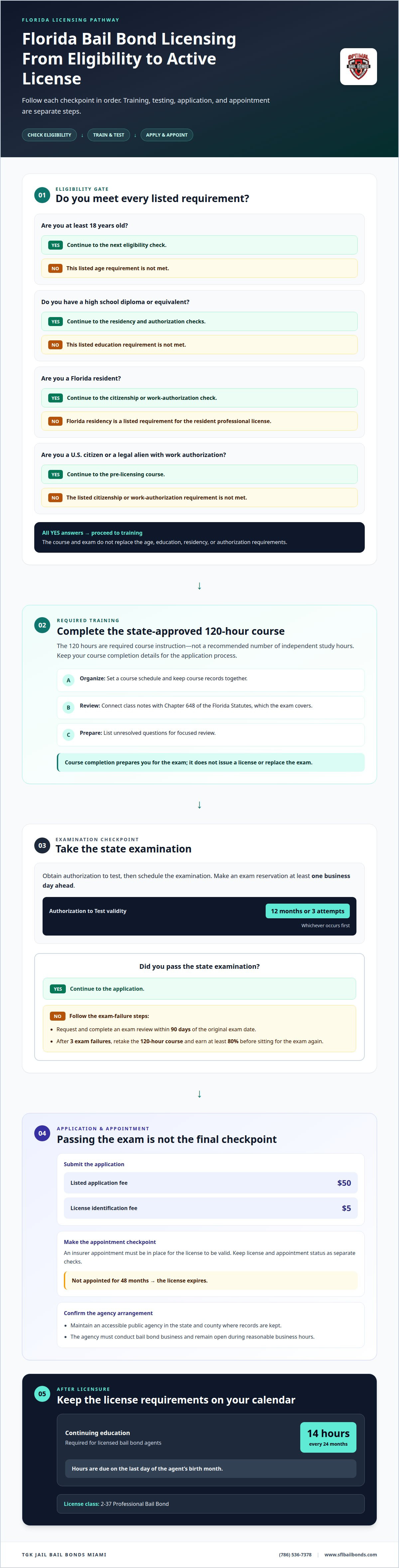
Passing the exam is one step, not the whole licensing process. Florida’s pre-licensing path begins with successfully completing a state-approved 120-hour basic certification course, which prepares you for the Florida bail bond pre-licensing exam and the requirements that follow.
It’s reasonable to focus on exam preparation, but eligibility and licensing steps matter too. Applicants must be at least 18 and have a high school diploma or equivalent; professional bail bond agent applicants must also be Florida residents and U.S. citizens or legal aliens with work authorization.
This guide explains how the course, eligibility rules, exam, and licensing process fit together. You’ll also learn how the candidate handbook’s coverage of Chapter 648 of the Florida Statutes can help you organize your study, and what happens if you need to retake the exam. With the steps in order, you can prepare with a clearer understanding of what comes before the test and what comes after it.
Key Takeaways
- Separate the exam, licensing application, and appointment into distinct steps so you can track what remains before a license is valid.
- Use the candidate handbook and content outlines to organize your study around the exam’s subject areas.
- Plan your test strategy around the 70% passing score; the Limited Surety examination has a one-hour time limit.
- If you fail the exam three times, The Florida Legislature requires you to retake the 120-hour course and earn at least 80 percent before sitting for it again.
120-Hour basic certification course
A state-approved 120-hour basic certification course is required for Florida bail bond applicants before licensing. The course is a structured preparation stage, separate from taking the state examination. Its 120 hours represent required course instruction, not a recommended number of independent study hours. Completing the training successfully is part of the pre-licensing pathway.
Keep the sequence clear: complete the approved course, then move on to the examination and licensing steps. Completing the course alone does not issue a license or replace the exam. Treat each stage as a separate milestone, and retain your course completion details for the application process. Good recordkeeping helps distinguish training requirements from later testing and licensing tasks.
Use the course period to build a consistent study routine instead of leaving review until the final days. Divide your study time into regular sessions and keep a short list of topics to revisit. Course schedules may vary, but the goal is practical: complete the required instruction and understand the material well enough to prepare for the exam.
The Florida Bail Bonds Exam covers Chapter 648 of the Florida Statutes. That gives your preparation a clear legal subject area to connect with the course and the candidate handbook. When a topic feels unfamiliar, note the term, find its place in your materials, and summarize it in plain language. Avoid relying on memorized phrases without understanding how each concept fits the licensing framework.
Course planning also means setting aside time for both instruction and review. Before starting, map your weekly commitments and identify realistic study periods. During the course, record key terms and questions as they arise. After each study session, revisit those notes and mark which topics still need attention. This approach keeps 120 hours manageable by turning a large requirement into a series of trackable steps.
A useful study sequence is:
- Organize: Set a course schedule and keep course records together.
- Review: Connect class notes with the Chapter 648 exam coverage.
- Prepare: List unresolved questions for a focused review session.
For Miami-area learners, the 120-hour bail bonds pre-licensing course is the relevant course offering. Keep the next step in view: finishing the training prepares you to move forward, while exam preparation and licensing remain distinct parts of the process. A steady plan, clear notes, and attention to Chapter 648 can help make the course more purposeful.
Florida bail bond agent licensing
Florida classifies the resident professional bail bond agent license as 2-37 Professional Bail Bond. If you fail the exam, request and complete an exam review within 90 days of the original exam date. According to The Florida Legislature, a person who fails the exam three times must retake the 120-hour course and earn at least 80 percent before sitting for it again. An Authorization to Test remains valid for 12 months or three attempts, whichever occurs first.
A valid license requires an appointment, meaning an insurer appointment must be in place for the license to be valid. If the license remains unappointed for 48 months, it expires. Licensed bail bond agents must complete 14 hours of continuing education every 24 months. The required hours are due on the last day of the agent’s birth month, so calendar that deadline alongside your appointment records.
Eligibility and business arrangements are part of the licensing process, not just paperwork to handle after the exam. Applicants must be Florida residents and U.S. citizens or legal aliens with work authorization. They must also maintain an accessible public agency in the state and county where records are kept. The agency must conduct bail bond business and remain open during reasonable business hours.
Use this sequence to keep the application stages distinct:
- Complete training and testing. Finish the required course, obtain authorization to test, and pass the state examination.
- Submit the application. The listed application fee is $50, and the license identification fee is $5.
- Arrange the appointment. A license needs an appointment to be valid, so licensing and appointment status are separate checkpoints.
Treat that fee separately from the application and identification fees; each applies to a different part of the process. An exam reservation should be made at least one business day ahead. Plan exam reservation changes or cancellations carefully, as scheduling policies may apply. These timing details matter when coordinating testing with work, travel, or course schedules.
Account for the agency requirement before considering licensure complete. The agency must be accessible to the public, located in the relevant state and county, and open during reasonable business hours. Records location and business operations therefore affect licensing arrangements, not just exam preparation.
For a clear next step in understanding the profession, explore bail bond licensing guidance alongside these application requirements.
Florida bail bondsman eligibility
Eligibility means meeting Florida’s personal qualifications before pursuing professional bail bond licensure. Applicants must be at least 18 years old and have a high school diploma or equivalent. These are separate checks: age establishes the minimum threshold, while education establishes the required academic credential. Completing the course or passing an exam doesn’t replace either qualification.
To qualify for a resident professional bail bond agent license, applicants must live in Florida. They must also be U.S. citizens or legal aliens with work authorization from U.S. Immigration and Naturalization Services. These conditions apply alongside age and education requirements; they are not alternatives. If you’re preparing an application, organize information for each eligibility category separately.
A recommendation is support from a reputable citizen who lives in a county where you propose conducting bail bond business. Florida requires recommendations from at least 3 reputable citizens residing in those counties. The county connection matters: if you propose business in Miami-Dade County, the recommendation requirement relates to citizens residing in the counties where that business is proposed. Treat recommendations as a distinct application element, not as proof of residence or education.
Use this practical eligibility review to keep the requirements clear:
- Age: Confirm that you meet the minimum age of 18.
- Education: Identify your high school diploma or equivalent credential.
- Residency: Establish that you are a Florida resident.
- Status: Meet the citizenship or work-authorization requirement.
- Recommendations: Arrange support from at least 3 qualifying citizens in the relevant counties.
Exam identification requires careful name matching: create your exam account using your legal name as it appears on government-issued ID. If the spelling or personal information is wrong, contact customer service immediately to correct it. Arrive at the test center 30 minutes before the exam. These steps help prevent a mismatch between your account details and identification on test day.
Keep the eligibility documents distinct from exam-day identification. Your diploma or equivalent supports the education requirement; government-issued ID supplies the name reference for your exam account. The research facts identify no other exam-day document category, so don’t assume that recommendations or education records replace identification. The central practical step is consistent personal information across your account and ID.
Before moving forward, make a simple record for each requirement: your age, Florida residency, education credential, citizenship or work authorization, and qualifying recommendations. That organization helps you spot an incomplete category early. For example, an applicant may meet the age and education criteria but still need recommendations from 3 reputable citizens in the counties where business is proposed. Eligibility is a set of distinct conditions, so review each one on its own.
Candidate handbook and content outlines
The candidate handbook explains exam expectations, while the content outline identifies the subject matter. Prepare by connecting those materials to Chapter 648 of the Florida Statutes, the exam’s stated coverage.
Exam Format and Scoring
The exam format describes the question style and score needed to pass. The Florida Bail Bonds Exam typically has 60 multiple-choice questions, and its passing score is 70%. That means candidates need to understand each concept, not just recognize legal terms. Use the handbook to match study topics with the exam’s stated scope.
Turn each outline topic into a prompt, then explain the answer without looking at your notes. Revisit any answer you can’t support with a clear explanation. This approach helps identify knowledge gaps before test day and keeps review focused on the material covered by the exam.
Exam Time Limit
The exam time limit is the period candidates have to complete a specific examination. The Florida Bail Bond Limited Surety examination has a one-hour time limit. That limit applies to the Limited Surety examination, so don’t assume every bail bond exam has the same duration.
Use timed review to practise making decisions without rushing through every question. Answer a set of multiple-choice questions, then review both correct and incorrect responses. Pay attention to wording that changes a question’s meaning. A steady pace leaves room to read carefully and reconsider an answer when needed.
Preparation and Practice Tests
Exam preparation is the planned review of required topics before testing. Start with the candidate handbook and outline, then study Chapter 648, which the Florida Bail Bonds Exam covers. Practice questions can help you check recall, but build them from the course and handbook topics rather than treating them as a replacement for those materials.
Organize your review by topic. After each study session, write a short explanation of the key idea and create a question that tests it. Return to topics that remain difficult, and use the outline to keep your review anchored to exam coverage. This approach gives practice a clear purpose without relying on unsupported promises about a separate practice-test resource.
For the Florida bail bond pre-licensing exam, use the handbook to guide your study and the outline to track coverage. A focused routine can combine topic review, self-testing, and careful reading of multiple-choice questions.
Planning the administrative steps alongside study can help keep preparation orderly. Florida bail bond candidates should make an exam reservation at least one (1) business day in advance. Treat that reservation as a separate task from reviewing the handbook and outline, and check that the information you provide is accurate before completing the process. Setting aside time for these arrangements can help keep them from interrupting your study routine.
Florida bail bond exam candidates should create their web account using their legal name as it appears on government-issued ID. Enter the spelling and name format shown on that ID. Keeping these tasks on your preparation checklist can prevent avoidable confusion and leave more time to study the exam’s subject matter. Once these steps are complete, return to the outline and compare each topic with your notes and explanations.
What is the Florida bail bond licensing exam format, passing score, and time limit?
The Florida bail bond licensing exam is a state examination applicants must pass as part of licensing. The Florida Bail Bonds Exam typically contains 60 multiple-choice questions, and the passing score is 70%. The Limited Surety examination has a one-hour time limit. These details help you plan both your answer strategy and your test-day schedule.
Multiple-choice format means selecting the best answer from the options provided for each question. Read the complete question before choosing, especially when it asks about a specific condition or exception. A familiar term may appear in several answer choices, so identify what the question actually tests. With 60 questions, steady reading matters as much as recalling course material.
The passing score is the minimum result needed to pass the examination. For this exam, the stated passing score is 70%. Use that threshold to set a practical goal during study, but avoid treating any single practice session as a prediction of your official result. Review questions you miss and identify whether the difficulty came from unfamiliar content, rushed reading, or confusion between similar terms.
The time limit is the allotted period for completing a particular examination. The Florida Bail Bond Limited Surety examination allows one hour. Keep this qualification clear: that limit is for the Limited Surety examination, not a stated duration for every bail bond exam. A useful preparation step is to practise reading and answering questions at a measured pace, without sacrificing careful review.
Registration and arrival require their own planning. Make an exam reservation at least one business day ahead. Arrive at the test center 30 minutes before your scheduled exam. If you need to change or cancel, the reservation must remain unchanged for at least 48 hours beforehand. Build these steps into your calendar so logistics don’t crowd out your final review.
Use your legal name as it appears on government-issued ID when creating the exam account. If your name or personal information is incorrect, contact customer service promptly to correct it. This keeps your account details aligned with your identification. Before leaving for the test center, confirm your reservation details and allow time for the required early arrival.
The Florida examination is given by the state Department of Financial Services. Keep exam preparation focused on the candidate handbook and Chapter 648 coverage, then use practice questions to check understanding. On test day, read every option before selecting an answer, watch the clock during the Limited Surety examination, and reserve time to review responses.
TGK Jail Bail Bonds Miami
If you’re looking for bail bond assistance in Miami, TGK Jail Bail Bonds Miami can help you explore your options. Its bail bond services are focused on helping people navigate the bail process and understand the steps involved. Contact TGK Jail Bail Bonds Miami to discuss your situation and learn more about available assistance.
Use this guide to identify your next step, whether that means seeking help with bail or learning more about the process. Each situation is different, and speaking with TGK Jail Bail Bonds Miami can help you understand how to proceed.
Take Your Next Step Toward a Bail Bonds Career
Preparing for the Florida bail bond pre-licensing exam can be the beginning of a professional path, not just a testing milestone. Focus on building sound study habits and understanding the responsibilities involved in bail bond work. Consistent preparation can help you approach the next stage with purpose.
TGK Jail Bail Bonds Miami provides bail bond services and can help you explore the profession. Whether you’re preparing for training or learning about bail bonds, take time to understand the process and the responsibilities involved. Choose the direction that fits where you are in the process, including 120 hours of study if that is part of your preparation.
Move forward one thoughtful step at a time. Preparation can help you approach this career path with greater clarity.
Frequently Asked Questions
What are the eligibility requirements for a Florida bail bond agent license?
Applicants must meet Florida’s age, education, residency, and status requirements. For example, a prospective applicant must be at least 18, have a high school diploma or equivalent, and be a Florida resident. Applicants must also be U.S. citizens or legal aliens with work authorization. At least 3 reputable citizens residing in the counties where the applicant proposes business must provide recommendations.
How many hours of pre-licensing education are required for Florida bail bond agents?
Florida requires applicants to successfully complete a state-approved 120-hour basic certification course. This is required course instruction, not a substitute for the state exam. Keep the course completion record with your licensing materials, so you can distinguish proof of training from exam results and application documents. For someone balancing work or family commitments, planning course sessions ahead can make the required instruction easier to manage.
What topics are covered in the Florida bail bond pre-licensing course?
The Florida Bail Bonds Exam covers Chapter 648 of the Florida Statutes, so use that chapter as the central reference point for organizing course review. The candidate handbook and course materials can help connect individual lessons to the exam’s stated coverage. For instance, keep notes by topic and mark which class material explains each point. This makes it easier to revisit a specific subject instead of rereading every lesson.
What steps follow passing the Florida bail bond exam to get licensed?
After passing, submit the license application and complete the appointment step, because an appointment is required for the professional bail bond agent license to be valid. Keep your exam result and application information organized as you move between these stages. The license is classified as 2-37 Professional Bail Bond. In Miami, applicants should also account for the required public agency and records location when planning their business setup.


