

Being out on bail in Florida doesn’t automatically mean you can travel out of state. Travel restrictions and out-of-state travel rules while on bail in Florida depend on the conditions of your release. If those conditions require court approval, get it before traveling. Even a routine trip can cause problems if it conflicts with a restriction.
It’s understandable to want a clear answer before making plans. Travel may be allowed, but don’t assume you have permission. A formal request should explain where you’re going, when, and why. Wait for approval before traveling to a restricted location.
This guide explains how bail conditions can limit travel, what to include in a request, and what may happen if you leave without approval. It also covers other restrictions that may affect your plans, so you can understand the conditions that apply and what to do before you go.
Key Takeaways
- Read your release conditions and bond agreement carefully; travel limits may come from more than one set of conditions.
- If your trip requires approval, request it before leaving and include the destination, dates, purpose, and how you’ll remain reachable.
- Once travel is approved, follow the permitted itinerary and purpose, and return within any required timeframe.
- Leaving without required permission can put your release at risk and may lead to arrest or other consequences.
- Account for other release conditions, such as curfews, check-ins, employment, or education requirements, when planning a trip.
Can you travel while out on bail?
Yes, you may be allowed to travel while out on bail in Florida, but the court can impose restrictions. Rules also differ between pretrial release, probation, and immigration holds because different orders or authorities may apply.
Court-Imposed Travel Limits
A court-imposed travel limit restricts where you may go during pretrial release. A trip within Florida or across state lines can conflict with a geographic boundary, curfew, or requirement to return to custody for specified hours.
Read your release order carefully before making travel plans. For example, the court may allow release for work or school while imposing other limits. A trip outside the county could conflict with a condition, even if the destination seems nearby. Your own order controls. Someone else’s experience in Miami-Dade or Fort Lauderdale doesn’t establish what you’re allowed to do.
Seeking Approval for Restricted Travel
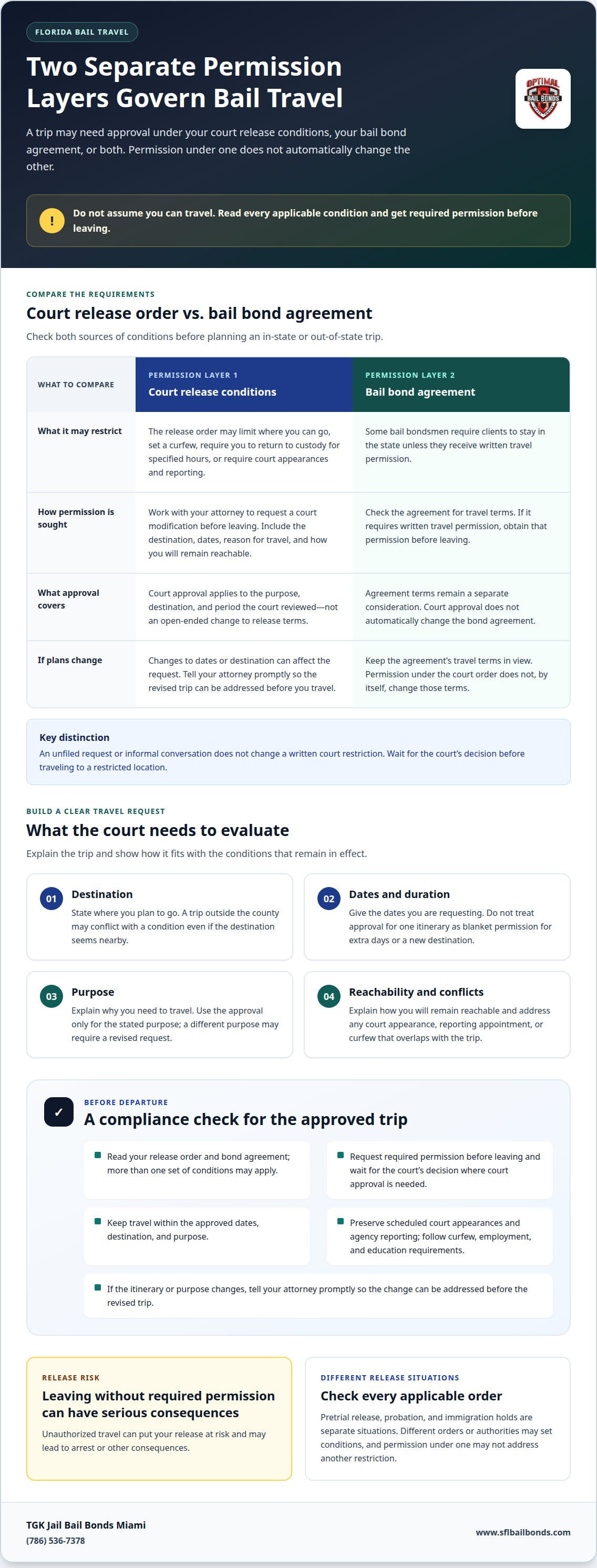
Seeking approval means asking the court to authorize travel that conflicts with a current release condition. An unfiled request or informal conversation does not change the written restriction.
Work with your attorney to request a court modification before you leave. Include your destination, dates, reason for travel, and how you’ll remain reachable. Explain any court appearances or reporting duties that overlap with the trip. For example, if a work trip conflicts with a hearing, address that conflict directly. Wait for the court’s decision before traveling to a restricted location.
Factors in Travel Requests
Courts review the proposed trip against your release conditions and the information you provide. The reason, destination, dates, and plan for staying reachable help explain how travel fits with the court’s requirements.
You must attend required court appearances. A proposed itinerary may also conflict with a curfew or reporting condition. Identify any reporting appointment that falls during the trip instead of leaving it unaddressed. Changes to the dates or destination can affect the request, so don’t treat approval for one itinerary as blanket permission.
Differences Across Release Situations
Pretrial release, probation, and immigration holds are separate situations, and different orders or authorities may set their travel conditions. Permission under one order may not address another restriction that applies to you.
Identify the type of release and the authority that issued each applicable condition. If more than one order governs your situation, consider each separately before making plans. The Oklahoma Legislature identifies §22-1105.2 Oklahoma Statutes Title 22 section as “Pretrial Release Act - Setting of bail - Schedule - Electronic monitoring.” This is an Oklahoma statutory reference, not a Florida travel rule.
Keep every court appearance. Missing a scheduled hearing can lead to arrest, while violating release conditions may put your release at risk. Account for hearing dates, reporting duties, and any curfew when planning an itinerary. If a hearing falls during a proposed trip, address it through the proper court process rather than assuming travel approval changes the court date. Florida courts may also require regular reporting or employment-related conditions that affect travel plans.
Following the purpose and conditions of an approved trip
Travel approval applies to the trip the court reviewed, not to an open-ended change in release terms. Plan around the approved purpose and every condition that remains in effect.
Trip Purpose and Approved Conditions
An approved trip is permitted for a stated purpose, destination, and period. Stick to those terms. Using permission for a different trip may be treated as contempt of court.
Compare your actual itinerary with the request the court approved. If permission covers a work meeting in another state, adding an unrelated visit changes the purpose. Don’t assume the original approval covers a new destination, extra travel days, or a different reason.
Changes can affect the court’s decision. If a medical appointment moves or work dates shift, tell your attorney promptly so the request can be addressed before the revised trip. If your trip is planned in two weeks, act now, not after departure arrangements are underway.
Compliance With Release Conditions
Compliance means following all active bail conditions during the trip, not just the travel permission. An approved itinerary doesn’t suspend other release requirements.
For example, a curfew may limit when you can travel, while regular reporting may require you to contact a designated agency. The court may also require you to maintain employment, seek work if unemployed, or continue an educational program. Plan your trip around those obligations.
Your circumstances can shape your release conditions. Employment and living situation may influence what the court requires, along with the charges and case details. A work-related trip, for instance, still needs to fit any reporting schedule or curfew imposed as a condition of release.
A bail bond agreement may also include travel terms. Some bail bondsmen require clients to stay in the state unless they receive written travel permission. Court approval and agreement terms are separate considerations, so permission under one doesn’t automatically change the other.
Before departure, organize your approved itinerary and note the conditions that remain in effect:
- Keep travel within the approved dates, destination, and purpose.
- Preserve scheduled court appearances and agency reporting.
- Follow curfew, employment, and education requirements.
- Contact your attorney promptly if the itinerary or purpose changes.
For example, if the court approves an out-of-state family event, don’t use that permission to extend the trip for unrelated travel. Following each condition helps you stay compliant during release and avoid mistaking approval for one purpose as permission for another.
Consequences of unauthorized travel
In Florida, traveling without required permission can violate release conditions and put your release at risk. Consequences may include arrest, detention until trial, additional criminal charges, or forfeiture of collateral.
Traveling Without Permission
Traveling without permission means leaving for a restricted location before getting required approval. It matters because a trip’s purpose, such as work or a family emergency, doesn’t replace permission required by the court or bond terms.
For example, crossing state lines for a scheduled work meeting could still violate a geographic restriction. If a court order prohibits leaving, you may face arrest for doing so. Missing a hearing during the trip can create a separate failure-to-appear problem, even if the reason for travel was important.
Violating Travel Restrictions
Violating a travel restriction means going beyond the limits in a release order or bond agreement. A breach may lead to bail revocation, re-arrest, and detention while the case proceeds.
Other consequences may follow. Traveling without required approval may expose you to additional criminal charges, and collateral securing a bail bond may be forfeited. The outcome depends on the violation and applicable conditions, so don’t treat a changed destination or extended stay as harmless.
A court may view unauthorized travel as a flight-risk concern, particularly if you miss a required appearance. For instance, leaving Florida and failing to appear at a scheduled hearing raises a different issue from taking an unauthorized trip and returning on time. Neither situation makes the travel authorized, and missing the appearance adds a separate compliance concern.
If you realize you may have violated a condition, contact your attorney promptly and explain what happened, including your location and any missed court date. Don’t ignore a notice or assume returning home resolves the issue. A clear account helps your attorney address the situation through the appropriate court process.
Keep records that explain the circumstances, such as a changed work schedule or a document related to emergency travel. These records don’t erase a violation, but they can help explain the purpose and timeline. Avoid making further travel plans until the restriction is addressed.
For a pending trip, seek approval before departure. If an unexpected event changes an already approved itinerary, notify your attorney as soon as possible rather than extending the trip without authorization. Prompt communication may help prevent a change in plans from becoming another alleged breach.
Circumstances for requesting permission to travel
A travel request is appropriate when an existing release condition conflicts with a necessary trip. Work, medical care, or a family emergency may provide a clear reason to ask, but the restriction remains in effect until the court approves a change.
Start by identifying the specific barrier: a Florida order may restrict travel outside a defined area, require a curfew, or set reporting times. Compare your trip plan with those conditions. For example, an out-of-state work meeting could overlap with a reporting appointment, while a medical visit may require travel beyond the permitted area.
Ask your attorney to request a court modification before departure. The request should identify your destination, travel dates, purpose, and how you’ll remain reachable. Make the plan concrete with details such as appointment dates, work obligations, and a reliable way to contact you. A request that simply says “family matter” gives less context than one that explains the event and its timing.
Timing matters. If your trip is scheduled in two weeks, tell your attorney immediately so the request can be filed before you leave. A pending request is not approval. A planned hearing, airline booking, or informal conversation doesn’t authorize travel against a court restriction.
The court can assess your reason for travel against your current release conditions and obligations. Your proposed trip should preserve scheduled court appearances and required reporting. For example, if an appointment conflicts with a hearing, address the conflict in the request rather than assuming the hearing will change. The destination and trip length also show how the plan fits the proposed modification.
Your employment and living situation may influence the conditions imposed on release. If you’re traveling for a documented work obligation, explain how the trip relates to your employment. If you’re facing a family emergency, describe the event and dates. These details help frame the request but don’t guarantee approval.
Before filing, organize the request around the key facts:
- State the exact destination, dates, and reason for travel.
- Explain how you’ll remain reachable during the trip.
- Identify any court appearance, curfew, or reporting duty affected.
- Describe the change needed to existing release conditions.
A serious criminal charge may make it especially important to handle a request carefully, but the charge itself doesn’t grant travel permission. If a bail bond agreement also limits travel, address that term separately. Some bondsmen require written permission. Court approval and permission under a bond agreement are distinct, so clarify which restriction applies before you leave.
Additional bail bond agreement restrictions
Travel limits may appear in both court release conditions and a bail bond agreement. The agreement can add restrictions, so checking only the court order may leave an important condition unnoticed.
Some bail bondsmen require you to stay in Florida unless they give written travel permission. Other agreement terms may require regular check-ins with a bail bond agent. For example, a trip outside the county could be allowed under one condition but conflict with a separate agreement restriction.
Keep the two sources of conditions distinct. Courts may require you to maintain employment, actively seek work if unemployed, or maintain or begin an educational program. They may also require regular reporting to a designated law enforcement, pretrial services, or other agency. These obligations can affect travel even when the travel term doesn’t specify a county boundary.
Courts may set a curfew or require you to return to custody for specified hours after release for employment, school, or another limited purpose. Even a work schedule that supports release may need to fit those limits. Similarly, a medical appointment outside the county could conflict with a curfew or reporting time. The reason for travel doesn’t, by itself, remove an existing condition.
Other restrictions can affect your daily plans. A court may prohibit possession of a firearm, destructive device, or other dangerous weapon. This is separate from a travel restriction, but it still applies during travel. Read the written terms carefully and consider how each condition applies to your itinerary, destination, and planned activities.
Before leaving, compare the court’s order with the bail bond agreement and note each requirement that could affect your trip:
- Identify any county, state, or other geographic limit.
- Mark curfew, reporting, and return-to-custody hours on the itinerary.
- Account for employment, education, and check-in requirements.
- Look for a written-permission term in the bond agreement.
If the agreement requires written permission, get it before leaving. Court approval may address a court-imposed restriction, while written permission from a bondsman addresses a bond-agreement term. Treat these as separate conditions. Don’t assume one satisfies the other.
Clear records can help prevent confusion. Keep copies of the applicable order, agreement, and any written permission together, then follow their terms throughout your trip. A changed destination or delayed return may affect compliance, especially if county limits, reporting, or curfew requirements apply. Raise a conflict before departure rather than relying on an informal understanding.
SFL Bail Bonds
Optimal Bail Bonds provides Bail Bonds Miami for individuals and families seeking release from jail. If a bail bond is part of your release, understanding its role can help you distinguish bond-agreement terms from court-imposed travel conditions. A bail bond doesn’t replace court approval or change restrictions in a release order. Requests to modify court conditions must go through the appropriate court process.
For bail bond support in Miami and North Miami, contact Optimal Bail Bonds. Bring the relevant bond documents and explain how travel restrictions and out-of-state travel rules while on bail Florida affect your plans, so the discussion can focus on the bond’s role in your release.
Plan your next step with clarity
Understanding travel restrictions and out-of-state travel rules while on bail in Florida can help you make informed plans and avoid treating a bond agreement as court permission. If a bail bond is part of your situation, SFL Bail Bonds can discuss its Bail Bonds Miami offering and help you understand the bond-related support available. Ask your attorney about court orders or legal strategy.
SFL Bail Bonds also offers a Pre-Licensing Bail Bonds Class, a 120 Hours Bail Bonds Course, and How to be a Bail Bondsman for people exploring the profession. These educational options serve a different need from bail bond support, but they provide a path for those interested in bail bond education.
Take the next step with a clearer picture of the support that fits your situation.
Frequently Asked Questions
What are Florida’s default travel restrictions while out on bail?
Florida release conditions depend on the terms set for each case, and the court may impose specific travel limits. Travel restrictions and out-of-state travel rules while on bail in Florida are determined by the conditions that apply to your release. Read the order to see whether it restricts travel by county, state, or another boundary. One person may have a geographic restriction, while another may have a curfew or reporting requirement.
Can a person on bail in Florida travel out of state without permission?
Only if your release conditions and bond agreement allow it. Travel restrictions and out-of-state travel rules while on bail in Florida may require permission before you leave the state. For example, a court order may limit travel even if the bond agreement doesn’t mention a state boundary. Review both documents before making plans, and don’t treat a booked trip as authorization.
Who must approve out-of-state travel while on bail in Florida?
The court must approve a change to a court-imposed travel restriction. A bond agreement may separately require written permission from the bail bondsman. These are distinct approvals: permission from a bondsman doesn’t change a court order, and court approval doesn’t automatically satisfy a separate agreement term. Identify which document imposes the restriction before seeking approval.
How do you request permission to travel while on bail in Florida?
If the order restricts your planned trip, ask your attorney to seek a court modification before traveling. The request should identify your destination, dates, purpose, and how you’ll remain reachable. For instance, explain how an out-of-state work commitment fits around scheduled court appearances. Wait for the court’s decision before you leave. Filing a request alone doesn’t change your conditions.
What information and documents are needed for a Florida bail travel request?
Include the trip’s destination, travel dates, purpose, and contact plan. Supporting documents can help explain the reason, such as an employer’s schedule for a work trip or appointment details for medical travel. Also identify any court appearance or reporting obligation that overlaps. These details give the court a specific itinerary to assess, but they don’t grant permission.
Do Florida bail travel rules vary by county, judge, or bond conditions?
Conditions can differ between cases, and the court order and bond agreement may each set terms. What matters is what your own documents require, not what someone in another county was allowed to do. For example, a Miami-Dade defendant’s travel conditions may differ from another defendant’s, depending on the order and case circumstances. Read the terms that apply to your release.
Can travel restrictions be changed or removed after bail is set in Florida?
Yes. You can ask the court to modify a travel condition through a formal request, usually filed by an attorney. Explain what needs to change and provide the trip details or circumstances supporting the request. Until the court approves a modification, follow the existing order. If a bond agreement separately restricts travel, address that requirement separately as well.


