
What if the best 120 hours bail bonds course does more than help you meet Florida’s pre-licensing requirement? It can also give you a clearer path toward exam readiness and a career as a 2-34 Limited Surety Agent. If state requirements feel overwhelming, you’re worried about the exam, or you’re trying to fit coursework around a job, you’re not alone. The right guidance can make the next steps feel manageable.
This guide explains what to expect from Florida’s pre-licensing process and how to choose a learning format that fits your schedule. Optimal Bail Bonds is a state-approved provider (#373447), offering correspondence self-study and live webinars, along with an Exam Readiness Suite and Digital Resource Library. You’ll learn how these options can support your preparation, what to consider as you work toward the state exam, and how the We Hire Our Students program may connect course completion with agency mentorship. We’ll also put the training in context for aspiring agents entering the Miami-Dade environment, including work connected to TGK Jail and North Miami-Dade.
Key Takeaways
- Understand how the 120 hours bail bonds course fits Florida’s pre-licensing requirements for the 2-34 Limited Surety Agent license.
- Learn why law, ethics, business operations, and bail-as-surety fundamentals matter in preparing for the profession.
- Use your work schedule and learning preferences to decide which course format may help you stay engaged and complete the training.
- Get a clearer view of the steps from pre-licensing education to submitting a license application to the Florida Department of Financial Services.
- See how agency-focused instruction can connect classroom concepts with the practical realities of bail bond work in Miami-Dade.
What is the 120-Hour Florida Bail Bond Pre-Licensing Requirement?
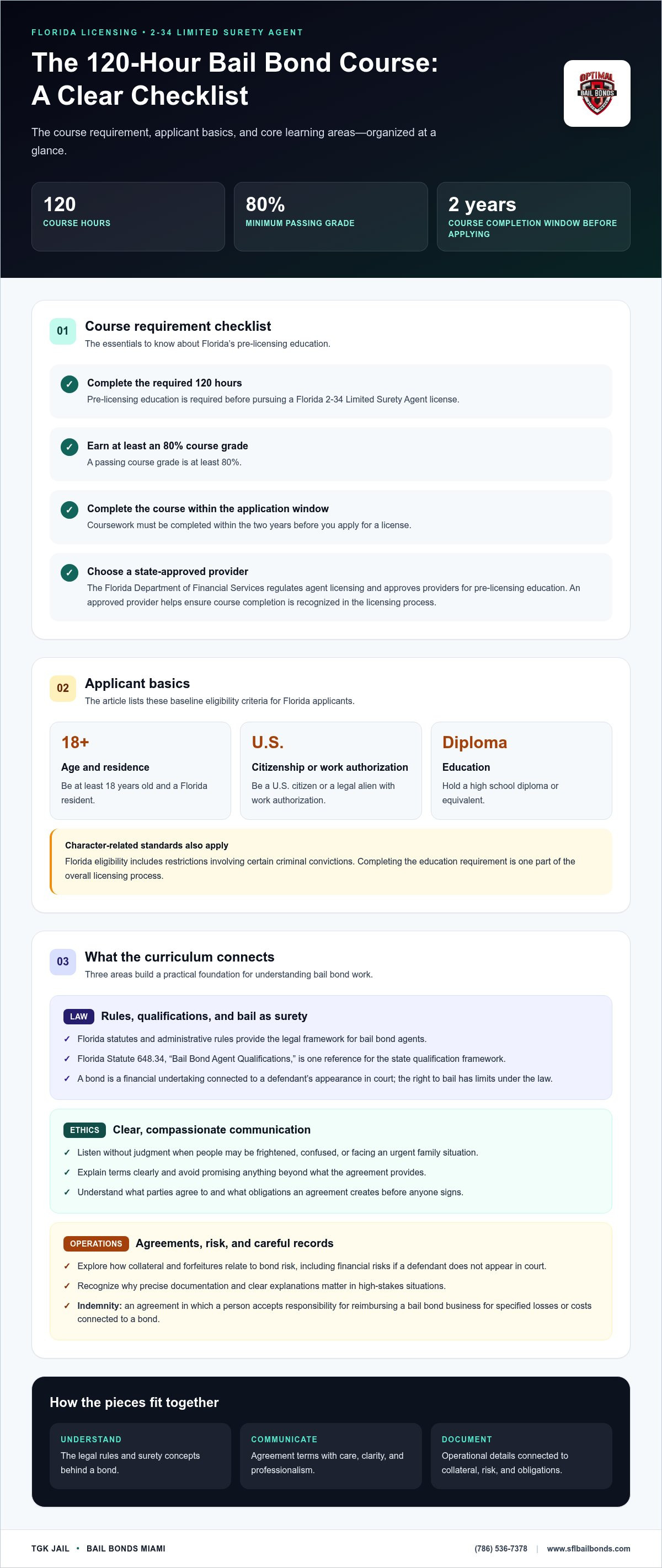
Before you can pursue a 2-34 Limited Surety Agent license in Florida, you must complete the required pre-licensing education. The 120 hours give you structured time to prepare for the responsibilities and concepts involved in bail bond work, rather than treating the course as a box to check. A passing course grade is at least 80%, and the course must be completed within the two years before you apply for a license.
The Florida Department of Financial Services (DFS) regulates bail bond agent licensing and approves providers for pre-licensing education. Choosing a state-approved provider matters: it helps ensure your course completion is recognized as part of the licensing process. Optimal Bail Bonds offers the 120-hour pre-licensing course through correspondence self-study and live webinars.
For a broader introduction to how bail bonds function in the U.S. legal system, see this overview of Bail Bond. Florida’s course adds the state-specific context you’ll need as you prepare for licensing.
Here’s a closer look at the legal framework and who may find this training a good next step.
Watch this course-related video for additional context:
The Legal Framework of Florida Bail Education
Florida’s bail agent licensing framework makes pre-licensing education a required step. The 120-hour course is sometimes described as the “gold standard,” but the practical point is that it provides a substantial, organized foundation before you apply. Those hours allow time to build familiarity with the field’s rules and concepts, then revisit material as needed instead of relying on a brief overview.
In 2026, online formats and live webinars offer options for students balancing coursework with work or other responsibilities. The format can change how you structure your study time, but it doesn’t replace the required course hours or the need to complete training through an approved provider.
Who Should Enroll in the Pre-Licensing Course?
This path may suit career changers seeking a professional role connected to the legal system, as well as people drawn to criminal justice and community support. In Miami-Dade, bail bond work takes place within a busy local environment that includes settings such as TGK Jail and North Miami-Dade. The course can help you assess whether the profession’s subject matter and responsibilities align with your goals.
Before enrolling, consider the basic eligibility criteria for Florida applicants. They must:
- Be at least 18 years old and a Florida resident.
- Be a U.S. citizen or a legal alien with work authorization.
- Hold a high school diploma or equivalent.
Florida also sets character-related eligibility standards, including restrictions involving certain criminal convictions. Meeting the education requirement is an important milestone, but it’s one part of the overall licensing process.
What You Will Learn: Breaking Down the 120-Hour Curriculum
A strong pre-licensing education does more than introduce industry terms. It helps connect the legal framework, ethical judgment, and business decisions that shape a bail bond transaction. In the 120 hours, students preparing for the 2-34 Limited Surety Agent license build a foundation for understanding how a bond works, what agreements mean, and why careful, respectful communication matters when people are under pressure.
Three core areas work together: law, ethics, and business operations. Law gives context for the rules governing bail bond activity. Ethics focuses on handling sensitive situations with professionalism and care. Business operations introduce the practical considerations behind agreements, collateral, and the financial risks that can arise if a defendant doesn’t appear in court. Understanding the relationship between these areas helps make the material useful beyond an exam answer.
Legal and Ethical Foundations
Florida statutes and administrative rules provide the legal framework for bail bond agents. Florida Statute 648.34 Bail Bond Agent Qualifications is one reference for understanding the state’s qualifications framework. Coursework can help students read legal concepts in context and recognize how rules affect decisions, rather than treating each requirement as an isolated fact to memorize.
The curriculum also introduces bail as surety: a bond involves a financial undertaking connected to a defendant’s appearance in court. That makes contract fundamentals important. Students need to understand what parties agree to, what obligations an agreement creates, and why accurate explanations matter before anyone signs. Constitutional principles around bail are also part of the broader context, including that the right to bail has limits under the law.
Indemnity is an agreement in which a person accepts responsibility for reimbursing a bail bond business for specified losses or costs connected to a bond.
Ethics are just as practical as legal knowledge. A person seeking help with release may be frightened, confused, or facing an urgent family situation. A compassionate expert listens without judgment, explains terms clearly, and avoids making promises beyond what the agreement provides. Calm communication can support trust while keeping decisions grounded in the facts.
Operational Skills for Future Agents
Business operations bring the concepts into everyday practice. Students explore how collateral and forfeitures relate to bond risk, and why precise documentation and clear explanations matter. In a high-stakes setting, a misunderstanding about an agreement can create serious consequences for everyone involved. The goal is to develop sound judgment, not to treat a bond as routine paperwork.
In Miami-Dade, future agents may encounter local jail-release settings such as TGK Jail. Learning the general sequence and terminology involved in arrest and release can help students understand how the agent’s work fits into a larger process, while recognizing that individual cases and procedures can vary.
Reference tools can help reinforce learning after class. Optimal Bail Bonds’ Digital Resource Library gives students material to revisit as they study, while the Exam Readiness Suite supports review. Explore the Florida bail bond pre-licensing course to see how structured education can support your next step toward the profession.
Choosing Your Path: Self-Study vs. Live Webinar Formats
Your course format can shape how you organize your time and engage with the material. Optimal Bail Bonds offers the 120 hours bail bonds course in Correspondence Self-Study and Live Webinar formats. Both are designed to support your pre-licensing education, but they suit different study habits. The best fit is the one that helps you keep moving through the coursework while balancing your other commitments.
Think about your typical week. If work hours change or family responsibilities make a fixed class schedule difficult, a correspondence format may offer useful flexibility. If you’re more likely to stay focused with scheduled sessions and instructor interaction, a live webinar may provide helpful structure. Either way, plan for steady study rather than leaving coursework until the last minute.
The Self-Paced Correspondence Advantage
Self-study can suit a working professional who needs to fit lessons around shifts, appointments, or a commute. You can organize study time to match your routine, but flexibility also asks you to take responsibility for maintaining momentum. Try setting recurring study blocks, choosing a quiet place to work, and keeping a simple record of completed material and topics to revisit.
Break the work into manageable sessions. For example, after studying a challenging topic, write down the key idea in your own words and note what still feels unclear. That small habit turns independent study into active review instead of passive reading. Build in time to revisit difficult material, and avoid assuming that a flexible schedule means the learning can be rushed.
Why Students Prefer Live Instructor-Led Webinars
A live webinar may be a better match if you learn by listening, discussing concepts, and asking questions as they arise. Instructor-led sessions create a set time to focus and offer the chance to engage with the material alongside an instructor. That structure can help students who find it difficult to stay on track when studying entirely on their own.
Live instruction can also make it easier to pause over unfamiliar terminology or connect a lesson to practical questions. It doesn’t remove the need for independent review, though. Set aside time after each session to revisit notes and identify topics you want to strengthen before the licensing exam.
The Exam Readiness Suite and Digital Resource Library are included as study supports. Use them as part of a consistent review routine, not as a last-minute substitute for working through course material. The available information doesn’t establish separate suite features for each format, so compare the formats by how you prefer to learn and structure your schedule, rather than assuming one includes different exam-preparation tools.
There’s no single right study style. If you thrive on a self-directed routine, correspondence may make coursework easier to fit around work. If instructor interaction and scheduled learning help you focus, webinars may be a more natural fit. Explore the Florida bail bond pre-licensing course to see the two formats and choose an approach that supports steady progress.
Beyond the Classroom: 5 Steps to Your Florida Bail Bond License
Completing pre-licensing education is a major milestone, but it’s not the final step. The path toward a Florida 2-34 Limited Surety Agent license includes an application, fingerprinting, an exam, and an appointment. Keep the steps organized, save your course records, and use the Florida Department of Financial Services (DFS) as the authority for current application instructions.
- Complete the pre-licensing course. Finish the 120-hour bail bond course with a state-approved provider and retain your completion documentation. Course timing matters: Florida’s requirement is that the course be completed within the two years before you apply.
- Submit your license application. Apply through DFS and carefully follow its instructions for the 2-34 Limited Surety Agent license. Review the application before submitting it so required information and supporting materials aren’t overlooked.
- Complete fingerprinting and the background check. Applicants must be fingerprinted as part of the licensing process. Follow the current DFS directions for completing this step and keep any confirmation or receipt with your application records.
- Pass the state exam. Prepare for the Florida Bail Bond Agent Exam by reviewing course material and practicing recall, not just rereading notes. The research brief states that the passing score is 70%; use current DFS or exam-provider instructions for scheduling and other exam details.
- Arrange an appointment. After meeting the licensing requirements, pursue an appointment with an insurer or agency operating in the bail bond field. An appointment connects your license to the authorized business relationship needed to begin professional practice.
Preparing for the State Exam
Build a review plan before exam day. The Exam Readiness Suite can support structured practice and help you identify concepts that need another look. Use it alongside your course notes, especially for contract fundamentals: review the parties to an agreement, the obligations each accepts, and the meaning of key terms. Explain concepts aloud or write short summaries from memory to test whether you understand them, rather than relying on recognition alone.
Keep your review focused and steady. If a topic remains unclear, return to the relevant lesson and make a short list of questions to resolve. That approach is more useful than trying to cram every subject into one session.
Finding Your First Appointment
A course completion certificate can help show an agency that you’ve completed the required education and are serious about entering the profession. Pair it with a concise introduction that describes your training and interest in bail bond work. As you explore opportunities, consider whether the agency’s culture values clear communication and non-judgmental support. Those qualities matter when families are dealing with stressful legal situations.
Optimal Bail Bonds’ We Hire Our Students program reflects an agency-first approach to education, connecting learning with potential career opportunities. A supportive transition from classroom study to professional practice can help new agents apply what they’ve learned with care and confidence.
Why Train with Optimal Bail Bonds? The Agency-First Difference
Preparing for a bail bond career means learning how professional judgment applies beyond the exam. An agency-first perspective can help connect course concepts with the kinds of decisions agents encounter, from communicating clearly to taking agreements and responsibilities seriously. For aspiring agents in Miami, understanding the local professional environment can make the transition from study to work feel more grounded.
Training also shapes how you approach people during stressful moments. Bail bond work involves conversations with individuals and families who may be worried or unfamiliar with the process. A careful, non-judgmental approach helps keep explanations respectful and clear. That human side of the profession deserves attention alongside the technical material.
A Mentor-Led Learning Environment
Learning from people with agency experience can help students see how classroom principles relate to day-to-day professional judgment. Rather than treating every scenario as identical, build the habit of asking what information is relevant, what an agreement says, and how to communicate it responsibly. Those questions provide a practical lens for applying what you learn as you enter the field.
South Florida has its own professional context. Familiarity with Miami-Dade settings such as TGK Jail can help aspiring agents picture where local bail bond work takes place, while remembering that procedures and circumstances vary. Good guidance should encourage careful learning, not imply that a single example applies to every case.
Compassion matters, too. An instructor who models patience and clear explanations demonstrates an approach students can carry into their own work. Clients in a difficult moment need accurate information delivered with dignity, not pressure or judgment.
Career Support and Networking
As you prepare to enter the profession, think about the kind of work environment where you can keep learning. Look for opportunities to ask questions, strengthen your understanding, and develop professional communication. Optimal Bail Bonds emphasizes an agency-first approach and its We Hire Our Students program, connecting its educational mission with the possibility of a future role for students.
Learning doesn’t stop after initial licensing. Optimal Bail Bonds also operates an Education Center with continuing-education classes for licensed bail bond professionals. Ongoing study can help agents revisit industry knowledge and continue developing professionally as their experience grows. For someone beginning a career in Miami, that link between initial training and later education offers a useful foundation for long-term growth.
Choose training that helps you build both knowledge and sound professional habits. A thoughtful start can prepare you to approach the work with confidence, diligence, and respect for the people who rely on clear guidance.
Enroll in the 120-Hour Course Today
Take Your Next Step Toward a Bail Bond Career
Choosing a professional path begins with deciding what you want to contribute. Bail bond work calls for sound judgment, steady communication, and respect for people facing difficult moments. If that combination speaks to you, turn your interest into a practical next step: commit to a study routine, make space for the coursework, and approach each lesson as preparation for responsible work with the public.
The 120 hours bail bonds course can be the start of that journey. Learning from instructors familiar with the Miami bail industry can help connect classroom concepts to the professional environment you’re preparing to enter. You don’t need to have every career question answered before you begin. A thoughtful first step can give you a clearer view of the path ahead.
Build your knowledge one lesson at a time, and move forward with confidence. Your commitment today can help shape the kind of capable, compassionate agent you hope to become.
Frequently Asked Questions
Is the 120-hour bail bonds course available fully online in Florida for 2026?
Optimal Bail Bonds offers correspondence self-study and live webinars, allowing students to study remotely. The experience differs by format: self-study is independently paced, while webinars involve live instruction. Before planning your study routine, review the selected format’s enrollment instructions so you understand how coursework is delivered and what participation involves. This can help you choose an option that fits your learning habits, not just your location.
How long does it typically take to complete the 120-hour pre-licensing course?
The course requires 120 hours of study, while the time on your calendar depends on how you schedule those hours and the format you choose. To estimate a realistic completion plan, look at the hours you can consistently set aside each week and build in time for review. A sustainable schedule is more useful than an ambitious one that leaves no room for work or personal commitments.
What is the passing score for the Florida Limited Surety Agent (2-34) exam?
The passing score for the Florida Bail Bond Agent Exam is 70%. Use practice sessions to spot topics that need more attention, then review those lessons before moving on to another full practice run. It may help to keep an error log with the subject, the reason your answer was incorrect, and the corrected concept. This turns each practice attempt into a focused study guide.
Do I need a background check before taking the 120-hour bail bonds course?
No. The background screening and fingerprinting steps are part of the licensing process, rather than a stated condition for beginning coursework. You can use the time in class to build your understanding while keeping application tasks separate. When you’re ready to apply, follow the current Florida Department of Financial Services instructions so your screening is completed through the process specified for applicants.
Can I take the 120-hour course if I live outside of Miami or South Florida?
Yes, Optimal Bail Bonds’ remote learning options allow students to take the course from outside the Miami area. Course access and eligibility for a Florida license are separate issues, though. Florida licensing requires state residency, so someone living elsewhere should consider that requirement when planning a Florida career. The course itself can still help you understand the profession and decide whether pursuing Florida licensure fits your plans.
What happens if I fail the state exam after completing the 120-hour course?
You can retake the exam within the allowed limits, and the licensing information for this guide states that a third failure requires repeating the course. After an unsuccessful attempt, note which concepts felt least familiar and adjust your review plan around them. Before scheduling another exam, verify current testing procedures and eligibility details with the appropriate Florida licensing or examination authority.
Does Optimal Bail Bonds offer job placement after course completion?
Optimal Bail Bonds has a We Hire Our Students program, but course completion should not be understood as guaranteed employment. Treat the program as a potential pathway to an opportunity, and prepare to discuss your interests and readiness for agency work. Keep your course documentation organized and be ready to explain what you’ve learned and how you hope to apply it in a professional setting in Miami.
What materials are included in the 120-hour pre-licensing enrollment?
The course includes the Exam Readiness Suite and Digital Resource Library. Use the library to revisit relevant course material as questions come up, and let practice review show you where further study may help. A practical approach is to set aside a review session after each major topic, rather than waiting until the course is finished. That way, your study resources support ongoing learning as well as exam preparation.


