

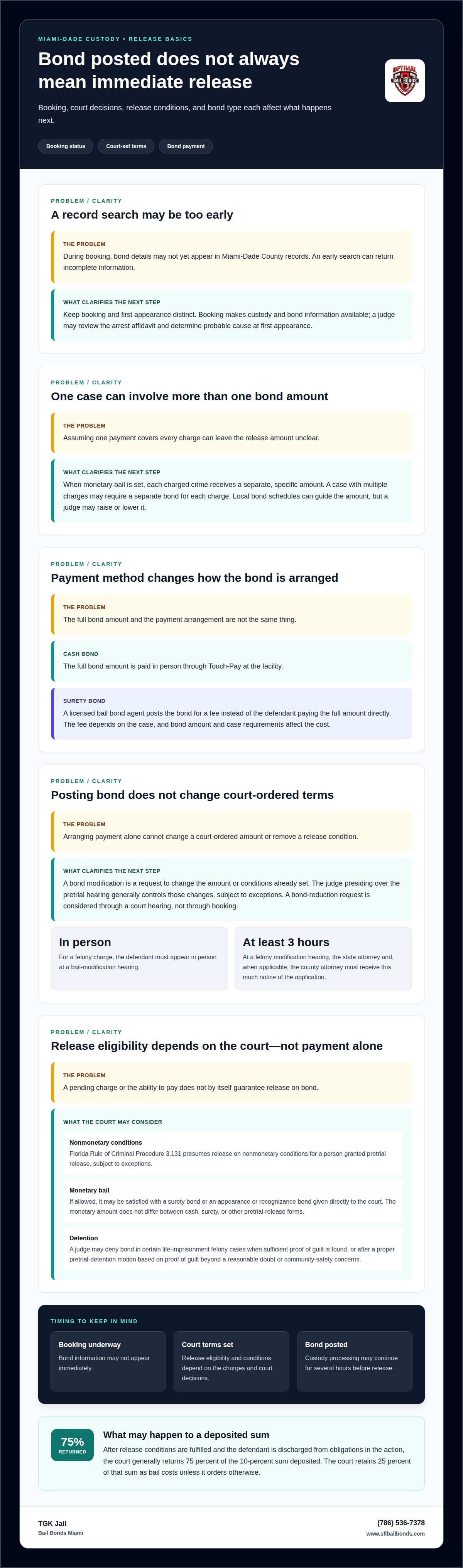
Posting bond doesn’t mean immediate release. Under standard Florida bail release protocols, bond information may not appear until booking is underway, and release from Miami-Dade custody may take several hours after bond is posted or charges are satisfied in court. Whether someone can be released, and on what terms, depends on the bond and any conditions set for the case.
Waiting without knowing what happens next is stressful. Optimal Bail Bonds understands that timing depends on more than payment: booking, a first-appearance decision, release conditions, and a transfer into the county detention system can all affect the process.
This guide explains how bond eligibility and Florida pretrial release terms work, what happens during local booking and county transfers, and why release may take time after bond is posted. You’ll get a clearer picture of the process and the factors that matter at each stage.
Key Takeaways
- Bond details may take time to appear while booking is underway, so release planning can begin before the full process is visible.
- Release eligibility and conditions depend on the charges and the court’s decisions, not just whether bond can be paid.
- A local booking followed by transfer into Miami-Dade’s detention system can add processing steps before release.
- Posting bond starts the release process, but custody processing may continue for several hours.
- At first appearance, a judge may review the arrest affidavit and determine probable cause, shaping what happens next.
Confirming bond amount and release eligibility
In North Miami Beach, release planning starts with confirming the bond and any court-ordered conditions. The bail release protocol for arrests in North Miami Beach, Florida, also depends on booking progress, since bond information may not appear immediately.
Florida’s local bond schedules can guide the type and amount of bond, but a judge may raise or lower the scheduled amount. When monetary bail is set, each charged crime receives a separate, specific amount. A case with multiple charges may therefore require a separate bond for each charge, rather than one payment covering everything. For a person with a right to bail, release follows after payment of the amount specified in the warrant.
The payment method also matters. A cash bond requires paying the full bond amount in person through Touch-Pay at the facility. With a surety bond, a licensed bail bond agent posts the bond for a fee instead of the defendant paying the full amount directly. The fee depends on the case, and the bond amount and case requirements affect the cost. Because the payment arrangements differ, identifying the bond type helps families understand what must happen before release processing begins.
Changes to Bond Conditions or Amount
A bond modification is a request to change the amount or conditions already set for release. The judge presiding over the pretrial hearing generally controls those changes, subject to exceptions for certain alternate judges. For a felony charge, the defendant must appear in person at a bail-modification hearing. This distinction matters because arranging payment alone cannot change a court-ordered amount or remove a release condition.
A bond-reduction request is considered through a court hearing, not through the booking process. At a felony modification hearing, the state attorney and, when applicable, the county attorney must receive at least 3 hours’ notice of the defendant’s application. The court process therefore affects timing and eligibility separately from the steps involved in posting a bond.
Booking Information and First Appearance
Booking is the intake process that records an arrest and makes custody and bond information available. During booking, bond details may not yet appear in Miami-Dade County records, so an early search can return incomplete information. At first appearance, a judge may review the arrest affidavit and determine probable cause, helping establish what happens next.
The first-appearance decision can affect release terms, while booking determines when bond information becomes usable. Understanding the bail release protocol for arrests in North Miami Beach, Florida, means keeping those stages distinct: a scheduled bond amount does not mean booking is complete, and completed intake does not change judicial conditions. Confirming the amount for each charge and the permitted bond type clarifies the next step.
Florida pretrial release and bail terms
Florida pretrial release can involve nonmonetary conditions, monetary bail, or detention. Under Florida Rule of Criminal Procedure 3.131, release on nonmonetary conditions is presumed for a person granted pretrial release, subject to the rule’s exceptions. A court must hold a pretrial-release hearing unless the state has filed a motion for pretrial detention under rule 3.132. That distinction matters: release isn’t automatic simply because a charge is pending.
Before first appearance, Florida Rule of Criminal Procedure 3.131 allows bail under an applicable local bond schedule, a Supreme Court uniform bond schedule, or an arrest-warrant order, under section 903.011(5). However, section 903.011(6), Florida Statutes, bars pre-first-appearance bail for a person who meets its criteria. After the court considers release, a judge may set terms addressing how the defendant must remain available to the court. The specific terms depend on the court’s decision and any applicable exception.
Some charges can lead to detention rather than release on bond. A judge may deny bond in certain cases involving an alleged felony punishable by life imprisonment when sufficient proof of guilt is found. A judge may also deny bond after the State Attorney’s office files a proper pretrial-detention motion based on proof of guilt beyond a reasonable doubt or community-safety concerns. These are distinct grounds, not simply a higher monetary amount.
If monetary bail is allowed, the defendant can satisfy it with a surety bond or an appearance or recognizance bond given directly to the court. Section 903.011, Florida Statutes, bars setting different monetary amounts for cash, surety, or other pretrial-release forms. A non-company surety must reside in Florida or own real estate within the state under section 903.05. The form of payment can differ, but the court-set monetary amount does not change between those forms.
Florida also sets requirements for certain applications and bond obligations. A defendant charged with a felony of the second degree or higher must sign an appearance-bond application under oath and in open court. Intentionally giving false or misleading material information, or intentionally omitting material information, is a misdemeanor or a felony one degree less than the crime charged. Accuracy is therefore important when completing release paperwork.
After release conditions are fulfilled and the defendant is discharged from obligations in the action, the court generally returns 75 percent of the 10-percent sum deposited. The court retains 25 percent of that sum as bail costs unless it orders otherwise. For someone arranging release, understanding the distinction between release eligibility, court conditions, and payment terms clarifies what bond can accomplish while the case remains pending.
Local booking and county detention transfers
An arrest in North Miami Beach can involve local booking followed by transfer into Miami-Dade County’s detention system. The custody location matters because intake, inmate location, and bond information are tied to the facility processing the person.
After an arrest, individuals are transported to the Turner Guilford Knight Correctional Center, commonly called TGK, for processing. TGK is at 7000 NW 41 Street, Miami, Florida 33166. Booking there may take several hours, depending on intake volume and individual circumstances. During that period, the person’s status and location can change as processing continues.
Custody does not always involve a single, immediate transfer. Someone arrested in North Miami Beach may be booked locally and later transferred into the county detention system. A family may first hear about a local booking, then need to locate the person within a Miami-Dade facility. A transfer changes where custody is managed; it does not determine bond eligibility or alter court-ordered terms.
The Miami-Dade detention facilities identified in this process include:
- Turner Guilford Knight Correctional Center, or TGK
- Miami-Dade Pretrial Detention Center
- Metro West Detention Center
Knowing facility names helps distinguish the arrest location from the place holding the person. For example, someone arrested in North Miami Beach may be processed at TGK, while a later custody update may involve another county detention facility. The current location helps direct a bond inquiry to the right place.
Transfer and intake can affect timing because booking may still be underway when relatives first seek bond information. Miami-Dade bond details may not be available immediately during booking, and the detention facility can change as custody records are updated. A delay in locating someone or seeing bond information does not, by itself, explain the court’s release decision.
Families can make updates easier to follow by keeping the arrest location, known facility, and any later transfer information together. TGK is a key facility in this process, but the county system also includes the Pretrial Detention Center and Metro West. A transfer is a custody and processing step, not a new bond ruling. Release still follows the applicable court terms and facility procedures.
Arrest and custody after arrest
After an arrest in North Miami Beach, custody continues through intake, court-related steps, and any required release processing. TGK is a key Miami-Dade facility in this process. Someone in custody may move through several stages before relatives see a release update, so posting bond and completing the exit from custody are separate events.
During booking, people in custody have access to free phone calls. These calls can help someone share basic information, such as their location or need for assistance. However, jail calls are recorded, so families should avoid discussing case details. Direct sensitive questions to the attorney and bond professionals assisting with the matter, not to a recorded line.
For inmate location, bond information, and general questions, the TGK Information Desk number is 786-263-5550. Having the person’s name and known arrest details available can help make an inquiry more focused. If the individual has been transferred, the current detention location matters because custody and release processing follow the facility holding them.
Once bond is posted or charges are satisfied in court, release from Miami-Dade custody may still take several hours. Facility staff must complete the release process before the person leaves. For example, a family may know bond has been posted while the individual remains in custody during processing. That interval does not mean the bond was rejected or the court changed its terms.
After processing is complete, inmates are released in front of TGK near the “Inmate Release Area” signage. This gives families a specific location to recognize when release from TGK is complete. It is separate from the time bond is posted: the person remains in custody until the facility completes the release steps and brings them to the release area.
Families can track three distinct updates: where the person is being held, whether bond has been posted or charges satisfied in court, and whether facility release processing is complete. The TGK Information Desk can address inmate location and bond information. The person’s attorney and assisting bond professionals are the appropriate contacts for sensitive case questions. Keeping those conversations separate helps protect case details and clarify what stage of custody remains.
When is a first appearance hearing held after an arrest in North Miami Beach?
A first appearance follows an arrest and brings the detained person before a judge for an initial review. There is no single release time for every North Miami Beach arrest. The hearing’s timing depends on custody processing and when the court can address the case. Booking delays can affect when bond information becomes available, but they do not establish what the judge will decide.
At this hearing, a judge may review the arrest affidavit and determine probable cause. That review is separate from deciding guilt. The judge also considers whether release is permitted and what terms apply under Florida’s pretrial-release rules. For families, the hearing is a key point for understanding whether the person remains in custody, may be released, or faces further court proceedings.
Florida Rule of Criminal Procedure 3.131 requires a pretrial-release hearing unless the state has filed a pretrial-detention motion under rule 3.132. A detention motion changes the issue before the court: instead of proceeding only with release terms, the court considers whether detention is sought under that process. The hearing’s result therefore turns on the matter presented to the judge, not simply on whether a bond amount appears in booking records.
A first appearance may also affect existing release status. Under section 903.0471, Florida Statutes, a judge at first appearance may revoke pretrial release in a case pending in the same judicial circuit. Florida courts must revoke pretrial release for a person who violates section 843.23, Florida Statutes, while on pretrial release. These rules show why an earlier release decision may not settle every later custody question.
For North Miami Beach families, it helps to distinguish the hearing from facility release processing. A judge’s decision sets or addresses legal release terms; the detention facility must still complete its own procedures before someone leaves custody. If a person remains detained after the hearing, the reason may relate to the court’s decision, an unresolved detention request, or unfinished facility processing. Each stage answers a different question.
Track whether the first appearance occurred, whether the judge reviewed probable cause, and what release or detention terms were ordered. These details clarify the next step without confusing a court ruling with a completed release. Do not use recorded jail calls to discuss case details; direct sensitive questions to the attorney and bond professionals assisting the family.
Optimal Bail Bonds: Bail Bonds Miami
Optimal Bail Bonds offers Bail Bonds Miami for families considering a surety bond after an arrest. Once the court’s release terms and bond amount are known, a bail bond can be a practical option for those who do not choose to pay the full cash bond. The service helps arrange the bond; it does not change the judge’s conditions or replace legal advice.
Understanding the difference between court decisions, bond arrangements, and detention-facility processing can help families see what comes next. If a surety bond fits the release terms, contact Optimal Bail Bonds to discuss Bail Bonds Miami.
Take the Next Step With Clarity
Understanding the bail release protocol for arrests in North Miami Beach, Florida, can help families focus on the next decision instead of trying to resolve every part of the case at once. If a surety bond fits the court’s terms, Optimal Bail Bonds’ Bail Bonds Miami service can help arrange the bond. Legal questions about the case belong with the defendant’s attorney.
For readers considering a career in the industry, Optimal Bail Bonds also offers a Pre-Licensing Bail Bonds Class, a 120 Hours Bail Bonds Course, and How to be a Bail Bondsman.
Take the next step with the information you have, and move forward one decision at a time.
Frequently Asked Questions
How Long Until They Are Released?
Release from Miami-Dade custody can take several hours after bond is posted or charges are satisfied in court. Booking and transfer steps can affect the timeline before then, so the time bond is posted is not the same as the time of release. For example, someone may still be at TGK while the facility completes processing. Release is complete when the person leaves custody, not when payment is submitted.
What Should You Do After an Arrest in North Miami Beach?
Start by finding out where the person is being held and whether booking has produced bond information. Keep the person’s name, known charge, and facility details together when following updates. If there is a recorded jail call, avoid discussing case details; direct sensitive questions to the attorney and bond professionals assisting the family. Separating location and release questions from legal case discussions keeps each conversation focused.
What happens once an individual is arrested?
After an arrest, the individual is transported for processing, with TGK serving as a key Miami-Dade booking facility. Intake records custody information, and the person may later be transferred within the county detention system. During booking, people in custody have access to free phone calls. A call can help relatives learn basic location information, but recorded calls are not appropriate for discussing case details.
What is the Procedure for Setting Bail?
A local bond schedule or an arrest-warrant order can guide pre-first-appearance bail under Florida Rule of Criminal Procedure 3.131. At first appearance, the judge may review the arrest affidavit and determine probable cause, then address release terms. If the state seeks pretrial detention under rule 3.132, a hearing is required. The outcome depends on the court’s release decision and applicable eligibility rules.
Where are people arrested in North Miami Beach, Florida booked and held?
People arrested in North Miami Beach may be booked locally and later transferred into Miami-Dade County detention. TGK, at 7000 NW 41 Street, Miami, Florida 33166, is a primary processing facility. Other county facilities include Miami-Dade Pretrial Detention Center and Metro West Detention Center. For federal charges, the Federal Detention Center in Miami is identified as a separate facility.
Who sets bail for arrests in North Miami Beach, and how are bail amounts determined?
A judge sets or changes court-ordered bail terms, while local bond schedules often guide the initial bond type and amount. Florida requires a separate, specific monetary bail amount for each charged crime, so multiple charges can mean separate bonds. A judge may adjust the scheduled amount. For a felony bail-modification hearing, the defendant must appear in person.
How do I pay cash bail or post bond for someone arrested in North Miami Beach?
For a cash bond in Miami-Dade County, the full bond amount is paid in person through Touch-Pay at the facility. A surety bond follows a different route: a licensed bail bond agent posts the bond for a fee. The court-set bond amount remains the reference point. Before arranging payment, identify which bond type applies and whether each charge has its own amount.
Can someone arrested in North Miami Beach be released on recognizance or pretrial release instead of bail?
Yes. Florida Rule of Criminal Procedure 3.131 presumes release on nonmonetary conditions for a person granted pretrial release, subject to exceptions. A defendant may also satisfy monetary bail with an appearance or recognizance bond directly to the court. Eligibility is not automatic: Florida law bars pre-first-appearance bail for people meeting section 903.011(6) criteria, and courts can deny release in qualifying detention cases.


