
Posting a bond is only one step; release still takes time. For people seeking 24 hour licensed bail services in Hialeah Miami Florida through Optimal Bail Bonds, release from the listed Miami-Dade detention facilities usually takes two to eight hours after a bond is posted.
It’s understandable to want clear answers when someone you care about is in custody. The process can involve a bail decision, payment, paperwork, and the facility’s release procedures. Knowing what each step means can make a difficult situation feel more manageable.
This guide explains how the bail process works for common charges in the Miami and Fort Lauderdale areas, what can affect approval and release timing, and how premiums, payment plans, and collateral fit in. You’ll also learn what details help get the process started and what to expect as the case moves from the jail to the next court date.
Key Takeaways
- Learn how collateral, bond discharge, and forfeiture affect the return or use of pledged assets.
- See which identifying details help begin the release process and what can influence its next steps.
- Understand why charge type and case circumstances matter when arranging a bond.
- Get a clearer picture of how premiums, payment arrangements, and cost factors fit together.
- Discover how the 120 Hours Bail Bonds Course can support people interested in learning about the bail bond profession.
Payment plans and collateral
Collateral is property or money pledged to secure a bail bond, separate from the premium. A co-signer may accept financial responsibility under the bond agreement. Before signing, identify who owns each asset, what obligation it secures, and which terms apply. For example, if a family member pledges a vehicle, the agreement should identify the vehicle and its owner. Keep copies of the signed paperwork and any receipt.
Florida has specific handling rules for cash collateral. If cash collateral exceeds $5,000, or its equivalent, the agent must immediately forward it to the insurer. An agent may accept more than $50,000 in cash as collateral per bond only if the amount above $50,000 is paid to the insurer in an approved form. These limits concern collateral handling, not a quoted premium or a payment plan. Ask for the arrangement’s terms in writing before money or property changes hands.
Keep the collateral receipt with the bond documents. It should help identify the asset or funds, the person who provided them, and the bond involved. In Florida, collateral should be returned to the indemnitor within 21 days after the bond is discharged and the agent is notified. Collateral is returned in full once the case is completed, subject to the bond’s status and applicable forfeiture rules. Keep contact details current so return arrangements can be made.
A written demand can matter if the agent has not received notice of discharge. In that situation, the agent must request discharge from the court. If the court does not provide discharge within 7 days after that request, the bond is automatically canceled, and collateral should be returned within 21 days. Record when a written demand is sent and retain a copy. These steps create a clear paper trail for the indemnitor and defendant.
Collateral may be at risk if the defendant fails to meet a bond condition and forfeiture follows. Before collateral is converted to cash to satisfy forfeiture, the agent or insurer must give the indemnitor and principal 10 days’ written notice. Expenses to convert collateral may not exceed 20 percent of the bond’s face value unless a court allows higher actual, reasonable expenses. Read notices promptly and keep them with confidential financial records.
Payment plans and collateral arrangements are separate decisions. A payment plan sets out how the premium will be paid; collateral secures the bond under its terms. Ask for a written schedule showing payment dates, the balance due, and any collateral pledged. A co-signor should understand the obligations before signing, especially if another person owns the pledged property. For a Hialeah or Miami-Dade County bond, clear records help everyone understand the source of each payment and the steps for resolving the agreement.
Approval and jail-release processes
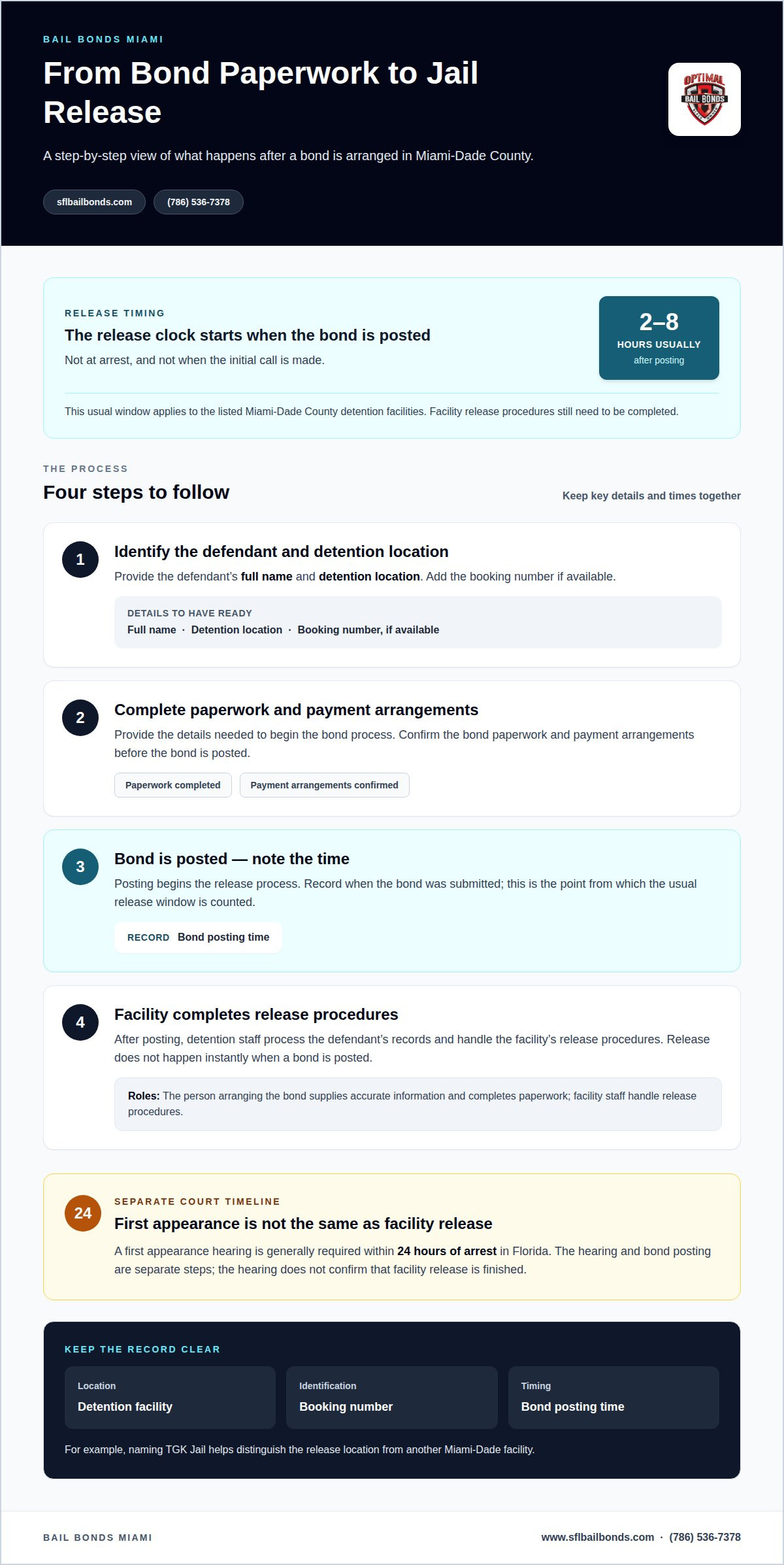
To arrange a Miami-Dade County bail bond, provide the defendant’s full name, detention location, and booking number if available. Then complete the bond paperwork and payment steps before the bond is posted.
Posting Bail and Jail Release
Posting a bond begins the release process, but it doesn’t mean the defendant leaves detention immediately. The facility must complete its release procedures and process the defendant’s records after the bond is posted.
For listed Miami-Dade County detention facilities, release usually takes two to eight hours after posting. The clock starts when the bond is posted, not at arrest or the initial call, so keep those events distinct when tracking progress.
Same-Day Release Support
Timely release support depends on moving accurate information and paperwork through the bond process. The person arranging the bond can help by sharing correct booking details and responding promptly if more information is needed.
A first appearance hearing is generally required within 24 hours of arrest in Florida. That hearing and bond posting are separate steps; a hearing does not itself confirm that facility release has finished.
Jail Release Assistance
Bail bond agents help arrange release for eligible defendants awaiting court proceedings. Their role centers on the bond process; detention staff handle the facility’s release procedures after posting.
Keep a record of the detention location, booking number, and time the bond was posted. For example, if the defendant is at Turner Guilford Knight Correctional Center, naming the facility helps distinguish the release location from another Miami-Dade facility.
Arranging a Bail Bond Step by Step
Start with the defendant’s full name and detention location. Add the booking number if available, then provide the details needed to begin the bond process. Confirm the bond paperwork and payment arrangements before the bond is posted.
After posting, track the release process with the facility and note when the bond was submitted. At listed facilities, the usual two-to-eight-hour release window begins after posting, not when the defendant is first detained.
These steps clarify the responsibilities involved: the person arranging the bond supplies accurate information and completes the paperwork, while the facility processes release. For help with Bail Bonds Miami, use the service information available here.
Felony, misdemeanor, DUI, domestic violence, and drug charge bonds
A charge label alone doesn’t explain the bond process. In Hialeah, the charge, court, bond decision, and case details shape the next steps. A felony, misdemeanor, DUI, domestic violence, or drug charge may involve different circumstances, so the bond paperwork must match the case. Start by identifying the exact charge and the court handling it.
Distinguish the charge from the bond decision. A felony or misdemeanor is a classification; DUI, domestic violence, and drug charges describe other case categories. These labels don’t establish a bond amount or guarantee release. The court’s bond decision and the defendant’s eligibility determine whether a bail bond can be used. Accurate booking and case details help connect the bond to the right person and charges.
Florida licensing matters because a bondsman must have the proper authority to perform bail bond duties. Under Section 648.30 of the Florida Statutes, a person may not act as a bail bond agent or perform those duties unless qualified, licensed, and appointed. Requirements can depend on license category and applicant circumstances. To assess a bondsman’s status, use state regulatory resources or request the license number directly.
Florida state bail bonds fall under Chapter 903 of the Florida Statutes. The applicable license category also matters: limited surety agents operate in connection with an authorized insurance company. Those rules concern Florida state bail activity. If a case proceeds in federal court, identify that jurisdiction before discussing a federal bail bond. Federal and state proceedings are distinct, and the bond arrangement must correspond to the case’s court.
Use a short checklist when discussing a bond: the defendant’s full name, booking details, detention location, exact charge, and court jurisdiction. For example, a Hialeah arrest involving a DUI charge requires identifying whether the case is in Florida state court or federal court. The charge itself doesn’t answer that question. Clear details help avoid confusion between people with similar names, separate cases, or different court systems.
Bail bond agents help arrange release for eligible defendants while their cases proceed, but they don’t replace legal representation. For a domestic violence or drug charge, keep the case information accurate and follow the bond’s stated conditions. The defendant’s responsibilities continue after release. Understanding the difference between the charge, licensing rules, and court jurisdiction helps identify the appropriate type of bail bond without assuming every case follows the same path.
Payment options and pricing transparency
Before signing a bail bond agreement, distinguish the premium from collateral and other terms. A clear written breakdown helps the person responsible for the agreement understand what is due and when.
Transparent Fees and Payment Plans
Review the premium, payment terms, and any collateral requirement before agreeing. The premium depends on the case and is provided after a quote request; relevant factors include the bond amount and whether the matter is state or federal.
Florida bail bond rates are subject to Part I of Chapter 627 of the Florida Insurance Code. A payment plan describes how the premium will be paid, while collateral secures obligations under the bond agreement. Keep both terms clear in the paperwork.
Payment and Financing Options
Payment arrangements depend on the agreement. If installments are included, the written schedule should identify due dates, amounts, and the remaining balance. The person signing should understand whether they are the defendant, indemnitor, or both, since each role carries different responsibilities.
Bond terms and payment arrangements should be explained plainly. An attorney handles legal advice about charges or court strategy; a surety bond addresses the defendant’s release conditions. These roles are distinct, even when families coordinate payment while someone remains in custody.
Review the cost breakdown before making a payment. It should distinguish the premium from collateral, explain when each amount is due, and identify any agreed payment terms. For example, if a family member pays the premium and another person pledges property, the agreement should make each person’s role clear. Keep receipts and copies of signed documents.
Florida rules also address what happens if release does not occur. If the defendant is not released from custody after the premium is paid, the indemnitor must receive a full premium refund. Keep proof of payment and written bond records together so the transaction can be identified and handled accurately.
A bail bond guarantees the released person’s appearance at the next scheduled court date. Payment does not end the defendant’s responsibilities: bond conditions and court obligations still apply. Before signing, make sure the payment schedule is manageable and each co-signer understands their commitment. Clear terms help prevent confusion later.
For federal matters, distinguish the federal bond arrangement from a Florida state bond. Applicable premium rules differ by jurisdiction, so the quote should identify the court and bond type it covers. Avoid relying on an estimate that does not identify the case or the agreement’s terms.
24/7 Service
For people seeking 24 hour licensed bail services in Hialeah Miami Florida, the provided contact number is (786) 536-7378. The local detention addresses below identify jail facilities, not a bonds office address.
An arrest can happen outside regular business hours, while booking, a court hearing, and bond paperwork follow separate steps. Florida generally requires a first appearance hearing within 24 hours of arrest. That hearing is a court event, not confirmation that a bond has been posted or release has finished. Keep the arrest time and hearing information distinct.
The 24/7 label refers to availability at any hour, but it doesn’t mean release is immediate. Florida bail bond agencies must be open and accessible to the public at least eight hours daily between 8:00 a.m. and 6:00 p.m., Monday through Friday, except legal holidays. Agency access, court schedules, and jail processing are separate parts of the process.
In Miami-Dade County, the detention facility helps identify where the defendant is being held. Common facilities include:
- Turner Guilford Knight Correctional Center, 7000 NW 41st Street, Miami, Florida 33166.
- Metro West Detention Center, 13850 NW 41st Street, Miami, Florida 33178.
- Pre-Trial Detention Center, 1321 NW 13th Street, Miami, Florida 33125.
These are correctional facility addresses, not a definition of a bail service’s coverage area. Hialeah and Miami are the local focus here. Naming the specific jail during a call helps distinguish the detention location from the defendant’s arrest location or court location.
For a call about 24 hour licensed bail services in Hialeah Miami Florida, prepare the defendant’s full name, jail location, and booking number if available. For example, identify Turner Guilford Knight rather than saying only “the Miami jail.” The facility name and booking details help connect the inquiry to the correct detention record and avoid confusion with someone who has a similar name.
After a bond is posted, detention staff complete the facility’s release procedures. Courts handle hearings and case decisions; jail staff manage custody and release. Record when the arrest occurred, when the hearing is scheduled, and when the bond is posted. These timestamps help clarify which stage is underway.
Optimal Bail Bonds: 120 Hours Bail Bonds Course
Optimal Bail Bonds offers the 120 Hours Bail Bonds Course for people exploring work in the bail bond field. If learning about the profession is your next step after understanding the release process, this course provides a relevant educational option.
Florida licensing requirements depend on the license category and the applicant’s circumstances, so understanding the path matters. Optimal Bail Bonds offers the Pre-Licensing Bail Bonds Class and How to be a Bail Bondsman for people exploring the profession and its responsibilities. For current bond assistance in the Miami area, the relevant offering is Bail Bonds Miami.
Contact Optimal Bail Bonds to discuss the Pre-Licensing Bail Bonds Class or bail bond assistance that fits your situation.
Choose Your Next Step With Confidence
In a stressful moment, focus first on what needs attention now: the person’s current situation, the information required to move forward, and the decision that can wait. For anyone seeking 24-hour licensed bail services in Hialeah, Miami, Florida, a clear conversation about the immediate need can help make the next step easier to identify.
If you’re supporting someone in custody, keep the relevant case details together and identify any questions you have about the bond process. If you’re considering a future in the bail bond field, treat that as a separate decision and take time to understand the educational path. Each situation calls for a different starting point.
Optimal Bail Bonds can help you discuss the appropriate next step, whether you’re seeking bail bond assistance in Miami or exploring education in the field. You don’t have to sort through every decision at once. Start with the question that matters most today.
A steady, informed decision can make a difficult day feel more manageable.
Frequently Asked Questions
Which bail bond agencies in Hialeah, Florida, are licensed and available 24 hours?
Optimal Bail Bonds states that it provides bail bond support around the clock in Miami. For 24-hour licensed bail services in Hialeah, Miami, Florida, distinguish advertised availability from an agent’s license status. Florida requires bail bond agents to be qualified, licensed, and appointed. Ask for the individual agent’s license number and review the relevant state regulatory information. An agency’s hours alone don’t establish that an agent is licensed.
What fees and payment options do Hialeah bail bond agencies offer?
The amount due depends on the case and the written bond terms. Ask for a breakdown that separates the premium, any collateral, and the payment schedule. Optimal Bail Bonds accepts checks and credit cards. These are payment methods, not a promise that installments are available. Before paying, identify who is responsible for each amount and keep the agreement and receipt with the case records.
What is Florida’s standard bail bond premium, and can fees be negotiated?
Florida bail bond premiums are governed by state rate rules, so the premium isn’t simply a freely negotiated amount. Payment timing is separate from the rate. Request a written explanation of the premium and distinguish it from collateral or other agreement terms. For a federal case, make sure the quote identifies the jurisdiction and bond type, since a federal matter is not the same as a Florida state bond.
What information and documents are needed to post bail for someone in Hialeah?
Provide the defendant’s full name, detention location, and booking number if available. These details help identify the right person and connect the bond paperwork to the correct detention record. If a relative has a common name, include the facility name to reduce confusion. The person arranging the bond also completes the required paperwork and follows the agreement’s payment terms. Keep copies of submitted documents and payment records.
How long does release from the Miami-Dade jail usually take after bail is posted?
Release from the listed Miami-Dade detention facilities usually takes two to eight hours after posting. For families using 24-hour licensed bail services in Hialeah, Miami, Florida, note the posting time separately from the arrest time. The facility’s release processing begins after the bond is posted, and the jail’s procedures remain distinct from the bond arrangement. Keep the facility name and posting time handy when tracking progress.
What collateral or cosigner requirements do Hialeah bail bond companies have?
Collateral and cosigner terms depend on the bond agreement. A cosigner should understand any financial responsibility accepted by signing, while a person pledging property should know exactly which asset is identified and what obligation it secures. If one relative pays and another pledges property, the documents should make their separate roles clear. Keep copies of the signed agreement and collateral receipt for your records.
What risks and responsibilities come with signing a bail bond agreement in Florida?
Signing may create financial obligations under the agreement, and the defendant remains responsible for following bond conditions and appearing in court. A co-signer should understand the possible consequences if those obligations aren’t met. Before signing, read the terms, clarify each signer’s role, and keep a copy. Bail bond assistance doesn’t replace legal advice about charges, court strategy, or other questions for an attorney.


