
A credit challenge can affect a surety bond application, but the impact depends on the bond type and the applicant’s financial profile. For Florida title agencies, the required surety bond is $35,000. For anyone seeking surety bond assistance near Little Haiti and North Miami, Florida, a useful first step is to identify the specific bond required and understand which details may shape the application.
It’s understandable to worry that credit difficulties could affect your eligibility. For a title agent bond, the premium may depend on the applicant’s credit score, financial standing, and the bond amount required by the state. Other bond types have different considerations. This article explains how to identify common surety bond needs, what can affect qualification and cost, and how to prepare for your next step. The rules vary by bond, so start with the specific requirement you need to meet.
Key Takeaways
- Identify the bond type you need first, since cost factors differ across probate, janitorial, title-agent, and contract bonds.
- Learn which applicant, business, or case details may shape a bond application and what information to organize before applying.
- Understand the steps that can affect turnaround time, so you can plan for the application and review process.
- Use practical criteria to assess a Florida provider’s licensing, communication, and reputation.
- If your goal is to learn about becoming a bail bondsman, explore how the How to be a Bail Bondsman offering fits that path.
What are the typical costs and fees for surety bonds in Miami-Dade County?
Surety bond costs depend on the bond’s purpose, required amount, and applicant’s risk profile. The bond amount is the protection stated in the bond; the premium is the cost of obtaining it. These figures are not interchangeable. If you’re comparing bonds in the Miami area, first identify the bond type and required amount, then consider which details about the applicant or business may affect the premium.
Probate bonds are commonly tied to the estate’s value. The bond amount is usually based on the total estate value, and the premium is a percentage of that amount. The fiduciary, such as an executor or administrator, pays the premium, though the estate may reimburse that person. A probate bond is typically required by a court before the fiduciary begins managing estate assets. It remains in effect until the estate is settled and the court discharges the fiduciary from their duties. These milestones explain why the bond can remain in place beyond the start of estate administration.
For cleaning businesses, a janitorial bond’s price varies with the coverage amount and the business’s risk profile. These bonds are generally not legally required, but are recommended for cleaning businesses. When assessing the expense, consider the coverage needed and the risks associated with the work. Because changing the coverage amount can affect the cost, evaluate the premium alongside the protection the bond is intended to provide.
Title agent bonds involve both a state-required amount and applicant-specific pricing. Florida title agencies are required to have a $35,000 surety bond. The premium can vary based on the applicant’s credit score, financial standing, and the bond amount required by the state. Florida title agencies must also maintain errors and omissions coverage and a fidelity bond. These are separate requirements to account for when planning business expenses; the $35,000 figure is the required bond amount, not the premium.
Contractors may encounter performance and payment bonds for a project. Combined rates can average less than 0.5% of the contract price up to about 3% of the contract price, depending on circumstances. Combined performance and payment bonds usually have one charge. The contract price and circumstances influence the rate, so a percentage should not be treated as a universal quote. A contractor reviewing project costs should distinguish the combined charge from the project’s overall contract value.
Immigration bond paperwork follows a separate process from probate, janitorial, title, and contract bonds. U.S. Immigration and Customs Enforcement identifies the immigration bond form as INS I-352. That form identifier helps distinguish this paperwork from other bond documents; it does not indicate a premium or establish a cost. Keep bond type, required amount, premium, and any separate coverage needs distinct when organizing expenses. The relevant factors differ by bond, so a cost comparison is meaningful only when it matches the same bond type and purpose.
For probate planning, the percentage-based premium depends on the bond amount, rather than being one fixed charge. The fiduciary pays it, so the person administering the estate may need to account for the payment. The estate may reimburse the fiduciary, but that possibility does not change who pays first. Keeping these roles distinct helps prevent a potential reimbursement from being mistaken for the initial payment.
When assessing the expense, separate the bond amount from the premium calculated as a percentage of it. The bond amount represents the stated protection and provides the basis for the calculation; the premium is the amount the fiduciary pays. The fiduciary can account for that payment and any potential reimbursement separately. Reimbursement by the estate, if it occurs, is a separate transaction from the initial payment.
What information and documents are needed to apply for a surety bond in Florida?
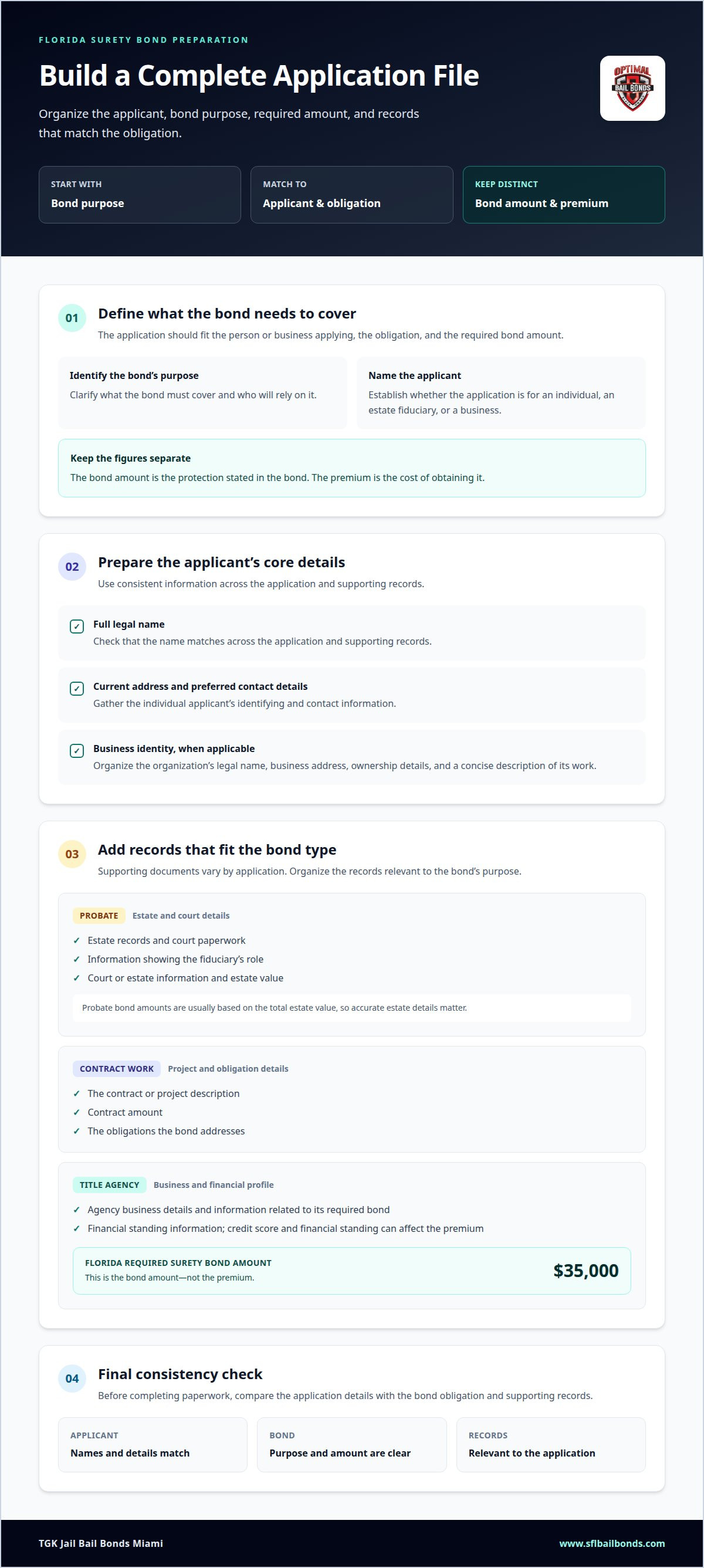
Start by identifying the bond’s purpose and the person or business applying. An application for a probate bond differs from one for a title agency or contract. The application details should match the applicant, the obligation, and the required bond amount. Before completing paperwork, clearly describe what the bond must cover and who will rely on it.
For an individual application, prepare identifying and contact information, including the applicant’s full legal name, current address, and preferred contact details. Make sure names match across the application and supporting records. For an estate bond, organize the court or estate information, the applicant’s role, and the estate value. Since probate bond amounts are usually based on the total estate value, accurate estate details matter.
Business applicants should gather the organization’s legal name, business address, ownership details, and a concise description of its work. A title agency applicant can also organize information about the agency and its required bond. Florida title agencies need a $35,000 surety bond. For a title agent bond, credit score and financial standing can affect the premium, so financial information may be relevant during review. Present business and personal details consistently rather than combining them without explanation.
The bond’s purpose determines which supporting records are useful. Depending on the application, organize documents such as:
- Probate: estate records, court paperwork, and information showing the fiduciary’s role.
- Contract work: the contract or project description, contract amount, and the obligations the bond addresses.
- Title agency: business details and information related to the agency’s required bond and financial standing.
- Janitorial work: a description of the cleaning business, its services, and the coverage being considered.
This list is a preparation guide, not a universal filing checklist. The bond’s purpose and the underwriter’s review determine which records apply. Keep copies legible, current, and organized by category. If documents show different addresses or business names, note the reason to help clarify the application. Provide the specific information requested rather than substituting a different record.
Disclose credit concerns clearly. For title agent bonds, the applicant’s credit score and financial standing can affect the premium, so accurate financial details are more useful than gaps or inconsistent answers. Organize records that explain the applicant’s current financial position, and respond clearly to requests for further details. Credit does not change the bond’s purpose or required amount, but it may inform pricing and underwriting review.
Before submitting, follow a simple sequence: identify the bond type, confirm the applicant’s legal name, assemble relevant supporting records, and review each answer for consistency. Keep a copy of the completed application and submitted documents. This provides a clear reference if the underwriter requests clarification. Organized information helps avoid preventable gaps in the application.
How long does it take to get a surety bond in North Miami?
There is no single processing timeline for every surety bond in North Miami. Timing depends on the bond type, how complete the application is, and the review required for that obligation. Consistent details and a complete application can help avoid clarification requests. Start by identifying the exact bond and the party requiring it.
Next, the applicant’s information and supporting records are reviewed. Probate, title agent, and contract bonds involve different obligations, so their review paths differ. A probate bond requires relevant estate information, while a title agency bond may involve business and financial details. A contract bond may require attention to project terms and the responsibilities described in the contract.
Credit and financial review can also affect processing time. For title agent bonds, the applicant’s credit score and financial standing can affect the premium. If the application needs an explanation or additional financial information, providing it adds a step. Clear, consistent answers keep the review focused. They do not remove underwriting review, but can help prevent unnecessary back-and-forth about mismatched names, addresses, or business details.
Keep the application organized by following a clear sequence:
- Identify the bond: confirm its purpose and the entity requiring it.
- Complete the application: use the applicant’s correct legal and business details.
- Provide relevant records: include documents that support the bond type and application answers.
- Address follow-up: respond to requests for clarification with information tied to the specific question.
- Review the issued bond: confirm that the document reflects the correct applicant and obligation.
Location alone does not determine turnaround. For applicants in North Miami, the bond’s complexity and review steps matter more than the neighborhood. A bond tied to a court or contract may also depend on related documents or approvals. Keep the requiring party’s instructions handy, since an unclear requirement can make it harder to identify the correct bond form.
It’s also useful to distinguish a surety bond application from a jail-release timeline. At Miami-Dade County facilities, booking can take several hours before bond information becomes available. Florida law generally requires a person arrested in Florida to receive a first appearance within 24 hours of arrest. Those are parts of the arrest and release process, not a promised timeline for issuing every type of surety bond. If the need involves a person at TGK Jail, clarify whether the immediate task concerns bail information or another surety obligation.
For planning, organize the application, the requiring party’s instructions, and supporting records before submission. Track any clarification requests and the final bond document as separate steps. This helps applicants in North Miami see what remains without confusing court timing, booking, and underwriting in one estimate.
How can someone verify a Florida surety bond provider is licensed and reputable
Start with the provider’s exact legal business name and the person handling your application. Ask what role each person or company performs, and request any license number they use. Compare those details with Florida’s official insurance-license lookup. Search the exact name and confirm the record matches the person or business you’re dealing with. A similar name alone does not establish a match.
Before sharing sensitive information or paying a premium, use a consistent review process:
- Identify the parties: Write down the provider’s legal name and the surety named in the paperwork.
- Check license details: Search the relevant official Florida licensing records using the name and number provided.
- Match the record: Compare the listed name and role with the person handling your application.
- Review bond documents: Confirm the applicant, obligee, bond type, and required amount appear correctly.
- Keep written records: Save the quote, application, payment terms, and messages together.
A bond document identifies parties with different roles. The applicant seeks the bond, the obligee requires it, and the surety is identified in the bond paperwork. Check that each name appears in the correct place. For example, if a court or contract names an obligee, compare that name with the bond’s obligee field before signing. A misspelling or incorrect entity can cause avoidable problems.
Reputation takes more than a polished website or a quick response. Look for a clear written explanation of the application, premium, and any separate charges. Ask for the bond type and amount in writing, then compare the explanation with the documents you receive. A transparent process helps you understand what you’re buying and who is responsible for each step.
Pay attention to how questions are answered. A provider should explain unfamiliar terms in plain language, including the difference between the bond amount and premium. If a credit concern affects the review, ask for a clear explanation of the information being considered. Do not rely on verbal assurances that conflict with written terms. Keep the proposal and final bond together so you can compare them carefully.
Pause if a representative avoids identifying the legal entity, gives inconsistent names, or pressures you to pay before explaining the paperwork. These details do not prove misconduct by themselves, but they are reasons to resolve discrepancies before proceeding. Use contact information from official records when confirming a license, rather than relying only on a number or link in an unsolicited message.
Before proceeding, record the provider’s name, license information, surety name, bond type, and written terms. This gives you a practical reference if questions arise during application or issuance. A careful review can help applicants in North Miami distinguish verifiable credentials and documents from details that remain unclear.
Optimal Bail Bonds: How to be a Bail Bondsman
Optimal Bail Bonds offers How to be a Bail Bondsman for people exploring a career in the bail bond field. This is a separate path from applying for a surety bond: it is relevant if your goal is learning about the profession, not securing a bond for an estate, business, or contract. The course connects with the career question by focusing on how to become a bail bondsman. If you’re considering this path, explore the course to decide what you’d like to learn next. For bail bond needs in Miami, Optimal Bail Bonds also offers Bail Bonds Miami.
Contact Optimal Bail Bonds to discuss your interest in becoming a bail bondsman at (786) 536-7378.
Choose the Next Step That Fits Your Goal
Your next step depends on whether you need a bond for a specific obligation or want to explore a career in bail bonds. If you’re seeking surety bond assistance near Little Haiti and North Miami, Florida, use the bond requirement and application details to guide your inquiry. If you’re interested in becoming a bail bondsman, choose learning that fits your career goal rather than treating it as a surety bond application.
Optimal Bail Bonds offers a Pre-Licensing Bail Bonds Class, a 120 Hours Bail Bonds Course, and How to be a Bail Bondsman. These educational offerings can help you explore the profession and decide what learning step fits your plans. Take time to clarify your goal and choose the route that addresses it directly. A focused next step can make a complicated process feel more manageable.
Whether you’re organizing a bond application or considering professional training, take the next step based on the decision in front of you.
Frequently Asked Questions
Which local agencies or brokers provide surety bond assistance near Little Haiti and North Miami?
For bail bond assistance in the area, Optimal Bail Bonds offers Bail Bonds Miami and TGK Jail support. First clarify whether you need a bail bond for someone in custody or a commercial surety bond for a business, contract, or estate. These are different needs. Describing the bond’s purpose and the party requiring it helps direct your inquiry to the relevant assistance.
Are there low-cost, payment-plan, or credit-challenged options for surety bonds near Little Haiti?
Do not assume a low-cost option or payment plan is available based on credit alone. For bail bond services, Optimal Bail Bonds accepts checks and credit cards; these are payment methods, not a stated installment plan. For a commercial surety bond, credit and financial review can affect the terms. Ask for a clear explanation of the premium and payment terms before deciding how to proceed.


