

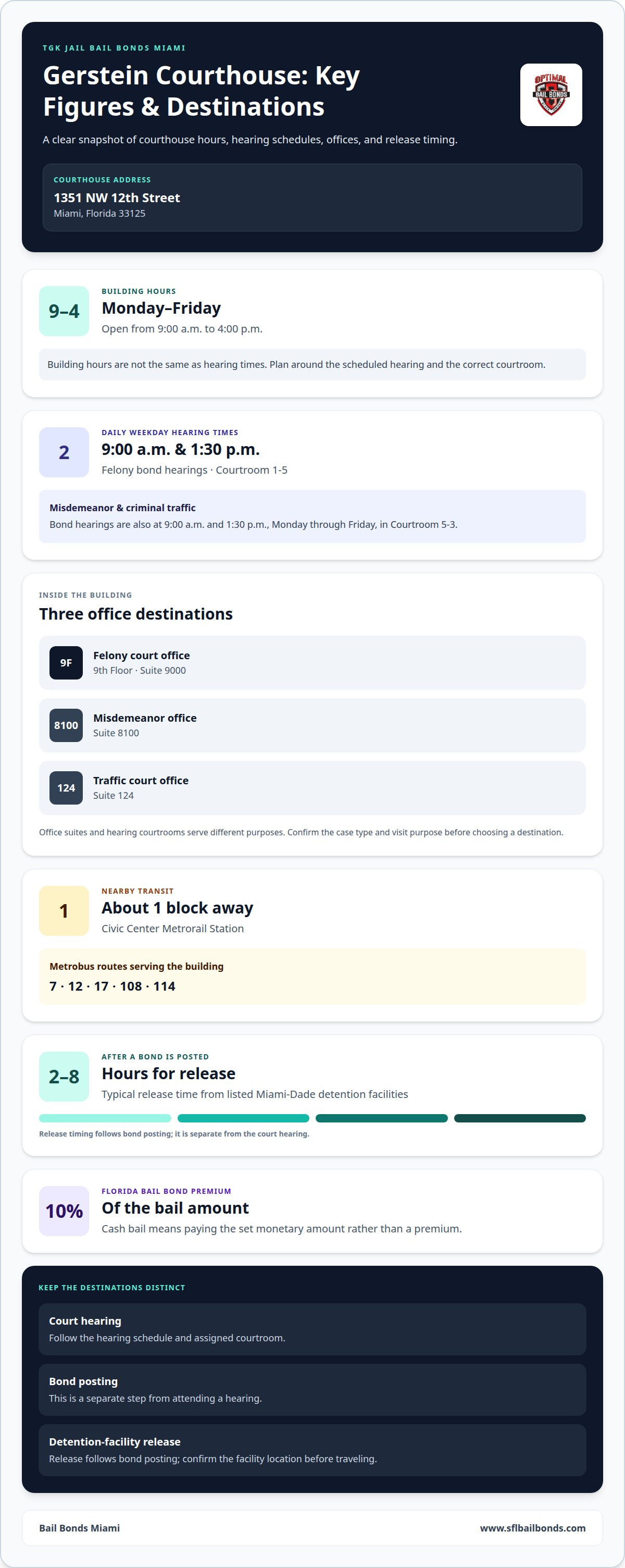
Posting bail at the Richard E. Gerstein Justice Building in Miami, Florida, involves knowing whether the next step is a court hearing or arranging release from detention. The building is at 1351 NW 12th Street and is open Monday through Friday from 9:00 a.m. to 4:00 p.m. Defendants typically appear in person, though a court may sometimes allow a Zoom appearance. After a bond is posted, release from listed Miami-Dade detention facilities usually takes two to eight hours.
A courthouse visit can feel like one more uncertainty when you’re already worried about someone in custody. Knowing where to go and what may happen there can make the process easier to navigate.
This guide explains the Gerstein building’s address and hours, whether a defendant must appear, and what to expect on arrival. It also distinguishes a court hearing from posting bond and waiting for release, so you can focus on the next practical step.
Key Takeaways
- For felony matters, the Criminal Court felony office is on the 9th Floor in Suite 9000; knowing the case type helps you head to the relevant office.
- Miami-Dade felony bond hearings are held at 9 a.m. and 1:30 p.m. Monday through Friday in Courtroom 1-5.
- A bench warrant, also called an alias capias, means the person cannot post bond and must appear before a judge.
- Plan your route to the courthouse in advance: the Civic Center Metrorail Station is about 1 block away, and Metrobus routes 7, 12, 17, 108, and 114 serve the building.
- Keep the court hearing, posting bond, and release from detention in perspective as separate steps in the process.
Courthouse security and arrival timing
Courthouse arrival planning means allowing time to reach the right office and courtroom. The Richard E. Gerstein Justice Building is at 1351 NW 12th Street, Miami, Florida 33125. Its listed hours are Monday through Friday, 9:00 a.m. to 4:00 p.m. Arriving during those hours doesn't replace a scheduled court appearance or bond process. First identify whether the matter involves a felony, misdemeanor, or traffic case. That distinction helps direct you to the appropriate court service.
Felony court services are handled through the Criminal Court felony office. It is on the 9th Floor, in Suite 9000. Miami-Dade County felony bond hearings are held Monday through Friday at 9 a.m. and 1:30 p.m. in Courtroom 1-5. These are hearing times, not building opening hours. A person attending a hearing should allow time to find the correct floor and courtroom. Misdemeanor and criminal traffic bond hearings take place at 9 a.m. and 1:30 p.m. Monday through Friday in Courtroom 5-3.
Courthouse security and arrival timing involve reaching the building early enough to enter and locate the correct destination. The available details establish the courthouse location and court schedules, but not specific screening steps or wait times. Build your plan around the scheduled hearing, the building’s weekday hours, and the correct courtroom. For example, someone attending a 9 a.m. felony hearing should plan for Courtroom 1-5, not just the 9th-floor felony office. The office and courtroom serve different purposes.
Metrobus service is public bus transportation serving the courthouse area. Routes 7, 12, 17, 108, and 114 serve the Richard E. Gerstein Justice Building. The Civic Center Metrorail Station is about 1 block away. These options can help with route planning, but allow time to get from your stop or parking space to the courthouse entrance.
In Florida, a bail bond premium is 10% of the bail amount; cash bail means paying the set monetary amount rather than a premium. Florida Legislature says a surety bond may satisfy a monetary or cash component of pretrial release, and cash and surety release amounts cannot differ. To post bail, the relevant office needs information that identifies the defendant and case; accepted payment methods depend on the bond process and location. The listed courthouse phone number is (305) 275-1155, and bond can generally be posted at Turner Guilford Knight Correctional Center between 6 a.m. and 9 p.m. After the case ends, the court’s handling of posted bail depends on the case outcome and applicable bond conditions.
The jury service office is in Suite 700. The building also provides services for traffic violations and misdemeanor cases.
Weekday domestic violence bond hearings are at 11 a.m. in Courtroom 2A at Lawson E. Thomas Courthouse Center, 175 NW 1st Avenue, Miami, FL 33128.
Richard E. Gerstein Justice Building address
The Richard E. Gerstein Justice Building is Miami-Dade County’s main courthouse for criminal cases. Its street address is 1351 NW 12th Street, Miami, Florida 33125. Use the full address when arranging a ride or entering directions, since a nearby detention facility has a different street address. The building handles felony and misdemeanor criminal matters, as well as traffic court. That distinction can help you understand why a courthouse visit and a jail visit may involve different locations.
Miami-Dade County’s Pre-Trial Detention Center is at 1321 NW 13th Street, adjacent to the Gerstein building. Most county arrests are booked into that facility, Turner Guilford Knight Correctional Center, or Metro West Detention Center. Confirm the destination before traveling, as detention facilities and courthouses may be in different locations. These are detention facilities, not alternate names for the justice building. The arrest or booking location matters when arranging a visit or asking about release.
The civil courthouse is separate from the Gerstein building, at 73 W Flagler Street in Miami. An injunction is a court order, and the word may appear in legal paperwork connected with a case. Read the case paperwork carefully and use its courthouse name and address to identify the destination. An attorney can help explain unfamiliar case terms, while the address itself helps distinguish the criminal courthouse from the civil courthouse. This is a useful step before setting out, especially when someone gives you a courthouse name without a street address.
At the Gerstein building, the felony office is on the 9th Floor, Suite 9000. The misdemeanor office is in Suite 8100, and the traffic court office is in Suite 124. These suite numbers identify offices inside the building, not the booking location or necessarily the courtroom for a hearing. For example, a person handling a felony matter may need to distinguish the felony office from the assigned courtroom. The case type and purpose of the visit help explain which destination is relevant.
For bail-related guidance in Miami when posting bail at Richard E. Gerstein Justice Building Miami Florida, Optimal Bail Bonds can be a helpful next step when you’re working out how to proceed. Keep the courthouse address and detention facility address separate in your plans. That simple distinction can prevent a trip to the wrong location.
Whether defendants must appear in person
An in-person appearance means the defendant attends a court proceeding at the courthouse. Miami criminal defendants typically appear in person, although courts may sometimes allow an appearance by Zoom. The court decides whether remote attendance is permitted, so don’t assume a video appearance replaces a required courthouse visit. A defendant facing a felony or misdemeanor matter should follow the instructions for that specific hearing. The hearing may address bond and whether police had probable cause for the arrest.
A first appearance is an early court hearing after an arrest. In Miami-Dade County, a person who can’t pay the required money or was arrested for certain charges is taken before a judge within 24 hours. A person arrested on a bench warrant, also called an alias capias, isn’t allowed to post bond and must appear before a judge. That rule makes identifying the warrant type important: arranging payment alone won’t resolve a bench warrant.
After release, the defendant should review the release paperwork for conditions and upcoming court instructions. Follow the conditions listed there, and keep the paperwork available. The applicable terms depend on the court’s release decision, so don’t assume someone else’s conditions apply. Rely on the terms in the defendant’s own order, not informal advice about another case.
To find the bail amount, use the defendant’s booking or court information and identify the correct case. The amount can depend on the charge and the court’s decision, so avoid relying on a figure from another arrest. The Richard E. Gerstein Justice Building’s listed phone number is (305) 275-1155. When seeking information, have the defendant’s name and case details ready to help identify the matter.
If bail can’t be posted, the next step may be a court appearance where a judge considers the case and release terms. If bond has been posted but release is delayed, release from the listed Miami-Dade detention facilities usually takes two to eight hours. Keep the payment record and case details handy. If release hasn’t occurred after that period, contact the detention facility handling the booking to ask about its status. A receipt or case number can help staff locate the transaction.
Building opening hours
Building opening hours are the times the courthouse is open to visitors. The Richard E. Gerstein Justice Building is open Monday through Friday from 9:00 a.m. to 4:00 p.m. It is closed on Saturdays. These hours describe the building, not every court hearing or detention service. A scheduled hearing may follow a separate timetable, so identify the specific court event before planning your trip.
For weekday felony matters, Miami-Dade County bond hearings are held at 9 a.m. and 1:30 p.m. in Courtroom 1-5. Misdemeanor and criminal traffic bond hearings are scheduled at those times in Courtroom 5-3. These hearing times differ from the building’s 9:00 a.m. opening time. For a 9 a.m. hearing, arriving at the courthouse after the hearing begins would be too late. Plan the route and entry around the scheduled court time.
Weekend and holiday schedules require particular care. Misdemeanor bond hearings are held once daily at 9 a.m. Weekend and holiday hearing schedules may differ from regular building hours. Weekend felony hearing schedules may differ from ordinary weekday schedules, so check the specific schedule before travelling. The building is listed as closed on Saturdays, while these special hearing schedules are also listed. Don’t treat ordinary public hours as a complete account of court scheduling.
A criminal case concerns an alleged violation of criminal law. The case type helps identify the relevant hearing schedule and courtroom. A federal case involves federal charges, while the listed Gerstein schedules cover Miami-Dade County court proceedings. Don’t assume the county courthouse’s public hours establish the schedule for a federal matter. Check the paperwork for the court and hearing details before travelling.
A payment plan is an arrangement for paying an obligation over time. It doesn’t change courthouse opening hours or a hearing time, and the stated information doesn’t establish that a payment plan is available for bail. Bond payment and court attendance are separate steps. Even when arranging payment, account for any scheduled appearance. If a hearing falls outside weekday public hours, follow the specific weekend or holiday schedule rather than assuming the weekday timetable applies.
To plan, match the case type to the hearing schedule, note the courtroom, then allow time to reach the building. Expect weekday public access between 9:00 a.m. and 4:00 p.m.; Saturday is listed as closed. A court hearing time, a building-hours listing, and detention booking operations are distinct details. Keeping them separate can prevent confusion when coordinating a courthouse visit for a Miami-Dade County case.
Can you post bail at the Richard E. Gerstein Justice Building?
Posting bail means meeting the court’s release conditions so a defendant may leave custody. The Richard E. Gerstein Justice Building is a courthouse for criminal matters, including bond hearings; bond can generally be posted at Turner Guilford Knight Correctional Center (TGK) between 6 a.m. and 9 p.m. A hearing at the courthouse and payment at a detention facility are separate steps. For families posting bail at the Richard E. Gerstein Justice Building in Miami, Florida, identifying the needed step helps avoid a trip to the wrong location.
A bond hearing is a court proceeding where a judge addresses release conditions. Miami-Dade felony bond hearings take place at the Gerstein building on weekdays, while misdemeanor and criminal traffic bond hearings have their own courtroom schedule. A judge may set or adjust bond based on the case. Florida Statute 903.046 allows judges to adjust bond based on the specific facts of a case. Attending a hearing doesn’t itself mean payment has been made or release completed.
Florida’s uniform statewide bond schedule under Florida Statute 903.011 took effect on January 1, 2024. The schedule provides a starting framework, while a judge may adjust bond under Florida Statute 903.046. Once the bond amount and type are known, the next step depends on the release option. Florida Legislature says a surety bond may satisfy a monetary or cash component of pretrial release, and different amounts for cash and surety release are barred.
Cash bail means paying the required amount, while a surety bond involves a bail bond arrangement. The detention facility and bond instructions determine where payment is processed. Have the defendant’s identifying and case information available when arranging payment. A bench warrant, also called an alias capias, is an important exception: someone arrested on one cannot post bond and must appear before a judge.
After bond is posted, the detention facility still has to process the release. Release from the listed Miami-Dade County detention facilities usually takes two to eight hours after bond is posted. This is a processing estimate, not the time needed to travel from the courthouse or attend a hearing. Keep the transaction details handy while release is processed. If the case requires a judge’s decision first, payment alone doesn’t replace that hearing.
Understanding posting bail at the Richard E. Gerstein Justice Building in Miami, Florida, means distinguishing among a court appearance, bond payment, and detention-facility release. TGK is the named facility where bond can generally be posted during the stated hours. The Gerstein building is relevant when the case requires a hearing. Identifying whether the immediate need is a hearing or payment helps determine the next step.
SFL Bail Bonds: Bail Bonds Miami
SFL Bail Bonds offers Bail Bonds for people considering a surety bond after a court sets bond. If you’re unsure how a bond arrangement relates to the courthouse hearing and detention-facility release, SFL Bail Bonds can help explain the process. Have the defendant’s name and case details ready so the conversation can focus on the situation. A bail bond is one way to meet a monetary release condition; the court’s order determines the amount and applicable terms.
For a separate educational goal, SFL Bail Bonds also offers How to be a Bail Bondsman. That offering is relevant to people exploring the profession, not families arranging release. For help with a Miami bail bond, contact SFL Bail Bonds at (786) 536-7378.
Take the next step with clarity
Once you know which part of the process is pending, focus on the next action: identify whether the priority is a court appearance, a bond arrangement, or release processing. If you’re coordinating posting bail at the Richard E. Gerstein Justice Building in Miami, Florida, keep case details and communication records together to follow developments and avoid confusing separate steps.
For help with a Miami bail bond, SFL Bail Bonds offers Bail Bonds Miami. Those exploring the profession can also learn about its Pre-Licensing Bail Bonds Class, 120 Hours Bail Bonds Course, and How to be a Bail Bondsman. These educational offerings serve a different goal from arranging release, so choose the path that fits your immediate need.
Take things one step at a time. A clear next action can make a difficult situation feel more manageable.
Frequently Asked Questions
How long does it take to get released from a Miami-Dade County jail?
Release from the listed Miami-Dade detention facilities usually takes two to eight hours after bond is posted. That timeframe starts after payment, not at arrest or arrival at court. If a judge must first determine release terms, the hearing comes before bond payment and release processing. Someone still awaiting a first appearance, for example, hasn’t yet reached the post-bond release stage.
What happens if I'm arrested?
After an arrest in Miami-Dade County, the person is booked into a detention facility, and the case may require a first appearance before a judge. A person who can’t pay the required money or was arrested for certain charges is taken before a judge within 24 hours. Most arrests are booked into the Pre-Trial Detention Center, Turner Guilford Knight, or Metro West Detention Center. The booking location helps identify where the person is held.
When will I get out of jail?
Release timing depends first on whether bond is set and the required bond is posted. Once posted, release from the listed Miami-Dade detention facilities usually takes two to eight hours. Someone arrested on a bench warrant, also called an alias capias, cannot post bond and must appear before a judge. A person waiting for that court decision is at a different stage from someone whose bond has already been posted.
Where is the Richard E. Gerstein Justice Building in Miami, Florida?
The Richard E. Gerstein Justice Building is at 1351 NW 12th Street, Miami, Florida 33125. It’s the main courthouse for criminal cases in Miami-Dade County, and it handles felony and misdemeanor matters, as well as traffic court. Don’t confuse the courthouse with the adjacent Pre-Trial Detention Center, which is at 1321 NW 13th Street. Use the courthouse address when travelling to a court appearance.


