
Will an arrest automatically come with a bond? No. In the bail release process for arrests in Doral, Miami, Florida, a judge may set, increase, reduce, or deny bond. Many people arrested in Miami are brought before a judge for a first appearance within about 24 hours, though the timing can vary.
It’s understandable to expect that paying bond means someone can leave right away. But even after bond is posted, release may take several hours because booking, other holds, court conditions, and jail processing can affect the timing.
This guide explains the steps from arrest and booking through the first appearance, how bond and release conditions are determined, and why posting bond may not lead to immediate release. You’ll also learn what information helps start the bond process and what to keep in mind after release. Knowing the steps can make a confusing situation easier to navigate.
Key Takeaways
- Understand what happens during booking and first appearance, and why the timing can vary.
- Learn which factors can shape bond amounts and release conditions, including the charges and a person’s history.
- Know why following every release condition and attending court dates matters after release.
- See how arrest transport and processing at a Miami-Dade detention facility fit into the release timeline.
- Compare the basic difference between posting a cash bond and using a surety bond.
Does posting bond guarantee immediate release?
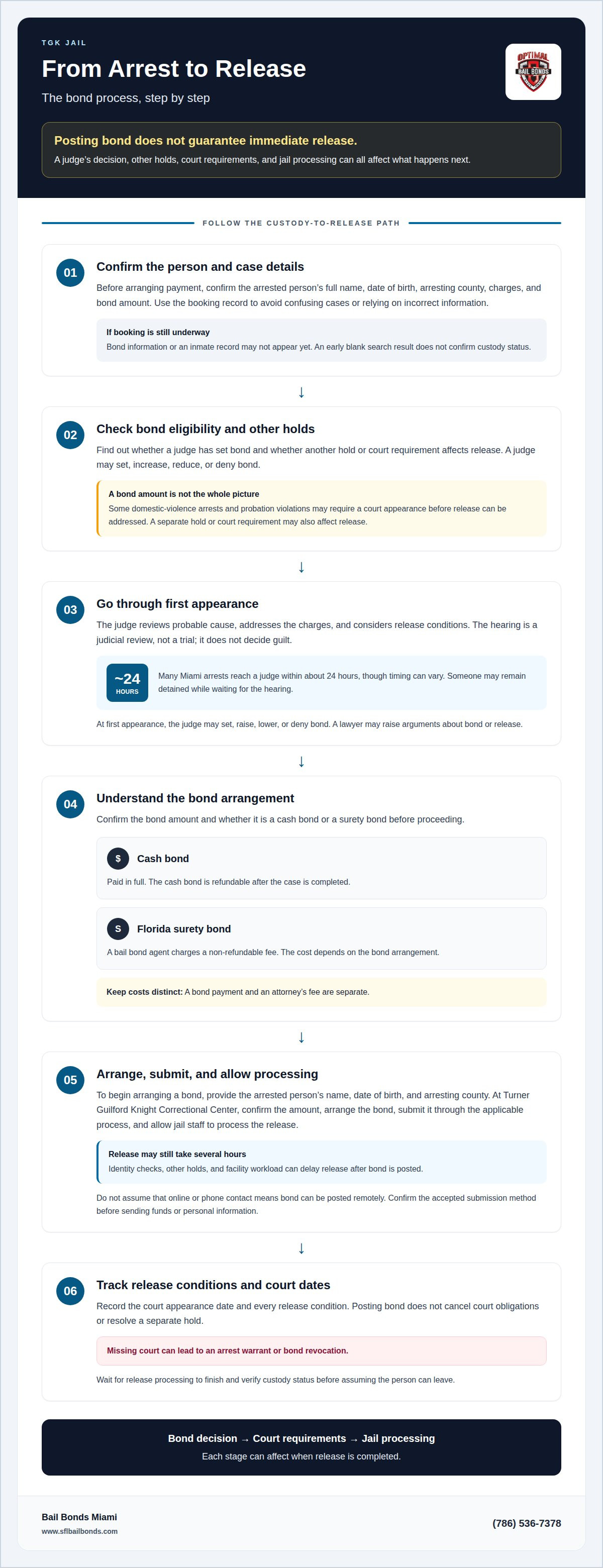
No. In the bail release process for arrests in Doral, Miami, Florida, a judge may set, change, or deny bond, and posting bond does not guarantee immediate release. Use these steps to confirm custody status, understand the bond arrangement, and keep track of court obligations.
-
Confirm Information Before Posting Bond
Confirm the arrested person’s full name, date of birth, arresting county, charges, and bond amount before arranging payment. Booking may still be underway, so bond information may not appear immediately. For information about posting bond or an inmate’s bond amount, call Miami-Dade County inmate information at 786-263-7000.
Use the person’s booking record to avoid confusing cases or paying based on incorrect information. If the record is not available yet, booking may still be underway.
-
Check Bond Eligibility and Holds
Find out whether a judge has set bond and whether another hold or court requirement affects release. A judge may set, increase, reduce, or deny bond. Some domestic-violence arrests and probation violations may require a court appearance before release can be addressed.
At first appearance, the judge reviews probable cause, addresses the charges, and considers release conditions. Many Miami arrests reach a judge within about 24 hours, though timing varies. An attorney can address bond arguments with the court.
-
Arrange and Post the Bail Bond
To begin arranging a bond, provide the arrested person’s name, date of birth, and arresting county. Confirm the bond amount and whether it is a cash or surety bond before proceeding. At Turner Guilford Knight Correctional Center, confirm the bond amount, arrange the bond, submit it through the applicable process, and allow jail staff to process the release.
Posting bond does not end the process immediately. Identity checks, other holds, and facility workload can delay release for several hours.
- A bail bond agent charges a non-refundable fee for a Florida surety bond. A Florida cash bond is paid in full and is refundable after the case is completed. The cost depends on the bond arrangement. Distinguish the bond payment from any separate attorney’s fee before deciding how to proceed.
- Do not assume that online or phone contact means bond can be posted remotely. Miami-Dade’s inmate information line provides bond information, but that does not establish that payment or posting can be completed online or by phone. Confirm the accepted submission method before sending funds or personal information.
- Record the court appearance date and every release condition. Missing court can lead to an arrest warrant or bond revocation. In the bail release process for arrests in Doral, Miami, Florida, remember that posting bond at TGK does not cancel court obligations or resolve a separate hold. Wait for release processing and verify custody status before assuming the person can leave.
How long can you be held after an arrest in Miami?
Booking can take several hours, and detention may continue until judicial review or release arrangements are complete. The steps below explain what happens while someone awaits a first appearance.
-
Complete Booking After Arrest
Check whether booking is complete before relying on an inmate search or expecting a bond decision. Miami-Dade booking may take several hours, depending on intake volume and individual circumstances. During this stage, the arrest record and charges are processed. A recent arrest may not appear in the county inmate search right away, so an early blank result does not confirm someone’s custody status.
Have the person’s full name and date of birth ready when seeking an update. These details help identify the correct record when names are similar.
-
Attend the First Appearance
Treat the first appearance as a judicial review, not a trial. The judge reviews probable cause, informs the arrested person of the criminal charges, and addresses counsel and release conditions. A lawyer may raise arguments about release or bond. If the judge finds no probable cause, the person may be released after this initial review.
In Miami, first appearance generally occurs within about 24 hours, though timing can vary. Someone may remain detained while waiting for that hearing.
- Find out whether a bond was scheduled during intake or remains for the judge to determine. If bond was not set earlier, the judge addresses it at the first appearance. The court may set, raise, lower, or deny bond. A scheduled bond does not remove the need to understand the charges, release conditions, or other custody issues.
For example, a listed bond amount may not resolve a separate hold or court requirement. Confirm what the record shows before treating a scheduled amount as a release time.
- Use the first appearance to understand the immediate court decisions. The hearing may address whether probable cause supports the arrest, the charges, release conditions, and appointment of a public defender if the person is eligible. It does not decide guilt. The judge’s review helps determine whether release can proceed or detention will continue.
Keep track of the hearing outcome and any instructions. Release conditions remain important after the person leaves custody.
- Separate the hearing timeline from the jail’s processing timeline. Even after a judge addresses release, staff may need to complete custody procedures. If bond was set during intake, confirm the record reflects that amount; if not, the first appearance is where the judge considers bond. For practical Miami bail bond guidance, focus on the bond status and the court’s specific release decision.
The wait depends on booking progress, the hearing, and any additional custody issue. Keep the person’s record details ready when following the case.
Release conditions and court dates
In Doral, a judge sets bond by considering the charges and case-specific release factors. The decision may be release on recognizance, a monetary bond, or release with other conditions.
-
Determine Bond Amounts and Conditions
Review the court’s decision and the factors behind the release terms. In Miami, charges, criminal history, flight risk, violence allegations, community ties, arrest circumstances, and court orders can affect bond and conditions. These factors vary by case; a defense attorney can address them at a bond hearing. A consultation can explain the hearing process, but cannot change the judge’s decision.
-
Review Release Conditions
Read every court-ordered condition carefully before leaving custody. Terms may include no-contact orders, travel limits, or testing requirements. If the order requires electronic monitoring, follow its instructions and restrictions. In a Miami-Dade case, an invitation from a protected person does not cancel a no-contact order. Follow the written court order.
- Record every court date and condition in one reliable place. Missing a court appearance can lead to an arrest warrant or bond revocation. For example, someone subject to a no-contact order should keep the order accessible and avoid contact, even if the protected person reaches out. Ask a lawyer about unclear terms before acting.
- Track the next court event as well as release. In Miami-Dade County, arraignment typically follows within 21 days for misdemeanor charges. When a defendant remains in custody on felony charges, arraignment typically follows within 33 days. These are typical timelines, not permission to miss a scheduled appearance. Use the date stated for the individual case.
- Address a condition promptly if circumstances make it difficult to follow. A travel restriction, for example, may affect work or family plans, while testing requirements may need careful scheduling. Do not assume an informal agreement changes a court order. A defense attorney can ask the court to address a condition. Continue following the existing terms unless the court changes them.
Arrest and transport to a Miami-Dade detention facility
For official Miami-Dade custody and bond information, use the county inmate search or call Miami-Dade County inmate information at 786-263-7000 about posting bond or an inmate’s bond amount. A recent arrest may take time to appear in search results.
- Identify the arresting agency and county before searching. An arrest in Doral may lead to processing in Miami-Dade County, but the custody location depends on the case and intake arrangements. An arrest may occur with or without a warrant, depending on the circumstances. Keep the person’s full name and date of birth handy to distinguish the correct record from similar names.
- Search the Miami-Dade County inmate database for a custody listing. A recent arrest may not appear right away, especially while booking information is being entered. If there is no result, use the Miami-Dade inmate information line for bond questions or search again as processing advances. The county search does not include everyone held by federal authorities, immigration authorities, or another county.
- Find out which detention facility may be involved. Miami-Dade arrests may be processed at Turner Guilford Knight Correctional Center, Pre-Trial Detention Center, or Metro West Detention Center. People arrested in the county are transported to a detention facility for processing. The facility shown in custody information can help families direct inquiries appropriately.
- Use TGK details when the person’s record points to Turner Guilford Knight Correctional Center. The center is at 7000 NW 41 Street, Miami, Florida 33166. Miami-Dade County identifies TGK as its designated inmate release center. That designation concerns release, while the specific arrest record helps establish where the person is being processed or held.
- Allow for transfers and incomplete updates when following custody information. Miami-Dade arrests may involve different facilities, and a person’s location can change as processing continues. Compare the name and date of birth against each update instead of relying on a single early result. If the person is not listed, remember that federal custody or custody in another county falls outside the county search.
- Keep practical details organized while the person is in custody. Record the arresting county, listed facility, booking status, and bond information as they become available. People in custody have access to free phone calls throughout the Miami-Dade booking process. A criminal defense attorney can address legal questions about the arrest, while the county’s inmate information line can answer bond-information questions.
Bail and release from custody
A person in Miami-Dade may be released without paying bail if the judge grants release on recognizance. This means release without posting money, although conditions may still apply.
- Identify the release arrangement ordered by the court. A person may be released on recognizance, required to post a cash bond, or released under other conditions. A cash bond requires payment of the full amount, while a surety bond involves a bail bond agent posting a bond. These are different arrangements, so confirm what the court requires before proceeding.
- Compare the bond amount with the person’s ability to pay it directly. In some Miami cases, the arrested person or family may pay the required bond amount; another option is to use a bail bond agency. A bond hearing can address whether release should occur before trial and under what conditions. The judge considers the case when setting or reviewing those terms.
- Ask a defense attorney about a bond hearing if the amount or conditions create a barrier to release. The person may ask the court to consider a lower bond or modified conditions. A defense attorney can present relevant circumstances, such as community ties or employment, when arguing for reasonable bail or release on recognizance. The court makes the decision.
- Consider the financial obligations before choosing a bond method. A Florida cash bond is paid in full and is refundable after the case is completed. A surety bond payment is non-refundable. A co-signer may guarantee compliance and could be responsible if conditions are violated. Understand these distinctions before agreeing to an arrangement or signing bond documents.
- Plan for processing after the bond is posted. In Miami-Dade, release can take several hours, and the process may take over 24 hours depending on bond status, facility, and processing volume. Identity verification, holds from other agencies, and facility workload can affect the wait. A posted bond does not itself resolve a separate hold or court condition.
- Keep state and federal custody procedures distinct. Federal arrests follow a different release process from state arrests, so Miami-Dade bond information may not explain a federal case. After release, follow every court condition and attend each appearance. Missing court can lead to an arrest warrant or bond revocation, regardless of the bond arrangement.
Optimal Bail Bonds: Bail Bonds Miami
Optimal Bail Bonds offers Bail Bonds in Miami for people considering a bail bond after a court sets bond. If someone is held at TGK, understanding the facility and bond status can help families identify the next step. A bail bond is one possible route to release; it does not replace court decisions, resolve separate holds, or remove release conditions.
Consider a bail bond when the court has set bond and you need help arranging that type of release. If the judge requires a hearing or denies bond, a bail bond alone will not secure release. A defense attorney can address legal questions about charges and court orders.
Contact Optimal Bail Bonds to discuss Bail Bonds Miami.
Take the next step with clarity
Understanding the bail release process for arrests in Doral, Miami, Florida can help families make informed decisions as a case moves forward. Focus on the immediate need: arranging a bond, understanding the court’s instructions, or learning about the bail profession. Each calls for a different kind of support.
For people exploring the profession, Optimal Bail Bonds offers a Pre-Licensing Bail Bonds Class, a 120 Hours Bail Bonds Course, and How to be a Bail Bondsman. These educational options are distinct from help arranging a bond after an arrest. Choose the path that fits the situation, and keep court-related questions directed to a defense attorney.
A difficult moment can feel more manageable when the next step is clear. Take one decision at a time.
Frequently Asked Questions
Will I get a bond automatically?
No. A judge may set bond, change an amount set earlier, or deny bond. The decision depends on the case and applicable release factors. Some people may be released on recognizance, which requires no bond payment but may still carry conditions. For example, the court could require someone to attend hearings or follow restrictions after release. Do not assume a bond amount until it appears in the case information.
How Long Until They Are Released?
The wait depends on booking, the first appearance, the bond decision, and jail processing. In Miami, many first appearances occur within about 24 hours, though timing varies. After bond is posted, release may still take several hours, and Miami-Dade release can take over 24 hours depending on the facility, workload, and custody status. A separate hold or unresolved court requirement can also affect when someone leaves custody.
What happens at a bond hearing and how can it affect the rest of the case?
A bond hearing addresses whether a person can be released before trial and what conditions apply. The judge may consider the charges, criminal history, community ties, employment, and risk of failing to appear. The hearing does not decide guilt. Its outcome can affect whether a person can live outside custody while the case proceeds, but the person must still attend court and follow all release terms.
Where are people arrested in Doral, Florida booked and held?
People arrested in Miami-Dade may be processed at Turner Guilford Knight Correctional Center, the Pre-Trial Detention Center, or Metro West Detention Center. The facility depends on the custody record and processing arrangements. Search the Miami-Dade County inmate database for a listing, keeping in mind that a recent arrest may not appear right away. The county search does not include people held by federal authorities or another county.
What payment methods and documents are needed to post bail in Doral?
To begin arranging a bail bond, have the arrested person’s name, date of birth, and arresting county ready. The payment method depends on the bond arrangement and where payment is made. Optimal Bail Bonds accepts checks and credit cards for its services; this does not establish which methods a jail accepts for direct cash-bond payment. Confirm the required payment route before sending money or documents.
How long does release take after bail is posted at a Miami-Dade jail?
Release processing can take several hours after bond is posted, and the total wait may exceed 24 hours. Timing can depend on the facility’s workload, identity verification, bond status, and whether another agency has placed a hold. For example, posting bond in one case won’t resolve a separate hold. Follow the custody record and allow the jail to complete its release procedures before expecting departure.
What happens if the arrested person violates bail conditions or misses court?
A missed court date can lead to an arrest warrant or bond revocation. Violating release terms, such as a no-contact order or travel restriction, can also create serious complications in the case. An invitation from a protected person does not cancel a court-ordered no-contact condition. Keep the written order and court dates accessible, and direct questions about changing a condition to a defense attorney rather than treating it as optional.


