
What happens after an arrest for alleged drug possession in Miami-Dade County? Navigating bail for drug possession charges in Miami-Dade County generally begins with a first appearance before a judge within 24 hours, when bail is set and the person’s rights are explained. The amount may follow a bond schedule or reflect the judge’s discretion.
An arrest can leave a person and their family facing urgent decisions with little time to understand the process. The charge alone does not determine the outcome: courts may consider the alleged offense, criminal history, prior missed court appearances, community ties, and public-safety concerns.
This guide explains how the bail process works in Miami-Dade County, how cash, surety, and property bonds differ, and what may affect a release decision. It also covers possible conditions, such as restrictions on locations or contact with specific people, so you can understand what release may involve and what comes next.
Key Takeaways
- A judge may use Florida’s statewide bond schedule as a guide, while also considering the circumstances of the case.
- Cash, surety, and property bonds work differently, so understand what each option may require before choosing how to secure release.
- Courts may weigh the charge, criminal history, prior missed appearances, community ties, and public-safety concerns when setting bail.
- Release can come with court-ordered conditions, including restrictions on locations or contact with specific people; follow every condition.
- According to the Florida Legislature, after a missed required court appearance and a later arrest, a defendant cannot receive a recognizance bond or a bond below $2,000 or twice the original bond’s monetary commitment, whichever is greater.
Release conditions such as home confinement, monitoring, and drug testing
In Miami-Dade County, a person arrested on a criminal charge is scheduled for a first appearance before a judge within 24 hours. At that hearing, the judge explains the person’s rights and addresses release, including bail and any conditions. The decision is separate from whether the defendant is guilty. It sets the rules that apply while the case is pending.
Florida Statute 903.047 is cited as setting conditions for pretrial release. A judge may set specific terms, including restrictions on locations or contact with particular people. Read the written order carefully: its exact wording identifies what the defendant must do or avoid. A general instruction to “follow the rules” is not a substitute for understanding each condition.
A release order may restrict movement, require monitoring, or include drug testing. For example, if the order requires a defendant to remain at home except for approved activities, leaving for an unapproved purpose could violate that condition. If testing or monitoring is ordered, the written conditions specify what applies. Do not assume a condition exists unless it appears in the court order.
Release on recognizance generally means a defendant is released after promising to attend court, rather than posting a monetary bond. Conditions may still apply. If pretrial services are involved, the order can specify reporting or other requirements. Keep the order accessible, note every court date, and follow the stated reporting instructions.
Release conditions can affect everyday decisions. A restriction naming a person or place may matter when arranging transportation, returning home, or managing family responsibilities. If a condition is unclear or circumstances change, raise the issue through a motion in court. A criminal defense attorney can address the legal request. Do not treat uncertainty as permission to ignore an order.
Florida law provides that a violation of a no-contact condition set at first appearance is a separate crime effective October 1, 2026. That makes compliance especially important when an order identifies someone the defendant must not contact. Calls, messages, or contact through another person can raise concerns under the order’s terms.
Release from custody follows the court’s decision and completion of the applicable release process. Posting bail does not cancel a court date or remove other conditions. Keep a copy of the release order, track every appearance, and follow each term until the court changes it. Missing an appearance or breaching a condition can create further problems in the pending case.
How bail works in Miami-Dade County
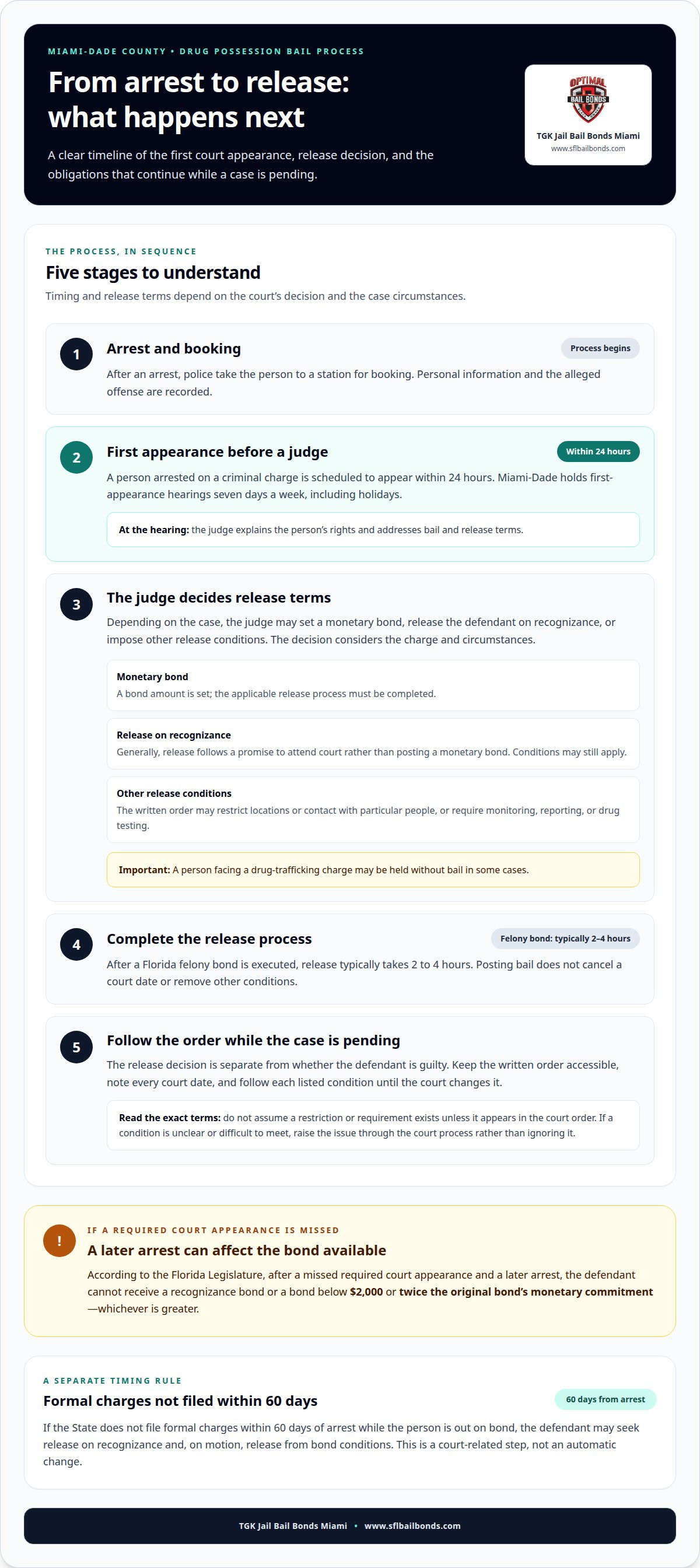
In Miami-Dade County, the process generally moves from arrest and booking to a judicial first appearance, followed by release or continued custody. Knowing this sequence helps families understand what happens after an arrest and what each court decision means.
After an arrest, police take the person to a station for booking, where personal information and the alleged offense are recorded. A person arrested on a criminal charge is scheduled for a first appearance before a judge within 24 hours. Miami-Dade holds these hearings seven days a week, including holidays. At the hearing, the judge explains the person’s rights and addresses bail and release terms.
The judge may set a monetary bond, release the defendant on recognizance, or impose other release conditions. The decision considers the charge and circumstances of the case. A person facing a drug-trafficking charge may be held without bail in some cases. If bail is set, release still requires completing the applicable process. After a Florida felony bond is executed, release typically takes 2 to 4 hours.
For families navigating bail for drug possession charges in Miami-Dade County, a missed appearance can quickly change the situation. Missing court can lead to bond forfeiture and additional legal consequences. If a defendant misses a required court appearance and is later arrested, the Florida Legislature states that the defendant cannot receive a recognizance bond or a bond below $2,000 or twice the original bond’s monetary commitment, whichever is greater.
Violating a release condition can put the defendant’s release at risk and prompt the court to address compliance. Follow the written order, including any restrictions on contact or location. If a condition becomes difficult to meet, raise the issue through the court process rather than disregarding it. A defense attorney can explain legal options and present a request to the judge.
Florida law also provides a route to address delayed formal charges. If the State does not file them within 60 days of arrest while the person is out on bond, the defendant may seek release on recognizance and, on motion, release from bond conditions. This is a court-related step, not an automatic change. Keep track of the arrest date, filed charges, and any motion.
For anyone navigating bail for drug possession charges in Miami-Dade County, understanding the process is essential. Identify the current court order, record every appearance date, and make sure the defendant understands each condition. Clear records and timely communication with a defense attorney can help keep the next court step focused.
Cash, surety, and property bonds
After a Miami-Dade judge sets bail, the bond type determines how release is secured and what financial risk remains. Cash, surety, and property bonds are not interchangeable. Each arrangement connects release to the obligation to attend court, so the choice matters beyond the first day out of custody.
A cash bond is money deposited with the court as security for the defendant’s court appearances. Florida Statute 903.31 provides for cash-bond refunds when the case ends or within 36 months, whichever comes first. A refund depends on the bond and the defendant meeting court obligations; it is not the same as a surety premium.
With a surety bond, a bail bond agent guarantees the required bond to the court. The defendant or family pays the agent a premium for that arrangement. The premium is generally nonrefundable, even if the charge is dismissed or the defendant is found not guilty. Before signing, understand who is responsible under the agreement and what happens if the defendant misses a hearing or court date. The agent’s obligation does not erase the defendant’s duty to appear.
A property bond uses real estate as collateral. In Miami-Dade County, the court places a lien on the property to secure bail, and the property can be forfeited if the defendant fails to appear. This puts the property owner at risk, not just the person charged. Before pledging real estate, understand the lien and the consequences of a missed appearance.
The practical difference is the source of security: cash is deposited, a surety agent guarantees the bond, and real estate backs a property bond. The amount set by the court still determines the required security. The charge and judge’s order shape what can be posted; the bond type does not decide guilt or predict a conviction.
Before choosing a bond type, identify what the court ordered and the required payment or collateral. For cash, clarify how the deposit is recorded and what court obligations affect its return. For surety, review the premium agreement and responsibilities. For property, understand the lien and the consequences of failing to appear. An attorney can explain legal options at a hearing, while the bond arrangement addresses release. Consider the ongoing obligations as well as the immediate release process, so the arrangement does not create avoidable financial strain.
Question #5: What factors will the court consider when deciding to give a defendant bail?
Florida judges may weigh the charge, criminal history, missed court appearances, community ties, and perceived public-safety risk. These factors can influence both the bail amount and any release conditions.
Judicial Bail Factors
Judicial bail factors are case details used to assess release and the amount required. Under §903.046, Florida judges consider the offense, criminal history, past missed appearances, community ties, and potential risk to public safety. The nature of the alleged drug offense matters, but it is only one part of the picture. A pending case is not a conviction.
For example, a defendant with strong local ties and a history of attending court may present different considerations from someone with missed appearances. A misdemeanor and a felony charge may also raise different concerns because the nature of the offense matters. The court exercises discretion rather than treating one detail as the only deciding factor.
The bail amount reflects the judge’s assessment of the case and release considerations. In Miami-Dade County, amounts can vary based on factors such as the nature of the offense and the defendant’s criminal history. The statewide bond schedule may guide a decision, but it does not strictly bind the Eleventh Judicial Circuit. A scheduled amount is not an automatic outcome.
Record and Status Considerations
A prior conviction can affect bail as part of the criminal history the judge considers. Probation status and immigration circumstances should be explained in context, but neither alone establishes a specific bail amount or release condition. A drug-related offense may separately affect a noncitizen’s ability to adjust to lawful permanent resident status, re-enter the United States, or seek naturalization, and may result in deportation.
At the hearing, the defendant’s record and current circumstances help frame the request. Relevant information may include local ties, prior court appearances, and the nature of the charge. If probation is part of the person’s circumstances, explain its relevance accurately rather than treating it as an automatic formula for a higher or lower amount. Bail decisions and immigration consequences are separate issues.
Community safety is another consideration, alongside the likelihood that the defendant will return to court. A history of missed court dates, for instance, relates directly to appearance concerns, while stable community ties may provide useful context. The judge weighs these details with the alleged offense rather than deciding based on the charge label alone.
Clear, relevant information can help the court understand the defendant’s circumstances during a bail hearing. A criminal defense lawyer can present those details and explain why a requested amount or condition fits the case. The judge makes the decision based on the factors before the court and the needs of the pending case.
How bail works in Miami-Dade County
In Miami-Dade County, the process generally moves from arrest and booking to a judicial first appearance, followed by release or continued custody. Each step affects what the defendant and family need to understand next.
After an arrest, the person is taken to a police station for booking, where personal information and the alleged offense are recorded. A person arrested on a criminal charge is scheduled for a first appearance before a judge within 24 hours. Miami-Dade holds these hearings seven days a week, including holidays. At the hearing, the judge explains the person’s rights and addresses bail and release terms.
The judge may set a monetary bond, release the defendant on recognizance, or impose other lawful release conditions. The decision considers the charge and the case circumstances. A person facing a drug-trafficking charge may be held without bail in some cases. If bail is set, release still requires completing the applicable process, and an executed Florida felony bond is typically followed by a release process taking 2 to 4 hours.
Missing court changes the situation. A missed appearance can lead to bond forfeiture and additional legal consequences. If a defendant misses a required court appearance and is later arrested, the Florida Legislature states that the defendant cannot receive a recognizance bond or a bond below $2,000 or twice the original bond’s monetary commitment, whichever is greater. A later arrest therefore may bring a stricter bond threshold.
Violating a release condition can put the defendant’s release at risk and prompt the court to address compliance. Follow the written order, including any restrictions on contact or location. If a condition becomes difficult to meet, raise the issue through the court process rather than disregarding it. A defense attorney can explain legal options and present a request to the judge.
Florida law also provides a route for addressing delayed formal charges: if the State does not file them within 60 days of arrest while the person is out on bond, the defendant may seek release on recognizance and, on motion, release from bond conditions. This is a court-related step, not an automatic change to the release order. Keep track of the arrest date, filed charges, and any motion.
For a family, practical next steps include identifying the court’s current order, noting every appearance date, and making sure the defendant understands each condition. A missed date or ignored term can affect the release decision. Clear records and timely communication with a defense attorney help keep the next court step focused.
Optimal Bail Bonds: Bail Bonds Miami
Optimal Bail Bonds offers Bail Bonds Miami for people and families arranging a bond after the court sets bail. This may be a useful next step when a surety bond is being considered and the defendant needs help with the release process. The court, not the bond provider, sets bail and any release conditions. A bail bond also doesn’t replace legal advice about the drug charge, a defense, or a court motion. For those questions, speak with a criminal defense attorney. Before proceeding, make sure you understand the bond agreement and the defendant’s ongoing duty to attend every court date. For help with a bail bond, contact Optimal Bail Bonds.
Take the Next Step With Clarity
If you’re navigating bail for a drug possession charge in Miami-Dade County, focus on the decision immediately in front of you. Understand the bond arrangement, keep communication clear, and make a plan to meet the court’s requirements. The bail process and the criminal case are separate matters, so questions about defense strategy belong with a criminal defense attorney.
For help arranging a bond, Optimal Bail Bonds offers Bail Bonds Miami. The company also offers a Pre-Licensing Bail Bonds Class, a 120 Hours Bail Bonds Course, and How to be a Bail Bondsman for people interested in bail-bond education. Choose the next step that fits your situation, and take it one decision at a time.
A clear next step can make a difficult moment feel more manageable. Move forward with care and support.
Frequently Asked Questions
How Does Posting Bail Work in Florida?
Posting bail means meeting the release terms ordered by the court so the defendant can leave custody while the case proceeds. First, identify the amount and bond type in the court record. Then arrange the required cash deposit, surety bond, or other ordered security. Release follows completion of the posting process, not simply the decision to pay. The defendant must still attend court and comply with every release condition.
How Much Bail Will I Have to Pay?
The amount depends on the charge, criminal history, prior court appearances, community ties, and the judge’s assessment of public-safety concerns. A schedule may guide the amount, but the judge can consider case-specific details. Distinguish the court’s bond amount from the payment for arranging a surety bond. Before paying, identify the bond type and exact amount in the current court order.
Question #2: What happens when the judge has ordered a Defendant held without bail pending the outcome of a bail hearing?
The defendant remains in custody while awaiting the hearing and the judge’s decision. At the hearing, the court considers whether release is available and what conditions may apply. A family can track the case and hearing information, while the defendant’s attorney addresses release arguments in court. A pending hearing does not authorize release; the court’s ruling and resulting order control.
Question #7: Can the defendant get bail without the necessity of having a full hearing?
Whether a defendant can post bail before arraignment depends on the circumstances and applicable court process. This differs from a judge making a case-specific decision at a hearing. The charge, existing court orders, and any release restrictions matter. If the court has ordered the person held, that order must be addressed through the court process before release can occur.
💊 Are People Charged with Drug Crimes Eligible for Bail in Florida?
Some people charged with drug crimes can be released on bail, but eligibility and conditions depend on the charge and the court’s decision. Possession allegations vary in severity, so the charge description alone does not establish release terms. The current court order determines whether bail is available and which conditions apply.
What bail amounts apply to drug possession charges in Miami-Dade County, Florida?
Estimates for Florida drug-charge bail start around $500 to $1,000 for a first-degree misdemeanor, around $10,000 for a third-degree felony, and $25,000 or more for a second-degree felony. These are starting estimates, not fixed amounts for every Miami-Dade case. The judge’s decision and specific charge control. A person navigating bail for drug possession charges in Miami-Dade County should rely on the amount in the current court record.
How does Florida’s bond schedule set bail for drug possession offenses?
Florida’s Statewide Uniform Bond Schedule provides a starting guide for bond decisions and takes effect January 1 each year. It guides, but does not strictly bind, decisions in Miami-Dade’s Eleventh Judicial Circuit. The schedule can help explain an initial amount, while the judge may weigh individual charges and circumstances. For anyone navigating bail for drug possession charges in Miami-Dade County, a scheduled amount is a guide, not a substitute for the court’s order.
How do you post bail in Miami-Dade County, and what payment methods are accepted?
Start by identifying the bond amount and type shown in the current court record. A surety bond is arranged through a bond agent, while a property bond uses real estate as collateral. The accepted payment method depends on the posting route and facility process, so follow the instructions for the specific bond.


