
A bond discharge certificate is not the same as a cleared criminal record. Obtaining a certificate of bond discharge from the Miami-Dade Clerk of Court provides official proof that a bond is no longer in effect. It also indicates that money posted for the bond will be released to the person who posted it. The case record is separate.
It’s understandable to expect one document to settle every loose end after a case or bond obligation ends. This guide explains what a certificate proves, what it doesn’t change, how to request the relevant court record, and what responsibilities remain after discharge. You’ll also learn what information a request may need and how bond discharge differs from sealing or expunging a record, so you can choose your next step with a clearer picture of what is and isn’t resolved.
Key Takeaways
- A bond discharge certificate shows that the bond is no longer in effect and supports release of money posted for it.
- Bond discharge doesn’t, by itself, clear or seal a criminal record; those are separate court processes.
- A petition to seal or expunge a record has specific attachment and sworn-statement requirements that affect whether it is complete.
- After a bond is discharged, the bondsperson is no longer responsible for the bond amount.
- Learn how Optimal Bail Bonds’ How to be a Bail Bondsman offering can help if you’re exploring work in the bail bond field.
Meaning of a certificate of discharge of bond
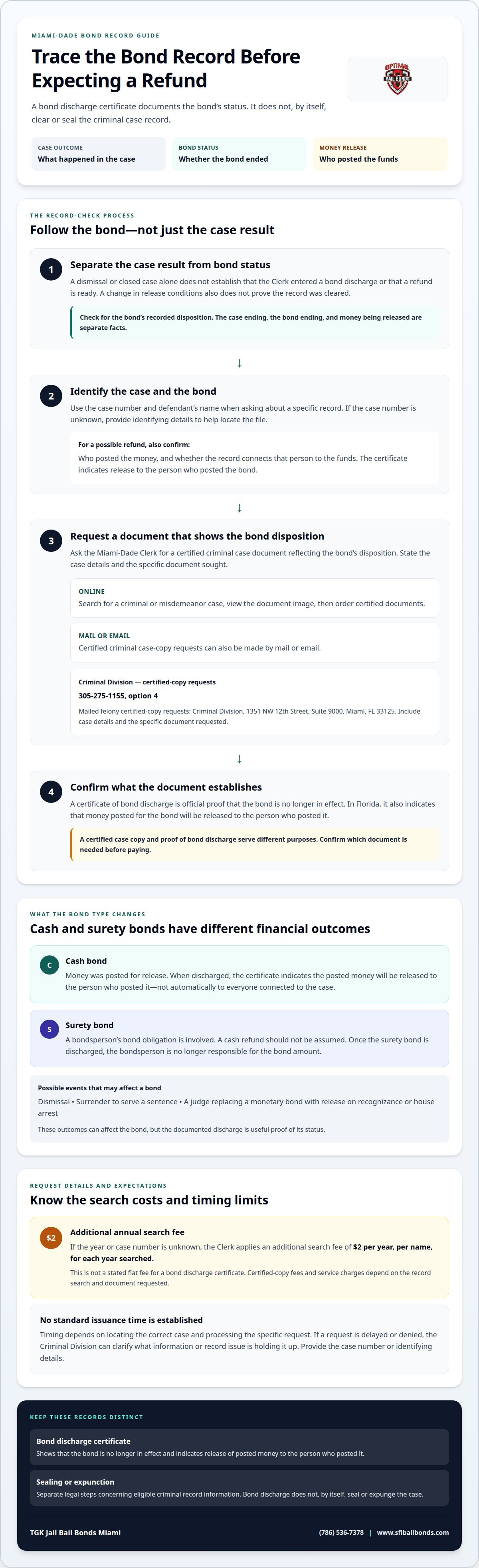
A certificate of bond discharge is a court record showing that a bond is no longer in effect. In Florida, it also indicates that money posted for the bond will be released to the person who posted it. It documents the bond’s status, not the outcome of every issue connected to a criminal case.
Discharge is different from clearing an arrest or criminal record. A discharged bond does not, by itself, seal or expunge the case record. For example, a person may have proof that a bond ended while the underlying case remains visible in court records. Sealing and expunction require separate legal steps, so don’t treat a bond document as proof that those steps occurred.
For certified criminal case documents, Miami-Dade provides several request routes. The Clerk’s online ordering service lets users search for a criminal or misdemeanor case and order certified documents after viewing the image. Requests for certified criminal case copies can also be made by mail or email. The Miami-Dade Clerk of the Court and Comptroller lists the Criminal Division at 305-275-1155, option 4, for certified-copy requests.
For a mailed felony certified-copy request, the Miami-Dade Clerk of the Court and Comptroller directs requests to the Criminal Division at 1351 NW 12th Street, Suite 9000, Miami, FL 33125. Include the case details and the specific document sought so the office can identify the record. If you don’t know the year or case number, the Miami-Dade Clerk of the Court and Comptroller applies an additional annual search fee of $2 per year, per name, for each year searched.
That search charge is not a stated flat fee for a bond discharge certificate. Fees and service charges apply to certified-copy orders, and the amount depends on the record search and document requested. Confirm which document you need before paying: a certified case copy and proof that a bond was discharged serve different purposes.
The available information doesn’t establish a standard issuance time for a bond discharge certificate. Timing depends on locating the correct case and processing the specific request. If the request is delayed or denied, contact the Criminal Division using the phone option above, provide the case number or identifying details, and ask what information or record issue is holding it up. For bond inquiries, use the Criminal Division contact; the listed Suite 9000 address is for mailed felony certified-copy requests.
Proof that a bond is no longer in effect
A bond discharge records that the bond obligation has ended. In Miami-Dade County, the case’s final outcome alone doesn’t establish that the Clerk entered a discharge or that a refund is ready.
Checking Discharge Status and Refund Eligibility
Discharge status is the court record showing whether a specific bond has ended. Obtaining a certificate of bond discharge from the Miami-Dade Clerk of Court starts with identifying the criminal case and requesting a document that reflects the bond’s disposition. A case dismissal or closed status alone may not mean the bond record was updated.
Look for the bond’s status, not just the case result. A dismissal may end the bond requirement, but the record should establish the bond’s own disposition. If a refund is at issue, confirm who posted the money and whether the record connects that person to the funds. The certificate indicates release to the person who posted the bond.
Use the case number and defendant’s name when contacting the court about a specific record. If you don’t know the case number, provide identifying details to help locate the correct file. Ask whether the discharge appears in the record and which document proves it. This separates three facts: the case ended, the bond ended, and money can be released.
Cash and Surety Bond Outcomes
A cash bond uses money posted for release, while a surety bond involves a bondsperson’s bond obligation. After a Miami-Dade case ends, the result for either type depends on whether the bond itself was discharged, not merely whether charges were dismissed.
For a discharged cash bond, the certificate indicates that posted money will be released to the person who posted it. That doesn’t mean everyone connected to the case receives the funds. The identity of the person who posted the money matters. A surety bond has a different financial arrangement, so don’t assume a cash refund applies.
A bond requirement may end after dismissal, surrender to serve a sentence, or a judge’s decision to replace a monetary bond with release on recognizance or house arrest. Those outcomes can affect the bond, but the documented discharge is useful proof of its status. A change in release conditions should not be mistaken for proof that a record was cleared.
For example, if charges are dismissed but the record still shows an active bond, ask about the bond’s recorded disposition. Before obtaining a certificate of bond discharge from the Miami-Dade Clerk of Court, distinguish the case outcome from the bond status. If a surety bond was discharged, the bondsperson is no longer responsible for the bond amount. Keep the case outcome and bond status distinct when discussing funds with the person who posted cash.
Required petition attachments and sworn statement
A petition to seal or expunge a criminal record is separate from a bond discharge request. A bond certificate concerns the bond’s status; a sealing or expunction petition asks the court to restrict or remove eligible record information.
To request proof of bond discharge, ask the Miami-Dade Clerk for a certified criminal case document reflecting the bond’s disposition. The Clerk allows certified criminal case copies to be requested by mail, email, or online. Include identifying case information and specify the document you need, so the request concerns the bond record rather than a record-sealing petition.
Florida Rule of Criminal Procedure 3.692 governs petition attachments for sealing or expunction. It provides that the petition is submitted to the clerk with the applicable certificate attached. For a sealing petition, Florida law requires a valid FDLE certificate of eligibility for the petition to be complete under section 943.059(3)(a). That eligibility certificate is not a bond discharge certificate.
The sworn statement is the petitioner’s signed, sworn account of eligibility and pending requests. Under Florida Rule of Criminal Procedure 3.692, it must state that the petitioner meets the eligibility rule and has no other sealing or expunction petition pending in any court. This statement addresses the petitioner’s record-clearing request, not whether a bond has ended or funds should be released.
Before filing, organize the petition and its attachments around the specific relief requested. A sealing petition needs its valid FDLE certificate of eligibility, and the sworn statement must address both required points. An expunction petition also follows the rule’s attachment process. Do not substitute a bond-discharge document for an eligibility certificate or assume one process completes the other.
Florida Rule of Criminal Procedure 3.692 also requires service of a sealing or expunction petition on the prosecutor and arresting agency. Those parties may respond, and the court may hear evidence about facts it needs to decide. A certificate of eligibility does not itself guarantee a court order; the rule permits a judge to deny the request.
If the court grants sealing or expunction, the person receiving the order must pay for certified copies unless indigent, under Florida Rule of Criminal Procedure 3.692. That later document step belongs to the record-clearing process, not the bond request.
For a Miami-Dade bond discharge record, request the certified case document that reflects the bond’s disposition. For sealing or expunction, file the separate petition with its required certificate and sworn statement. Keeping these requests distinct helps prevent a bond record from being mistaken for proof that criminal records were cleared.
Bondsperson responsibility after discharge
A bondsperson is the person or surety responsible for a bond obligation. In Florida, once the bond is discharged, the bondsperson is no longer responsible for the bond amount. The discharge applies to that bond; it doesn’t explain every separate arrangement connected with posting it.
Keep the bond record and case outcome distinct. A case may end through dismissal, sentencing, or another court action, but the bond’s recorded status shows whether the bond obligation ended. For example, a dismissal notice and a bond discharge document may describe different events. The discharge is the relevant record for confirming that the bondsperson’s responsibility has ended.
For a specific Miami-Dade case, identify the defendant and case number before discussing the bond’s status. Then obtain the court record reflecting discharge if you need written proof. A bondsperson reviewing a file should distinguish the named bond from other cases or obligations involving the same defendant. Similar names alone don’t establish that a record concerns the same bond.
A discharge certificate also has a limited purpose. It documents the bond status; it doesn’t certify that a professional license is active, determine future licensing eligibility, or clear the defendant’s criminal record. Those are separate questions. In Florida, keep any license inquiry separate from the court document confirming discharge, rather than treating one paper as proof of every status.
After discharge, use a short records check to keep the bond file clear:
- Match the case number and defendant’s name to the bond record.
- Keep the discharge document with the file for that bond.
- Separate the court’s discharge record from receipts or private agreements.
- Record any remaining question as a separate matter, not as an active bond amount.
These steps organize documents; they don’t create additional legal duties. For instance, if a Miami-Dade certificate shows discharge, the bondsperson is no longer responsible for that bond amount. The certificate doesn’t establish what any separate private agreement requires. Read each document for its own purpose, and don’t assume the court record resolves terms outside the bond.
If a record appears inconsistent, compare the case number, defendant’s name, and bond details first. A mismatch may mean the document belongs to another file, not that the discharged bond remains active. Ask the Miami-Dade Clerk about the court record if its status is unclear. Keep any license or private payment question separate, and use the discharge certificate only as evidence of the bond’s status.
Which Miami-Dade court office handles bond discharge certificates?
The Miami-Dade Clerk of the Court and Comptroller’s Criminal Division handles certified-copy requests for criminal case documents. For a bond record, direct the request to the criminal case file and identify the document you need.
Start by locating the case record. The Clerk’s online ordering service lets users search criminal or misdemeanor cases and order certified documents after viewing the image. Certified criminal case copies can also be requested by mail, email, or online. These options concern court documents; they don’t mean every kind of request follows the same process.
For help with a certified criminal copy request, the Miami-Dade Clerk of the Court and Comptroller lists the Criminal Division phone number as 305-275-1155, option 4. Have the defendant’s name and case number ready, if available. Explain that you need a document showing the bond’s disposition, rather than a general case summary or a record-clearing petition.
Mail requests for felony certified copies go to the Miami-Dade County Criminal Division at 1351 NW 12th Street, Suite 9000, Miami, FL 33125, according to the Miami-Dade Clerk of the Court and Comptroller. A mailed request should identify the defendant and case, state the document type, and provide the requester’s name and return address. Include a self-addressed stamped envelope for the response.
Before sending anything, separate the document you need from its purpose. A certified copy can provide an official case record. A bond discharge document concerns whether the bond obligation ended. A request to seal or expunge a record is a different court process with separate petition requirements. Naming the specific record helps the office understand what you’re seeking.
If you don’t know the case number or year, the Clerk’s search may require more identifying information. For certified-copy requests, the Miami-Dade Clerk of the Court and Comptroller charges an additional search fee of $2 per year, per name, for each year searched when the requester doesn’t know the year or case number. Including accurate names and available case details can help narrow the search.
Use the Criminal Division contact for certified criminal case documents, including a felony case copy request. Keep the case number, request details, and any response together. If a document does not show the bond’s disposition, describe the gap when contacting the office and ask which criminal case record addresses it.
Separately, the Clerk of the Court and Comptroller keeps official records that can be requested online, by mail, or in person.
Optimal Bail Bonds: How to be a Bail Bondsman
Optimal Bail Bonds offers a next step for readers exploring the bail bond field or facing a Miami bail question. If you’re interested in learning about the profession, its How to be a Bail Bondsman offering connects with that goal. If your concern is bail in Miami, Bail Bonds Miami is the relevant offering.
A bond discharge certificate addresses a court record, while these offerings relate to bail bonds and the profession. Keeping those needs separate can help you choose a useful next step without mistaking educational or bail-related information for a court document.
For questions about the available offerings, contact Optimal Bail Bonds at (786) 536-7378.
Choose Your Next Step With Confidence
Once your court-record task is clear, decide what you want to do next. If you're learning about the bail bond profession, Optimal Bail Bonds offers a Pre-Licensing Bail Bonds Class, a 120 Hours Bail Bonds Course, and How to be a Bail Bondsman. These educational options are for readers exploring professional training, not for requesting a court document.
If you’re still working through obtaining a certificate of bond discharge from the Miami-Dade Clerk of Court, keep your court-record request separate from any career plans. That distinction helps you focus on the right next step without expecting a training course to resolve a court matter.
Take the time you need to choose what fits your situation. Whether you’re considering training or want to understand the bail bond field better, a thoughtful next step can make the path ahead feel more manageable.
Move forward at your own pace, with a clear purpose for each step.
Frequently Asked Questions
Does a certificate mean the record is already cleared?
No. A bond discharge certificate concerns the bond, not whether a criminal record has been sealed or expunged. For example, a case may still appear in court records after the bond obligation ends. Record sealing or expunction involves a separate petition and eligibility process. Treat each document according to what it establishes, and don’t rely on bond paperwork as proof that a record is cleared.
What is a bond discharge certificate?
A bond discharge certificate is a court document showing that a specific bond obligation has ended. It helps distinguish the bond’s status from other case matters, such as pending charges or the visibility of a criminal record. For instance, someone may need proof of discharge for their own records even though the case file remains accessible. The certificate applies to the bond it identifies.
What is a bond discharge certificate in Miami-Dade County, Florida?
In Miami-Dade County, it is documentation connected to the bond record in a criminal case, not a document that erases the case itself. The Clerk’s Criminal Division handles certified-copy requests for criminal case records. If you need documentation for a particular matter, identify the case and specify that you’re seeking a record reflecting the bond’s disposition, not an expunction or sealing order.
What documents and case information are required to request bond discharge?
For a mailed criminal case copy request, provide the defendant’s name, case number, date of birth, charges, and the document type requested. Include your own name and mailing address, plus a self-addressed stamped envelope. If you don’t know the case number or year, provide the identifying details you have so the record can be searched. State clearly that you’re requesting documentation of the bond’s disposition.
What is the fee for a bond discharge certificate in Miami-Dade County?
Certified-copy fees depend on the record search and document requested. The $2-per-year search charge is not a flat fee for a bond discharge certificate.


