
Random drug-testing rules while you’re out on bond in Miami-Dade County depend on the release conditions in your case. Those terms say whether testing is required and what you must do to comply. If testing is part of your conditions, missing a test may raise concerns about compliance with your release.
It’s understandable to feel uncertain when instructions are unfamiliar or the consequences seem serious. To understand random drug-testing rules while out on bond in Miami-Dade County, start by identifying what your release order requires and how it explains testing and reporting.
This guide explains how court-ordered testing works, which substances and methods may be involved, and how missed tests can affect release conditions. You’ll also learn how to read your release terms and where bail bond guidance can help you navigate the process.
Key Takeaways
- Read your release conditions carefully to understand whether testing is required and what instructions apply.
- Testing procedures can affect how a specimen is collected and how results are interpreted.
- Pretrial Services may require random testing and may report missed tests or other noncompliance to the court.
- If you can’t attend a scheduled test, respond promptly and follow the instructions tied to your release conditions.
- Learn how different testing methods work before drawing conclusions about what a test can detect.
Court-ordered testing collection and result timing
Start with your written release conditions: they govern required tests and reporting instructions. Collection details and result timing depend on the procedure used for your test.
Testing Notices and Reporting Frequency
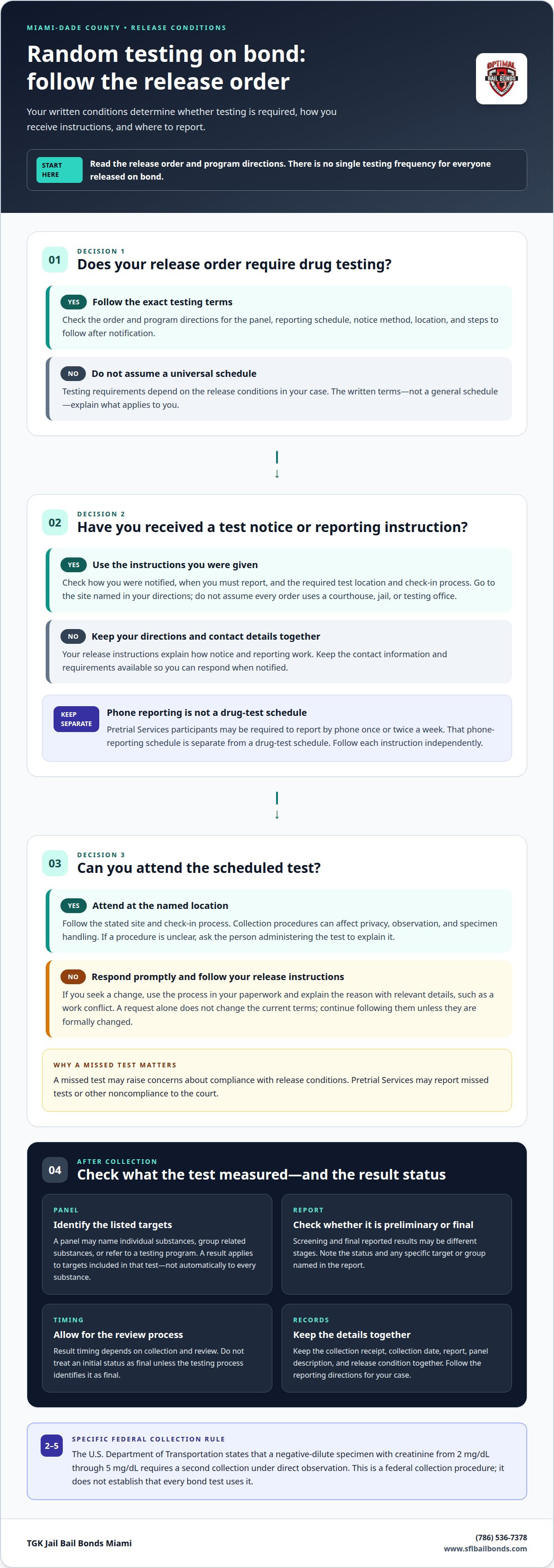
In Miami-Dade County, your release instructions determine how you receive notice and when testing or reporting is required. Read the order or program directions for the contact method, reporting schedule, and steps to follow after notification. There isn’t one testing frequency that applies to everyone released on bond.
Pretrial Services participants may be required to report by phone once or twice a week. That phone-reporting schedule is separate from a drug-test schedule. Follow each instruction independently, and keep the contact information and reporting requirements together so you can respond when notified.
Court-Ordered Testing Locations
Your court or program instructions identify where to complete a required test in Miami-Dade County. Go to the location named in those directions rather than assuming that a courthouse, jail, or testing office handles every order. If the instructions provide a specific site, address, or check-in process, follow those details.
At collection, staff follow the procedure for the test being administered. The collection method can affect privacy, observation, and specimen handling. Before collection begins, ask the person administering the test to explain the steps, especially if your written instructions describe a special procedure.
One federal collection rule addresses specimens reported as negative-dilute. According to the U.S. Department of Transportation, a negative-dilute specimen with creatinine from 2 mg/dL through 5 mg/dL requires a second collection under direct observation. This rule describes a federal collection procedure; it doesn’t establish that every bond test uses that procedure.
Result timing also depends on the collection and review process. A specimen may need additional handling or review before a final result is available. Keep any collection receipt or written instructions, note the collection date, and follow the reporting directions for your case. Don’t treat an initial status as a final result unless the testing process identifies it as final.
Testing and criminal charges are separate issues. Florida law prohibits specified controlled-substance offenses within 1,000 feet of the property of a public or private college, university, or other postsecondary institution, according to the Florida Legislature. That location-based rule concerns specified offenses, not the routine collection location for a bond test.
Likewise, a testing result doesn’t itself explain the penalty for a separate offense. The Florida Legislature states that, for a felony of the third degree, imprisonment may not exceed 5 years. Keep charge-related questions distinct from collection questions, and use the release instructions to understand where and when testing is required.
Drug-testing panels and substances detected
A drug-testing panel identifies the substances or substance groups included in a particular test. A bond condition that says “drug testing” doesn’t, by itself, describe every substance the panel covers. The test order and collection instructions are the key documents for understanding what a result addresses.
Read the panel description closely. It may name individual substances, group related substances, or refer to a testing program. Those labels matter: a result applies to the targets included in that test, not automatically to every substance a person might encounter. If the paperwork uses an unfamiliar abbreviation, ask the testing staff to explain it before collection.
A result also needs context. A screening result and a final reported result may represent different stages of the testing process. Check the status shown on the report, the panel used, and whether the result identifies a specific target or a broader group. This helps you avoid treating a preliminary status as a complete account of the test.
For example, if a report lists a group rather than a named substance, the group label describes the test’s scope. It doesn’t explain the circumstances behind a result. Keep the report together with the panel description and the release condition that required testing. These records help distinguish what the test measured from what the court ordered.
- Order: Find the exact wording of the testing condition.
- Panel: Identify the listed substances or groups.
- Report: Note whether the result is preliminary or final.
- Follow-up: Ask about unclear labels through the testing process.
Testing conditions can change. To request a different panel, testing condition, or schedule, use the process stated in your release paperwork and explain your reason. Include relevant details, such as a work conflict affecting a scheduled test. Continue following the existing terms unless they’re formally changed.
Make a change request specific. Identify the condition you want changed, explain the practical problem, and state the adjustment you’re seeking. For example, if your work schedule conflicts with a reporting time, describe the conflict and propose a workable alternative. A request alone doesn’t change the current instructions.
Panel details answer what a test may detect; they don’t answer every question about the bond. For information about the bond process in Miami, explore Bail Bonds Miami.
A test result should be considered separately from possible workplace or criminal consequences. Under Chapter VIII, Section 7, the Miami-Dade County Personnel Rules allow administrative action up to and including termination for a county employee's illegal use, sale, attempted purchase, or possession of narcotics, drugs, or controlled substances, on or off duty. The panel identifies its testing targets; the personnel rule describes possible action related to the conduct it covers.
Florida Statute § 893.13 makes it unlawful to sell, manufacture, or deliver a controlled substance, or possess one with intent to sell, manufacture, or deliver it, according to the Florida Legislature. Florida classifies certain controlled-substance offenses as first-degree felonies punishable by up to 30 years in prison and a $10,000 fine. Florida classifies certain controlled-substance offenses as second-degree felonies punishable by up to 15 years in prison and a $10,000 fine. A test panel’s scope and these legal consequences address different questions.
Miami-Dade County Monitored Release and probation programs
Miami-Dade release conditions depend on the court order and program instructions. Read both to understand required testing, reporting, and compliance steps.
Requirements Across Charges and Programs
There isn’t one testing schedule for everyone released in Miami-Dade County. The charge, judge’s release conditions, and program terms can shape what applies. Pretrial Services in South Florida is typically offered to local residents charged with nonviolent offenses who are first-time offenders.
People released through Pretrial Services don’t have to post a monetary bail bond. A judge may set an alternative bond amount that applies if someone violates program terms and returns to custody. Read your release order and program instructions for testing requirements, reporting steps, and any bond terms.
Authority to Order Bond Testing
The judge’s release order sets the conditions that apply to your release, while program instructions explain how participants must comply. Read a testing condition alongside the other terms rather than inferring it from the charge alone. Check the order for the condition and the program directions for notices and required actions.
Pretrial Services may administer reporting requirements, but the written release terms are essential for understanding what applies. Keep copies of the order and program instructions together. If the documents appear inconsistent, raise the specific difference through the court or program process stated in them.
Challenges to Test Results
If a result seems inaccurate, preserve the test paperwork and note your specific concern. For example, record whether the report identifies a preliminary or final result and whether its panel matches the stated testing condition. Promptly raise the discrepancy through the process identified in your release or program instructions.
Keep relevant records, including collection paperwork and communications about the result. Describe the issue clearly, such as a disputed result or a mismatch between the report and the panel. Follow your existing release requirements while the concern is being addressed; a disagreement alone doesn’t change those terms.
Testing requirements can include random tests, and Pretrial Services participants may also need to report by phone once or twice a week. Phone check-ins and drug tests are separate requirements, so follow each instruction in your program terms.
Testing rules can differ by charge, judge, and release program because the specific release conditions and program terms control. If you’re on Pretrial Services, follow the testing and reporting requirements provided for that program.
The court’s release conditions establish whether testing is required, and the program directions explain how to comply. Read both documents for the stated testing and reporting instructions.
There isn’t one cost or payer for every court-ordered test. Review your release and program paperwork for payment instructions; the amount may depend on the required test and collection arrangements.
Missed tests and possible non-compliance
A missed test can become a release-condition issue, not just a scheduling problem. In South Florida, Pretrial Services may treat a missed drug test as a failed test and report the violation to the judge. Respond promptly and keep a clear record of what happened.
Random drug-testing rules while out on bond in Miami-Dade County make prompt communication important if you miss an appointment. Contact the program using the instructions in your release paperwork. Explain the specific reason, such as a transportation problem or unexpected work conflict. Record when you called, whom you spoke with, and any directions you received. Don’t assume that taking a later test erases the missed appointment.
Pretrial Services may notify the court about noncompliance in a memo if someone fails to report. A judge can then consider the reported conduct alongside the person’s release conditions. A Pretrial Services violation doesn’t automatically result in jail; the outcome depends on how proactively the person responds.
A positive result raises a different concern from a missed appointment. The court may consider it in relation to the person’s release conditions, and a program may report a violation. The exact consequence depends on the applicable conditions and the court’s response, so don’t assume one result automatically means detention.
Keep documents that clarify what happened and when. For a missed test, save appointment notices, call records, and any message explaining a scheduling problem. For a disputed positive result, retain the test paperwork and identify the specific issue, such as an unclear report or disagreement about what it records. These details help explain the situation.
Use a practical response sequence:
- Read the release order and program instructions again.
- Contact the program promptly through its stated reporting channel.
- Explain the missed test or disputed result factually.
- Keep records of calls, notices, and documents.
- Follow current release instructions unless the court changes them.
For example, if a work shift prevented you from attending, state the shift timing and when you learned of the conflict. If transportation failed, describe the problem and your attempts to reach the program. Concrete details give the court and program a clearer account than a general statement that you couldn’t attend.
Understanding random drug-testing rules while out on bond in Miami-Dade County also means responding to notices promptly. Don’t wait for your next scheduled check-in to explain a missed test. Keep each message and note the date you completed any required follow-up step.
IDENTICO says missing a scheduled court-ordered drug test may be considered non-compliance by the court. That possibility makes a clear, timely account especially important: explain what prevented you from attending, when you became aware of the problem, and what steps you took to contact the program. Keep your explanation factual and consistent with any notices or records you have. If you receive a communication about a missed test, address the specific concern rather than assuming the court or program already knows what happened. Continue following your release instructions.
Urine, hair, saliva, and nail testing
The specimen type matters, but it doesn’t change your release conditions. Check your order and testing instructions to identify the required sample, collection location, and preparation steps. Urine and hair tests involve different specimens, so don’t assume one method can replace another.
Urine: The collection instructions should identify whether urine is required and explain how to provide the sample. Read those steps before attending. If the paperwork names urine, arriving prepared for a different collection method may not satisfy the stated requirement.
Hair: A hair collection uses a hair sample rather than urine. The test paperwork should specify the method and relevant collection directions. Don’t assume a hair test is part of a bond condition simply because it’s used in another testing setting. The written requirement controls.
Saliva: A saliva test collects a different type of specimen. Review the notice for the required sample and collection instructions. If the notice only says “drug test,” use the program’s directions to determine which method applies; the phrase alone doesn’t identify the specimen.
Nail: A nail test uses a nail specimen. As with other methods, the specimen name doesn’t establish what a specific panel tests for or how a result will be interpreted. Look for both the collection method and panel description in your testing documents.
These distinctions matter when reading paperwork. The specimen type tells you what is collected; the panel describes what the test is designed to assess. Neither detail alone explains every result. For example, a report identifying a hair sample doesn’t tell you which substances were included unless the panel or report also identifies them.
Before a scheduled appointment, use this short review:
- Match the specimen named in the notice to the required test.
- Read the collection directions and follow the stated steps.
- Keep the notice and any receipt with your release paperwork.
- Review the panel and result wording separately from the specimen type.
If a notice names one method but the collection site appears prepared for another, show the written instructions before collection. Record the date and the response you receive. If a report later appears to describe a different specimen or panel, keep it and raise the specific discrepancy through the process provided for your case.
Don’t infer a detection period from “urine,” “hair,” “saliva,” or “nail” alone. The test method, panel, and report wording all matter. Focus on the actual documents, and follow your current release terms while addressing questions about collection or results.
Optimal Bail Bonds: Bail Bonds Miami
Optimal Bail Bonds offers Bail Bonds in Miami for people who need help with the bail bond process. If your concern is whether someone can be released from custody or how a bond fits into the situation, contact Optimal Bail Bonds for support. Court-ordered testing conditions are separate from the bond itself, so use your release paperwork for testing instructions and contact the court or program about compliance questions.
For information about bail bond assistance in Miami, contact Optimal Bail Bonds at (786) 536-7378. You can discuss the bond-related situation and determine what support is appropriate for that need.
Keep Your Next Step Clear
Make your release conditions part of your regular planning, not something you revisit only when a test notice arrives. Keep instructions accessible and respond promptly to official communications. If the court changes a condition, follow the updated terms and keep them separate from older paperwork.
Understanding random drug-testing rules while you’re out on bond in Miami-Dade County can help you approach the process with greater clarity. For questions about the bond process itself, seek support that matches your immediate need. Testing conditions and bond arrangements are related to release, but they involve different instructions.
Take the next step with care. A clear plan can make a stressful process feel more manageable.
Frequently Asked Questions
What substances do Miami-Dade bond drug tests screen for?
The substances tested depend on the panel specified for the required test; there isn’t one universal list for everyone released in Miami-Dade County. Compare the panel description with the wording in your release documents. If the order identifies a testing program rather than naming substances, ask the program what its panel covers. A test result applies to its listed targets, so don’t assume it screens for every substance.
What happens if someone misses a random drug test while out on bond in Miami-Dade?
A missed test may be treated as a failed test and reported as noncompliance. Contact the pretrial program promptly, explain the circumstances clearly, and keep a record of your communication. If a notice or follow-up instruction arrives, respond through the stated process. A missed test doesn’t automatically mean jail, but the court may consider the reported circumstances when reviewing compliance with your release.


