
A surety bond can cost less upfront, but its premium is nonrefundable once the bond is posted; cash bail requires the full bail amount upfront and may be returned after the case, minus authorized fees or fines, if the defendant attends every court date. In Florida, the surety bond premium is 10% of the bond amount. A cash bond vs. surety bond cost comparison in Miami, Florida therefore comes down to more than the initial payment: it also depends on whether you can tie up the full amount and whether you may recover it later.
It’s understandable to focus on what must be paid now, especially when a loved one is in custody. The key difference is that cash bail requires the full amount upfront, while a surety bond uses a premium to pay a bonding company for its guarantee to the court. That premium is not a refundable deposit.
This guide explains how each option works in Miami-Dade County, what the costs mean in practice, and when cash bail may be returned or forfeited. A side-by-side comparison and decision guide will help you weigh the financial trade-offs before choosing an option.
Key Takeaways
- Compare the upfront cash needed with the surety premium, and weigh how long cash could remain tied up.
- Premium estimates can vary with the bond amount and credit profile, so use both when assessing potential costs.
- Understand what can affect a cash-bail refund, including court attendance and authorized deductions.
- Know that a cash-only bond changes the available options because a bonding company cannot provide a third-party bond.
- Use the decision guide to match the payment structure to your immediate finances and the possibility of recovering funds later.
What is the Difference Between a Cash and Surety Bond?
A cash bond vs. surety bond cost comparison in Miami, Florida, starts with one practical question: who provides the security for release? The bond order determines which option is available. Cash requires the full bond amount; a surety bond involves a bonding company that guarantees the amount to the court.
How Cash Bonds Work
A cash bond is paid directly to the court by the person posting bail. That person needs access to the full amount rather than paying a premium for a bondsman’s guarantee. There is no single cash-bail amount for common charges in Miami-Dade County; the amount depends on the bond set for the individual case.
To post bail at a Miami-Dade jail, first identify the bond type and amount. Cash bail means paying the full amount directly to the court. A surety bond is arranged through a bonding company. A cash-only condition rules out a third-party surety bond. The bond type determines how payment is made, and the defendant must still meet court requirements.
Cash may suit someone who has the full amount available and can manage having those funds tied up. Consider the potential refund, timing, and authorized deductions when comparing this option with paying a premium.
How Surety Bonds Work
A surety bond is an agreement among the principal, surety company, and obligee. In a bail case, the bonding company guarantees the bond amount to the court, while the defendant or family arranges the bond through a bail bondsman. The premium pays for the guarantee, so the upfront cash required differs from a direct cash payment.
This option involves a third party and may require pledged property or a co-signer if the agreement is breached. The guarantee does not remove the defendant’s responsibility to attend court.
Other bonds secure different obligations. A bid bond supports a bid commitment, while performance and payment bonds relate to fulfilling contract terms and payment obligations. These are contract bonds, not bail bonds. Commercial bonds address compliance with applicable laws and regulations. An ancillary bond is an additional bond connected to a broader obligation.
In a cash bond vs. surety bond cost comparison in Miami, Florida, keep these options distinct. A construction contract bond does not secure a defendant’s release, and its costs are not relevant to comparing bail options.
| Option | Upfront requirement | Security | Key consideration |
|---|---|---|---|
| Cash bond | Full bail amount | Cash paid to court | Funds may be tied up; a refund can be subject to deductions |
| Surety bond | Premium | Bonding company guarantee | May involve a co-signer or pledged property |
| Contract or commercial bond | Depends on the obligation | Supports contract terms or compliance | Does not serve as a bail bond |
Start by checking the bond order. Then weigh the permitted payment route, the funds available, and whether tying up cash or paying a premium better fits your circumstances.
Are Surety Bond Premiums Refundable?
A surety bond premium is nonrefundable once the bond is posted and the surety’s liability attaches. In Florida, the bail bond premium is 10% of the bond amount. The percentage-based calculation answers the minimum-fee question differently from a flat charge: the premium is calculated from the bond amount, rather than described as a separate fixed minimum.
The bond amount and the premium are different figures. The bond amount is the full obligation guaranteed to the court; the premium is the cost of that guarantee. When comparing release options, distinguish the premium from cash bail, which requires the full amount upfront.
Credit can affect estimates for surety bonds generally, but broad credit-based estimates should not be treated as Florida bail-bond pricing. For context, one surety-bond estimate framework groups credit scores this way:
| Credit category | Score range | How it affects a general estimate |
|---|---|---|
| Excellent | 675+ | Often associated with lower quoted rates |
| Average | 600-675 | May produce a different rate than excellent credit |
| Poor | 599< | May lead to a higher estimate |
These categories illustrate how underwriting factors can affect estimates for other surety products; they do not replace Florida’s bail premium calculation. Bond amount, credit, and financial information may matter in underwriting, while the bond type determines which pricing framework applies.
Financing changes payment timing, not whether the premium is refundable. Eligible applicants financing a surety premium may pay 30-40% upfront, then pay the balance in monthly installments over 4-6 months. That arrangement can spread the cost, but the premium remains earned once the bond is posted.
Renewal is another cost consideration. Surety bonds may carry a renewal premium, while cash deposits have an opportunity cost because the funds remain tied up. The situations differ: a continuing bond may involve renewal, while cash held for a case limits access to that money during the holding period.
When assessing a general surety estimate, consider the factors reviewed in underwriting, including credit and financial strength. Compare the bond amount with the actual obligation, and distinguish a bail bond from commercial or contract surety. Those other bond types may use different underwriting and pricing, so their estimates should not be presented as the cost of a Miami bail bond.
Whether cash bail is refunded after a case
In Florida, cash bail may be returned at the end of the case, minus fees or fines, if the defendant attends every court appearance. The outcome depends on the case closing and whether the court has authorized deductions. Treat a possible refund as conditional, not guaranteed: the court may retain amounts it is allowed to deduct.
If the court exonerates a cash bond, the deposit may be released after the case’s obligations are resolved. That differs from a surety premium. Once the bond is posted and liability attaches, the premium is nonrefundable, so the defendant or other paying party should not treat it like cash held by the court.
What happens if the defendant misses court after posting cash bail or a surety bond in Miami? Missing a hearing can put the bond at risk: cash bail may be forfeited, and a judge may order the defendant’s arrest. If a surety pays a valid claim, the bonded party must reimburse the surety.
Timing also differs by payment route. There is no single processing timeline for both: cash bail starts with payment to the court, while obtaining a surety bond requires paperwork and may take a few days. The case’s eventual closure and any court deductions affect when a cash refund can be resolved.
For a cash-bail refund, keep the transaction details together and follow the case through its final disposition. The person who posted the funds should be ready to identify the case and payment when dealing with the court. This helps distinguish three events that may happen at different stages: posting the cash, resolving the case, and returning any eligible balance.
Before choosing a payment method, compare what happens to the money in these situations:
- Every appearance is made: Cash bail may be returned after the case, less authorized fees or fines.
- A court deduction applies: The amount returned may be lower than the original cash deposit.
- A hearing is missed: Cash may be forfeited, and the judge may order an arrest.
- A surety bond is posted: The premium isn’t refunded simply because the case ends; a valid claim paid by the surety may require reimbursement.
“Exonerated” means the bond is released from its obligation; it does not mean every dollar is automatically returned. The final amount depends on applicable deductions, and cash bail may be returned only after the case ends. Consider both the upfront payment and what may happen to it later when choosing a bail bond.
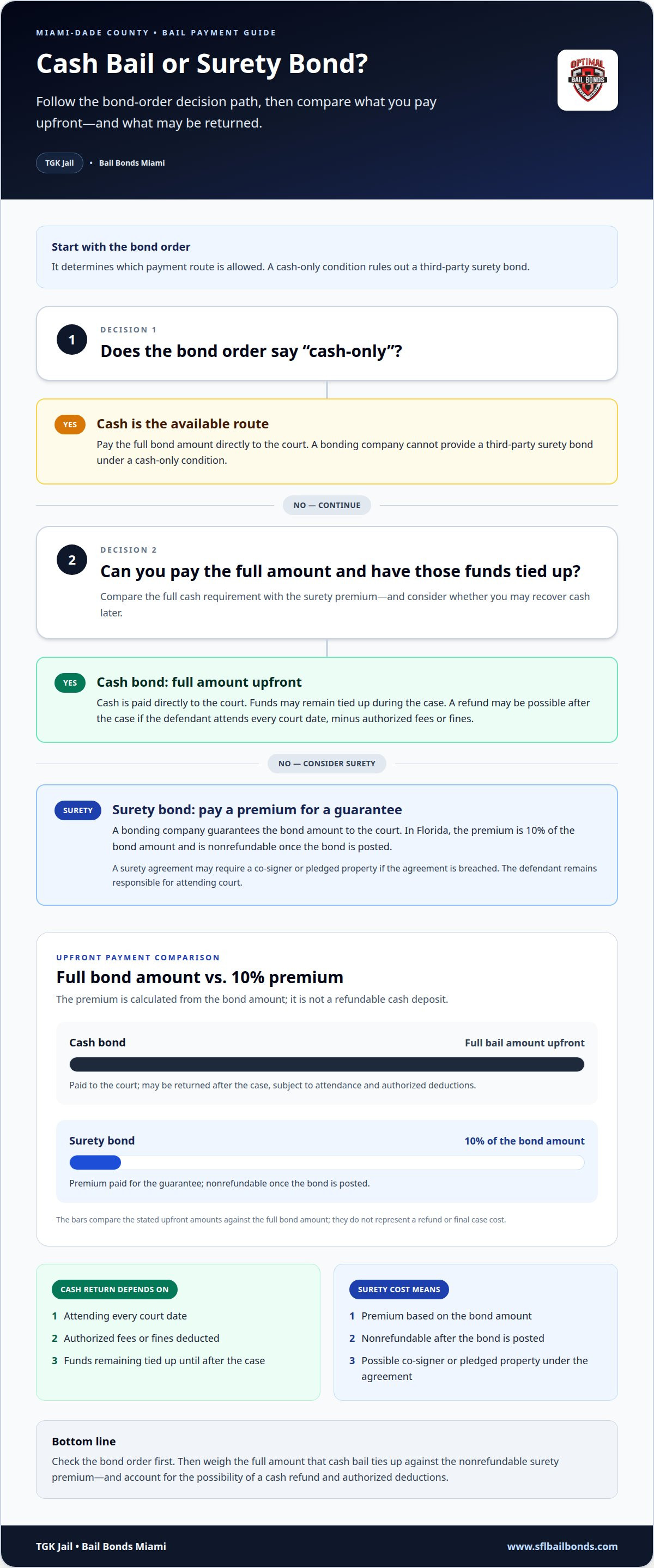
Surety bond fees compared with full cash bail
The key cost difference is the upfront commitment: cash bail ties up the full bail amount, while a surety bond involves a premium for the bonding company’s guarantee. In Florida, the premium is calculated in relation to the bond amount. Comparing only the initial payment can overlook the impact of having cash tied up until the case ends.
For example, a family with access to the full amount may avoid a surety premium by paying cash bail. But that money may remain unavailable for household bills or other needs while the case proceeds. A surety bond can reduce the cash required upfront, though its premium is a separate expense, not a deposit returned at the end.
The options also differ if the defendant fails to meet the bond conditions. A cash deposit can be drawn down directly. If a surety pays a valid claim, the bonded party must reimburse the surety. In that situation, surety bond costs are not limited to the initial payment.
Compare the options using the same case details. Start with the court-ordered bond amount, then identify the cash required for each route and whether funds could be tied up. Include any premium, payment arrangement, and possible reimbursement obligation. This shows the difference between reducing the upfront amount and reducing overall financial exposure.
- Cash bail: Requires the full amount upfront, but eligible funds may be returned after the case, subject to authorized deductions.
- Surety bond: Uses a premium instead of paying full bail directly; the premium isn’t refundable once the bond is posted.
- Either option: Missing court can put the bond at risk and create further financial consequences.
Florida’s premium rules provide a framework, but the case determines the bond amount and payment arrangement. For an individual bail bond, the cost depends on the bond amount, selected payment structure, and circumstances. The exact figure for the case is provided in a quote.
Consider how long cash may be unavailable, not just whether it could eventually be returned. A refund at the end of the case can make cash bail less costly in the long run, but timing and authorized deductions matter. A surety premium provides a guarantee without requiring the full bail amount to be set aside, but it remains a cost after the case concludes.
For a practical comparison, write down the full bail amount, the premium, any payment terms, and what happens if the defendant misses court. Then compare the cash needed now with the possible refund later. The better fit depends on liquidity, refund eligibility, and the responsibilities attached to each bond.
Cash and Surety Bonds in Miami-Dade County, Florida
In Miami-Dade County, the bond order determines whether cash or a surety bond can be used. Identify the bond type and amount, then compare the payment route permitted for that case. A cash-only bond changes the choice: a judge may require it, and a third-party bond agent cannot provide a surety bond instead.
For a cash bond, the person posting bail pays the full amount directly to the court, so they need access to the entire amount before proceeding. For a surety bond, a bonding company guarantees the full bond amount to the court. The defendant or family works with a bondsman and completes the required paperwork.
Obtaining a surety bond usually requires paperwork and may take a few days. Keep that in mind when comparing routes, especially if a family is arranging documents or a co-signer. A surety arrangement may involve pledged property or a co-signer who could be asked to provide funds if the agreement is breached.
A judge may set a cash-only bond because of concerns that the defendant might not return for trial. A history of missed hearings or a risk of disappearing can inform that decision. In that situation, the choice is not simply between paying cash and paying a premium. The bond condition itself limits the available route.
Use this practical sequence for a Miami-Dade case:
- Read the bond information: Identify whether the order allows cash, surety, or requires cash only.
- Note the amount: This is the full amount required for a cash bond and the amount guaranteed under a surety bond.
- Compare what must be paid now: Cash requires the full amount; a surety bond requires its premium and may involve paperwork or a co-signer.
- Consider the responsibilities: A defendant must meet court conditions, and a surety may seek reimbursement after paying a valid claim.
For example, if the bond order permits either method, a family with access to the full amount can weigh a cash payment against the surety premium. If funds are limited, a surety bond may reduce the initial cash needed, but the premium is not refundable. If the order says cash only, that comparison does not create an alternative: the court’s stated condition controls.
Miami-Dade families can clarify the decision by separating three details: the bond type, the bond amount, and the funds required upfront. Those details show whether a bonding company can be involved and what financial commitment each permitted route requires.
Optimal Bail Bonds: Pre-Licensing Bail Bonds Class
Optimal Bail Bonds offers Bail Bonds to individuals and families navigating release in Miami and North Miami. If you’re weighing cash against a surety bond, Optimal Bail Bonds can help you take the next step through the bonding process.
For readers exploring the profession instead, the Pre-Licensing Bail Bonds Class, 120 Hours Bail Bonds Course, and How to be a Bail Bondsman provide educational pathways related to bail bonding. These courses are for career learning, not a substitute for help with an active case.
Choose the path that fits your immediate need: bail bond assistance for a current situation, or education if you’re considering the field. Contact Optimal Bail Bonds or visit sflbailbonds.com to take the next step.
Make the Next Step With Clarity
A cash-bond-versus-surety-bond cost comparison in Miami, Florida, is most useful when it reflects the actual bond order and your household’s financial priorities. Before acting, gather the case details, consider who will manage payments and court obligations, and decide how much flexibility your family needs while the case moves forward. A clear plan can make a stressful decision feel more manageable.
If you need help with a bail bond in Miami or North Miami, contact Optimal Bail Bonds to take the next step.
Take the decision one step at a time. With the right information in hand, you can move forward with greater confidence and focus on supporting your family.
Frequently Asked Questions
How Can I Lower My Bond Price?
In Florida, the bail bond premium is 10% of the bond amount, so the main cost factor is the amount set for the case. You can compare payment arrangements, but financing changes when you pay, not the premium itself. Eligible applicants who finance a premium may pay 30-40% upfront and the remaining balance in monthly installments over 4-6 months.
What Factors Determine My Surety Bond Cost?
For a Florida bail bond, the premium is tied to the court-set bond amount. A larger bond amount means a larger premium under the 10% calculation. Don’t confuse bail-bond pricing with general commercial surety estimates, where underwriting may weigh credit and financial information. For a Miami-Dade case, first identify the bond amount, then calculate the premium using the applicable Florida bail rate.
Which is cheaper?
Cash bail may cost less in direct fees because it does not involve a surety premium. But it requires access to the full amount, which may remain unavailable until the case ends. A surety bond requires a premium that is not refunded after posting. Compare direct cost with the impact of tying up cash, and account for any court-authorized deductions from a cash refund.
Is cash bail refunded after a Miami-Dade case ends, and what deductions apply?
Cash bail may be returned after the case ends if the defendant attended every required court appearance. The refund can be reduced by fees or fines the court is authorized to deduct. For example, an authorized deduction may mean the person who posted the money receives less than the original deposit. Missing court can put the cash at risk of forfeiture.
Is a surety bond premium refundable if charges are dismissed or bail is reduced in Florida?
A surety bond premium is nonrefundable once the bond is posted and liability attaches. A later dismissal does not turn the earned premium into a refundable deposit. If bail is reduced after posting, the premium already paid remains nonrefundable under that rule. The key distinction is whether the bond has been posted and liability attached, not whether the case later changes.
When is paying cash bail cheaper than hiring a Miami surety bondsman?
Cash bail can cost less in direct dollars when the full amount is available, the court permits cash, and the defendant meets every appearance requirement. An eligible refund may then return the deposit, less authorized deductions, while a surety premium remains a cost. Consider whether having funds tied up through the case creates a greater burden than paying a nonrefundable premium upfront.


