
The Miami-based ICE field office currently records the highest number of immigration arrests in the country, averaging nearly 120 arrests every single day. When a loved one is suddenly taken to the Krome North Service Processing Center or the Broward Transitional Center, the shock can feel paralyzing. You're likely searching for immigration bail bonds Miami while wrestling with a confusing federal bureaucracy and the terrifying fear of deportation. It's a high-stakes situation where every hour counts. The path to release often feels hidden behind complex legal jargon and language barriers.
We understand that you're feeling overwhelmed and just want your family back together under one roof. It's completely normal to feel lost when facing the Department of Homeland Security's strict requirements. This guide provides a clear, step-by-step checklist designed to simplify the immigration bond process in South Florida and facilitate a fast release. We'll walk you through understanding bond eligibility under current Eleventh Circuit rulings, managing the specific payment methods required by ICE, and gathering the documentation needed to work with a licensed expert who can bring your loved one home.
Key Takeaways
- Learn the critical differences between delivery bonds and voluntary departure bonds to ensure you pursue the correct path for your loved one's specific legal situation.
- Follow a clear five-step checklist for immigration bail bonds Miami to quickly locate a detainee and verify their eligibility for release from South Florida facilities.
- Understand how ICE determines bond amounts and what to expect regarding non-refundable premiums so you can prepare your family's finances without surprises.
- Discover why working with a licensed bail bond education center provides a higher level of professional diligence and compassionate, non-judgmental support.
- Gain the confidence to navigate complex federal bureaucracy by mastering the use of the ICE Online Detainee Locator System and local facility protocols.
Understanding Immigration Bail Bonds in Miami
When you're dealing with the detention of a family member, securing immigration bail bonds Miami requires a clear understanding of federal law. An immigration bail bond is a specific type of federal guarantee provided to the Department of Homeland Security (DHS). Unlike standard Florida criminal bonds that deal with state-level offenses, these bonds are administrative and fall under federal jurisdiction. They ensure that a non-citizen will appear for all future court dates and comply with the terms of their release. To understand the broader context of how these systems function, it's helpful to look at the history of Bail in the United States.
The Miami ICE Field Office plays a pivotal role in this process because it manages the highest number of immigration arrests in the country. With an average of about 120 arrests per day as of April 2026, the local system moves fast. Local expertise is vital. Facilities like Krome or the Broward Transitional Center have specific logistical protocols that outsiders might not recognize. Knowing the local landscape helps prevent unnecessary delays during an already stressful time.
To better understand this concept, watch this helpful video:
Who is Eligible for an Immigration Bond?
Eligibility isn't guaranteed; it's determined by an ICE officer or an Immigration Judge through "Conditions of Release." They evaluate several factors to decide if someone can be released while their case is pending. The primary considerations include whether the person is a flight risk, a danger to the community, or has a significant criminal history. There's a distinct difference between a bond set by ICE immediately after detention and one set during a hearing. While the statutory minimum for a delivery bond is $1,500, a judge may adjust this based on the specific details of the case. Having professional guidance ensures you understand the criteria being used to evaluate your loved one's situation.
The Role of the Obligor and the Bond Agent
The "Obligor" is the individual who takes responsibility for the detainee by signing the bond paperwork. This person must be a U.S. citizen or legal permanent resident. Because these are federal surety bonds, you'll need a licensed agent to facilitate the transaction with the government. We take our role as your partner seriously. In the state of Florida, a licensed bail bond agent is legally responsible for ensuring the defendant appears in court and must strictly adhere to all state and federal regulations regarding the execution of the bond. Working with an agency that also serves as a Bail Bond Education Center means you're getting advice from the people who actually teach the industry standards.
Types of Immigration Bonds: Which One Do You Need?
Identifying the correct bond type is the first step toward bringing your loved one home. In the complex world of immigration bail bonds Miami, there isn't a one-size-fits-all solution. Most families encounter two primary categories: delivery bonds and voluntary departure bonds. Each serves a specific legal function and carries different long-term implications for the detainee's status. Understanding these options is essential for making an informed decision that protects both your family's finances and your relative's future.
Delivery Bonds vs. Voluntary Departure Bonds
A delivery bond is the most common path for release. Its primary purpose is to ensure the individual appears for all future immigration court hearings while remaining in the country. This allows families to stay together during what can be a lengthy legal process. For families navigating immigration bail bonds Miami, a voluntary departure bond is a different strategy. It is issued when a person agrees to leave the United States at their own expense by a specific date. For a deeper look at your legal protections during this process, the NILC Know Your Rights guide offers excellent resources for families. While delivery bonds are typically refundable once the case concludes, voluntary departure bonds are only returned after ICE receives proof that the individual has successfully left the country.
Surety Bonds vs. Cash Bonds
When it's time to pay, you have two main choices. A cash bond requires paying the full amount directly to the Department of Homeland Security. This can tie up thousands of dollars for years. A surety bond involves working with a licensed agent who posts the full amount on your behalf in exchange for a non-refundable premium. Choosing a surety bond often provides much-needed financial flexibility. It also grants you access to professional guidance from experts who navigate these federal systems daily. If you're feeling overwhelmed by the financial requirements, speaking with a specialist in immigration bail services can help clarify your options and speed up the release process.
Beyond the bond itself, you should be aware of the Order of Supervision (OSUP). If a bond isn't an option, ICE may release someone under an OSUP, which requires regular check-ins and strict compliance. Additionally, many families worry about public charge considerations. It's helpful to know that posting a bond for a loved one is generally not considered a public benefit that would negatively impact their immigration status. Our goal is to provide the steady reliability you need to navigate these regulatory nuances with confidence and integrity.
The Cost of Immigration Bail Bonds in Florida
The financial burden of securing a release is often the most stressful part of the process for families. When searching for immigration bail bonds Miami, you'll find that ICE determines the bond amount based on several risk factors. While the statutory minimum for a delivery bond is $1,500, bonds at the Miami Krome Immigration Court typically range between $5,000 and $25,000. Understanding whether you should pay the full amount directly to the government or use a surety bond is a critical decision that impacts your family's long-term liquidity.
Choosing a surety bond means paying a non-refundable premium to a licensed agent. This premium is a percentage of the total bond amount, and it's strictly regulated by Florida's insurance laws. It provides an alternative to tying up a large sum of cash for the duration of a legal case that could last years. Transparent fee structures are essential here. You should always know exactly what you're paying for without hidden costs. To coordinate the actual posting of the bond, families often need to visit specific ICE ERO Bond Acceptance Facilities, such as the Krome North Service Processing Center.
Factors Influencing Bond Amounts
Several elements impact the final figure set by an officer or judge. Length of residency in Miami carries significant weight. The longer a person has lived in the community, the less they're viewed as a flight risk. Strong family ties in South Florida, such as having a spouse or children who are U.S. citizens, also work in the detainee's favor during a hearing. Conversely, prior immigration violations or any criminal history will likely increase the total cost. Judges look for stability, so providing proof of employment or local community involvement can sometimes help lower the required amount.
Collateral and Payment Plans
If you don't have the full amount in liquid cash, collateral becomes a necessary part of the arrangement. Most South Florida agencies accept real estate, cash assets, or other high-value property to secure the bond. This allows families to act quickly even when immediate funds are limited. We understand that this is a significant commitment. The process of collateral return begins once the immigration case is officially closed and the bond is exonerated by the government. As an agency that operates a Bail Bond Education Center, we ensure your assets are managed with the highest level of professional diligence and ethical care.
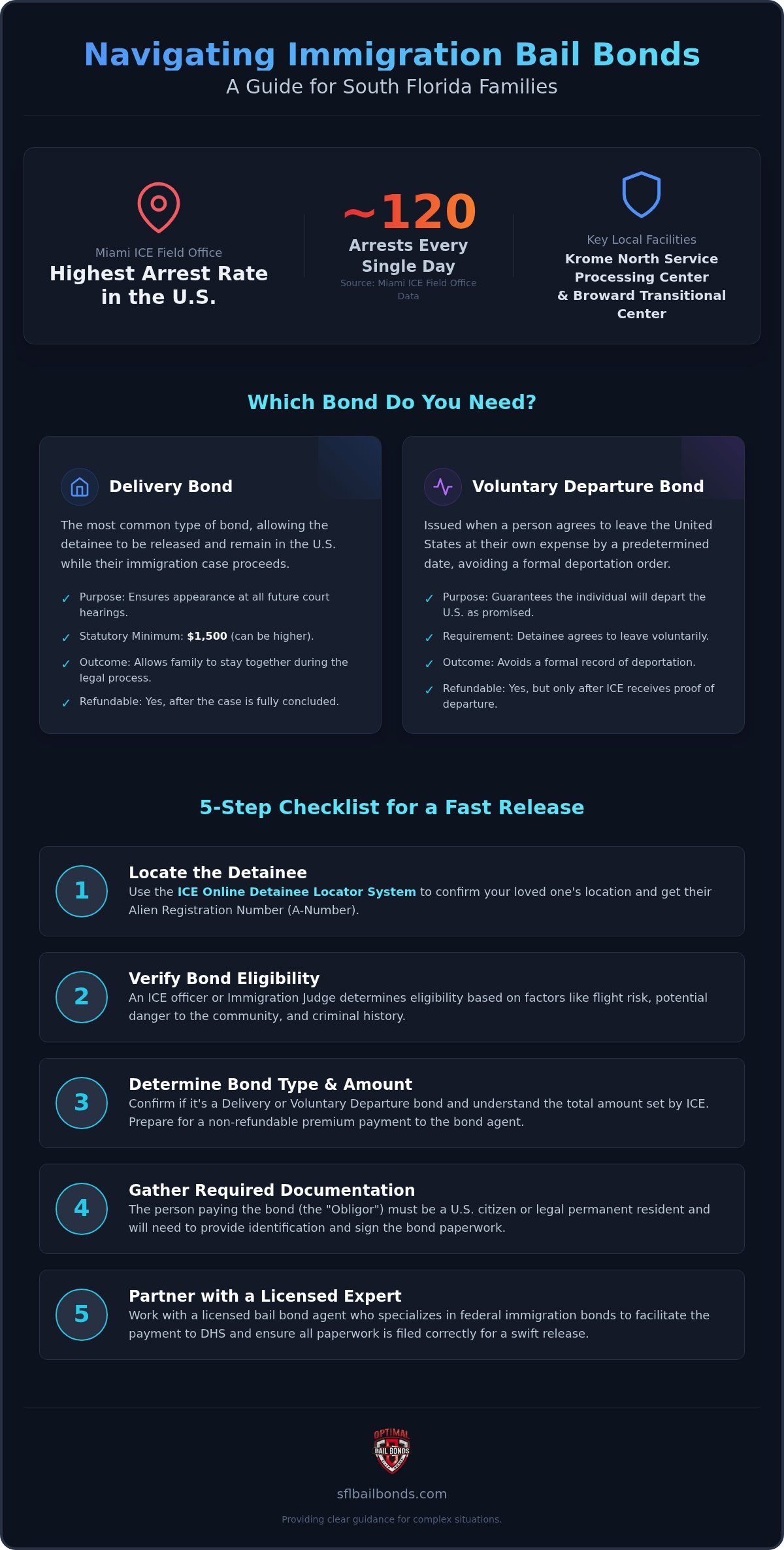
Miami Immigration Bond Checklist: 5 Steps to Release
Taking swift action is vital when a family member is detained. The process for securing immigration bail bonds Miami follows a specific sequence of federal requirements and local facility protocols. Missing a single document or failing to follow a specific instruction from the Miami Field Office can delay a release by days or even weeks. Use this checklist to stay organized during this high-stakes time.
- Step 1: Locate the Detainee. Use the ICE Online Detainee Locator System. You'll need the individual's Alien Registration Number (A-Number) and country of birth, or their full legal name and date of birth.
- Step 2: Verify Eligibility. Contact the local ICE Enforcement and Removal Operations (ERO) office to confirm if a bond has been set. With nearly 120 arrests occurring daily in the Miami area, records update frequently.
- Step 3: Gather Documentation. Prepare your identification and financial records. If the bond exceeds $10,000, ICE ERO at Krome requires a single cashier's or certified check payable to the "U.S. Department of Homeland Security."
- Step 4: Contact a Specialist. Speak with a licensed expert who understands South Florida's specific detention landscape. Professional guidance ensures your paperwork is filed correctly the first time.
- Step 5: Coordinate the Release. Once the bond is posted, you must arrange transportation from the specific facility where the person is held.
Facility-Specific Logistics: Krome and BTC
Most detainees in South Florida are held at either the Krome North Service Processing Center or the Broward Transitional Center (BTC). Krome is located at 18201 SW 12th St, Miami, FL 33194. It's a high-volume facility with its own on-site immigration court. The Broward Transitional Center in Pompano Beach typically houses low-risk detainees and has different release windows. If the Miami facilities reach capacity, your loved one might be moved to the Glades County Detention Center in Moore Haven. We monitor these transfers closely to ensure you always know where to go for the final release.
Required Documentation for the Obligor
The person posting the bond, known as the obligor, must meet strict federal criteria. You must provide a valid government-issued photo ID, such as a U.S. passport or a permanent resident card. ICE requires proof of legal status; only U.S. citizens or legal permanent residents can serve as an obligor. You'll also need your Social Security number to complete the necessary federal immigration forms. Having these items ready prevents common administrative hurdles that can stall the process. If you're ready to start the paperwork, contact our Miami bond specialists for immediate assistance with your case.
Why Expert Guidance Matters: The Optimal Bail Bonds Difference
Choosing a partner for immigration bail bonds Miami is about more than just a financial transaction. It's about finding a knowledgeable guide who understands the emotional weight of your situation. We pride ourselves on being more than just a service provider; we're a protective and efficient ally for families in immediate distress. Our deep roots in North Miami-Dade and our extensive knowledge of local detention protocols at Krome and the Broward Transitional Center allow us to act with precision. When a crisis hits, the confusion of federal requirements can be paralyzing, and our team focuses on de-escalating that stress through clear, instructional support.
We treat every client with a human-centric approach that's especially vital for families dealing with sensitive immigration status issues. We understand the high financial stakes and the fear of deportation that keep you awake at night. By combining professional authority with deep empathy, we create a sense of order in a chaotic situation. Our expertise spans the entire South Florida region, including Ft. Lauderdale and West Palm Beach. This local knowledge ensures that our clients receive the most diligent and comprehensive assistance available during their time of need.
Professionalism Through Education
We uniquely operate a Licensed Florida Bail Bond Education Center. This role as the "teacher of bondsmen" ensures we remain at the forefront of every federal regulation change and procedural update. It's our mission to maintain the highest ethical standards in the industry, providing a level of professional diligence that is hard to find elsewhere. This educational foundation means we don't just process cases; we apply specialized knowledge to navigate complex systems with integrity. For those interested in the rigorous standards we uphold for our students and our staff, you can explore our resource on How to Become a Bail Bondsman in Florida: The 2026 Career Guide.
Next Steps: Securing Your Loved One’s Release
You don't have to face the federal bureaucracy alone. We provide compassionate, non-judgmental support to every family, regardless of the complexity of their case. Our goal is to ensure you feel seen and supported rather than just processed through a system. We're ready to help you take the first step toward reunification by explaining your options clearly and helping you manage the necessary paperwork. You can learn more about our specialized approach in our comprehensive guide to Bail Bonds Miami: The 2026 Guide to Securing a Fast, Compassionate Release. Your family's peace of mind is our priority, and we're here to offer the steady reliability you need during this overwhelming time.
Taking the Next Step Toward Family Reunification
Facing the federal detention system is one of the most stressful experiences a family can endure. By following our checklist and understanding the specific requirements for Krome and BTC, you've already taken the first steps toward bringing your loved one home. Navigating immigration bail bonds Miami requires precision; knowing the difference between delivery and voluntary departure bonds ensures you make the right choice for your family's future. You've learned how to locate a detainee and gather the necessary obligor documentation to prevent administrative delays.
We are here to provide the steady reliability you need. Our specialized immigration release team operates out of a Licensed Bail Bond Education Center, ensuring we apply the highest ethical standards to every case. We are available 24/7 in Miami-Dade and Broward to provide the non-judgmental support you deserve during this overwhelming time. Contact our Miami Immigration Bond Specialists for Immediate Help and let us help you navigate the path to release. Stay strong; with the right guidance and a clear plan, you can move through this process and reunite your family quickly.
Frequently Asked Questions
How long does it take to get someone out of ICE custody in Miami after the bond is paid?
Release typically occurs within the same day the bond is posted, though it can take up to 24 hours depending on the specific facility's processing speed. Facilities like the Krome North Service Processing Center handle high volumes, which sometimes impacts the timeline. We work closely with families to coordinate transportation immediately once the release is authorized. It's vital to stay in constant communication with your agent to track the status in real-time.
Can a non-citizen post an immigration bail bond in Florida?
No, a non-citizen cannot serve as the obligor for an immigration bond. The person posting the bond must be a U.S. citizen or a Legal Permanent Resident with a valid Social Security number. This individual takes legal responsibility for ensuring the detainee attends all future court dates. If you don't have a family member who meets these criteria, we can help you understand your options for securing immigration bail bonds Miami through a qualified professional.
What happens to the bond money if the person is deported?
If you paid a cash bond directly to the government, the money is typically returned to the obligor after the individual is deported or departs the country. However, if you used a surety bond, the premium paid to the agent is non-refundable as it covers the service of guaranteeing the bond. Collateral is returned only once the case is officially closed and the bond is exonerated by the Department of Homeland Security, provided all conditions were met.
Where are immigration bond payments made in Miami-Dade County?
In Miami-Dade, payments are generally processed at ICE ERO Bond Acceptance Facilities. The most common location is the Krome North Service Processing Center. You must provide a cashier's check or money order made payable to the "U.S. Department of Homeland Security." For amounts exceeding $10,000, only a single certified check is accepted. Our team helps you verify the current facility protocols before you make the trip to avoid administrative delays and wasted trips.
Is an immigration bond the same as a criminal bail bond?
Immigration bonds are federal administrative bonds governed by the Department of Homeland Security, while criminal bonds are handled by state or local courts. The rules for immigration bail bonds Miami are entirely different from standard Florida criminal bail procedures. While criminal bail focuses on local laws, immigration bonds ensure compliance with federal immigration proceedings. Working with an agency that runs a Bail Bond Education Center ensures you get accurate advice on these distinct legal systems.
Can I get an immigration bond reduced through a hearing?
Yes, you can request a bond reduction through a Bond Redetermination Hearing. An Immigration Judge has the authority to lower the amount set by ICE if you can prove the detainee is not a flight risk or a danger to the community. Factors like deep family ties in South Florida and a clean criminal record are highly influential. While we don't provide legal representation, we can coordinate with your legal team once the judge sets the new amount.
What is the minimum amount for an immigration bond in 2026?
The statutory minimum for an immigration delivery bond remains $1,500 in 2026. However, actual amounts set by ICE or judges in Miami often range from $5,000 to $25,000 based on the specific risks associated with the case. Voluntary departure bonds have a lower statutory minimum of $500. We help families prepare for these costs by providing transparent fee structures and explaining the factors that might push the bond amount significantly above the federal minimum.
Do I need an attorney to post an immigration bail bond?
You don't need an attorney to physically post the bond, but having legal counsel is highly recommended for the bond hearing. An attorney can argue for a lower amount or better release conditions. To actually post a surety bond, you must work with a licensed bail bond agent. We act as your specialized guide through the federal bureaucracy, ensuring all paperwork is completed correctly so the release process moves forward without any technical errors.


