
Imagine walking into a career where you are the steady hand in someone's darkest hour, only to find the rulebook you studied has completely changed. Knowing how to become a bail bondsman in Florida in 2026 requires more than just a background check; it demands staying ahead of major legislative shifts like Senate Bill 600. You might feel overwhelmed by the complex web of state regulations or worried about the difficulty of the mandatory pre-licensing course. It is natural to feel a bit of hesitation when the legal landscape shifts so quickly and virtual offices are no longer an option.
We are here to guide you through these changes with the steady hand of an experienced mentor. You'll discover the exact steps to earn your Florida bail bond license while mastering the latest 2026 industry shifts and technological advancements. We will preview the transition to the mandatory 80 hour instruction format, explore the financial potential of specialized niches like immigration bonds, and help you locate a reputable training center in Miami. By the end of this guide, you'll have the specialized knowledge and confidence needed to build a resilient, ethical career in this professionalized market.
Key Takeaways
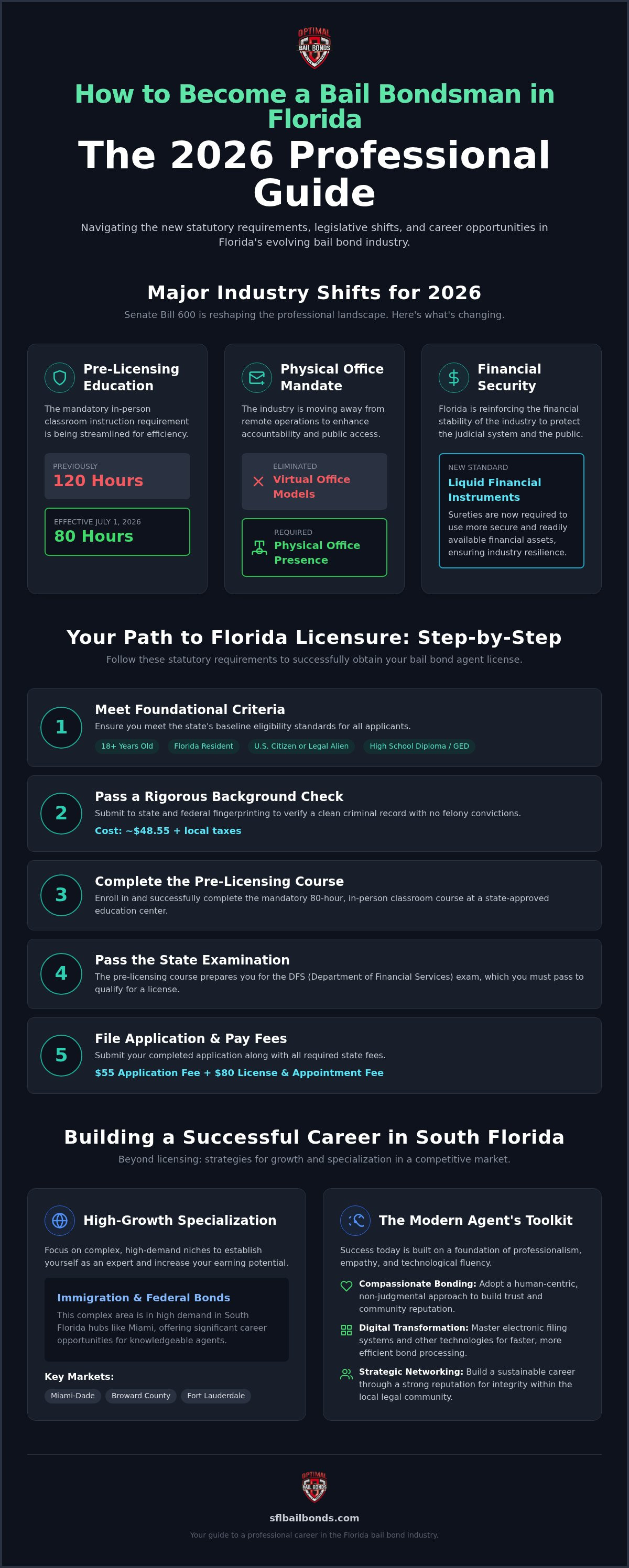
- Master the updated 2026 statutory requirements on how to become a bail bondsman in Florida, including the transition to the 80-hour pre-licensing course.
- Navigate the regulatory shifts introduced by Senate Bill 600, such as the mandatory physical office presence and the elimination of virtual office models.
- Identify why choosing a state-approved education center in Miami is the most reliable path to passing the DFS exam and establishing professional authority.
- Explore high-growth career opportunities in South Florida by specializing in the complex and high-demand niche of immigration and federal bail bonds.
- Build a sustainable career through strategic networking and a reputation for integrity within the Miami-Dade and South Florida legal communities.
The Evolving Landscape of the Florida Bail Bond Industry in 2026
The year 2026 marks a significant turning point for the Florida bail bond market. While other states have experimented with eliminating cash bail, Florida has doubled down on a model that emphasizes accountability and professional standards. This stability makes it an ideal time to learn how to become a bail bondsman in Florida. The introduction of Senate Bill 600 has reshaped the environment, moving the industry toward a higher level of scrutiny and transparency. You aren't just entering a trade; you're joining a regulated legal profession that requires diligence and high ethical standards.
Gone are the days of the gritty "bounty hunter" stereotype often depicted in movies. Today's agents are sophisticated legal service navigators who understand complex statutes and financial instruments. In high-traffic areas like Miami-Dade and Broward, digital transformation has streamlined bond processing. Electronic filing systems now connect agencies directly with court clerks, allowing for faster releases and more accurate tracking. This Bail Bondsman Industry Overview highlights how the role has historically functioned, but the 2026 Florida landscape adds a layer of tech-integrated efficiency that new agents must master.
Bail Reform and Industry Resilience
Florida's legislative environment supports the private bond industry by recognizing its role as a vital safeguard for the judicial system. In growing hubs like Ft. Lauderdale, the demand for professional agents remains high because they ensure defendants appear in court without costing taxpayers for unnecessary incarceration. The move toward requiring liquid financial instruments for sureties, effective July 1, 2026, ensures that the industry remains financially sound. This resilience provides a secure career path for those willing to navigate the updated regulatory framework with professional dedication.
The Rise of Compassionate Bonding
Success in modern bonding requires a non-judgmental approach. We've seen that empathy is a powerful tool for de-escalating the stress of a legal crisis. Agencies in South Florida that prioritize a supportive service model often see higher client retention and a stronger community reputation. When you understand how to become a bail bondsman in Florida, you'll learn that being a human-centric guide is your greatest competitive advantage. This shift toward professional empathy helps bridge the gap between the legal system and the families it affects. It's about seeing the person behind the case number and providing steady reliability during overwhelming times.
Step-by-Step: Statutory Requirements for Florida Licensure
Understanding how to become a bail bondsman in Florida starts with meeting the foundational standards set by the state. You must be at least 18 years old, a resident of Florida, and either a United States citizen or a legal alien with proper work authorization. Educationally, the state requires a high school diploma or an equivalent credential. These criteria serve as the baseline for all applicants, ensuring that those entering the field have the maturity and residency status required to serve the local judicial system effectively.
Navigating the background check is often the most rigorous part of the initial application. You'll need to submit to FDLE and FBI fingerprinting to ensure you have a clean criminal record, specifically avoiding any felony convictions. The state charges approximately $48.55 for this process, plus any applicable local sales taxes. You can find detailed context on Florida's Statutory Bail Bond Licensing Requirements to see how Chapter 648 governs your entry into the field. Once your fingerprints are clear, you'll file your application with a $55 fee and an $80 license and appointment fee.
The 80-Hour Pre-Licensing Shift
A major change for 2026 is the update to mandatory pre-licensing education. Under Senate Bill 600, the requirement was reduced from 120 hours to 80 hours of in-person classroom instruction, effective July 1, 2026. This course is the "make or break" moment for aspiring agents, covering essential curriculum topics like law, ethics, and industry practices. It's designed to prepare you for the high-stakes environment of bond posting while ensuring you operate within ethical boundaries. If you're looking for a structured way to manage this requirement, you can explore our pre-licensing classes. This course provides the specialized knowledge you'll need, and you can find more details in How to Become a Bail Bondsman in Florida: The 2026 Career Guide.
The State Examination and Professional Path
After completing your 80 hours of education, you must pass the Florida Department of Financial Services (DFS) exam. The fee is $44 per attempt. It's a comprehensive test of your knowledge regarding the Florida legal landscape and regulatory compliance. It's important to note that the state discontinued temporary licenses in 2023, which means there is no longer a formal "temporary license phase" for an internship. Instead, you move directly into full licensure. You'll also need to maintain a $50,000 surety bond to operate as a professional agent. Finding a mentor in the Miami or West Palm Beach area is still vital for gaining practical experience and building a reputation for integrity from day one.
Choosing the Right Bail Bond Education Center in Miami
Selecting your training provider is the first professional decision you'll make on your path toward licensure. While you research how to become a bail bondsman in Florida, you'll notice many schools vying for your attention. A state-approved status is the absolute minimum requirement. Without it, the Florida Department of Financial Services (DFS) won't recognize your hours, rendering your hard work and investment useless. You can verify a provider's credentials by checking their specific ID number directly on the DFS website to ensure they meet 2026 standards.
The real value, however, lies in the difference between generic online courses and agency-led education. Training with an active South Florida agency like Optimal Bail Bonds provides a distinct advantage. Our instructors aren't just reading from a manual; they're active participants in the Miami-Dade and Broward legal systems. This real-world mentorship is vital. A licensed instructor who still works in the field can explain the nuances of courtroom etiquette and the practicalities of bond processing that a textbook might overlook. You're not just earning a certificate; you're building a foundation of professional authority.
Webinar vs. In-person Learning in 2026
The 2026 educational landscape offers more flexibility than ever before. Modern webinar formats allow working professionals to complete their requirements without sacrificing their current income. It's essential to choose an education center that offers interactive, real-time instruction rather than pre-recorded videos. This live interaction allows you to ask questions and receive immediate guidance on complex regulatory nuances. This steady, supportive environment helps de-escalate the stress of learning a new, highly regulated trade.
Continuing Education (CE) and Career Longevity
Your education doesn't end once you pass the state exam. Career longevity in this field depends on staying current with legislative changes and technological shifts. Planning for your mandatory CE credits should begin from your first day as a licensed agent. This commitment to ongoing learning ensures you maintain your edge in a competitive market. For a detailed look at maintaining your credentials, see our Bail Bond Continuing Education Florida: The 2026 Agent Renewal Guide. We view our students as long-term partners, providing the instructional support needed for every stage of your professional development.
Beyond the Basics: Mastering Immigration and Federal Bonds
While many people start their professional journey by learning how to become a bail bondsman in Florida for criminal cases, South Florida offers a unique and high-demand specialty: immigration bonds. In regions like Miami-Dade and Broward, the ability to navigate federal systems is a significant professional advantage. These bonds are distinct from standard state-level criminal bonds because they involve federal agencies like Immigration and Customs Enforcement (ICE). Mastering this niche requires a deeper understanding of federal statutes and a specific set of technical skills for processing complex documentation.
Understanding how to become a bail bondsman in Florida also means recognizing where the industry is growing. Specializing in federal bonds allows you to diversify your revenue stream while providing a vital service to the community. Federal cases often involve higher stakes and more intricate financial requirements than local criminal matters. For instance, while state premiums are fixed at 10%, immigration bond premiums can sometimes reach 15% to 20% depending on the risk profile and specific federal requirements. This specialized knowledge transforms you from a general agent into a highly skilled legal navigator who can handle the nuances of federal detention with professional authority.
ICE Custody and the Florida Agent
Working with facilities like the Krome Detention Center requires more than just a license; it requires a compassionate understanding of families in crisis. As an agent, you often act as a critical liaison between the federal government and family members who may be confused or frightened by the process. It's a role that demands both professional authority and deep empathy. To better support these families, you should be familiar with resources like Immigration Bail Bonds Miami: The Essential Family Checklist for ICE Release. Providing this level of guidance helps de-escalate the stress of a federal legal crisis and builds long-term trust in your expertise.
Digital Bond Processing and Remote Filings
Technological proficiency is no longer optional in 2026. The shift toward digital bond processing, or e-bonding, has accelerated across Florida counties, allowing for faster releases and more efficient collateral management. Modern agents use specialized software to track court appearances and manage financial instruments in real time. This digital transformation means you can often handle filings remotely, which is particularly useful when dealing with federal facilities spread across the state. If you are ready to expand your professional toolkit, you can apply for our specialized immigration bail training to stay ahead of these technological shifts.
Launch Your Career: Success Strategies for New Florida Agents
Securing your license is a significant milestone, but the transition from student to professional requires a strategic shift in mindset. Learning how to become a bail bondsman in Florida involves mastering the statutes, yet building a sustainable career depends on your ability to integrate into the local legal ecosystem. In a fast paced market like Miami-Dade, your reputation is your most valuable asset. You must move beyond the mechanics of bond posting and focus on becoming a trusted partner for families and legal professionals alike. This phase of your journey is about proving your reliability every single day.
Networking within the South Florida legal community is essential for long term growth. Establish professional relationships with court clerks and local defense attorneys who value integrity and efficiency. These professionals need to know that when they refer a client to you, the process will be handled with the utmost diligence and respect. In cities like Ft. Lauderdale and West Palm Beach, being known as an agent who operates with transparency can set you apart from the competition. It's about showing up, being present at the courthouse, and demonstrating a deep understanding of the local judicial nuances we covered in your training.
Operational excellence in 2026 demands constant availability. Legal crises don't follow a nine to five schedule, and neither can you. Success as a new agent requires 24/7 availability and immediate mobile responsiveness. When a family is in distress at two in the morning, they need a steady, calming voice that answers on the first ring. Using mobile technology to process documents and provide real time updates isn't just a convenience; it's a requirement for maintaining a competitive edge in the modern Florida landscape.
Marketing Yourself in a Competitive Market
Building a local brand in South Florida requires a mix of digital presence and human connection. Focus on gathering compassionate client testimonials that highlight your supportive, non-judgmental approach. Reviews are the social proof that modern families look for before making a high stakes decision. You can also use social media ethically to educate the public about the bail process, positioning yourself as a knowledgeable guide rather than just a service provider. This educational approach builds authority and trust before a potential client even picks up the phone.
Joining the Optimal Bail Bonds Network
We take pride in ensuring our graduates are fully prepared for the realities of agency work. At Optimal Bail Bonds, our support doesn't end when you receive your certificate. We provide a non-judgmental, expert led training environment that bridges the gap between classroom theory and street level practice. Our graduates enter the field with the confidence of a seasoned professional because they've been mentored by active agents who understand the current market. If you're ready to take the first step toward a rewarding new career, Start your journey at the Optimal Bail Bond Education Center today. We are here to partner with you as you navigate the path of how to become a bail bondsman in Florida with integrity and professional dedication.
Begin Your Professional Journey in the Florida Legal System
You now have a clear roadmap for navigating the updated 2026 requirements, from mastering the new 80-hour pre-licensing course to leveraging digital tools for bond processing. Success in this field requires more than just meeting statutory standards; it demands a commitment to ethical service and a deep understanding of specialized niches like immigration bail. Mastering the process of how to become a bail bondsman in Florida is the first step toward a resilient and rewarding career.
As a state-approved education provider, we offer expert mentors with real-world experience to guide you through every regulatory nuance. We're ready to provide the compassionate career guidance you need to transition from a student to a high-impact professional. Enroll in Our State-Approved Pre-Licensing Classes today and start building your reputation for integrity in South Florida. You have the potential to make a meaningful difference in your community, and we are here to support you every step of the way.
Frequently Asked Questions
Is it hard to become a bail bondsman in Florida?
The process is rigorous but manageable if you have the right educational support and professional dedication. You must complete a state-approved pre-licensing course, pass a comprehensive background check, and succeed on the Florida Department of Financial Services exam. While the material is dense, learning how to become a bail bondsman in Florida is achievable for those who approach the 2026 regulatory updates with a focus on integrity and specialized knowledge.
How much does the 120-hour bail bond course cost in 2026?
It is important to note that as of July 1, 2026, Senate Bill 600 reduced the mandatory pre-licensing education from 120 hours to 80 hours of in-person instruction. While tuition varies by provider, you should also budget for state-mandated fees such as the $55 application fee, the $80 license and appointment fee, and the $44 exam fee. Fingerprinting through the FDLE and FBI typically costs an additional $48.55 plus local sales tax.
Can you be a bail bondsman in Florida with a felony?
No, a felony conviction is a disqualifying factor for licensure under Florida Statutes Chapter 648. The state maintains high ethical standards to ensure the integrity of the judicial system. During the application process, you must submit fingerprints for a thorough background check. If you have a criminal history, it's best to consult the Florida Department of Financial Services to see how specific past records might impact your eligibility for a license in Miami or Ft. Lauderdale.
How long does it take to get a bail bond license in Florida?
The timeline typically takes between two to four months from start to finish. This includes completing the 80-hour pre-licensing course, waiting for your background check results, and scheduling your state exam. When you are researching how to become a bail bondsman in Florida, remember that your fingerprint results and application review by the state can take several weeks. Promptly submitting your documentation can help speed up your entry into the South Florida market.
What is the difference between a Limited Surety Agent and a Professional Bail Bond Agent?
A Limited Surety Agent is the most common path for new professionals; these agents are appointed by an insurance company to execute bonds on their behalf. In contrast, a Professional Bail Bond Agent uses their own personal assets or cash as collateral to guarantee the bonds they write. Most agents in the Miami-Dade area choose to work as Limited Surety Agents because it provides the backing of an established insurance company and reduces personal financial risk.
Do I need to work for an agency, or can I start my own bail bond business immediately?
While you can technically open your own agency once licensed, 2026 regulations now prohibit virtual offices and require a physical office presence. Most new agents find it beneficial to work within an established agency first to gain practical experience and mentorship. Building a reputation for reliability in West Palm Beach or Ft. Lauderdale is much easier when you have the support and resources of an experienced team behind you during your first year.
What are the continuing education requirements for Florida bail agents?
Florida bail agents must complete mandatory continuing education (CE) credits every two years to keep their licenses active. These courses ensure you stay current with the latest legislative shifts and technological advancements in bond processing. We provide specialized CE classes that focus on high-growth areas like immigration bail. Staying educated is not just a regulatory requirement; it is a way to maintain your professional authority and provide the best support for families in crisis.


