
Imagine the heart-stopping moment your phone rings and a loved one tells you they're being held at the Krome North Service Processing Center. In that instant, your world feels like it's crashing down, and the pressure to act quickly becomes overwhelming. You need reliable information about immigration bail bonds Miami to bring them home, but the federal system often feels like a maze designed to keep you lost.
We understand that you're facing high financial stakes and the constant, heavy fear of deportation. It's completely normal to feel paralyzed by the confusing bureaucracy and language barriers that stand between your family and a reunion. This article provides a clear, step-by-step checklist designed to help you navigate the South Florida immigration bond process with confidence and speed.
We'll walk you through the specific requirements for facilities like the Broward Transitional Center, explain the 15% premium rate set by Florida law, and detail the liquid collateral rules you must follow under recent state regulations. By the end of this guide, you'll have a professional roadmap to secure a fast release and regain your peace of mind.
Key Takeaways
- Learn the vital differences between delivery bonds and voluntary departure bonds so you can select the correct option for your family's needs.
- Discover how to calculate the 15% premium for immigration bail bonds Miami and which specific financial instruments are accepted for collateral in Florida.
- Follow our streamlined 5-step checklist to locate your loved one within the federal system and verify their bond eligibility at local facilities.
- Gain insight into the unique logistics of South Florida detention centers like Krome and Broward to help expedite the release process.
- Understand the value of partnering with a compassionate expert who also serves as a licensed instructor for the bail bond industry.
Understanding Immigration Bail Bonds in Miami
An immigration bail bond is essentially a three-party contract between the federal government, the bond agent, and the person being detained. It serves as a financial guarantee to the Department of Homeland Security (DHS) that the individual will attend all future court dates and comply with the terms of their release. This is a critical part of the U.S. immigration detention system; it allows families to stay together while legal proceedings move forward. Because these are federal matters, they involve a much higher level of scrutiny than local cases.
Unlike standard Florida criminal bonds that handle state-level offenses, immigration bonds are strictly federal. This means the rules are different, the paperwork is more complex, and the stakes involve federal agents rather than local police. The Miami ICE Field Office manages these cases for South Florida, making local knowledge of their specific protocols vital for a fast release. When someone is held at Krome or the Broward Transitional Center, having a specialist who understands the local landscape of immigration bail bonds Miami can save hours or even days of unnecessary waiting. We know how much every minute counts when a family member is away from home.
Who is Eligible for an Immigration Bond?
Not every person in detention is automatically eligible for release. An ICE officer or an Immigration Judge determines the "Conditions of Release" based on several key factors. They primarily look at whether the individual poses a flight risk or a danger to the community. They also examine the person's criminal history and their ties to the South Florida area. Strong community ties often help in securing a bond.
There's a significant difference between a bond set by ICE immediately after an arrest and one set during a bond hearing. If ICE denies bond initially, you can request a hearing where a judge may reconsider the decision. This is why professional guidance is so important. You need to understand the nuances of the law to present the strongest possible case for your family member's release.
The Role of the Obligor and the Bond Agent
The "Obligor" is the person who takes responsibility for the detainee by signing the bond paperwork. This person must have lawful immigration status and a valid government ID. They are the primary point of contact for the government and ensure the detainee follows all rules. It's a role that requires trust and diligence.
Because these are federal surety bonds, you need a licensed agent to facilitate the process. A specialized agent acts as the bridge between your family and the federal bureaucracy. In Florida, a licensed bail bond agent is legally responsible for ensuring the defendant appears in court and must strictly adhere to the regulatory standards set by the Department of Financial Services.
Types of Immigration Bonds: Which One Do You Need?
Choosing the right path for your loved one's release requires understanding the specific categories used by the Department of Homeland Security. When you start searching for immigration bail bonds Miami, you'll quickly realize that federal cases are handled differently than local ones. The most frequent option is the Delivery Bond. This bond allows a detainee to return home while their immigration case remains pending in court. Its primary purpose is to guarantee that the individual will appear for all future hearings and interviews.
In some instances, a Voluntary Departure Bond might be set instead. This occurs when a person agrees to leave the United States at their own expense by a specific date. It's a way to avoid a formal order of deportation, which can carry much harsher legal consequences for future reentry. Additionally, you might hear about an Order of Supervision (OSUP). While not a bond itself, an OSUP is a set of conditions for release when a person cannot be immediately deported. It requires regular check-ins with ICE officers. Violating these rules can lead to immediate re-detention and the loss of any bond money already posted.
Many families also worry about "public charge" rules. It's helpful to know that posting a bond for a family member is generally a private financial arrangement. It doesn't typically trigger the specific public charge restrictions that impact future residency applications. We understand these fears and are here to provide clear, honest guidance through every step.
Delivery Bonds vs. Voluntary Departure Bonds
The main difference lies in the ultimate goal of the release. A Delivery Bond is for those fighting their case to stay in the country. If the person attends every court date, the bond is eventually canceled once the case concludes. A Voluntary Departure Bond, however, is only canceled once the person provides proof they've actually left the country. Both types are technically refundable by the government once conditions are met, but the premium paid to a bond agent is the cost of securing that release without having the full amount in cash.
Surety Bonds vs. Cash Bonds
When it's time to pay, you have two main choices: a cash bond or a surety bond. A cash bond requires you to pay the full amount directly to ICE, often via a cashier's check. This can tie up thousands of dollars for years. A surety bond involves working with a licensed professional who posts the full amount for you. In Florida, the premium for this service is 15% of the total bond amount, a rate set by the Department of Financial Services. This is often the most manageable way for families to act quickly during a legal emergency. If you're feeling overwhelmed by these choices, reaching out to a specialized bail bond agent can provide the clarity you need to move forward.
The Cost of Immigration Bail Bonds in Florida
The financial burden of a detention crisis is often the first thing families worry about. It's a heavy weight to carry. Understanding the costs of immigration bail bonds Miami is the first step toward regaining control of the situation. In Florida, the cost structure is strictly regulated by the Department of Financial Services. When you use a surety bond, you pay a non-refundable premium of 15% of the total bond amount. This fee is the price for the agent's professional service and their financial guarantee to the government. It's important to work with an agency that explains these costs clearly from the start.
ICE determines the specific bond amount based on several risk factors. While the statutory minimum for an immigration bond is $1,500, the actual amounts are often much higher. For individuals held at the Krome North Service Processing Center, bonds typically range between $5,000 and $25,000. These figures depend heavily on the detainee's history and their connections to the community. In early 2025, the national median bond amount fell to $3,500, but local Miami cases often stay on the higher side due to the complexity of cases handled at Krome.
Factors Influencing Bond Amounts
The government evaluates how likely a person is to stay in the area and attend their hearings. Long-term residency in Miami is a significant positive factor. If a loved one has lived in South Florida for years, it shows they have roots here. Strong family ties, such as having a spouse or children who are U.S. citizens or legal residents, also weigh heavily in favor of a lower bond during a hearing. Conversely, prior immigration violations or a criminal record can quickly drive the cost toward the higher end of the scale. Judges and ICE officers look for stability when deciding how much money is needed to ensure a person won't disappear.
Collateral and Payment Plans
Collateral is another vital part of the process. It's important to be aware of recent legal changes in Florida that affect your options. As of July 2026, state law (SB 600) prohibits the use of real estate as collateral for surety bonds. Instead, agencies must require liquid financial instruments. This includes cash, cashier's checks, or U.S. Postal Money Orders.
This shift means families need to have these liquid assets ready to secure a release. If you don't have the full cash amount for the total bond, a surety agent provides the necessary bridge by taking the 15% premium and holding the required collateral. Once the immigration case is officially closed and the bond is canceled by the government, the collateral is returned to the person who provided it. We prioritize transparent fee structures so you can focus on your family's future instead of worrying about hidden charges.
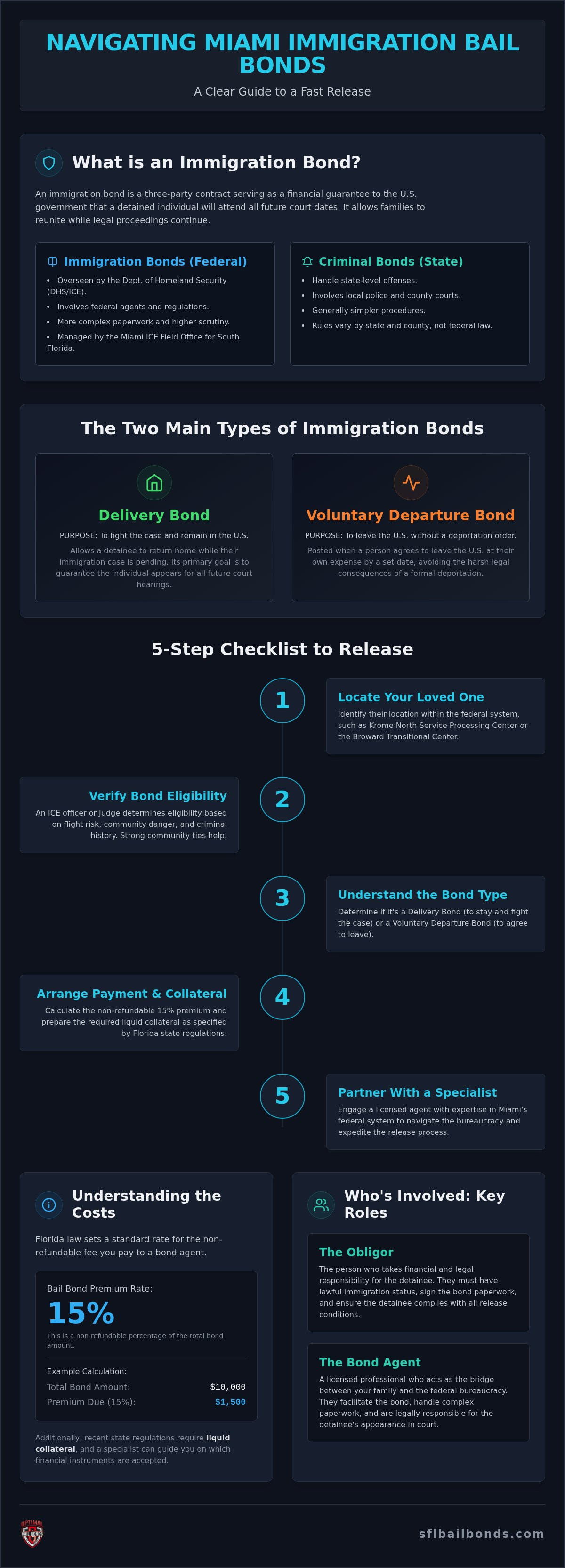
Miami Immigration Bond Checklist: 5 Steps to Release
The waiting is the hardest part. You need a clear plan to navigate the next few hours. While federal systems move slowly, your actions can significantly speed up the timeline for your loved one's return. When you're ready to start the process for immigration bail bonds Miami, follow this checklist to ensure nothing is missed.
- Step 1: Locate the detainee. Use the ICE Online Detainee Locator System. You'll need the individual’s Alien Registration Number (A-Number) and their country of birth, or their full name and date of birth.
- Step 2: Verify bond eligibility. Not everyone is granted a bond immediately. Contact the local ICE office to confirm if a bond has been set and the exact amount required for release.
- Step 3: Gather your documentation. You'll need your government ID and proof of your own legal status. Having these ready prevents delays when the agent starts the federal paperwork.
- Step 4: Contact a specialist. Reach out to a licensed agent who understands the specific requirements of South Florida facilities. You can contact our Miami bond specialists to begin the filing process immediately.
- Step 5: Coordinate the release. Once the bond is posted, ICE typically processes the release within 24 to 48 hours. Stay in close contact with your agent to know exactly when and where to pick up your family member.
Facility-Specific Logistics: Krome and BTC
Knowing where your loved one is being held changes the logistics of their release. The Krome North Service Processing Center is located at 18201 SW 12th St, Miami, FL 33194. It's a high-security facility, so follow all posted signs and staff instructions carefully. If they're at the Broward Transitional Center (BTC) in Pompano Beach, located at 1000 NW 31st Ave, the atmosphere is different, but the release protocols remain strict. Occasionally, detainees are moved to the Glades County Detention Center in Moore Haven if local facilities are at capacity. We track these movements to ensure we're working with the correct office for your immigration bail bonds Miami.
Required Documentation for the Obligor
The person posting the bond, known as the obligor, must meet specific federal requirements. You must be a U.S. citizen or a Lawful Permanent Resident (Green Card holder). ICE requires a valid government-issued photo ID, such as a driver's license or passport, to verify your identity. Additionally, you must provide your Social Security number. This is a mandatory requirement for the federal forms used to guarantee the bond. We treat this sensitive information with the highest level of confidentiality and professional care.
Why Expert Guidance Matters: The Optimal Bail Bonds Difference
When you're dealing with the federal government, you need more than just a service provider. You need a partner who understands the emotional weight of your situation. We take pride in being a North Miami-Dade specialist that doesn't just process bonds but also operates a licensed Bail Bond Education Center. This role as an instructor for the industry gives us a unique perspective on the complexities of immigration bail bonds Miami. We don't just follow the rules; we teach them. This ensures your family receives guidance based on the most current regulations and ethical standards.
Professionalism Through Education
Our position as an education center means we're constantly analyzing federal shifts and local facility changes. Whether it's a new ruling from the Eleventh Circuit or a change in collateral laws like SB 600, we stay ahead of the curve to protect our clients. This deep knowledge is part of our commitment to the profession. For those interested in the broader industry, we even provide resources like our How to Become a Bail Bondsman in Florida: The 2026 Career Guide. Our expertise allows us to handle sensitive immigration cases with a level of diligence that others might miss. We believe that every family deserves a guide who acts with integrity and professional dedication.
Empathy is at the core of everything we do. We know that families dealing with ICE detention often feel judged or ignored by the system. Our approach is strictly non-judgmental and supportive. We've spent years building relationships and understanding the protocols at Krome and the Broward Transitional Center. This local expertise allows us to move quickly when urgent cases in Miami-Dade and Broward require immediate attention. You aren't just another case number to us; you're a family in crisis, and we're here to de-escalate that stress with clear, calming communication.
Next Steps: Securing Your Loved One’s Release
Securing a release is a time-sensitive mission. You've already taken the first step by educating yourself on the checklist and the costs involved. Now, it's time to put that knowledge into action. You can start the process right now by reaching out for a consultation to review the specifics of your loved one's case. For more detailed information on local logistics, see our guide on Bail Bonds Miami: The 2026 Guide to Securing a Fast, Compassionate Release. You don't have to navigate the federal bureaucracy alone. We're here to stand by your side until your family is reunited.
Bringing Your Loved One Home Today
Navigating the federal detention system is one of the most stressful experiences a family can face. By understanding the specific requirements for delivery bonds and following our five-step checklist, you've already taken the most important steps toward a reunion. You now know how to locate a detainee and which financial instruments are required for collateral under Florida's current regulations. This complex process moves much faster when you have a partner who specializes in immigration bail bonds Miami and understands the unique logistics of Krome and the Broward Transitional Center.
Our specialized immigration release team operates as a licensed Bail Bond Education Center; this ensures we provide the most accurate and ethical guidance available in South Florida. We're available 24/7 across Miami-Dade and Broward to support you during this legal crisis. Contact our Miami Immigration Bond Specialists for Immediate Help and let us manage the federal paperwork while you focus on your family. You don't have to carry this burden alone; help is just a phone call away.
Frequently Asked Questions
How long does it take to get someone out of ICE custody in Miami after the bond is paid?
Release from ICE custody typically occurs within 24 to 48 hours after the bond is verified. Processing times at the Krome North Service Processing Center or the Broward Transitional Center depend on the facility's current administrative workload. We maintain constant communication with these offices to give you the most accurate updates. It's a stressful wait, but we're here to ensure the paperwork is handled correctly to prevent any avoidable delays.
Can a non-citizen post an immigration bail bond in Florida?
A non-citizen can post a bond only if they have lawful status. The obligor must be a U.S. citizen or a Lawful Permanent Resident with a valid Green Card and government-issued ID. People without legal status or those on certain temporary visas aren't eligible to sign as the financial guarantor. We'll help you verify if your chosen sponsor meets these federal requirements before you begin the paperwork for immigration bail bonds Miami.
What happens to the bond money if the person is deported?
If the person is deported, the bond's outcome depends on their compliance. If they attended every required hearing until their removal, the bond is usually canceled and the collateral is returned to the obligor. However, if they missed a court date before being deported, the government might forfeit the funds. We provide clear guidance on how to track these cases so you can protect your financial assets throughout the legal process.
Where are immigration bond payments made in Miami-Dade County?
Bond payments in Miami-Dade are typically handled at the ICE Enforcement and Removal Operations office or directly at the Krome facility. You must provide a cashier's check or money order made out to the "U.S. Department of Homeland Security." ICE doesn't accept cash or personal checks for these federal bonds. Our team ensures you have the correct payment method ready so your trip to the facility is successful and efficient.
Is an immigration bond the same as a criminal bail bond?
These bonds are not the same. Criminal bonds involve local or state police, while immigration bonds are federal matters managed by the Department of Homeland Security. The regulations for premiums and the types of accepted collateral differ significantly between the two systems. As a licensed education center, we specialize in these federal nuances to ensure your family isn't confused by the different rules that apply to immigration bail bonds Miami.
Can I get an immigration bond reduced through a hearing?
You can request a bond redetermination hearing before an Immigration Judge to seek a reduction. The judge evaluates factors like your loved one's ties to the Miami community and their past immigration record. If the judge lowers the amount, it reduces the total collateral you need to provide. While we don't offer legal representation, we're ready to adjust your bond paperwork as soon as the court issues a new order for release.
What is the minimum amount for an immigration bond in 2026?
The statutory minimum for an immigration bond is $1,500 in 2026. While this is the lowest legal limit, actual amounts are usually higher. In South Florida, bonds frequently range from $5,000 to $25,000 based on the detainee's flight risk and criminal history. We monitor these trends closely through our education center to give families realistic expectations about the financial requirements for securing a fast release from local detention facilities.
Do I need an attorney to post an immigration bail bond?
You don't need an attorney just to post the bond, but you must work with a licensed bond agent for surety options. An attorney focuses on the legal arguments in court, while we handle the financial guarantee and the logistics of the physical release. We provide the compassionate, expert guidance you need to navigate the federal bureaucracy without the high costs often associated with hiring a private investigator or additional legal staff.


