
Imagine it's midnight and you just received a call from the Miami-Dade Turner Guilford Knight Correctional Center. Your heart sinks as you realize a loved one is behind bars, and you're suddenly facing the complex florida legal system you never expected to encounter. You're likely feeling a mix of fear and confusion. It's a heavy burden to carry alone, especially when you don't know where to start.
We understand that the bail bond process often feels like a maze of non-refundable 10% premiums and strict regulations. You're probably worried about the difference between criminal and immigration cases or how to even locate someone in the massive Broward County jail system. It's okay to feel anxious; these are high-stakes situations that require precise knowledge and a calm hand. We're here to offer that support.
This guide serves as your expert roadmap to help you regain control during this overwhelming time. We'll break down the latest 2026 legal updates, provide specific search tools for local jails, and explain exactly how to choose a licensed agent who treats you with dignity. By the end of this article, you'll have the specialized knowledge necessary to navigate this crisis with steady reliability and confidence.
Key Takeaways
- Understand the legal framework of the florida bail system, including the non-negotiable 10% premium and the 24-hour first appearance hearing requirement.
- Learn how to navigate specific inmate search tools for Miami-Dade, Broward, and Palm Beach jails to locate your loved one quickly.
- Identify the critical differences between state-level criminal bonds and federal immigration cases to avoid costly procedural mistakes.
- Discover how local expertise and professional support can de-escalate the stress of a legal crisis and streamline the release process.
Understanding Florida Bail Laws and the Legal Framework
Florida bail bonds are not just a service; they're a safeguard for your constitutional rights. Under Chapter 903 of the Florida Statutes, most individuals accused of non-capital offenses have a fundamental right to release while awaiting trial. This legal framework ensures that the presumption of innocence remains a reality rather than just a concept. To understand how this fits into the broader legal landscape, Understanding the U.S. Bail System provides valuable context on why these protections exist across the country.
The Florida Department of Financial Services oversees the industry, regulating licensed agents to maintain ethical standards and financial accountability. In South Florida, specifically Miami-Dade and Broward counties, the courts often issue administrative orders to standardize bond schedules. These orders help manage the high volume of cases in our local jail systems, creating a structured path for release that local experts must follow precisely. We act as your mentor through this process, ensuring you aren't just another case number in a crowded system.
To better understand how legal complexities can impact your case, watch this helpful video:
The 10% Surety Bond Rule in Florida
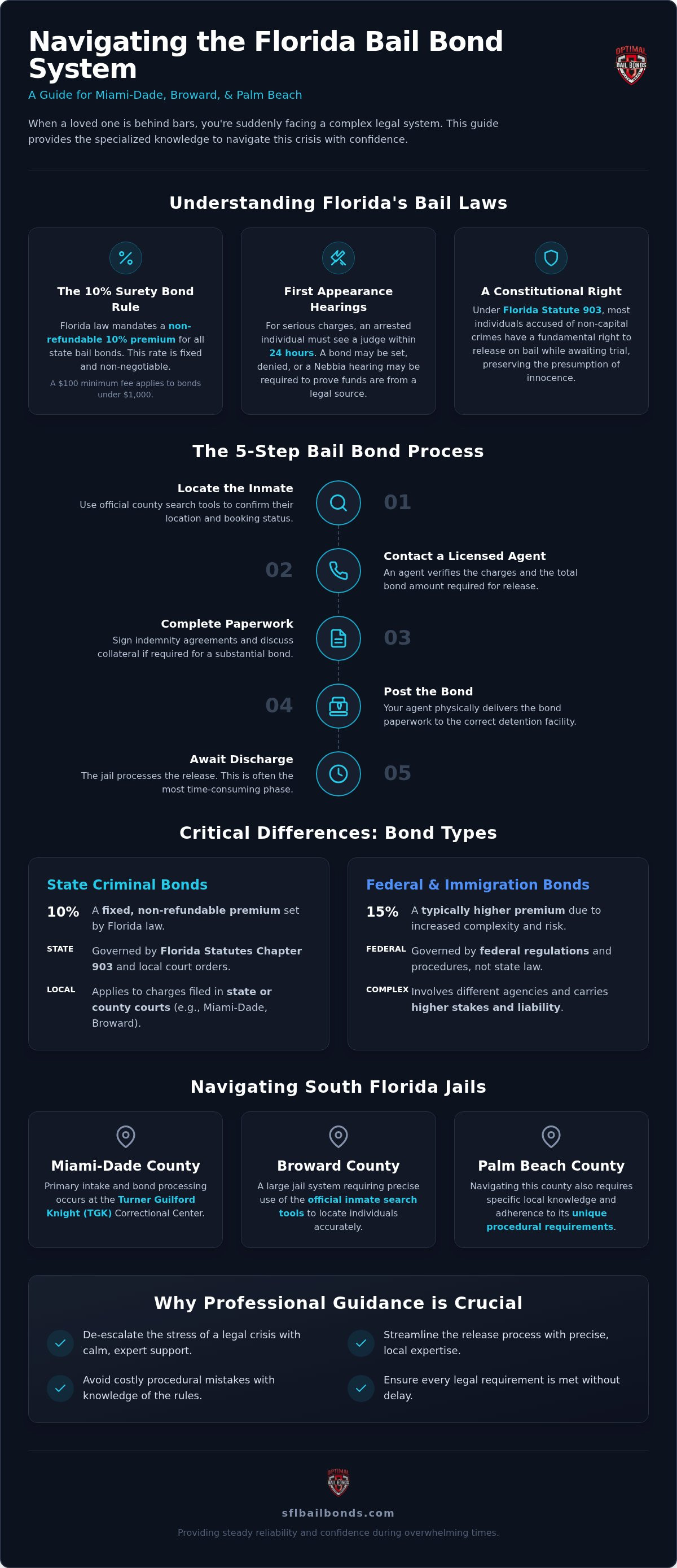
Florida law sets a mandatory, non-refundable premium for state bail bonds at exactly 10% of the total bond amount. This rate is fixed by the state. It's illegal for any agent to offer discounts or "deals" on this fee. If the bond is under $1,000, there is a minimum flat fee of $100. Federal or immigration bonds are different, typically requiring a 15% premium due to their increased complexity and risk. We prioritize transparency, ensuring you understand that these funds are the cost of the bond service and are not returned after the case concludes. Our goal is to provide clarity so you can make informed decisions for your family.
Bail Schedules vs. First Appearance Hearings
For many minor offenses, a standard "bond schedule" allows for almost immediate release once booking is complete. However, for more serious charges, the "24-hour rule" applies. This requires the arrested individual to appear before a judge for a first appearance hearing within one day of arrest. In South Florida, judges may also order a Nebbia hearing. This requires the defendant to prove that the funds used for bail come from legitimate, legal sources. If a judge denies bond or sets an unreachable amount, your agent acts as a vital guide. We help you understand the next steps and potential legal avenues for a bond reduction, standing by you during these high-stress moments.
The Bail Bond Process in Miami-Dade, Broward, and Palm Beach
The moment you learn someone is in custody, the clock starts ticking. Securing a release in South florida requires a methodical approach to ensure every legal requirement is met without delay. While the overarching rules are defined in Florida Statutes Chapter 903: Bail, the ground-level experience varies significantly between counties. We guide families through this journey with diligence and care, following a standardized five-step process.
- Locate the inmate: Use official county search tools to confirm their location and booking status.
- Contact a licensed agent: We verify the specific charges and the total bond amount required.
- Complete paperwork: This includes signing indemnity agreements and discussing collateral if the bond is substantial.
- Post the bond: Your agent physically delivers the bond to the correct detention facility.
- Discharge: The jail processes the release, which is often the most time-consuming phase.
Miami-Dade County Bond Procedures
In Miami-Dade, most adult intake and bond processing happens at the Turner Guilford Knight (TGK) Correctional Center. It's a high-volume facility that can be intimidating for families. Your first step is often a Miami-Dade jail inmate search to find the booking number. Once we have that, we work directly with the Miami-Dade Corrections and Rehabilitation Department to ensure the bond is accepted quickly. Their administrative staff handles the discharge, but release times are never guaranteed. They depend entirely on the facility's current volume and staffing levels.
Broward and Palm Beach County Differences
Navigating Broward County requires knowing where the inmate is housed. While the Broward County Main Jail handles many initial bookings, some individuals are moved to the Joseph V. Conte Facility. Each building has its own rhythm for accepting bonds. Moving north to Palm Beach County, the "Gun Club" jail, formally known as the Main Detention Center, follows its own strict procedures. Families should expect a thorough check of all paperwork before the release clock even starts. Having an agent who understands the unique administrative quirks of all three counties prevents unnecessary delays. If you're feeling overwhelmed by these differing rules, reaching out to a professional bail agent can provide the clarity you need to bring your loved one home.
Criminal vs. Immigration Bail Bonds in Florida
Florida serves as a major hub for immigration detention. This creates a unique and often overwhelming challenge for families who find themselves dealing with both state criminal charges and federal immigration holds simultaneously. It's a stressful intersection of two very different legal systems that operate under entirely separate rules. We understand the confusion this causes. Our role is to act as your knowledgeable guide, helping you distinguish between these two paths so you can make the best decision for your loved one.
The most immediate difference lies in the jurisdiction and the mandatory premium costs. Criminal bonds are handled at the state level and follow a strict 10% premium mandated by law. Federal immigration bonds fall under the authority of U.S. Immigration and Customs Enforcement (ICE) and the Department of Homeland Security (DHS). Because these cases involve federal oversight and often carry a higher risk of non-appearance, the premium is set at 15% of the total bond amount. For any bond under $1,000, a minimum fee of $100 applies. In 2023, the median immigration bond was $7,000, though some cases in the florida federal system exceeded $40,000.
How Immigration Bonds Work in South Florida
In the Miami area, the Krome North Service Processing Center is the primary facility for immigration detention. Navigating Krome requires specialized knowledge that many standard bail bond agents don't have. Most immigration cases involve a "delivery bond," which ensures that the non-citizen appears for all future immigration court hearings. When you post this bond, you become the "Obligor." This means you're legally responsible for ensuring the individual complies with every federal requirement. It's a significant commitment. We act as your mentor to ensure you understand every obligation before you sign any paperwork.
Collateral Requirements for Federal Bonds
Federal immigration bonds often require more substantial collateral than state-level criminal cases. This is because the federal government enforces strict protocols, and the financial risk to the bonding agency is much higher if the individual fails to appear. Families often need to provide liquid assets or real estate to secure these bonds. Acceptable forms of collateral in our region typically include:
- Real estate with sufficient equity located within the state
- Cash, certified funds, or money orders
- Irrevocable letters of credit from recognized financial institutions
Optimal Bail Bonds guides families through these complex federal documentation requirements with diligence and care. We specialize in handling these intricate cases that other agencies often avoid. Our non-judgmental approach ensures that you feel supported while we handle the heavy lifting of federal paperwork. We provide the steady reliability you need when your family's future feels uncertain.
Navigating South Florida Jails and Inmate Searches
Finding an inmate is the first step toward understanding how bail bonds work. This initial search provides the foundational information needed to start the release process in florida. You'll need to distinguish between the "Booking Number," which identifies the specific stay in jail, and the "Case Number," which refers to the legal charges in court. Having the booking number is much more helpful for a bail agent. Don't panic if your loved one doesn't appear in a search immediately after an arrest. A "processing lag" of several hours is common while the jail staff completes fingerprints, medical screenings, and data entry.
For those in the local area, our North Miami-Dade bail bonds services offer a rapid response to help you cut through this initial confusion. We act as your partner, ensuring you don't have to face the massive county systems alone.
The South Florida Jail Directory
Each county has a primary facility where the majority of bond processing occurs. Knowing the correct address is essential for coordinating with an agent or planning for a pickup.
- Miami-Dade (TGK): 7000 NW 41st St, Miami, FL 33166.
- Broward Main Jail: 555 SE 1st Ave, Ft. Lauderdale, FL 33301.
- West Palm Beach (Main Detention): 673 Gun Club Rd, West Palm Beach, FL 33406.
While visiting hours are strictly limited and vary by facility, bonding hours are typically available 24/7. As of 2026, the Miami-Dade Pre-Trial Release program utilizes the new uniform statewide bond schedule to provide standardized, non-monetary release options for eligible non-violent defendants before their first appearance hearing.
What to Do if Your Loved One Isn’t in the System
If a search returns no results, the individual might still be at a local municipal police department. Smaller cities like Coral Gables or Fort Lauderdale often hold detainees at their own stations before transporting them to the county jail. Another possibility is a "Transfer" status. This happens when an inmate is being moved between facilities, such as from TGK to a specialized annex. A professional agent can often track an inmate through these administrative transitions much faster than a civilian using public websites. We have the experience to call the right desks and get answers when the online portals are lagging. This speed is a critical advantage during the first few hours of an arrest.
If you need immediate assistance locating someone or starting the bond process, contact a licensed florida bail bonds expert today to get the help you deserve.
Why Choose Professional Guidance for Florida Bail Bonds
A legal crisis is one of the most stressful experiences a family can face. It's easy to feel lost when you're trying to figure out the florida bail system on your own. Choosing professional guidance isn't just about the paperwork; it's about having a compassionate expert who can de-escalate the situation. We pride ourselves on a non-judgmental approach that respects your dignity. Our goal is to act as a protective ally while ensuring the legal process moves as quickly as possible.
Our deep roots in the industry set us apart. Because we operate a state-approved education center and provide the Florida bail bond pre-licensing course, our agents are mentors in the field. We don't just follow the rules; we teach them. This ensures your case is handled with the highest level of diligence and accuracy. We stay ahead of every regulatory change to prevent the administrative errors that often lead to unnecessary jail time. Expertise in Miami and Ft. Lauderdale is vital, as knowing the specific desk sergeants and local jail workflows prevents costly delays.
The Optimal Bail Bonds Difference
We balance professional authority with deep human empathy. It's a dual-layered approach designed to support you through every stage of the process. Whether you're dealing with standard criminal charges or complex immigration detention, we have the specialized knowledge to help. Standard agencies often avoid immigration cases because of the federal paperwork involved. We embrace these challenges with a promise of partnership, ensuring you feel seen and supported. We also work closely with the defendant to ensure they understand their court obligations. This clear communication prevents bond forfeiture and helps your loved one stay on the right side of the law.
Next Steps: Securing a Release Today
Time is of the essence. The faster you act, the sooner the discharge process can begin. Before you pick up the phone, try to have the following information ready:
- The full legal name and date of birth of the person in custody.
- The specific jail facility where they're being held, such as TGK or Broward Main.
- Any information you have regarding the charges or the bond amount set by the judge.
If you're still feeling unsure, our bail bonds Miami guide offers a deeper look at local procedures. Don't wait for the system to move at its own pace. Reach out to a professional who can advocate for your family's needs with integrity and skill.
Take Control of the Florida Bail Process Today
Navigating the legal system during a crisis is never easy, but you don't have to face it alone. You now understand that the florida bail process requires more than just paying a premium; it demands a clear grasp of local jail procedures and the distinct rules governing criminal versus immigration cases. By identifying the right detention facility and choosing a guide with deep educational roots, you've already taken the first step toward a successful release.
Our team stands ready to offer the steady reliability and specialized knowledge your family needs. As a state-approved education center, we provide 24/7 support across Miami-Dade, Broward, and Palm Beach counties. We handle the complex paperwork for both state and federal cases so you can focus on what matters most: your loved one's return home. If you're ready to move forward, Contact Optimal Bail Bonds for Fast, Compassionate Release in South Florida. We're here to help you find the way back to stability with integrity and care.
Frequently Asked Questions
Is the bail bond premium refundable in Florida?
No, the bail bond premium is not refundable. Per florida law, the 10% premium for state bonds and 15% for federal bonds are fees paid for the agent's service of guaranteeing the defendant's appearance. Once the bond is posted and the individual is released, the agent has fulfilled their obligation. These funds are earned at that moment. You won't get this money back regardless of the case's final outcome in court.
How long does it take to get someone out of jail in Miami?
Release times in Miami vary significantly based on the facility's current volume and staffing. After an agent posts the bond at the Turner Guilford Knight (TGK) Correctional Center, the jail must process the discharge paperwork and return personal property. This typically takes anywhere from 4 to 12 hours. We cannot promise a specific release time because it depends entirely on jail administrative procedures. We stay in contact with the facility to monitor progress.
Can I pay an immigration bond at a regular Florida jail?
No, you cannot pay an immigration bond at a standard local jail like the Broward County Main Jail. Immigration cases are federal matters handled by U.S. Immigration and Customs Enforcement (ICE). These bonds must be processed through an ICE Enforcement and Removal Operations office, such as the Krome North Service Processing Center in Miami. We specialize in these complex federal cases and guide families through the specific documentation required for immigration release.
What happens if a defendant misses a court date in Ft. Lauderdale?
If a defendant misses a court date in Ft. Lauderdale, the judge will likely issue a bench warrant for their arrest and declare the bond forfeited. This means the court demands the full bail amount from the bondsman. We work closely with families to prevent this by ensuring defendants understand their obligations. If a mistake happens, it's critical to contact us immediately so we can help surrender the defendant and potentially reinstate the bond.
Do I need collateral for every Florida bail bond?
You don't always need collateral for a bail bond in florida. We evaluate each situation based on the total bond amount, the severity of the charges, and the defendant's ties to the community. Many standard state bonds are signature bonds that only require an indemnity agreement from a qualified co-signer. However, larger bonds or federal immigration cases often require real estate or cash collateral to secure the financial risk involved in the guarantee.
What is a Nebbia hearing in the South Florida court system?
A Nebbia hearing is a court proceeding where the defendant must prove that the funds used for bail and collateral come from legitimate, legal sources. This is common in South Florida for cases involving high-value theft or drug trafficking. The judge wants to ensure that dirty money isn't being used to secure a release. We assist families by coordinating the necessary financial documentation, such as bank statements or tax records, to satisfy the court's requirements.
Can a bail bondsman help with an ICE detainer in Florida?
A bail bondsman can help you secure an immigration bond if ICE sets a bond amount, but we cannot remove a detainer. An ICE detainer is a request from federal authorities to hold an individual after their local criminal case is resolved. If a bond is granted by an immigration judge, we process the federal paperwork to facilitate release. We act as your specialized guide through this complex intersection of state and federal law.
How do I find someone in the Miami-Dade jail system?
You can find someone by using the Miami-Dade Corrections and Rehabilitation Department's online inmate search tool. You'll need the person's full legal name and date of birth to get the best results. If the online portal is lagging or if you can't find them, our agents can call the jail directly to check the booking status. We often track inmates through the system faster than the public can by using our professional local contacts.


