
What matters most in Florida bail bond agent training: memorizing course material, or learning to use sound judgment under pressure? Professional preparation should build more than familiarity with industry concepts. It should help you develop clear communication, careful information handling, and a practical foundation for approaching the work responsibly.
If you’re unsure what the role demands, or concerned that training will be difficult to follow, that uncertainty is understandable. Preparation can feel confusing when it is discussed alongside state licensing requirements. The two are connected, but they are not the same: training helps you build knowledge, while licensing requirements define the formal steps to pursue a license.
This article explains the skills training can support, how to assess your learning needs, and how to approach the process with realistic expectations. Optimal Bail Bonds’ Bail Bond Education Center offers a pre-licensing class and a 120 Hours Bail Bonds Course for people ready to explore structured learning in Florida.
Key Takeaways
- Florida bail bond agent training should develop industry knowledge alongside sound judgment, careful information handling, and clear communication.
- Separate professional learning goals from formal licensing steps, and use current Florida agency information to understand the requirements.
- Course concepts and scenario-based practice can help you build applied understanding, but they do not replace workplace experience.
- Set clear learning goals and identify the skills or concepts you want to strengthen before you begin studying.
- Explore pre-licensing education through Optimal Bail Bonds’ Bail Bond Education Center, including its 120 Hours Bail Bonds Course.
What Florida Bail Bond Agent Training Is Designed to Teach
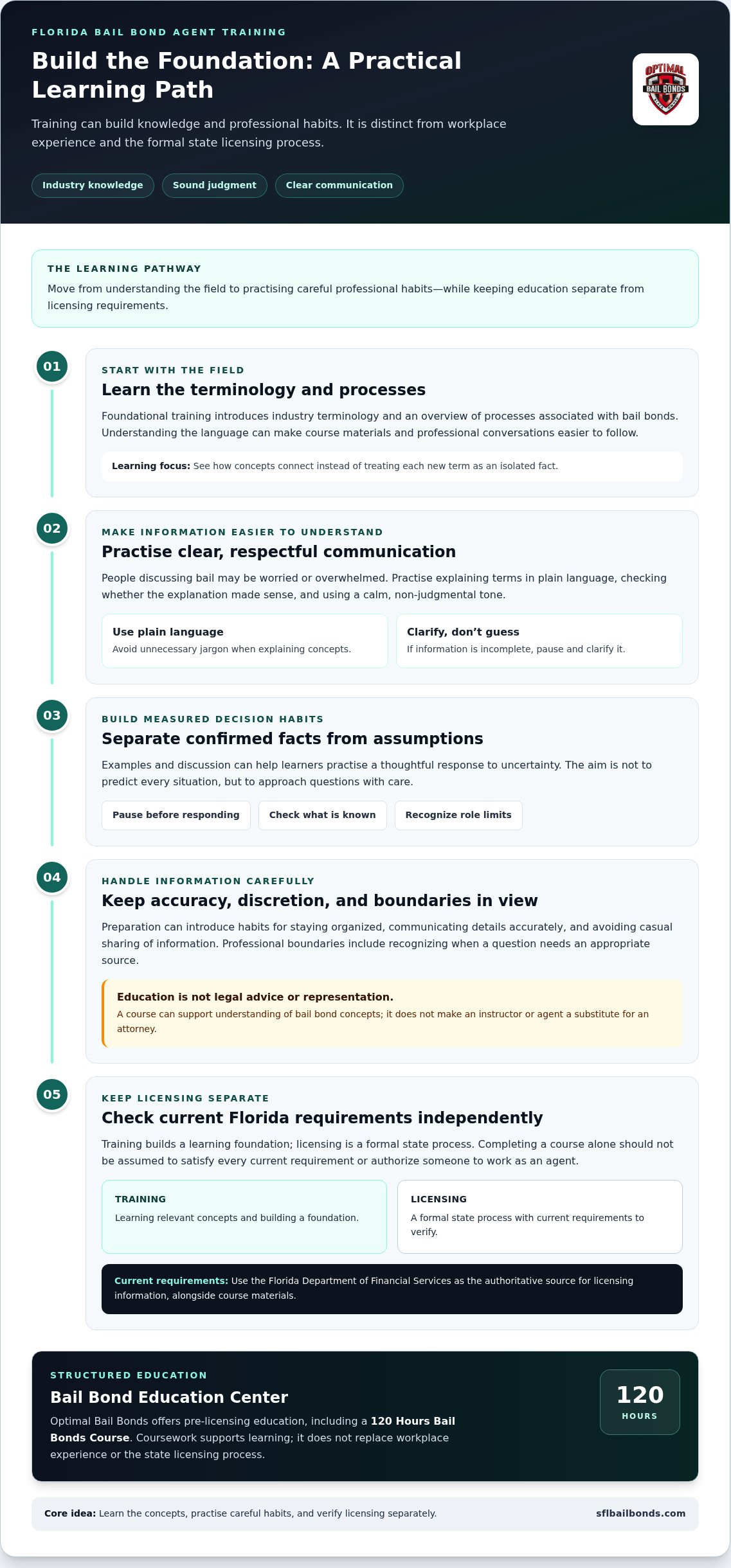
Bail bond agent training is structured education that introduces learners to knowledge and professional practices relevant to bail bond work. It can make an unfamiliar field easier to understand by organizing terminology, processes, and professional expectations into a learning path. For someone considering this career in Florida, that foundation can replace guesswork with a clearer idea of what to study next.
Florida bail bond agent training is professional preparation, not a promise of job readiness or a substitute for the state licensing process. Bail bond work connects with the justice system, and a general Bail bondsman overview can provide background on the profession. Training offers a setting to become familiar with industry concepts and consider how to approach them carefully and responsibly.
What does a bail bond agent learn during training?
At a foundational level, learners encounter industry terminology and an overview of processes associated with bail bonds. Knowing the language makes course materials and professional conversations easier to follow. Process knowledge can also help you see how concepts relate, rather than treating each new term as an isolated fact.
Preparation can also introduce the importance of professional communication and careful information handling. These are learning goals, not guarantees about performance in every workplace situation. Education about an industry is distinct from legal advice or representation. A course can support your understanding of bail bond concepts, but it does not make an instructor or agent a substitute for an attorney.
How is training different from Florida licensing?
Education and licensing are related, but they serve different purposes. Training focuses on learning relevant concepts and building a foundation. Licensing is a formal state process, and completing a course alone should not be assumed to satisfy every current requirement or authorize you to work as an agent.
Requirements can change, so use the Florida Department of Financial Services as the authoritative source for current licensing information. Review its guidance alongside your course materials, and treat state rules as separate from general instruction. This distinction helps you plan without mistaking an educational step for completion of the licensing process.
Optimal Bail Bonds’ Bail Bond Education Center offers a 120 Hours Bail Bonds Course and pre-licensing education. Reviewing the course alongside current state agency information can help you understand how education fits into your next steps.
Florida Bail Bond Agent Training Builds Knowledge, Judgment, and Communication
Understanding industry concepts is only part of professional preparation. Learners can also work toward communicating clearly, handling information carefully, and making measured decisions. These are skills to develop through study and practice, not automatic results of completing a course. Accurate information, respectful communication, and responsible judgment work together to support professional interactions.
Why communication and compassion matter in bail work
People discussing bail may be worried or overwhelmed. Terms that feel familiar to a professional can be confusing to someone encountering them for the first time. Training can help learners recognize key terms and explain concepts in plain language, making conversations easier to follow without promising a particular outcome.
For example, if someone asks what a term means, practise explaining it clearly, checking whether the explanation made sense, and avoiding unnecessary jargon. A calm, non-judgmental tone matters, too. It keeps an exchange focused on information rather than adding blame or pressure to an already stressful moment.
Clear communication also means being precise about what is known. If information is incomplete, pause to clarify it rather than guessing. That habit supports trust and helps prevent misunderstandings.
How training can strengthen judgment and professionalism
Sound judgment starts with simple habits: pause before responding, distinguish confirmed facts from assumptions, and recognize when a question falls outside your knowledge or professional role. In training, learners can practise these habits through examples and discussion. The goal is not to predict every situation, but to build a thoughtful approach to uncertainty.
Careful information handling is another useful learning goal. Consider how to stay organized, communicate details accurately, and avoid sharing information casually. Professional boundaries matter as well. Understanding the limits of your role includes knowing when a question needs to be directed to an appropriate source, rather than attempting to provide legal advice or representation.
Ethical awareness develops over time. Use education to reflect on how respect, accuracy, and accountability apply across different interactions, then continue strengthening that understanding as you gain experience. These principles do not guarantee performance, but they offer a grounded framework for approaching professional situations with care.
Optimal Bail Bonds offers a 120 Hours Bail Bonds Course and pre-licensing class for learners seeking structured education.
Does Bail Bond Agent Training Prepare You for Real-World Situations?
Training can help you connect industry concepts to practical questions, but coursework and workplace experience are not the same. A lesson may introduce terminology or explain how ideas relate. Applying that knowledge in a changing professional setting takes further learning and experience. A useful course can give you a foundation and a way to think through unfamiliar situations. It cannot promise mastery, employment, or a particular career outcome.
For Florida bail bond agent training, the value of applied learning depends in part on how instruction is structured. When a course includes scenarios, learners can practise interpreting information, identifying what they still need to clarify, and explaining a concept in plain language. Reflection can help, too. After considering an example, ask yourself what you understood, what remains uncertain, and where authoritative guidance may be needed.
What classroom learning can help you practise
Consider a hypothetical example in which someone uses an unfamiliar industry term. You might explain what it means in the context of the lesson, then notice whether the question also raises an issue that needs more information. This kind of exercise can build familiarity with concepts and encourage careful, measured communication. It illustrates how applied practice may work, rather than making a claim about a particular course’s contents.
When instruction includes examples or scenarios, focus on the reasoning process instead of guessing a single “right” response. Practise separating known details from assumptions, listing questions that need clarification, and identifying when to consult current official guidance. These habits make learning more active and reveal areas to review.
Practice has limits. Classroom exercises support understanding, but they do not replace workplace experience or formal state requirements. For current Florida licensing information, refer to the Florida Department of Financial Services.
What training cannot replace
A course should not be treated as a guarantee of career success or proof that every real-world situation will feel familiar. People and circumstances vary. Professional judgment develops over time, and a learner may need further guidance and experience to apply concepts confidently.
Training is also not the same as licensure or independent legal expertise. Keep those distinctions clear as you plan your next steps. Rules and professional contexts can change, so learning does not necessarily end when a course does. Revisiting current state information and continuing to strengthen your understanding can help you stay oriented as expectations evolve.
Approach education with realistic expectations: use it to build a foundation, practise thinking carefully, and identify what you still need to learn. That is meaningful preparation, even though it cannot replace the next stages of professional development.
How to Prepare for Florida Bail Bond Agent Training
A little preparation can make new material easier to absorb. You do not need to know the industry before you begin. Start by identifying what you already understand, what feels unfamiliar, and what you hope to learn. This gives your study a clear direction and helps you notice progress as concepts become more familiar.
Set learning goals before enrolling
Write down practical goals before beginning Florida bail bond agent training. You might want to become more comfortable with industry terminology, explain concepts in plain language, understand expectations for professional conduct, or feel more confident asking questions. Keep your goals focused on learning rather than assuming a course will guarantee workplace performance.
As you study, keep a concise question list. Add unfamiliar terms, topics that need another explanation, and points where you are unsure how separate concepts connect. When you find an explanation, note it beside the question. This record helps you review efficiently and distinguish what you have learned from what still needs clarification.
If you are exploring the broader career path, a guide on how to become a bail bondsman in Florida can help you consider the learning journey in context. Use it to shape your questions, and rely on current state information for licensing details.
Keep course learning aligned with current Florida information
Study course concepts alongside current information from the Florida Department of Financial Services. When a lesson discusses licensing, compare it with the state agency’s latest guidance. Do not rely on an old summary or informal explanation for current requirements. The agency is the appropriate place to review official information.
Keep education types distinct, too. Pre-licensing education is a learning step for someone exploring entry into the field. Bail bond continuing education in Florida refers to ongoing study for already licensed agents, so it serves a different point in a professional path. If you are not yet licensed, focus first on understanding the pre-licensing route and relevant state guidance.
A steady study routine can be simple: review a concept, record unfamiliar terms, write down questions, then revisit them using course materials and official information. This gives you a practical way to stay organized without expecting yourself to master everything at once.
Read about the 120 Hours Bail Bonds Course and pre-licensing class
Explore Florida Pre-Licensing Training Through Optimal Bail Bonds
Once you have clarified your learning goals and reviewed the distinction between education and licensing, a structured pre-licensing class can be a practical next step. Optimal Bail Bonds provides bail bond education through its Bail Bond Education Center, including pre-licensing and continuing-education classes. Choose the learning stage that matches where you are in your professional path.
When a pre-licensing class may fit your next step
If you are exploring entry into the field and want organized instruction, pre-licensing education may fit your plans. The 120 Hours Bail Bonds Course pre-licensing information explains this education option. Keep your goals in view as you review it, and compare licensing references with current information from the Florida Department of Financial Services.
Florida bail bond agent training can give you a structured opportunity to build foundational knowledge, but a course and the state licensing process remain distinct. Use education to support your preparation, and rely on the state agency for current requirements. This approach helps you move forward with clear expectations instead of assuming course enrollment or completion settles every licensing question.
Continue building knowledge as your professional path develops
Continuing education serves a different learning stage from pre-licensing. It supports ongoing learning as a professional path develops, rather than serving as an introductory step for someone just beginning to explore the field. Optimal Bail Bonds’ Bail Bond Education Center offers both pre-licensing and continuing-education classes for different stages.
You do not have to map out every career step at once. Start with the learning option that matches your current stage, keep questions organized, and review official Florida information as you go. A thoughtful next step can make the process feel more manageable.
Learn about the Bail Bond Education Center
Take Your Next Step Toward Professional Preparation
Strong Florida bail bond agent training is about more than learning terminology. It can help you build foundational knowledge, practise clear communication, and approach professional situations with care and sound judgment. Set realistic learning goals, keep track of questions, and remember that education supports preparation but does not replace Florida’s formal licensing process or workplace experience.
As you plan, use current state agency information to understand licensing requirements and choose learning that fits your stage. Optimal Bail Bonds’ Bail Bond Education Center offers pre-licensing classes, including a 120 Hours Bail Bonds Course, as well as continuing education for a different point in the professional journey.
Build your foundation with focused study, clear questions, and a learning option suited to your current stage.
Frequently Asked Questions
What is Florida bail bond agent training?
Florida bail bond agent training is structured education that introduces learners to concepts and professional skills relevant to bail bond work. It can help you understand industry terminology, communicate information clearly, and think carefully about professional boundaries. Training supports preparation, but it is not the same as workplace experience or state licensing. Use it to build a foundation and identify what to learn next.
How do you become a bail bond agent in Florida?
Start by learning about the profession and the education options available for your stage, then review current licensing information from the Florida Department of Financial Services. The state agency is the place to verify Florida’s current requirements before making decisions about your next steps. A pre-licensing class can support your education, but completing coursework alone should not be assumed to meet every requirement or authorize you to work as an agent.
How many hours is the Florida bail bond pre-licensing course?
Optimal Bail Bonds offers a 120 Hours Bail Bonds Course. That is the stated duration of this course. Course duration and current state requirements are related questions, but they are not automatically interchangeable. If you are planning your education around Florida licensing, check the Florida Department of Financial Services for current requirements and use the course information to understand the education option.
What skills should bail bond agent training teach?
Training should support learning goals such as understanding industry terminology, communicating in plain language, handling information carefully, and approaching decisions thoughtfully. It can also help learners practise recognizing when they need clarification or should refer to an appropriate source. These are capabilities to develop through education and continued learning, not guaranteed outcomes of course completion or proof of performance in every professional situation.
Does completing a bail bond course make you a licensed agent in Florida?
No. Completing a course is an educational step, while licensure is a separate state process. Do not treat enrollment or course completion as confirmation that you are licensed or authorized to work as an agent. Review the Florida Department of Financial Services’ current licensing information to understand the requirements that apply. This distinction helps you plan your education without mistaking preparation for official approval.
Is continuing education the same as pre-licensing training?
No. Pre-licensing education is intended for people preparing to pursue entry into the field, while continuing education serves a different learning stage for already licensed professionals. The two forms of study have distinct purposes, so choose learning that matches where you are in your professional path. Optimal Bail Bonds’ Bail Bond Education Center offers both pre-licensing and continuing-education classes.
Ready to begin? Explore Optimal Bail Bonds’ 120 Hours Bail Bonds Course and pre-licensing class.


