
What if the biggest obstacle to getting your loved one home isn't the cost of the bond, but the misinformation surrounding the Miami-Dade legal system? When you're standing outside a facility like the Turner Guilford Knight Correctional Center, every second feels like an eternity. Knowing exactly how to bail someone out of jail Miami is the difference between a sleepless night of panic and a structured path toward freedom.
It's completely natural to feel overwhelmed by the complex terminology or anxious about the financial commitment. You're likely worried about the distinction between criminal and immigration bonds, or perhaps you're afraid of being exploited during a vulnerable moment. We understand that this isn't just a transaction; it's a family crisis that requires both professional expertise and genuine empathy. You deserve a partner who views you as a person, not just a case number.
This guide will demystify the 2026 bail landscape in South Florida, showing you how to navigate the process with clarity and speed. We'll break down the actual costs involved, clarify the specific requirements for different bond types, and provide a step-by-step roadmap to secure a compassionate release for your loved one.
Key Takeaways
- Understand the financial reality of the bail system and learn why you rarely need the full cash amount to secure a release.
- Follow a clear, stress-reducing roadmap on how to bail someone out of jail Miami, specifically tailored to the local intake procedures.
- Distinguish between standard criminal charges and immigration detention to ensure you're working with the right specialized bond agent.
- Learn how to verify specific bond requirements, such as Nebbia hearings, to avoid common technical delays in the Miami-Dade court system.
- Discover the benefits of partnering with a professional guide who prioritizes family education and compassionate support over simple transactions.
Common Misconceptions About Posting Bail in Miami
Facing a sudden arrest is terrifying. You might think you need tens of thousands of dollars sitting in a bank account right now to help your family member. This is a common myth that often keeps families in a state of paralysis. In reality, the bail system in the United States is designed to allow for commercial surety. Instead of paying the full court-ordered amount to the jail, you partner with a licensed agent who posts the bond on your behalf.
Learning how to bail someone out of jail Miami often starts with understanding that you only pay a small percentage of the total bond as a service fee. This premium allows the agent to act as a guarantor for the full amount. This path makes release much more accessible for families in North Miami-Dade who don't have immediate access to large sums of liquid cash. It's about moving from fear to a structured, manageable solution.
To better understand this concept, watch this helpful video:
Why the 'Lawyer First' Strategy Can Delay Release
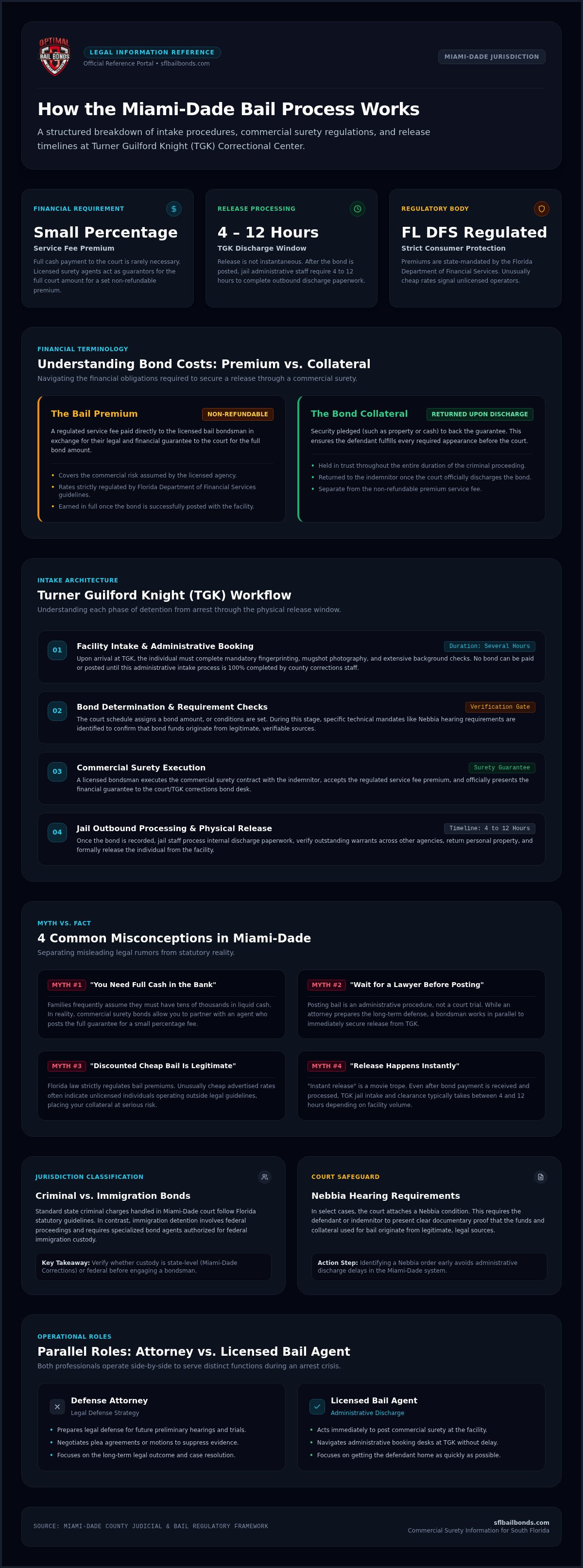
Waiting for a lawyer before acting is a frequent mistake. It sounds logical, but posting bail is an administrative task rather than a legal trial. While an attorney prepares your defense for future court dates, a bondsman works parallel to them to secure an immediate release from facilities like Turner Guilford Knight (TGK). A lawyer focuses on the long-term case; a bondsman focuses on getting your loved one home as quickly as possible. A bail bond premium is a non-refundable service fee paid to the agent in exchange for their financial guarantee to the court.
The Truth About 'Cheap' Bail Bonds
You might see ads promising significantly lower rates than the standard percentage framework. Be very careful here. Florida law strictly regulates bond premiums to ensure ethical standards and consumer protection across the industry. If an agent offers a discount that seems suspicious, they might be unlicensed or operating outside of mandatory state guidelines. Working with these individuals puts your collateral and your loved one's freedom at significant risk. It's always safer to stick with established professionals who prioritize transparency and follow the legal framework set by the state. This ensures your journey through the system is handled with integrity and professional dedication.
How the Miami-Dade Bail Process Actually Works
The booking process at Turner Guilford Knight (TGK) is the first hurdle families face. When someone is arrested, they don't immediately receive a phone call or a bond amount. They must first go through fingerprinting, photography, and a comprehensive background check. This administrative phase can take several hours depending on the current volume at the facility. Learning the mechanics of how to bail someone out of jail Miami involves more than just paying a fee; it's about understanding this intake window. Once the intake is complete and a bond is set, the licensed bail agent steps in as the guarantor for the court. This relationship is strictly regulated by the Florida Department of Financial Services bail guidelines, which protect you from unethical practices and ensure professional transparency.
Understanding the difference between premiums and collateral is vital for your financial peace of mind. Your premium is the non-refundable service fee for the bondsman's risk. It's the cost of the agent's professional intervention. Collateral, however, is a form of security like property or cash that you "get back" once the case is fully resolved and the court officially discharges the bond. Regarding the timeline, "instant" release is a myth often portrayed in movies. Even after the bond is posted, the jail must process the release paperwork, which can take anywhere from four to twelve hours. Patience is difficult during a crisis, but it's a necessary part of the reality within the Miami-Dade system. We act as your guide during these quiet hours of waiting.
Step 1: Locating the Inmate in the Miami System
You can't start the release process until you know exactly where the individual is being held. Using the Miami-Dade County Jail Inmate Search: A Guide for Families is the most efficient way to gather this data. You'll need their full legal name and date of birth to use the portal effectively. If you have the booking number, the search is even faster. This tool confirms the specific charges and the exact bond amount required by the court for their release.
Step 2: Contacting a Professional Bail Bond Agent
Once you have the inmate's information, the next step is a phone call to a licensed professional. We'll ask about the arrest location, the nature of the charges, and your relationship to the person in custody. Choosing an agent with specific North Miami-Dade expertise is crucial because they understand the local rhythms of the jail staff and court clerks. At Optimal Bail Bonds, we take a non-judgmental approach to every call. We see you as a partner in this journey, not just a file on a desk. If you need immediate guidance on how to bail someone out of jail Miami, our team is ready to provide the compassionate support your family deserves during this overwhelming time.
Myth: Criminal Bail and Immigration Bail are the Same
One of the most dangerous assumptions families make is believing that a county arrest and an immigration hold are the same thing. While they both involve detention, they operate under entirely different legal jurisdictions. When you're researching how to bail someone out of jail Miami, you're usually looking at state-level charges processed through the Miami-Dade Corrections system. However, if your loved one has an immigration detainer, they fall under the authority of Immigration and Customs Enforcement (ICE). This shift moves the case from Florida state statutes to the federal immigration bond process, which follows strict Department of Homeland Security (DHS) protocols.
The 'Krome North' factor is a specific reality for South Florida families. The Krome Service Processing Center in Miami handles federal detainees, and the bonding process there doesn't mirror the local jail's workflow. You can't simply walk into a local precinct and post an immigration bond. It requires a specialist who understands the federal CeBONDS system and the specific paperwork required by DHS. Many local agents lack the federal credentials or the specialized knowledge needed to navigate these complex waters, leaving families frustrated and delayed. We pride ourselves on being the guide you need when these two worlds collide.
Understanding the Immigration Bond Release Process
Federal bonds generally fall into two categories: Delivery Bonds and Voluntary Departure Bonds. A Delivery Bond allows an individual to remain in the country while their case is decided by an immigration judge. A Voluntary Departure Bond, conversely, is for those who agree to leave the country by a specific date. These bonds often take significantly longer to process than criminal ones because they require verification through multiple federal databases. In this system, the person posting the bond is known as the 'Obligor.' This role carries heavy responsibilities, as the Obligor must ensure the individual attends all future immigration hearings to avoid forfeiting the bond amount.
Navigating the Krome Service Processing Center
If your loved one is held at the Krome facility, the environment feels much different than a standard county jail. The administrative hurdles are higher, and the communication channels are more restricted. We act as a vital bridge between these state and federal systems, ensuring that no detail is overlooked during the transition. Our background as a state-approved education center gives us the instructional depth to explain these nuances clearly, so you never feel lost. For more comprehensive support, explore our Professional Bail Bond Guidance in Miami: Navigating the 2026 Legal System to see how we manage these intersecting challenges. Understanding how to bail someone out of jail Miami when immigration is involved requires a guide who doesn't just process paperwork but understands the human weight of federal detention.
5 Critical Steps to Take After an Arrest in Miami
The moments following a phone call from jail are often the most stressful. Learning how to bail someone out of jail Miami requires a tactical approach to replace panic with progress. Your first priority is to stay calm and gather specific data. You need the individual's full legal name, their date of birth, and the specific facility where they are being held. Without these details, the process cannot move forward. Once you have this, verify the exact charges and the bond amount. This is where you determine if the court has set a standard bond or if a "Nebbia" requirement has been attached to the case.
Consulting a specialist at an educator-led agency ensures you receive guidance based on deep industry knowledge rather than just a sales pitch. We act as your mentor through this system, helping you prepare the necessary documentation. You will typically need a valid government-issued ID, proof of residency, and an approved payment method for the premium. Finally, cooperation with your agent is vital. You must ensure the defendant fully understands their future court obligations. A successful release is a partnership between the family, the defendant, and the bondsman to ensure all legal requirements are met until the case is resolved.
Identifying the Correct Miami-Dade Facility
Miami-Dade County utilizes several different detention centers, and the location of the arrest usually determines where a person is initially taken. The Turner Guilford Knight Correctional Center (TGK) is the primary intake hub, but individuals may also be held at the Metro West Detention Center or the Pre-Trial Detention Center (PTDC). Knowing the exact facility is crucial because each has slightly different administrative rhythms for processing releases. For more specific details on these facilities, see our guide on Florida Bail Bonds: How to Secure a Release in Miami.
What is a Nebbia Hearing? (The 'Anti-Money Laundering' Myth)
In some high-level cases, the court may impose a Nebbia requirement. This isn't a myth; it's a procedural safeguard used to ensure the funds used for bail don't come from illegal activities. When this happens, a bondsman helps you prepare a "Nebbia proffer," which is a collection of documents like bank statements or tax returns that prove the source of the money. A Nebbia requirement is not a denial of bail, but a request for transparency. Navigating this requires a guide who understands exactly what the court needs to see to lift the hold and allow the release to proceed.
Why Choose Optimal Bail Bonds for Your Miami Release?
Choosing the right agency is about more than just a quick transaction. It's about finding a guide who understands the emotional weight of your situation. When you're figuring out how to bail someone out of jail Miami, you need a partner who prioritizes your family's dignity. We don't see you as a case number; we see you as a neighbor in North Miami-Dade, Pembroke Pines, or Miramar who is facing a difficult moment. Our approach combines deep professional authority with a commitment to human empathy, ensuring you feel supported from the first phone call until the case is closed.
Our unique advantage lies in our role as educators. Operating a state-approved Bail Bond Education Center means we don't just follow industry standards; we help set them. This instructional background ensures every agent on our team possesses a thorough understanding of the regulatory nuances that others might overlook. This expertise translates into a smoother, more efficient experience for you. We handle the technical complexities with diligence so you can focus on your family's well-being. By utilizing modern tools and maintaining high ethical standards, we navigate the 2026 legal landscape with a level of integrity that builds lasting trust.
A Guide Who Understands the System
Our team members serve as instructors for future bondsmen, which keeps us at the forefront of the industry. This means we're constantly studying the latest Florida legislative changes and court procedures to provide the most accurate guidance. Working with agents who are also mentors provides you with a layer of protection and insight that is rare in this field. We're committed to ethical, state-compliant practices that prioritize transparency. We believe an informed client is a more confident client. That's why we take the time to explain the "why" behind every step, ensuring you never feel processed or ignored.
24/7 Availability Across South Florida
Legal crises don't follow a schedule. Whether you're in Miami, Ft. Lauderdale, or West Palm Beach, our team is ready to assist you at any hour. We provide steady reliability when the legal system feels overwhelming and unpredictable. Our deep roots in the South Florida community allow us to navigate local facilities with speed and professional dedication. If you're currently searching for how to bail someone out of jail Miami, don't wait for business hours to seek the help you need. Contact Optimal Bail Bonds now for immediate, compassionate assistance and let us help you bring your loved one home.
Take the First Step Toward Bringing Your Loved One Home
Navigating the South Florida legal system doesn't have to be a journey you take alone. By understanding the distinction between standard county charges and complex immigration detainers, you've already moved from panic to a position of strength. You've seen that the bail process is a manageable administrative system when you have the right information and a professional guide by your side. Mastering how to bail someone out of jail Miami is ultimately about more than just paperwork; it's about reclaiming peace of mind for your entire family.
As a State-Approved Bail Bond Education Center, we bring a unique layer of instructional authority to every case. We specialize in both immigration and criminal bonds, ensuring that no matter the complexity of the situation, you have a highly skilled ally. Our team serves the Miami-Dade community 24/7 with unwavering integrity, treating every family like a partner rather than just a case number.
You have the roadmap now. Take a deep breath and let us help you navigate the final steps to secure your loved one's freedom and start moving forward together.
Frequently Asked Questions
How do I find out if someone is in jail in Miami-Dade?
You can verify an inmate's status by using the Miami-Dade County Corrections and Rehabilitation inmate search portal online. You'll need the person's full legal name and date of birth to locate their current facility and booking status. Most individuals are initially taken to the Turner Guilford Knight Correctional Center (TGK) for processing. It's the most reliable way to confirm they're in custody before you contact a professional bail agent for assistance.
Can I bail someone out of jail without a bondsman in Florida?
Yes, you have the option to pay the full cash amount of the bond directly to the court or the jail facility. This path requires you to have the entire sum available in liquid funds immediately, which can be difficult for many families. If you choose this method, the court typically returns the money after the case is fully resolved, provided the defendant attends every hearing. Most people prefer using a bondsman to avoid tying up large amounts of capital.
How much does it cost to bail someone out of jail in Miami?
The cost is determined by the total bond amount set by a judge during the initial hearing. When you're learning how to bail someone out of jail Miami, you'll find that licensed agents charge a non-refundable premium. This fee is a state-regulated percentage of the total bond amount. Florida law ensures these rates are standardized across the industry to protect consumers from price gouging. This premium covers the agent's professional service and their financial guarantee to the court.
What happens to the bail money once the case is over?
The outcome for your funds depends entirely on whether you posted a cash bond or a surety bond. If you paid the full cash amount directly to the court, that money is generally returned to you minus any court fees once the legal proceedings conclude. However, the premium you pay to a bail bondsman is a non-refundable service fee. It's the price paid for the agent's labor and the risk they take by guaranteeing the defendant's appearance in court.
Do I need to be in Miami to post bond for someone in a Miami jail?
No, you don't have to be physically present in the city to secure a loved one's release. Modern digital tools allow us to process all the necessary documentation and payments electronically from any location. Whether you're in Orlando, Jacksonville, or even across the country, we can coordinate the entire bonding process remotely. This ensures that your loved one doesn't have to wait for you to travel before they can return home to their family.
What information do I need to give the bail bondsman?
You should provide the defendant's full legal name, their date of birth, and the specific jail where they're currently being held. It's also helpful to have their booking number and a list of the specific charges if that information is available to you. We'll also need your current contact information and a valid government-issued ID to finalize the agreement. Having these details ready allows us to act quickly and start the release process without unnecessary administrative delays.
Is the bail bond premium refundable if the charges are dropped?
No, the bail bond premium is not refundable even if the state attorney decides not to file formal charges. This fee is paid in exchange for the bondsman's immediate service of securing the defendant's release from custody. Once the agent has posted the bond and the individual is released, the service has been fully rendered. The premium covers the professional expertise and the financial risk the bondsman assumes the moment the paperwork is filed with the court.
What is the difference between a cash bond and a surety bond?
A cash bond requires you to pay the total bail amount in full directly to the jail or the clerk of the court. A surety bond involves a licensed bail bondsman who guarantees the full amount to the court while you only pay a small percentage as a premium fee. Understanding this distinction is vital when deciding how to bail someone out of jail Miami efficiently. Surety bonds are the most common choice for families who want to keep their savings intact.


