

A family trying to locate someone at the TGK Jail should look for the Miami-Dade County TGK Correctional Center at 7000 NW 41st St, Miami, Florida 33166. In Miami-Dade County, people with bondable charges can bond out at any time.
Finding out where someone is being held and what to do next can be stressful. Start by confirming the facility: contact, visitation, release, and bond questions each involve different steps. Knowing what “TGK Jail” refers to helps keep your inquiries focused.
This guide explains how to identify the correctional center, reach or visit someone in custody, and understand bondable charges and release. It also covers practical details such as inmate account funds. First confirm the facility and the person’s custody details, then use the relevant section to plan your next step at TGK Jail.
Key Takeaways
- Learn how to distinguish the correctional center’s location from confirmation that someone is in custody.
- See which contact and visitation options families can use and what to prepare before reaching out.
- Understand how bondable charges affect release and which case details matter when planning next steps.
- Find out how deposit timing and validation can affect when funds become available in an inmate account.
TGK Correctional Center identification
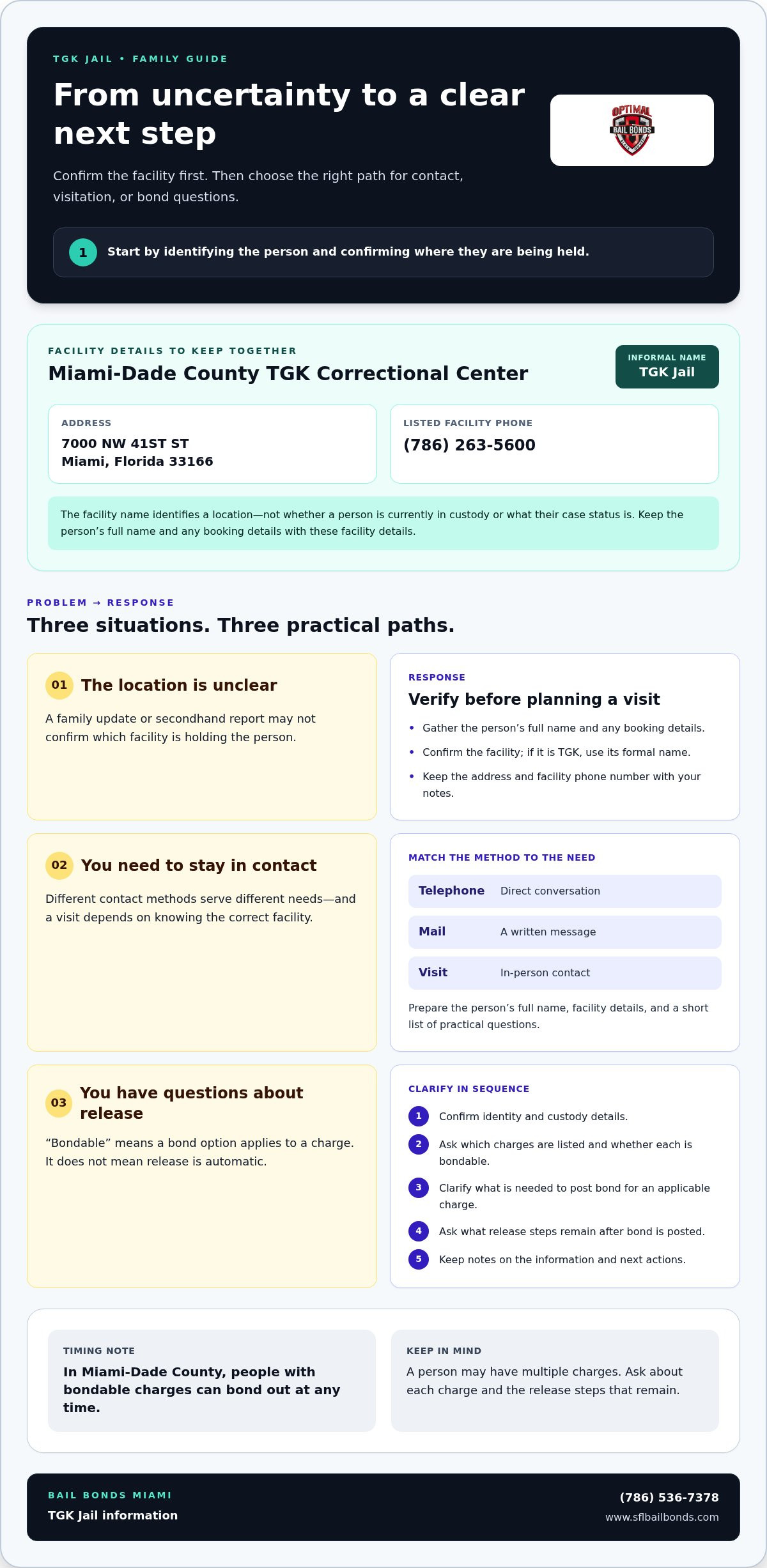
The Miami-Dade County TGK Correctional Center is located at 7000 NW 41ST ST, Miami, Florida 33166. Its listed phone number is (786) 263-5600. Families often hear the informal name TGK Jail, but the formal facility name is useful when asking about custody, planning a visit, or discussing records. Keep the address and phone number together so you can refer to the same location in calls and travel plans.
TGK is part of Miami-Dade County’s correctional system. According to the Miami-Dade Corrections and Rehabilitation Department, it is responsible for the care, custody, and control of between 4,000 and 4,200 people in its detention facilities. That figure applies across the department’s facilities, not to TGK alone. Use the full center name when distinguishing this location from other county facilities.
People held in county detention facilities may have different custody situations. According to the Miami-Dade Corrections and Rehabilitation Department, they may be awaiting trial or serving sentences of 364 days or less. Those circumstances describe different stages: a person awaiting trial has a pending case, while a person serving a sentence has been sentenced. The informal phrase TGK Jail identifies a location, not a person’s case status.
Keep these details together when making plans or inquiries:
- Formal facility name: Miami-Dade County TGK Correctional Center.
- Street address: 7000 NW 41ST ST, Miami, Florida 33166.
- Listed phone number: (786) 263-5600.
- Person’s details: Write down their full name and any booking information you have.
Use the street address to plan your route and the formal name when discussing the facility. If someone says a relative is at “TGK,” clarify that they mean the Miami-Dade County TGK Correctional Center before traveling. This helps avoid confusion with another detention location. Keep the person’s name and booking details handy, then direct your inquiry to the right contact for the question.
“TGK Jail” is a commonly used name; “Miami-Dade County TGK Correctional Center” identifies the facility more precisely. Use the formal name when comparing a family update with booking information or discussing the center. Once you have the facility name and custody details, you can focus on the next step, whether it concerns contact, visitation, or release.
Inmate contact and visitation
People in Miami-Dade custody can stay in contact by telephone, mail, and in-person visitation. Choose the option that suits your purpose, and have the person’s identifying details ready.
Inmate Contact
Telephone calls, mail, and visits are the main contact options for people in Miami-Dade custody. Each serves a different need: calls allow direct conversation, mail provides a written message, and visits offer face-to-face contact. Decide what you need to communicate before choosing. A brief update may suit a call, while a longer family message may be easier to write.
Keep the person’s full name and facility details together when preparing any communication. For a time-sensitive matter, organize your questions beforehand so you can use the contact opportunity clearly. Separate practical topics, such as family arrangements, from questions about the case. This keeps the conversation focused and helps prevent misunderstandings.
Finding an Inmate
Start with the person’s full name and the facility name you were given. If the information points to TGK, use the formal name, Miami-Dade County TGK Correctional Center. This distinguishes it from other Miami-Dade detention facilities. Keep any booking details handy to clarify whom you mean when asking about custody.
If you are unsure where the person is being held, don’t plan a visit based only on a family message or secondhand report. Gather the name and any custody details you have, then use the appropriate Miami-Dade contact route to clarify the location. Confirming the facility before traveling helps direct your next questions to the right place.
In-person visitation is one way people in Miami-Dade custody can stay in contact with family. Treat it as a separate step from calls or mail. Before traveling, note the facility name, the person’s full name, and your question. The address and phone number in the identification section can help keep your plans and inquiries focused on TGK.
Use this simple preparation list to keep communication organized:
- Record the person’s full name and available booking details.
- Note whether you intend to call, send mail, or visit in person.
- Prepare a short list of family or practical matters to discuss.
- Keep facility information with your notes to avoid mixing up locations.
Contact options are not interchangeable. A written message may not answer an urgent question, and a visit requires knowing the correct facility. Match the method to your need and keep a record of the information you use. This gives families a clearer starting point for staying connected while someone is in Miami-Dade custody.
Inmate release and bondable charges
At TGK, booking and release involve identifying the person, clarifying the charge and bond status, and completing the applicable release steps. In Miami-Dade County, inmates with bondable charges can bond out at any time.
“Bondable” means a bond option applies to the charge. It does not mean release happens automatically when a family member asks about it. First clarify the person’s current charge and whether it is bondable. A person may have multiple charges, so ask about each one rather than relying on a single detail from a brief call.
Use a step-by-step approach to keep the process clear:
- Confirm the person’s identity and custody details.
- Ask which charges are listed and whether each is bondable.
- Clarify what action is needed to post bond for the applicable charge.
- Ask what release steps remain after bond is posted.
- Keep notes about the information received and any next actions.
The order matters. If you arrange payment before understanding the charge, you may not know whether the bond applies to every charge. Learning that one charge is bondable answers only part of the question; other charges or release steps may remain. Ask focused questions and write down the answers in plain language.
“At any time” describes when inmates with bondable charges can bond out in Miami-Dade County. It does not promise immediate physical release. Posting bond and completing release are separate stages. Find out which stage has been reached before making travel plans or telling others to expect the person home.
Booking information helps keep conversations accurate. Use the person’s full name and any available booking details when discussing the case or custody status. If there are multiple charges, record each separately. This makes it easier to track which charge has a bond option and what still needs clarification. Don’t assume a general statement about bond applies equally to every charge.
Before taking the next step, summarize the situation in one clear sentence: who is in custody, what charge information you have, and what you need clarified. Ask whether the listed charge is bondable, then what remains after bond is posted. This keeps the discussion focused on release instead of mixing it with visitation or account questions. Clear notes help relatives share consistent information and avoid confusion during a stressful process.
How can I find someone in TGK jail?
Start with the person’s full legal name and any booking details you have. Call the Miami-Dade County TGK Correctional Center and ask whether the person is there. “TGK Jail” is common in everyday conversation, but the formal facility name makes your inquiry specific. Focus first on confirming the custody location.
Check the spelling of the person’s name, especially if you heard it secondhand. A middle name, hyphen, or spelling difference can affect how clearly staff understand your inquiry. Keep the arrest location or booking information ready if you have it. Those details can help distinguish the person from someone with a similar name.
Organize the details before calling:
- The person’s full name, spelled clearly.
- Any booking or custody information shared with you.
- The arrest location, if you know it.
- Your immediate question, such as whether the person is held at TGK.
Ask one question at a time. First confirm whether the person is at TGK Jail. If so, ask what information you need for your next step, such as contact or release. Keeping those topics separate makes the answer easier to understand and helps you record what remains to be done.
If the person isn’t at this center, that does not establish where they are. Miami-Dade County has detention facilities beyond TGK, so use the name and booking details you have to clarify the correct location. Don’t travel based only on an informal message. Confirming the TGK Jail location before making plans helps direct your next steps.
For records-related needs, Miami-Dade Corrections and Rehabilitation accepts requests through an online form. A records request is different from asking where someone is currently held. Keep the purposes distinct, and note whether you’re seeking records or trying to locate someone.
When relatives share updates, write down both the question asked and the answer. Note whether the conversation covered custody location, visitation, or release. This gives everyone a consistent reference and helps prevent repeated inquiries with different details. Use the formal facility name and the person’s identifying information when following up about TGK Jail.
How can I add money to an inmate's account at TGK jail?
Miami-Dade inmate trust accounts can be used for fees, recurring expenses, and commissary purchases. Before sending funds, carefully identify the person and account, then follow the deposit instructions for Miami-Dade County TGK Correctional Center. Keep the transaction details so you can track the deposit.
Timing matters. Funds sent before 11:59 PM EST Sunday are available for spending Monday, subject to depositor validation. This means the submission time and validation both affect access. For example, a deposit sent before the Sunday cutoff still depends on validation before it becomes available. Plan around the stated timing rather than assuming funds can be spent immediately.
Before making a deposit, gather the information needed to identify the intended recipient and record the transaction details. Follow a careful process:
- Confirm the inmate’s name and relevant account information.
- Review the deposit instructions for the Miami-Dade facility.
- Submit the funds using the details requested for the transaction.
- Save the confirmation or other deposit record.
- Use the Sunday-to-Monday timing rule when planning for spending.
Depositor validation is part of the availability process, not a separate spending purpose. Make sure the information you enter identifies the correct person. If family members are coordinating support, agree on who will submit the deposit and share the transaction record. This helps avoid duplicate attempts or confusion about the payment.
Trust-account funds serve a different purpose from release arrangements. Miami-Dade inmate accounts can cover fees, recurring expenses, and commissary items. A deposit supports the account; it does not pay bond or confirm release. If release is your immediate concern, keep that question separate from adding money to an inmate account.
For a deposit planned around a specific need, work backward from the Monday availability timing. Submit before 11:59 PM EST Sunday and allow for depositor validation. Keep the recipient’s account details and transaction record together. If relatives are contributing, tell them whether the funds are intended for commissary purchases, fees, or recurring expenses, so everyone understands the purpose of the account support.
For questions about release rather than account funds, explore bail bond options.
Optimal Bail Bonds: How to be a Bail Bondsman
Optimal Bail Bonds offers information about TGK Jail and guidance on how to be a bail bondsman. For families, its TGK information connects to practical questions covered here, including locating someone and understanding custody and release. For those considering the profession, the “How to be a Bail Bondsman” offering is a starting point for exploring that career path. These are distinct needs, so focus on the one that fits your situation: family support during a custody matter or learning about the profession. Clear information helps you identify the next question without confusing education with immediate case steps.
Visit sflbailbonds.com to explore information that fits your needs.
Choose the next step that fits your situation
Once you know what you need to find out about someone at TGK Jail, choose one clear next action. Keep custody questions separate from account deposits and bond questions, and share only details you understand with relatives coordinating support. A focused plan can make a difficult situation easier to manage.
If this experience has sparked an interest in the bail bond profession, Optimal Bail Bonds offers a Pre-Licensing Bail Bonds Class, a 120 Hours Bail Bonds Course, and How to be a Bail Bondsman. These educational options serve a different purpose from family guidance during a current custody matter.
Take the next step at your own pace. Clear questions and steady communication can help you move forward with greater confidence.
The facility’s listed phone number is (786) 263-5600.
Frequently Asked Questions
What does TGK stand for in jail or law enforcement?
Here, TGK refers to the Miami-Dade County TGK Correctional Center. Use the full facility name when discussing custody, making an inquiry, or arranging a visit to reduce confusion with another county detention location. The initials identify the center; this guide uses its formal name to keep references clear for families.
Where is the TGK jail located?
The facility is in Miami, Florida, in Miami-Dade County. For your plans, use its full street address rather than relying on a map label or a general reference to a Miami jail. Before traveling, make sure you’re heading to the TGK Correctional Center. This helps families avoid arriving at another county facility.
Which county or agency operates TGK jail?
Miami-Dade County’s corrections agency is the Miami-Dade Corrections and Rehabilitation Department. It oversees the county detention system, including the TGK Correctional Center. When asking about custody or facility procedures, use the department and center names clearly. This helps distinguish county corrections matters from questions about a court case or another agency.
What is the address and phone number for TGK jail?
The Miami-Dade County TGK Correctional Center is at 7000 NW 41ST ST, Miami, Florida 33166. Its listed phone number is (786) 263-5600. Keep both details together in your notes, especially if relatives are coordinating a call or visit. State the person’s name and your reason for calling so your inquiry begins with the relevant information.
How do I contact or visit an inmate at TGK jail?
People in Miami-Dade custody can stay in contact by telephone, mail, and in-person visitation. Choose the method that suits your purpose, and have the person’s name and facility details ready. For a visit, call the center before traveling and ask about the current process. For mail, prepare the recipient’s identifying information so the correspondence can be directed appropriately.
What are TGK jail's visitation rules and hours?
Visitation procedures and hours are specific to each facility, so contact the TGK Correctional Center before planning a trip. Ask about visiting arrangements, required identification, and whether you need to schedule a visit. Don’t assume the hours or procedures are the same across Miami-Dade facilities. Have the inmate’s name ready so staff can address your question about the correct location.
How do I post bail for someone held at TGK jail?
First confirm whether the person’s charge is bondable and clarify the required next step. In Miami-Dade County, inmates with bondable charges can bond out at any time. If there are multiple charges, ask about each one separately. Posting bond and completing release are distinct stages, so find out which step has occurred before making plans.
What are the rules for sending mail or packages to TGK jail inmates?
Mail is one way people in Miami-Dade custody can stay in contact, but package acceptance and mailing instructions depend on facility procedures. Call the TGK Correctional Center before sending a package and ask which items and addressing details are permitted. Follow the instructions for the recipient’s identifying information. This helps avoid preparing a shipment based on assumptions or another facility’s rules.


