
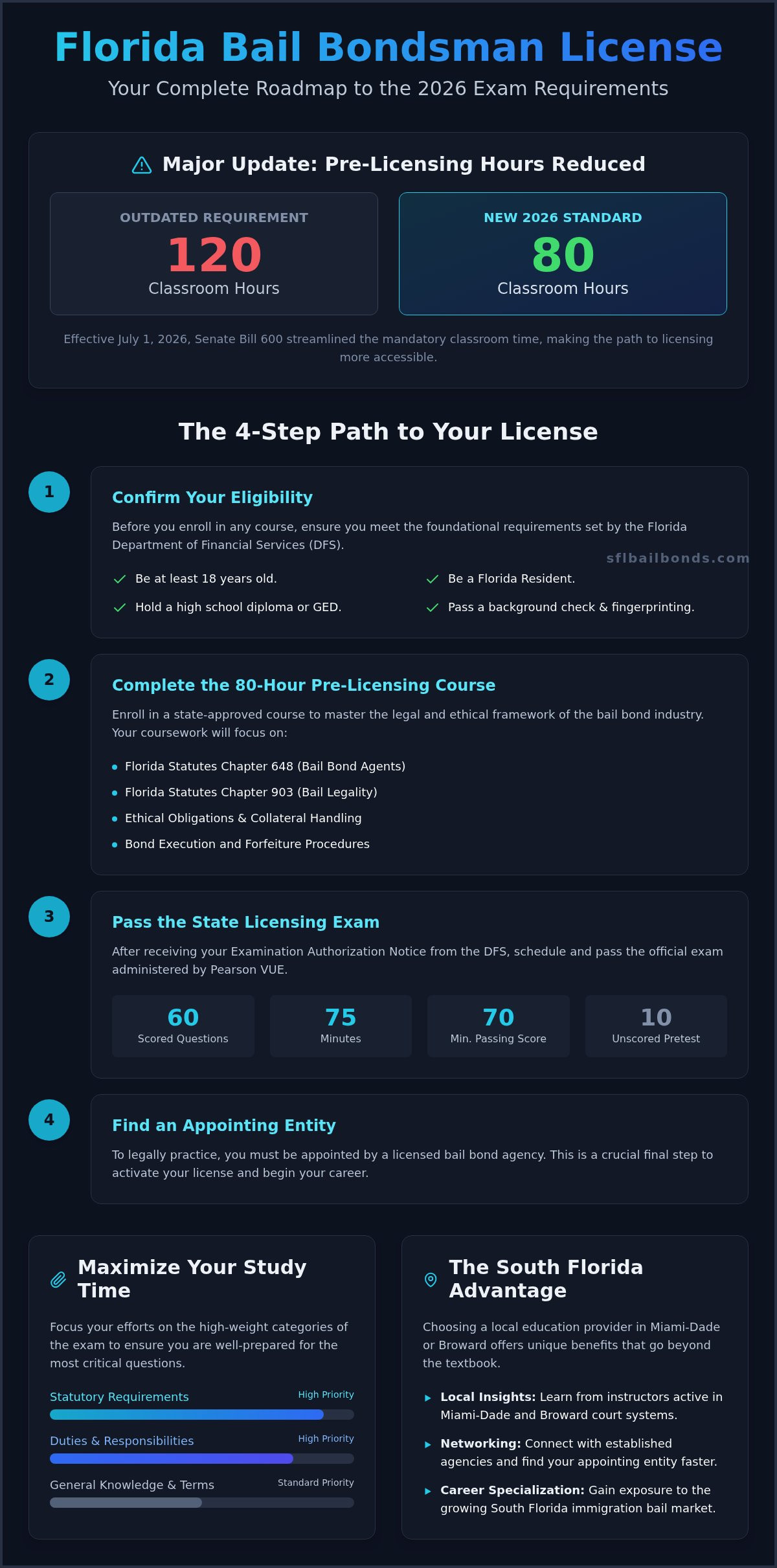
The landscape for the Florida bail bondsman license exam shifted dramatically on July 1, 2026, yet many aspiring agents are still following outdated roadmaps. With the passage of Senate Bill 600, the mandatory pre-licensing classroom time dropped from 120 hours to just 80 hours. While this reduction is a welcome relief, it also comes with stricter regulations on physical office spaces and liquid financial requirements that can leave even the most dedicated students feeling overwhelmed. You might feel buried under complex Florida Statutes or anxious about the high-stakes environment at the Pearson VUE testing center. It's completely normal to feel this pressure when your future career is on the line.
We understand that the transition to a licensed professional requires more than just memorizing legal jargon; it requires a mentor who has walked the path. This guide promises to help you master the Florida Department of Financial Services requirements and provide a comprehensive South Florida study roadmap to ensure you pass your exam. We will provide a clear checklist of licensing steps, identify reliable study materials, and show you how to navigate the DFS portal with confidence. You are about to gain a methodical plan to conquer the 60-question exam and launch your career with professional dedication.
Key Takeaways
- Navigate the updated DFS pre-licensing requirements and ensure your 80-hour course provider meets the latest 2026 state standards.
- Master the specific structure of the Florida bail bondsman license exam to handle the 60-question Pearson VUE assessment with total confidence.
- Streamline your professional journey with a localized checklist for fingerprinting and finding an appointing agency in Miami-Dade or Broward.
- Focus your study time on high-weight categories like "Statutory Requirements" and "Duties and Responsibilities" to ensure a passing score.
- Discover how to expand your career prospects by leveraging specialized training in the growing South Florida immigration bail market.
Navigating the Florida Department of Financial Services (DFS) Bail Course Requirements
Securing your spot for the Florida bail bondsman license exam begins with meeting the state’s rigorous educational mandates. While many legacy resources still mention a 120-hour requirement, the passage of Florida Senate Bill 600 on July 1, 2026, streamlined the pre-licensing classroom time to 80 hours. This shift aims to modernize the entry process without sacrificing the depth of knowledge required for 2-34 Limited Surety and 2-37 Cash Bail Bond applicants. You’ll need to complete this state-approved course through a certified provider before the DFS grants you authorization to test. This foundational step ensures every agent understands the legal weight of their role within the justice system.
Before enrolling, verify your eligibility to avoid administrative delays. The DFS requires all applicants to be at least 18 years old, hold a high school diploma or equivalent, and maintain Florida residency. Beyond these basics, you must pass a "good moral character" assessment. This involves a comprehensive background check and fingerprinting. If you are new to the field, reading an Overview of the Bail Bondsman Profession can provide helpful historical context on how these regulations evolved to protect both the court and the defendant. Once you confirm your eligibility, you'll choose between the full classroom requirement and the 20-hour correspondence course, which is typically reserved for those seeking a temporary license or specific appointment renewals.
The Education Syllabus: What You Will Learn
Your coursework focuses heavily on Florida Statutes Chapter 648, which governs bail bond agents, and Chapter 903, which covers the legalities of bail itself. You won't just memorize numbers; you'll study the ethical obligations of a Limited Surety Agent and the strict rules regarding collateral handling. Practical training is a core component. Instructors walk you through bond execution, the proper way to handle a defendant's surrender, and the high-stakes process of managing forfeitures. Mastering these statutory requirements is essential because they form the bulk of the Florida bail bondsman license exam.
Choosing a State-Approved Education Center in South Florida
While generic online modules exist, local classroom instruction in Miami or Ft. Lauderdale offers a distinct advantage. Learning in a physical classroom allows you to engage with instructors who are active participants in the South Florida court systems. These mentors provide real-world insights into the local nuances of Miami-Dade and Broward counties that a textbook simply can't capture. Additionally, attending a local center provides networking opportunities with established agencies in North Miami-Dade. These connections are often the bridge between passing your exam and finding the "Appointing Entity" you need to actually practice.
Mastering the Florida Bail Bond Licensing Exam Content and Structure
Once you complete your classroom hours, the next hurdle is the Florida bail bondsman license exam. This isn't just a formality. It's a rigorous assessment of your ability to operate within the state's legal framework. To sit for the test, you must first receive an Examination Authorization Notice through the Florida Department of Financial Services (DFS) MyProfile portal. Without this digital green light, you can't schedule your session with Pearson VUE. The exam itself is a timed, multiple-choice challenge that demands both speed and precision. Taking the time to understand the logistics now will save you unnecessary stress on test day.
Understanding the scoring system is vital for your peace of mind. Florida uses a scaled scoring system where a 70 is the minimum passing grade. This doesn't mean you simply need 70% of the questions right. Instead, the DFS converts your raw score to a consistent scale to account for slight variations in difficulty between different versions of the test. According to current 2026 standards, you'll face 60 scored questions along with 10 unscored pretest questions used for future exam development. You have exactly 75 minutes to complete the assessment. Every minute counts when you're analyzing complex legal scenarios.
The Core Categories of the Florida State Exam
Success requires a strategic focus on high-weight categories. You must deeply master Florida Statutes Chapter 648 and the Florida Administrative Code Rule 69B-221. These sections cover your essential "Duties and Responsibilities" and the specific "Statutory Requirements" that govern daily operations. You'll also need to identify prohibited practices that could lead to license revocation, such as improper solicitation. While criminal bonds are the standard, knowing the nuances of state versus federal authority is crucial. If you feel stuck on these legal distinctions, joining a Pre-Licensing Bail Bonds Class can provide the professional mentorship needed to clarify these concepts.
What to Expect at the Pearson VUE Testing Center
The testing environment is strictly controlled to maintain exam integrity. You'll need two forms of valid ID, and the staff will require you to store all personal items in a secure locker. Prohibited items include everything from cell phones to watches. Once the clock starts, use a "Flag and Return" strategy. If a question about bond forfeitures or collateral stumps you, flag it and move on. Don't let one difficult prompt drain your 75-minute window. When you finish, the proctor will provide your score report immediately. You'll walk out of the center knowing exactly where you stand in your professional journey.
Essential Study Resources and Key Terms for Exam Success
Preparing for the Florida bail bondsman license exam requires a shift from passive reading to active absorption of the law. Your primary study bible for 2026 is the Florida Bail Bond Candidate Handbook. This document outlines the exact territory Pearson VUE expects you to master. Many students find that reading the text isn't enough. You must learn to speak the language of the court. We recommend performing a deep dive into Florida Statute 648.44, which covers prohibited practices. Read this section at least three times. Understanding what can lead to a license revocation is just as important as knowing how to issue a bond.
The legal qualifications for entry are strict. Before you can even sit for the test, you must meet the standards detailed in Florida Statute 648.34, which governs the application process and background requirements. Once you clear those hurdles, focus on these ten "must-know" terms to build your foundational knowledge:
- Indemnitor: The person who signs for the bond and takes financial responsibility.
- Principal: The defendant who is released on bail.
- Writ of Habeas Corpus: A court order used to determine if a person's imprisonment is lawful.
- Forfeiture: The loss of the bond amount when a defendant fails to appear.
- Exoneration: The release of the surety from liability once the case is resolved.
- Surety: The insurance company that guarantees the bond.
- Power of Attorney: The document giving an agent authority to bind the surety.
- Collateral: Property or cash held to secure the bond.
- Estreature: The legal process of calling a bond for payment.
- Remittitur: A partial or full refund of a forfeited bond under specific conditions.
Flashcard Strategy: Memorizing the Regulatory Numbers
Numbers are the backbone of state regulation. Use flashcards to memorize that Florida mandates a non-refundable premium of 10% for state charges and 15% for federal charges. You must also remember that agents have exactly 10 working days to report a change of name, residence, or email address to the Department. A Limited Surety Agent is an individual who is appointed by an insurer by power of attorney to execute or countersign bail bonds in connection with judicial proceedings.
Leveraging the Optimal Bail Bonds Study Guide
Our Miami-based Education Center instructors often see students confuse "Temporary" and "Limited" license authorities. A temporary license is a supervised, 90-day entry point, whereas the Limited Surety license is your goal for full professional practice. Our study guide includes a "Mental Prep" checklist to help de-escalate exam-day anxiety. We focus on teaching you how to manage the 75-minute clock effectively. This mentorship approach ensures you aren't just memorizing facts but are preparing for the real-world pressure of the Florida bail bondsman license exam.
Practical Steps for Licensing in Miami, Ft. Lauderdale, and West Palm Beach
Passing the Florida bail bondsman license exam is a major professional milestone, but the administrative journey continues right here in South Florida. You must coordinate your local fingerprinting through a DFS-approved vendor to complete your background check. In Miami-Dade and Broward, multiple Fieldprint locations offer these services for approximately $48.55 plus local sales tax. This step is non-negotiable for your application. Once your prints are in the system, you must diligently manage your DFS MyProfile portal. Any change to your South Florida contact information, including your email or residence, must be updated within 10 working days to maintain your standing with the state.
Operating within the 11th Judicial Circuit in Miami-Dade requires an understanding of local courtroom nuances. Judges and clerks in the Miami justice system expect agents to be punctual and precise with their filings. You also need to secure an "Appointing Entity." This is a licensed bail agency or insurer that officially sponsors your license. Without this appointment, your license remains inactive, and you cannot legally execute bonds. Finding a reputable agency in North Miami-Dade or West Palm Beach is often the final piece of the licensing puzzle.
The Temporary License Phase in South Florida
Most new agents begin with a temporary license, which serves as a 12-month residency and apprenticeship phase. You must secure full-time employment with a licensed Miami bail agent who will supervise your progress. During this year, you are required to document at least 30 hours of supervised activity every week in a formal work log. This hands-on period allows you to apply what you learned for the Florida bail bondsman license exam to real-world scenarios. Once you hit the 12-month mark and meet all work requirements, you can apply for your permanent license through the DFS portal.
Networking in the South Florida Legal Community
Success in this industry depends on the relationships you build within the legal community. Take the time to introduce yourself to jail staff and court deputies in Ft. Lauderdale and West Palm Beach. Understanding the local "Bond Schedule" in these jurisdictions is vital, as it helps you provide accurate information to families in crisis. We also recommend joining professional associations like the Florida Association of Bail Bond Agents (FABBA) to stay connected with peers. If you are ready to take the first step toward your new career, enroll in our Pre-Licensing Bail Bonds Class to receive expert mentorship from active South Florida professionals.
Beyond the Exam: Launching Your Career with Optimal Bail Bonds Education
Passing the Florida bail bondsman license exam is a significant achievement, but it's just the entry point into a complex profession. Real success requires you to move past simple memorization and into the realm of practical application. We believe your education shouldn't stop at the testing center door. Specialized training in de-escalation and legal nuances helps you manage the high-stress environment of the South Florida justice system. Building a reputation for compassionate, non-judgmental support is what transforms a licensed agent into a trusted community partner.
In Miami, immigration bail bonds represent a vital and underserved market niche. While standard criminal bonds are the bread and butter for many agencies, mastering federal bonding authority sets you apart from the competition. This specialized knowledge allows you to assist families navigating the federal immigration system with the same steady reliability you provide in state courts. It's a specialized skill set that requires mentorship and a deep understanding of federal regulations that go beyond the basic state exam requirements.
Long-term career health also depends on strict regulatory compliance. Florida requires all licensed agents to complete 14 hours of continuing education every two years. This biennial requirement ensures you stay current with evolving laws, like the July 2026 mandate requiring liquid financial instruments over real estate property for suretyship. We prioritize these updates in our curriculum so our graduates never fall behind on regulatory changes or professional standards. Staying educated is the only way to maintain your license and your professional integrity.
The Optimal Bail Bonds Mentorship Advantage
Our mentorship program focuses on moving you from classroom theory to actual Miami jail releases. We provide real-world scenarios that prepare you for the fast pace of the 11th Judicial Circuit. Our career placement support connects top students with reputable South Florida agencies looking for fresh, well-trained talent. We also host advanced workshops on Federal and Immigration bond processing to ensure you have the specialized skills needed to thrive in our unique local market.
Enroll in Your Florida Bail Bond Pre-Licensing Course Today
Our Miami Education Center is currently accepting enrollments for our upcoming pre-licensing sessions. While the state recently reduced the classroom requirement to 80 hours, we maintain a comprehensive curriculum that covers every detail of the Florida bail bondsman license exam. We provide clear tuition information and a streamlined enrollment process to help you get started without any administrative delays. You can start your career journey with the Optimal Bail Bond Education Center right now to secure your future in this rewarding and essential field.
Secure Your Future in the Florida Bail Industry
Mastering the Florida bail bondsman license exam is the essential first step in a career built on trust, integrity, and legal expertise. You've now explored the 80-hour pre-licensing mandate, the strategic weighting of the Pearson VUE assessment, and the practical steps required to secure an appointment in Miami-Dade or Broward. This journey demands significant diligence, but you don't have to navigate these complex regulatory systems alone. Success comes from combining your personal drive with the right professional guidance.
Our education center provides the steady reliability you need to thrive. As a DFS-approved education provider, we offer expert instruction from active Miami bondsmen who understand the real-world nuances of the South Florida justice system. We pair technical knowledge with compassionate professional mentorship to ensure you're prepared for both the exam and your first day on the job. Enroll in the Florida Bail Bond Pre-Licensing Course today to begin your transformation into a skilled bail professional. Your new career is within reach, and we are here to support every step of your progress.
Frequently Asked Questions
How much does the Florida bail bond license exam cost in 2026?
The fee to sit for the Florida bail bondsman license exam is $44 per attempt as of 2026. This payment is made directly to Pearson VUE during the scheduling process. You should also account for additional state costs, such as the $55 license application fee and the $48.55 fingerprinting fee. These administrative costs are separate from your pre-licensing tuition and are required by the Florida Department of Financial Services to process your professional credentials.
Can I take the 120-hour Florida bail bond course online?
While the state previously required 120 hours, the passage of SB 600 in 2026 reduced the mandatory classroom requirement to 80 hours. You cannot complete the full pre-licensing course entirely online. Florida law emphasizes in-person instruction to ensure agents master complex legal statutes. Our Miami Education Center provides this essential classroom experience; however, some specific 20-hour correspondence modules are available for secondary licensing needs or temporary license renewals.
What is the passing score for the Florida Department of Financial Services bail exam?
You must achieve a minimum scaled score of 70 to pass the state assessment. The exam consists of 60 scored multiple-choice questions and 10 unscored pretest questions used for future development. This scaled scoring system ensures fairness across different versions of the test. If you score below 70, you won't receive your license authorization. We focus our curriculum on high-weight categories like statutory requirements to help you reach this passing score on your first attempt.
How many times can I retake the Florida bail bondsman exam if I fail?
There is no state-mandated limit on how many times you can retake the exam, but you must pay the $44 fee for every attempt. You are required to wait for a new Examination Authorization Notice from the DFS before rescheduling with Pearson VUE. Repeated failures may suggest a need for deeper study of Florida Statutes Chapter 648. Our instructors offer personalized mentorship to help students identify and correct knowledge gaps after an unsuccessful try.
Do I need a high school diploma to become a bail bondsman in Florida?
Yes, a high school diploma or an equivalent GED is a mandatory requirement for all applicants. The Florida Department of Financial Services also requires you to be at least 18 years old and a legal resident of the state. You'll need to provide proof of these credentials during the initial application process on the MyProfile portal. Meeting these basic eligibility standards is the first step before you can sit for the Florida bail bondsman license exam.
How long is a Florida bail bond license valid before I need continuing education?
Your license remains valid as long as you complete 14 hours of continuing education every two years. This biennial requirement ensures all agents stay current with shifting state and federal regulations. If you fail to meet this credit deadline, the DFS may suspend your appointment or fine you. We offer state-approved continuing education courses in Miami to help you maintain your compliance and keep your professional standing in good order within the industry.
What disqualifies you from getting a bail bond license in Florida?
Certain criminal convictions, particularly felonies or crimes involving moral turpitude, will disqualify you from licensure. The DFS conducts a thorough background check and fingerprinting process to evaluate every applicant's "good moral character." If you have a history of financial fraud or violent offenses, your application will likely be denied. It's best to be transparent about your history during the application phase to avoid immediate rejection by state regulators during the background screening.
How do I schedule my exam with Pearson VUE in Miami or Ft. Lauderdale?
You can only schedule your session after receiving an Examination Authorization Notice from the Florida Department of Financial Services. Once you have this notice, visit the Pearson VUE website to select a testing center in Miami, Ft. Lauderdale, or West Palm Beach. You'll need to create an account, upload your authorization details, and pay the $44 exam fee. We recommend booking your seat at least two weeks in advance to secure your preferred date and location.


