
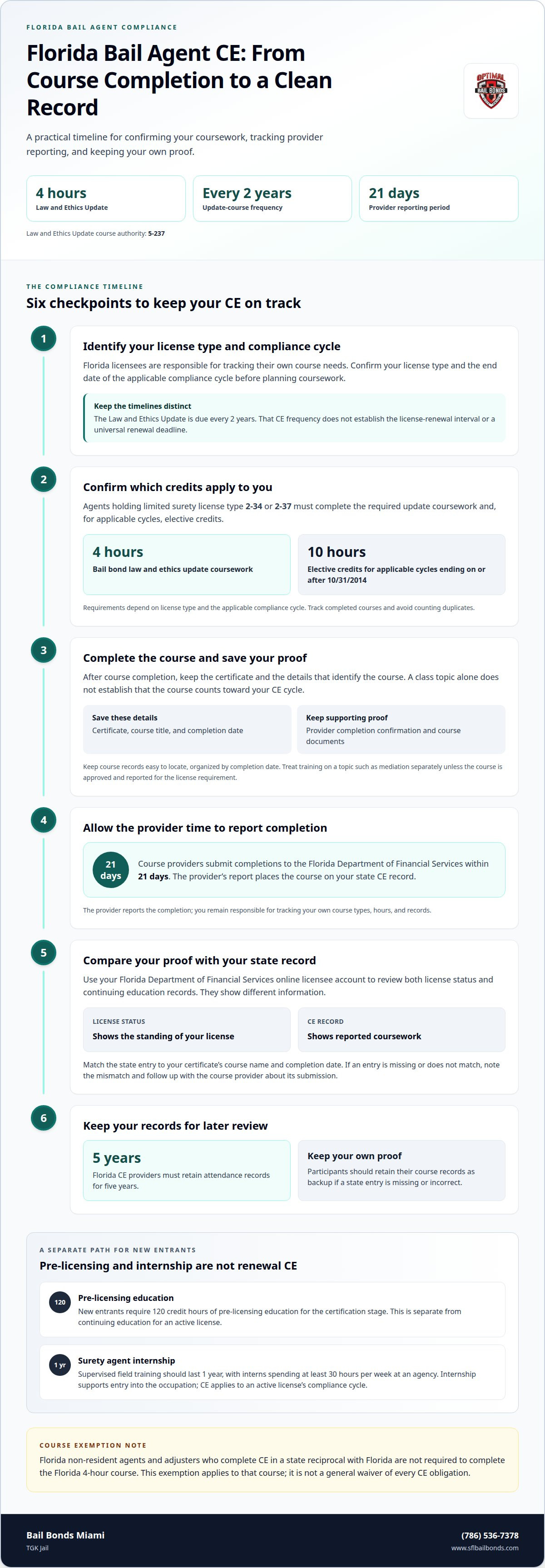
Keeping a Florida bail agent license current involves more than completing a course. Florida’s continuing education requirements for bail agents include a 4-hour Law and Ethics Update course every 2 years, with course authority 5-237. Agents are responsible for monitoring their own records, while course providers report completions to the Department within 21 days.
It’s understandable to focus on the credit requirement first, but the details that keep a renewal on track include who must act, which course applies, and when the update rule took effect. This guide explains how credits and records work, who carries each responsibility, and what changed for compliance cycles ending on or after January 31, 2022.
If you’re entering the field rather than maintaining a license, Florida’s licensing path matters too. You’ll also learn how pre-licensing education fits into the process, so you can distinguish the steps to become an agent from the continuing education required to maintain a license.
Key Takeaways
- Keep your own course-completion records, and remember that providers must retain attendance records for five years.
- For applicable compliance cycles ending 10/31/2014 or later, limited surety agents must complete 10 hours of elective credits in addition to required update coursework.
- Track your license type, compliance cycle, and completed courses so you can identify which credits you still need.
- New entrants follow a separate certification path that includes 120 credit hours of pre-licensing education.
- Use the licensing overview to distinguish becoming a bail bond agent from maintaining an existing license.
CE completion reporting and recordkeeping
CE completion reporting is the provider’s submission of a completed course to Florida’s Department of Financial Services. Providers have 21 days to report each completion. That reporting step places the course on the agent’s state record, but agents still need to keep their own proof.
Keep records showing which course you completed and when. Florida continuing education providers must retain attendance records for five years, and participants should keep their own course records. Both provide useful backup if a completion does not appear in the state record.
After completing a course, save the certificate, course title, completion date, and any confirmation from the provider. Compare those details with the course entry in your CE record. For example, match the certificate’s course name to the reported entry instead of relying only on an email receipt or calendar reminder.
Florida bail agents can review license status and continuing education records through the Florida Department of Financial Services’ online licensee account. Check both: license status shows the standing of your license, while the CE record shows reported coursework. Keep your certificates available in case an entry is missing or does not match.
A simple record routine can make renewal preparation clearer:
- Save the certificate and course details after completion.
- Compare the certificate with the state CE record.
- Keep the provider’s completion confirmation with your course documents.
- Record any mismatch and follow up with the course provider about its submission.
- Retain your documents so you can refer to them during a later compliance review.
Mediation training teaches ways to help people work through disputes and consider possible resolutions. Treat its records separately from a CE completion unless the course is approved and reported for the license requirement. If a course covers mediation, keep its certificate and description so you can distinguish the subject matter from its credit status.
A topic covered in class does not, by itself, mean the course counts toward an agent’s CE cycle. Check the course record and provider documentation to confirm what was completed. The provider’s report and your saved proof serve different purposes, so keep both.
For a clean file, organize certificates by completion date and keep course titles easy to locate. Then compare the saved documents with the state record before relying on a course to satisfy a cycle. The provider’s 21-day reporting period gives agents a clear point to remember when reviewing a new completion.
Who is Responsible for What With Regard to CE Requirements?
Florida licensees track their own course needs, while providers report completions. For limited surety agents, the license type and compliance cycle determine the education plan.
Agent Education and Internship Requirements
Limited surety agent CE is coursework required for Florida bail bond licenses. Agents holding license type 2-34 or 2-37 must complete 4 hours of bail bond law and ethics update coursework and 10 hours of elective credits during applicable compliance cycles ending 10/31/2014 or later. A surety agent internship is supervised field training for an agent entrant. It should last 1 year, with interns spending at least 30 hours per week at an agency.
Monitor your course records, confirm which hours you need, and avoid duplicate courses. Internship training and an agent’s CE have different purposes: internship supports entry into the occupation, while CE applies to an active license’s compliance cycle.
Renewal Timing and Completion Deadlines
A CE compliance cycle is the period in which a licensee completes required coursework. Bail agents must complete the Law and Ethics Update course every 2 years, but that CE frequency does not establish the license-renewal interval. Complete required coursework within the applicable cycle and review its end date before planning enrollment.
Florida’s license-renewal interval is separate from its biennial CE schedule. The requirements here establish course frequency, not a universal renewal deadline. If you miss a CE or renewal deadline, review your license record and course status to identify what remains outstanding. The CE requirements alone do not establish a specific penalty.
Continuing Education Exemptions
A CE exemption is a rule that removes a qualifying licensee from a specified course requirement. Florida non-resident agents and adjusters who complete CE in a state reciprocal with Florida are not required to complete the Florida 4-hour course. That exemption concerns the 4-hour course; it should not be treated as a general waiver of every CE obligation.
For other bail agents, requirements depend on license type and the applicable cycle. Don’t assume an exemption applies because another license category or residency status differs. Identify your license type and course requirement before counting credits toward compliance.
Approved providers are providers whose courses satisfy the applicable Florida CE requirements and can report completions. The reporting process depends on the provider submitting the completed course to the Department; agents remain responsible for tracking course types and hours and avoiding duplicates. No particular provider name or course price is needed to understand those responsibilities. Course costs depend on the provider and course, so compare the listed fee and course details before enrolling.
For new entrants, Florida requires 120 credit hours of pre-licensing education. This is separate from renewal CE. A course focused on 120-hour bail bonds pre-licensing education fits the certification stage, while licensed agents should plan coursework around their CE cycle.
Bail bond elective credits
Elective credits are continuing education hours selected from qualifying courses outside required update coursework. Florida limited surety agents must complete 10 hours of elective credits during applicable compliance cycles ending 10/31/2014 or later. Treat those hours as a distinct part of the cycle, not as a substitute for required bail bond law and ethics update coursework.
Start by identifying the license type associated with your cycle. The elective-credit requirement applies to Florida limited surety, or bail bond, agents. Match your course plan to the license and compliance cycle shown in your records. If you hold more than one license, track each requirement separately rather than assuming a course counts for all of them.
Before enrolling, compare the course information with your outstanding credit needs. Florida licensees are responsible for checking their continuing education records to determine the course types and hours they need, and for making sure a course is not a duplicate. A different course title may still cover material you have completed, so review the details and your course history before choosing.
A simple tracking table can help you keep elective credits clear:
- License type: note the limited surety license associated with the compliance cycle.
- Cycle status: record the cycle’s end date and the elective hours already completed.
- Course details: save the course title, credit designation, and completion evidence.
- Duplicate review: compare the proposed course with prior entries before enrolling.
- Remaining hours: subtract documented elective credits from the required total.
If your record shows completed elective coursework, count only the hours reported as applicable credits for your cycle. Identify what remains, then choose a course that addresses that gap. Don’t count a completion twice. You remain responsible for reviewing the official course record and tracking required course types, even if you also use a spreadsheet or calendar.
Keep elective-course documents with the relevant cycle information. A certificate helps identify a completion, while the course record shows how it was reported. Compare them if a course appears under an unexpected title or credit category. If the entry does not match your documents, save the details of the discrepancy and follow up about the course record.
Tracking elective credits separately also makes renewal planning clearer. List required update coursework separately from elective credits to avoid treating all education hours as interchangeable. As the cycle progresses, review your remaining elective balance and course history before choosing another course.
Effective date of the 4-hour update requirement
The effective date is the point when a rule begins applying to qualifying compliance cycles. Florida began enforcing the 4-hour update requirement for continuing education cycles ending on or after January 31, 2022. The key date is the cycle’s end, not simply when an agent took a course.
To identify which update applies, start with the end date shown for your CE cycle. Compare that date with January 31, 2022. A cycle ending on that date or later falls under the 4-hour update requirement. This approach helps separate the applicable course from other education completed during the same period.
The 4-hour update course has course authority 5-237. Use the authority number, course title, and cycle end date together when reviewing course records. A course record that shows only a completion date may not make the cycle’s requirement obvious. Match it against the cycle information before counting it toward compliance.
For a cycle ending before January 31, 2022, a separate transition rule applies to licensees with outstanding CE. Those licensees should complete a previously approved 5-hour update course. The 5-hour course applies to that older outstanding cycle, while the 4-hour update requirement applies to cycles ending on or after the effective date.
Use this sequence to sort the requirement:
- Find the CE cycle’s recorded end date.
- Compare it with January 31, 2022.
- For a cycle ending on or after that date, identify the 4-hour update course with authority 5-237.
- For an outstanding cycle due before that date, identify the previously approved 5-hour update course.
- Keep the cycle date and course information together in your records.
For example, an agent reviewing a cycle that ends after January 31, 2022, should use the 4-hour rule. An agent addressing an outstanding cycle due earlier should follow the 5-hour transition provision. The distinction turns on the cycle deadline, not on which course seems newer or shorter.
Reviewing dates is especially useful if you have more than one cycle or license. Check each cycle separately: one cycle’s end date does not establish the requirement for another. Record the applicable duration and course authority for each cycle, then compare that information with your CE record.
The date also helps explain why course histories can show different update durations. A 5-hour entry can relate to an outstanding pre-effective-date cycle, while a 4-hour entry applies to a cycle ending on or after January 31, 2022. Keeping the dates visible prevents those course records from being mistaken for interchangeable options.
Florida agent certification and licensing steps
Agent certification is the entry process for qualifying to work as a Florida bail bond agent. It is different from maintaining an existing license through continuing education. New entrants must complete pre-licensing education and licensing steps before focusing on an active agent’s CE cycle.
Florida requires entrants seeking bail bond agent certification to complete 120 credit hours of pre-licensing education. Entrants must also complete an additional 20 credit hours through an online correspondence course administered by the University of Florida. Treat these as separate education components, and keep their course records distinct.
A temporary license is an interim license that is valid for 18 months. Florida entrants should receive one in about 6 weeks. Applicants must provide 3 sworn statements with their application. Keep the education records and sworn statements organized together, so each required item is easy to identify during the licensing process.
For a practical overview, organize the entry requirements by stage:
- Pre-licensing education: complete the required 120 credit hours.
- Additional education: complete the 20 credit hours through the University of Florida online correspondence course.
- Application materials: prepare the 3 sworn statements required with the application.
- Temporary license: account for its 18-month validity period as you plan the transition into the field.
This sequence helps separate education from application documentation. Course completion records show the learning requirements; sworn statements are application materials. Keep each item identifiable rather than combining them into a single general checklist entry. For example, label the 120-hour coursework and University of Florida correspondence course separately.
Distinguish certification preparation from later license maintenance. Pre-licensing coursework prepares you for the licensing pathway; continuing education applies to licensed agents’ compliance cycles. These stages serve different purposes, so pre-licensing hours should not be treated as renewal credits.
Those preparing for certification can use a 120-hour bail bonds pre-licensing course as a starting point for the required education. Keep the University of Florida course and application documents on a separate tracking line. That organization makes it easier to see which items belong to certification and which relate to a later CE cycle.
For a clear next step, review the Florida bail bonds pre-licensing education.
Optimal Bail Bonds: How to be a Bail Bondsman
Optimal Bail Bonds is a natural next step if you’re exploring how to enter the bail bond field. Its How to be a Bail Bondsman offering is relevant to prospective agents planning their career path. Keep that entry-stage guidance separate from continuing education, which applies to agents maintaining an existing license.
Use the licensing steps above to distinguish certification preparation from ongoing CE. If you’re considering becoming an agent, explore Optimal Bail Bonds’ Pre-Licensing Bail Bonds Class as you plan your next step.
Visit Optimal Bail Bonds to learn more.
Build Your Next Step With Confidence
A clear professional path starts with knowing whether your next step is license maintenance or entering the field. Understanding Florida’s continuing education requirements for bail agents helps clarify the difference, while aspiring agents can focus on the separate certification process. Choose the path that matches your current stage, then plan your next education step.
For those preparing to enter the profession, Optimal Bail Bonds offers a Pre-Licensing Bail Bonds Class, a 120 Hours Bail Bonds Course, and How to be a Bail Bondsman. These offerings connect career exploration with pre-licensing education, rather than ongoing CE for an existing license.
Take your next step at your own pace, with a clearer sense of where your professional journey begins.
Frequently Asked Questions
What continuing education is required for Florida bail bond agents?
Florida bail bond agents generally complete a Law and Ethics Update course as part of their CE cycle. The continuing education requirements for bail agents in Florida also depend on license type and cycle dates. For example, limited surety agents may need elective credits alongside update coursework. Match each course to the license and cycle it is intended to satisfy, rather than treating all education as interchangeable.
How many continuing education hours must Florida bail agents complete?
The required hours depend on the agent’s license and applicable cycle. The Law and Ethics Update is 4 hours and is required every 2 years. Limited surety agents also complete 10 elective hours during applicable compliance cycles. These requirements should be tracked as separate course categories. An outstanding cycle due before January 31, 2022, follows the previously approved 5-hour update course rule.
Which courses count toward Florida bail agent continuing education?
Courses count when they meet the applicable CE requirement for the agent’s license and cycle. For example, the 4-hour Law and Ethics Update uses course authority 5-237. Elective credits must apply to the licensee’s cycle, too. Before enrolling, compare the course type with your remaining requirements and prior completions. Florida licensees are responsible for avoiding duplicate courses, so a different course title alone doesn’t establish that credits are distinct.
What are Florida's continuing education requirements for bail bond agents by license type?
Florida limited surety agents holding license type 2-34 or 2-37 must complete 4 hours of bail bond law and ethics update coursework and 10 elective hours during applicable cycles ending 10/31/2014 or later. Requirements vary by license type under section 626.2815 of the Florida Statutes. Agents holding multiple licenses need a 4-hour update specific to at least one license type held.
How do Florida bail agents report continuing education credits to the state?
Course providers report completions to Florida’s Department; agents don’t submit each course completion themselves. Providers have 21 days to report a completed course. After taking a course, keep its completion details and compare them with your CE record. If a completion is missing, use your course documentation to follow up with the provider. In Miami, Florida, agents can also review their records through the state’s online licensee account.


