
Florida bail bond agents must complete four hours every two years of law and ethics continuing education. That requirement is part of the state’s 14 hours of continuing education every two years. An ethics course for bail bondsmen in Florida therefore needs to fit the agent’s license-maintenance requirements, not just cover broad professional principles.
It’s understandable to want clear guidance: licensing, renewal deadlines, and everyday responsibilities can make training choices feel complicated. This article explains how Florida’s licensing and continuing education requirements shape your options, and why ethics matters in bail bond work. You’ll also learn how pre-licensing education differs from continuing education, so you can choose the right learning path for your career stage.
Key Takeaways
- Separate pre-licensing education from continuing education so you can choose training that fits your current licensing stage.
- Track your renewal period and birth-month deadline, then plan continuing education early enough to meet Florida’s requirements.
- Look for law and ethics instruction that connects professional standards to real decisions, including clear and responsible handling of collateral.
- Compare course formats and schedules against the education you need, especially if you’re balancing training with work.
- If you’re starting your licensing journey, explore Optimal Bail Bonds’ Pre-Licensing Bail Bonds Class and 120 Hours Bail Bonds Course.
Florida bail bondsman licensing requirements
Florida licensing involves pre-licensing coursework, an examination, application requirements, and continuing education. These steps help distinguish initial licensing from later ethics training.
-
Confirm Required Education and Coursework
Start by identifying whether you’re applying for a temporary bail bond agent license or maintaining an existing license. Florida requires applicants to complete a state-required 120-hour bail bond course and earn at least 80% in required classroom instruction. Check the applicable licensing instructions to confirm which correspondence coursework you need to complete. The required classes must be taken from a provider approved by the Florida Department of Insurance.
Course format matters, too. Before enrolling, find out whether instruction is classroom-based, by correspondence, or online. Review the course’s enrollment instructions for technology needs, such as internet access or a compatible device, rather than assuming every format works the same way.
-
Verify Ethics Topics and Course Approval
Choose a continuing education course that meets the law-and-ethics requirement, then verify its approval and credit classification with the Florida Department of Financial Services. Florida bail bond agents must complete four hours of law and ethics every two years. Before relying on a course for renewal, confirm that it is approved for insurance continuing education credit and identified as law and ethics.
Both approval and course content matter. A general professional ethics class, for example, may not count toward the required category if it lacks the appropriate approval or credit designation. Keep the course details and completion record with your licensing materials.
-
Track Renewal Deadlines and Course Costs
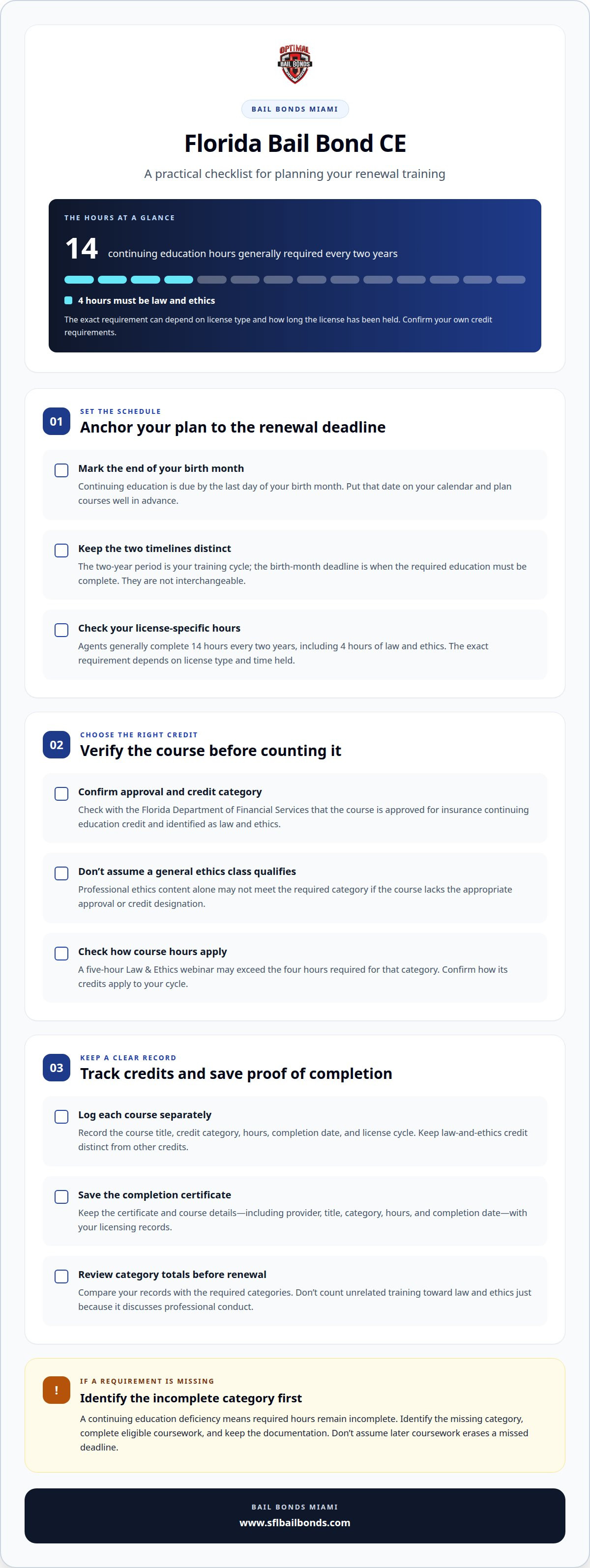
Mark the end of your birth month as the continuing education deadline. Florida agents generally must complete 14 hours of continuing education every two years, with the required hours due by the last day of the licensee’s birth month. The exact continuing education requirement depends on license type and how long the agent has held the license, so separate your law-and-ethics hours from other required credits.
Course costs vary by provider, format, and course content; request a quote for the specific class and compare what it includes. Florida temporary licenses are valid for 18 months, a separate timeline from continuing education renewal.
- Check temporary-license conditions before applying. Applicants must be at least 18 years old, and they must complete the required education within four years before applying for a temporary license. A temporary agent also needs employment with a supervising agent. Keep education records and employment details organized so each application requirement can be addressed clearly.
- Plan the examination and work requirement as distinct licensing steps. A Florida bail bond agent candidate must answer 70% of licensing examination questions correctly to pass. A temporary agent must work at least 30 hours per week for 52 weeks before taking the final examination for a full license. Track those work hours separately from education credits.
Continuing education for license maintenance
Use a renewal calendar and credit log to organize your ethics training. Florida’s requirements include total hours, course categories, and a birth-month deadline.
- Map credits to your license cycle. Florida bail bond agents generally complete 14 continuing education hours every two years. Four hours must cover law and ethics, and the remaining credits must satisfy the applicable categories. The exact requirement depends on license type and how long you’ve held the license, so record those details before choosing a class.
Create a simple tracker with the course title, credit category, hours, completion date, and license cycle. Record a law-and-ethics class separately from elective credits, for example. This makes it easier to spot a missing category before the deadline instead of counting only your overall hours.
- Schedule the deadline first. Continuing education is due by the last day of your birth month. Set calendar reminders well in advance, then plan courses around work and other renewal tasks. The two-year period is the training cycle; the birth-month deadline is the date by which you must complete it. Don’t treat them as interchangeable.
Missing the deadline means your continuing education is incomplete for renewal. Identify eligible credits to complete and keep the completion record; don’t assume later coursework erases a missed deadline. Keep renewal planning separate from temporary-license timelines and examination requirements.
- Keep proof of ethics training. Save the completion certificate and course details, including the provider, title, credit category, hours, and completion date. Follow the reporting and submission instructions for your course and renewal. Before filing, compare your records with the required credit categories so you don’t mistake a general course certificate for law-and-ethics credit.
Florida requires four law-and-ethics hours every two years. A five-hour Law & Ethics webinar may exceed the hours required for that category, but confirm how its credits apply to your cycle. Keep the certificate with your licensing records in case you need to document completion.
- Address a missed requirement promptly. A continuing education deficiency means required hours remain incomplete for license maintenance. Start by identifying the missing category, then complete eligible coursework and keep its documentation. Don’t count unrelated training toward the law-and-ethics category just because it discusses professional conduct.
For a refresher on foundational training, review bail bond education resources. Use that distinction to keep initial education separate from the continuing education required during a licensing cycle.
The Florida bail bond agent Law & Ethics continuing education webinar is 5 hours long; verify its credit category and cycle applicability before counting it toward your requirement.
Course availability
Florida-approved law-and-ethics training is available as a scheduled webinar. One listed Florida bail bond agent Law & Ethics webinar begins at 08:30am on November 19, 2026, and another begins at 08:30am on December 17, 2026.
- Compare the scheduled dates with your calendar. The November 19 and December 17, 2026 sessions both begin at 08:30am. Choose a date that gives you room to attend the full webinar without scheduling conflicts. Write the selected date and start time beside your continuing education plan, rather than relying on memory as the deadline approaches.
Both listed sessions cover Florida bail bond agent Law & Ethics and have the same scheduled start time. The main difference for planning is the date. If one conflicts with a work commitment, the other offers a separate scheduled option.
- Match the course title to your requirement. Look for a course explicitly identified as Florida bail bond agent Law & Ethics. A broad ethics seminar may discuss professional conduct but differ from a course designated for bail bond agents. Compare the title and credit category before enrolling, and keep the course information with your renewal records.
The listed webinar runs for five hours. Consider the duration when planning attendance, and review how the course credit applies to your education record. Don’t assume the title alone proves the credit; check the approval and credit details.
- Confirm approval and credit classification. The listed Florida bail bond agent Law & Ethics webinar is approved for insurance continuing education credit by the Florida Department of Financial Services. When choosing a course, confirm it has the relevant approval and category, especially if its description uses general ethics language.
Florida-approved providers offer scheduled law-and-ethics courses, including webinars. Review each course’s approval and credit information to distinguish eligible training from a class that merely discusses ethics.
- Plan for the webinar format. Since the listed course is a webinar, set aside the scheduled session time and prepare to participate remotely. Before the November 19 or December 17 session, review the enrollment instructions and any access details supplied for that course. Keep those details accessible so setup doesn’t interfere with the scheduled start.
A webinar’s scheduled date is different from an on-demand class. Treat 08:30am as the listed start time, and arrange your calendar around the session rather than assuming you can complete it whenever convenient.
- Save course records after completion. Keep the webinar title, session date, completion record, and credit information together. For example, label your file “Florida bail bond agent Law & Ethics” and add the date you attended. This makes it easier to distinguish the course from other continuing education and track your licensing cycle accurately.
Use the November or December 2026 schedule as a planning reference, then record the session you actually complete. Organized course records make it easier to match training to the correct license period.
Florida bail bondsman training courses
Choose training based on its purpose, not just its title. In Florida, initial licensing education and continuing education serve different stages of a bail bond agent’s career.
- Separate licensing education from renewal training. If you’re preparing to enter the profession, start with the required pre-licensing coursework. A 120-hour bail bond course prepares applicants for initial licensing requirements. By contrast, an ethics or law-and-ethics class addresses continuing education for agents already maintaining a license. Treat these as separate tracks, not interchangeable options.
An applicant who hasn’t completed the initial coursework, for example, shouldn’t assume a short ethics class replaces it. An active agent planning for renewal should identify the continuing education category needed for that cycle.
- Check each course’s purpose and approval. Match the course description to the requirement you need to meet. Initial bail bond instruction must come from a provider approved by the Florida Department of Insurance. For law-and-ethics continuing education, confirm approval for insurance continuing education credit through the Florida Department of Financial Services.
These approvals relate to different requirements. Read course information carefully, especially when the title uses broad terms such as “bail bond training” without specifying the credit category or licensing purpose.
- Plan the required coursework as a sequence. Initial applicants need the bail bond course and the required correspondence course on insurance and bonds. Completing one doesn’t complete the other. Record each course title and completion date so you can identify any remaining requirement before moving to the next licensing step.
After education, candidates must address the licensing examination. A Florida exam candidate must answer 70% of the questions correctly to pass. Use coursework to build familiarity with the material, then prepare for the examination as a separate task.
- Choose continuing education by credit category. Florida agents need law-and-ethics instruction as part of continuing education, alongside other applicable credits. A five-hour Law & Ethics webinar is one training format, but its duration alone doesn’t show how credits apply. Compare its designation with your license requirements and keep proof of completion.
A general business class may not satisfy the law-and-ethics category just because it discusses workplace conduct. Use the course’s category, approval, and credit details to distinguish eligible training.
- Keep a course record that supports your next step. Save the course title, approval information, hours, and completion evidence together. For example, keep initial licensing coursework separate from later ethics credits. This organization helps you see whether you’re preparing for entry, an examination, or license maintenance.
The key is to choose a course that fits your licensing stage and required credit category, then document completion before moving on.
What ethics topics are required for Florida bail bond agent continuing education?
- Start with the required category. Florida bail bond agents must complete four hours of law and ethics continuing education every two years. This is the required ethics component. An ethics course for bail bondsmen in Florida should be identified as law-and-ethics training, not merely as a general professional conduct class.
Compare the course’s stated subject and credit designation with your renewal needs. The category tells you what type of instruction to choose, but courses may use different lesson titles and formats.
- Connect rules with judgment. A useful class can help agents consider how professional standards apply to bail bond work. An ethics course for bail bondsmen in Florida may use scenarios about clear explanations and accurate recordkeeping to show how everyday choices affect trust.
These are practical applications for learning, not a separate list of required lesson titles. Florida’s continuing education category is law and ethics; examples can help connect the subject to everyday decisions.
- Practice communication in stressful situations. Bail bond conversations may take place while families face urgent uncertainty. Use course discussions to practice sharing accurate information in plain language, distinguishing known facts from assumptions, and communicating respectfully.
If someone misunderstands a document, for example, explain its terms clearly instead of relying on jargon. This supports ethical judgment without suggesting that a specific script or scenario is state-mandated.
- Examine careful handling of collateral. Consider how clear records and communication can prevent confusion about collateral arrangements. A practical scenario might ask what someone needs to know before pledging property and how records can accurately reflect the agreement.
Keep the discussion grounded in professional responsibility. The continuing education requirement identifies law and ethics; scenarios like these help agents apply those principles to sensitive decisions.
- Confirm the course fits your cycle. Florida agents complete law-and-ethics continuing education every two years. Before enrolling, match the course category to your license maintenance needs and keep the completion record with your education documents.
A five-hour Law & Ethics webinar is one available course format. Review its title and credit information, then record the training you complete during your licensing cycle.
Florida bail bond agents must take the Law & Ethics continuing education course every 2 years. Treat the required course as the starting point when reviewing education options. Check that the course description clearly identifies Law & Ethics continuing education, rather than relying on a broad reference to professional development. Keep the course details and your completion information together so you can refer to them when organizing your education records. If a description is unclear, seek clarification before enrolling rather than assuming it matches the requirement.
Optimal Bail Bonds: Pre-Licensing Bail Bonds Class
Optimal Bail Bonds offers a Pre-Licensing Bail Bonds Class for people preparing to enter the profession. Its 120 Hours Bail Bonds Course aligns with the initial education path, while continuing education serves licensed agents maintaining their credentials. Keeping those tracks distinct helps you choose education that matches your next step, whether you’re beginning training or planning ongoing professional development.
If you’re ready to explore pre-licensing education, visit Optimal Bail Bonds online.
Take Your Next Training Step
Ethical judgment grows through deliberate learning and everyday choices. An ethics course for bail bondsmen in Florida can support that development, but your next course should fit your current stage: entering the field, building foundational knowledge, or continuing professional development. Use that distinction to choose a useful next step instead of treating every class as interchangeable.
For aspiring agents, Optimal Bail Bonds offers its Pre-Licensing Bail Bonds Class, 120 Hours Bail Bonds Course, and How to be a Bail Bondsman. These education options provide a starting point for exploring the profession and its training path.
Keep building your knowledge thoughtfully. Careful training can help you bring clarity and integrity to your work with people facing a difficult moment.
Frequently Asked Questions
Does Florida require bail bondsmen to complete ethics continuing education?
Yes. Florida requires bail bond agents to complete law-and-ethics continuing education as part of license maintenance. When choosing a class, focus on its stated credit category, not simply whether the description mentions ethics. A course about general business conduct, for example, may not meet the relevant requirement. Keep the course description and completion record together so you can identify the training completed for your licensing cycle.
How many continuing education hours must Florida bail bond agents complete each year?
Florida sets this requirement over a two-year cycle, not as a separate annual allotment. Agents generally complete 14 continuing education hours every two years, with the required total varying by license type and time held. If you’re planning year by year, use the two-year cycle and your license details to pace coursework. Don’t mistake a personal yearly study target for the state’s stated renewal period.
Are Florida bail bond ethics courses available online or in person?
A webinar is one format for Florida bail bond agent Law & Ethics training. Formats vary by course, so review the schedule and delivery details before planning. If you prefer an in-person class, treat that as a format preference separate from the course’s approval and credit category. Format alone doesn’t establish whether training counts toward your continuing education requirements.
How can a Florida bail bond agent submit proof of completed ethics training?
Keep the completion certificate and course details, including the provider, title, credit category, hours, and completion date. Follow the reporting and submission instructions provided for the course and renewal.


