
Imagine the phone rings at 2:00 AM and you learn your spouse is being held at the Krome North Service Processing Center. The panic is immediate, but the path forward doesn't have to be a mystery. Securing a release often depends entirely on how your family approaches immigration bond hearings in 2026. It isn't just about the law; it's about proving that your loved one has a stable home and deep roots right here in Florida.
We know the weight of this moment feels unbearable, especially when language barriers and complex court procedures stand in your way. You want them home, and you need a bond amount that won't destroy your family's financial future. This guide provides the clarity you're looking for by detailing exactly how to prepare your evidence and what to expect when facing an immigration judge. We'll walk through the specific requirements for Florida detention centers like BTC, explain how to demonstrate community ties, and outline the transition from a successful hearing to the final bond payment that brings your family back together.
Key Takeaways
- Understand the difference between mandatory detention and discretionary eligibility to determine if your loved one qualifies for a release request.
- Learn how to effectively counter the two biggest legal obstacles at immigration bond hearings: being labeled a danger to the community or a flight risk.
- Discover the essential documents needed for a "Bond Packet," including how a strong sponsor letter can demonstrate deep ties to the Florida community.
- Prepare for the reality of televideo court appearances at Florida facilities like Krome and BTC so you know exactly what to expect on the day of the hearing.
- Navigate the final steps of securing a fast release by choosing between cash and surety bonds once the judge sets a bond amount you can afford.
What is an Immigration Bond Hearing and Who is Eligible?
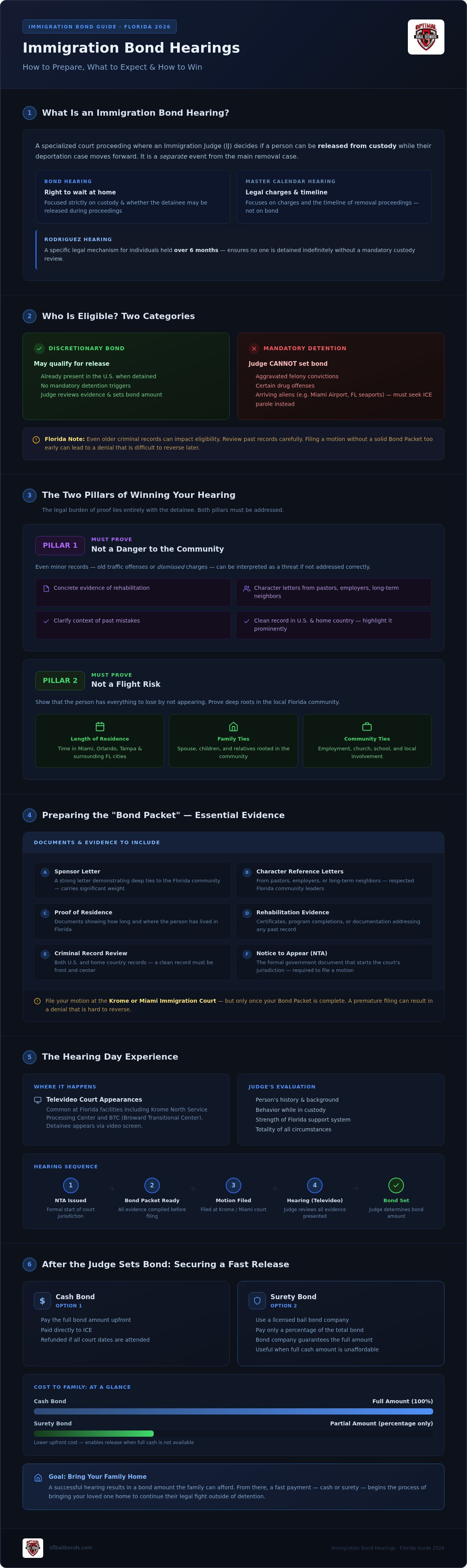
An immigration bond hearing is a specialized court proceeding where an Immigration Judge (IJ) decides if a person can be released from custody while their deportation case moves forward. This is a separate event from your main case. Unlike a Master Calendar hearing, which focuses on legal charges and the timeline of your removal proceedings, immigration bond hearings are strictly about the detainee's right to wait for their day in court from the safety of their home. For those facing long-term detention, a Rodriguez Hearing serves as a specific legal mechanism to ensure individuals aren't held indefinitely without a custody review after six months of confinement.
The judge's role is to decide if the person is eligible for a discretionary bond. If they are, the judge then determines the bond amount based on the evidence provided. This process offers a vital lifeline to families in 2026, providing a structured way to navigate immigration bond hearings and bring a loved one home while they continue to fight their legal battle.
Determining Eligibility for Release
Not everyone qualifies for release. Federal law creates two distinct categories: discretionary bond and mandatory detention. If a person falls under mandatory detention, the judge lacks the legal authority to set a bond, regardless of the person's character or family ties. This often happens due to specific criminal convictions, such as aggravated felonies or certain drug offenses. In Florida, even older criminal records can impact your eligibility, making it essential to review past records carefully with your support team.
The person's status at the time of detention also matters. Arriving aliens, such as those stopped at Miami International Airport or a Florida seaport, are often ineligible for bond before an Immigration Judge. They must instead seek parole directly from ICE. Conversely, people who were already present in the U.S. when they were taken into custody usually have a better chance of requesting a custody review.
How to Request a Bond Hearing in Florida
To get a date on the calendar, you must file a motion for a bond redetermination with the local immigration court, such as the Krome or Miami courts. The timing of this request is vital. You don't want to rush into a hearing without your evidence ready. The process usually begins once the government issues a Notice to Appear (NTA). This document outlines the charges against the individual, and it serves as the formal start of the court's jurisdiction over the custody matter. Filing the motion too early without a solid Bond Packet can lead to a denial that's difficult to reverse later.
The Two Pillars of Winning Your Hearing: Danger and Flight Risk
Winning at immigration bond hearings requires a clear strategy that addresses the two specific concerns of every Immigration Judge: danger to the community and flight risk. You aren't just asking for a favor; you're presenting a case. The legal burden of proof lies entirely with the detainee to show they deserve to be released. If the judge believes the individual poses even a slight risk in either category, the request for bond will likely be denied. Judges look at the totality of the circumstances, reviewing the person's history, their behavior while in custody, and the strength of their support system in Florida. Understanding how ICE detention management classifies individuals can help you prepare for the specific questions the judge might ask during the hearing.
Mitigating 'Danger to the Community' Concerns
The "danger" standard is often the highest hurdle. Even minor criminal records, such as old traffic offenses or dismissed charges, can be interpreted as a threat to public safety if not addressed correctly. To counter this, you must provide concrete evidence of rehabilitation or clarify the context of past mistakes. Character reference letters from respected Florida community leaders, such as pastors, employers, or long-term neighbors, carry significant weight. If the detainee has a clean record both in the U.S. and their home country, make sure that fact is front and center in your presentation.
Proving Stability to Reduce 'Flight Risk'
A flight risk is someone the judge fears will disappear into the shadows rather than attending future court dates. You prove stability by highlighting deep roots in the local area. Showing that a person has everything to lose by running away is the most effective way to win. Focus on these key areas:
- Length of Residence: Show exactly how long the person has lived in cities like Miami, Orlando, or Tampa.
- Family Ties: Identify relatives who are U.S. citizens or Legal Permanent Residents (LPRs) who rely on the detainee.
- Financial Stability: Provide proof of past employment and a clear plan for where the person will live after release.
A well-prepared case demonstrates that the individual is part of the fabric of their community. If you're unsure how to start gathering this evidence, exploring Florida immigration bond resources can help you understand the requirements for a successful release. Judges want to see a clear path from the courtroom back to a stable home environment.
Preparing the 'Bond Packet': Essential Evidence for Success
A well-organized "Bond Packet" is often the single most important factor during immigration bond hearings. It's the physical evidence that backs up your claims of stability and good character. Without it, your words are just statements; with it, they become verifiable facts. Judges in 2026 face heavy caseloads and appreciate clarity. You'll need to gather original identity documents or certified copies, including birth certificates, passports, and marriage licenses, to prove the legal reality of family relationships. Financial evidence is equally vital. Judges want to see tax returns, recent bank statements, and utility bills from Florida addresses to confirm the detainee has a legitimate, stable place to live upon release.
Think of this packet as a resume for freedom. When you stand before a judge at immigration bond hearings, the quality of your paperwork speaks louder than your testimony. Every document should be translated into English and clearly labeled so the judge can find information quickly. A messy packet suggests a lack of preparation, while a professional one demonstrates that the family is serious about following the law and attending future court dates.
Crafting the Perfect Sponsor Letter
The sponsor letter serves as the foundation of your evidence. Typically, a sponsor must be a U.S. Citizen or a Lawful Permanent Resident who can vouch for the detainee's character. This letter shouldn't just be a few sentences. It needs to include the sponsor's full address, their specific relationship to the detainee, and a clear, written promise to ensure the individual attends every future court date. It's helpful to mention how the sponsor will provide financial support or housing during the legal process. For a deeper look at how these roles function within the larger system, see our Immigration Bail Bonds Florida guide.
Proving Community Ties in South Florida
Florida judges look for deep integration into the local community. This goes beyond just having a home. You can demonstrate this through church membership certificates, records of local volunteer work, or school enrollment papers for the detainee's children. If the family owns property or has a long-term lease in Miami-Dade or Broward County, include those documents to show the person isn't a flight risk. A letter from an employer stating that the detainee's job is waiting for them is incredibly persuasive. It proves the person is a productive member of society with a reason to stay and fight their case the right way.
What Happens Inside the Courtroom: The Hearing Day Experience
Walking into a Florida immigration court can feel overwhelming. Whether your case is heard in Miami, Orlando, or specialized facilities like the Krome Service Processing Center or the Broward Transitional Center (BTC), the atmosphere is formal and high-stakes. In 2026, most immigration bond hearings are conducted via televideo. This means while you and the judge are in the courtroom, your loved one remains at the detention facility, appearing on a screen. This physical separation adds to the emotional stress, but staying focused on the legal goal is essential for a positive outcome.
The Department of Homeland Security (DHS) will have their own counsel present, commonly referred to as the ICE Attorney. Their role is to represent the government's interest, which often involves challenging the evidence in your bond packet. They may bring up past police interactions or argue that the detainee's ties to Florida aren't strong enough. The judge listens to both sides before delivering a final decision: either a bond denial or a specific dollar amount required for release.
The Role of Testimony
Preparation is key because the judge or the ICE attorney may ask the sponsor to testify. You should be ready for direct questions about the detainee’s criminal history, their work habits, and your specific plan to ensure they attend future hearings. Judges value honesty above all else. If you don't know an answer, it's better to say so than to guess. Being respectful and clear in your responses helps build the credibility the judge needs to feel comfortable granting a release.
Understanding the Judge’s Decision
If the judge grants bond, they'll set a dollar amount. By law, the statutory minimum for an immigration bond is currently $1,500, though amounts are often significantly higher depending on the perceived risk. In some cases, a judge might grant "Conditional Parole," which allows for release without a financial bond, usually involving an ankle monitor or regular check-ins. This is quite different from the Florida Bail Bonds process used in criminal courts, where specific percentages and state regulations dictate the costs. Once the judge signs the order, the focus shifts to the logistics of payment and the actual release from custody.
After the Judge Sets Bond: How to Secure a Fast Release
Winning at immigration bond hearings feels like a mountain has been moved. However, the judge's signature on a bond order is only the first half of the process. Your loved one won't be released until the financial obligation is met. Families usually face a choice between two paths: paying a "Cash Bond" directly to ICE or securing a "Surety Bond" through a specialized immigration bail bond company. Each option has different requirements for your family's immediate finances and long-term security.
A cash bond requires you to pay the full amount upfront to the government. For many Florida families in 2026, coming up with $7,500 or $15,000 in liquid cash on short notice is nearly impossible. This is where the surety bond becomes a vital tool. By working with a professional bondsman, you typically pay a 10% premium of the total bond amount. This smaller, non-refundable fee makes the financial burden manageable, allowing you to keep your savings for upcoming legal fees while still bringing your relative home from detention.
The Logistics of Payment and Release
Once the judge sets the amount, the bond must be processed at an ICE Enforcement and Removal Operations (ERO) office. In Florida, these payments are typically handled at the ERO offices in Miami or Orlando. Timing is everything. If the bond is posted early in the day, the release from facilities like Krome or BTC can often happen within the same business day. If the paperwork is delayed until late afternoon, it might push the release to the following morning. You'll also need to provide collateral to secure the bond, which ensures the full amount is covered if the individual fails to attend their future court dates.
Why Work with Optimal Bail Bonds?
We understand that this is one of the most stressful experiences a family can face. Our team provides compassionate, non-judgmental assistance to families across Florida who are trying to navigate the federal immigration system. We don't just process paperwork; we act as your partner through the final steps following immigration bond hearings and the subsequent release. We're here to explain the rules, handle the logistics with ICE ERO, and ensure you feel supported every step of the way. Our goal is to bring your family back together with as little friction as possible.
Bringing Your Loved One Home in 2026
Navigating the detention system requires more than just hope; it demands a strategic approach to evidence and a clear understanding of the law. By focusing on your family's deep roots in Florida and organizing a professional bond packet, you can directly address the court's concerns regarding safety and flight risk. Successful immigration bond hearings are the result of diligent preparation and a commitment to following the legal process through to the very end.
Once the judge sets a bond amount, our team at Optimal Bail Bonds is here to help you navigate the final logistics. As experienced immigration bond specialists, we provide 24/7 compassionate support to families across the state. We serve all Florida detention centers, ensuring that the transition from a courtroom victory to a physical release is handled with speed, integrity, and professional care.
You don't have to face this overwhelming system alone. Your family belongs together, and we're here to provide the steady partnership you need to bring your loved one home safely.
Frequently Asked Questions
How long does it take to get an immigration bond hearing in Florida?
It typically takes several weeks to a couple of months to secure a date for immigration bond hearings in Florida. The timeline depends heavily on the specific court's current backlog, such as the busy Miami or Orlando dockets. Once your motion for a bond redetermination is filed, the court will schedule a hearing. Preparing your evidence early ensures you don't face further delays when a slot finally opens up on the judge's calendar.
Can I pay an immigration bond myself without a bondsman?
You can pay an immigration bond yourself by posting the full amount as a cash bond directly at an ICE ERO office. This requires a cashier's check for the entire sum, which the government holds until the case concludes. Many families find this financially difficult. Choosing a surety bond through a specialist allows you to pay a smaller, non-refundable premium while keeping your savings available for other family needs during the legal process.
What is the minimum amount for an immigration bond in 2026?
The statutory minimum amount for an immigration bond in 2026 remains $1,500. However, it's rare for a judge to set the bond at this lowest level. Most bonds in Florida range much higher, often between $5,000 and $15,000, depending on the judge’s assessment of flight risk and community safety. The specific amount is determined during the hearing after the judge reviews the sponsor's financial stability and the detainee's ties to the area.
What happens if the judge denies bond at the hearing?
If the judge denies bond, the detainee will remain in ICE custody while their deportation case proceeds. You have the right to appeal this decision to the Board of Immigration Appeals (BIA) within 30 days. Alternatively, if new evidence emerges or the detainee's situation changes significantly, you may be able to file a motion for a new hearing based on changed circumstances. It's a difficult setback, but other legal avenues may still exist for your family.
Can someone with a deportation order get a bond hearing?
Individuals with a final order of deportation are generally not eligible for immigration bond hearings. Federal law typically requires mandatory detention for those whose cases have already been decided. However, if a lawyer successfully reopens the case or stays the removal, the individual might regain eligibility for a custody review. It's a complex situation that depends entirely on the current status of the legal proceedings and any pending motions with the court.
Do I need a sponsor for an immigration bond hearing?
Yes, having a sponsor is practically essential for a successful outcome. The sponsor must be a U.S. Citizen or Lawful Permanent Resident who provides a stable Florida address and a written commitment to ensure the detainee attends all future court dates. Judges look for a sponsor with clean records and financial stability. Without a strong sponsor to anchor the bond packet, proving that the detainee is not a flight risk becomes significantly harder.
Where are immigration bond hearings held in South Florida?
In South Florida, these hearings are primarily held at the Miami Immigration Court on North Miami Avenue or specialized facility courts like Krome and the Broward Transitional Center (BTC). While the judges are often physically in a courtroom in Miami or Orlando, the hearings frequently use televideo technology. This allows the court to connect with detainees held at various facilities across the state without requiring physical transport for every scheduled appearance.
How do I find out which ICE facility my relative is in?
To locate a relative, use the ICE Online Detainee Locator System. You'll need the person's Alien Registration Number (A-Number) and their country of birth, or their full legal name and date of birth. This system provides the name of the facility, such as Krome or Glades County, where they're currently held. If the system doesn't show a location, they may still be in the processing phase at a local Florida ICE field office.


