
Walking out of jail brings immense relief, but posting bond is only the opening chapter of your legal journey. Understanding the strict court appearance requirements after bail Ft Lauderdale defendants must follow is critical to protecting your freedom and avoiding immediate re-arrest. You aren't alone if the sudden arrival of court notices, complex docket systems, and unfamiliar hearing names feels completely overwhelming. Cosigners often lose sleep worrying about pledged collateral, while defendants fear that a single missed mailing could trigger a bench warrant. That anxiety is entirely normal when your future hangs in the balance.
You can replace that uncertainty with orderly, practical action. This guide delivers a clear breakdown of your mandatory obligations across Broward County's 17th Judicial Circuit, showing you how to safeguard your bond and maintain total compliance. We will walk you through the distinct post-release hearings, practical tools for tracking dates via the Broward Clerk of Court, and how an experienced bail agent works alongside your legal counsel to keep you informed.
Key Takeaways
- Master the mandatory court appearance requirements after bail Ft Lauderdale courts enforce across the 17th Judicial Circuit to keep your bond secure.
- Learn the critical procedural differences between initial arraignments, case management conferences, and calendar calls so you never miss a required appearance.
- Discover practical tools and docket lookups through the Broward County Clerk to verify your upcoming dates and receive timely updates.
- Protect cosigner collateral and prevent the issuance of bench warrants by understanding the severe legal fallout of a failure to appear.
- See how an experienced bail professional acts as your administrative compliance partner alongside your legal counsel without providing legal advice.
Understanding Mandatory Court Appearance Requirements After Bail in Fort Lauderdale
Securing release from jail offers immediate relief, but that release is conditional rather than absolute. When you leave custody on a surety bond, your physical freedom depends entirely on satisfying judicial attendance orders. Cosigners often worry about pledged collateral, while defendants worry about getting arrested again without warning. Navigating the specific court appearance requirements after bail Ft Lauderdale judges enforce ensures you protect your freedom while your defense attorney handles your case.
The Legal Foundation of Post-Bail Court Mandates
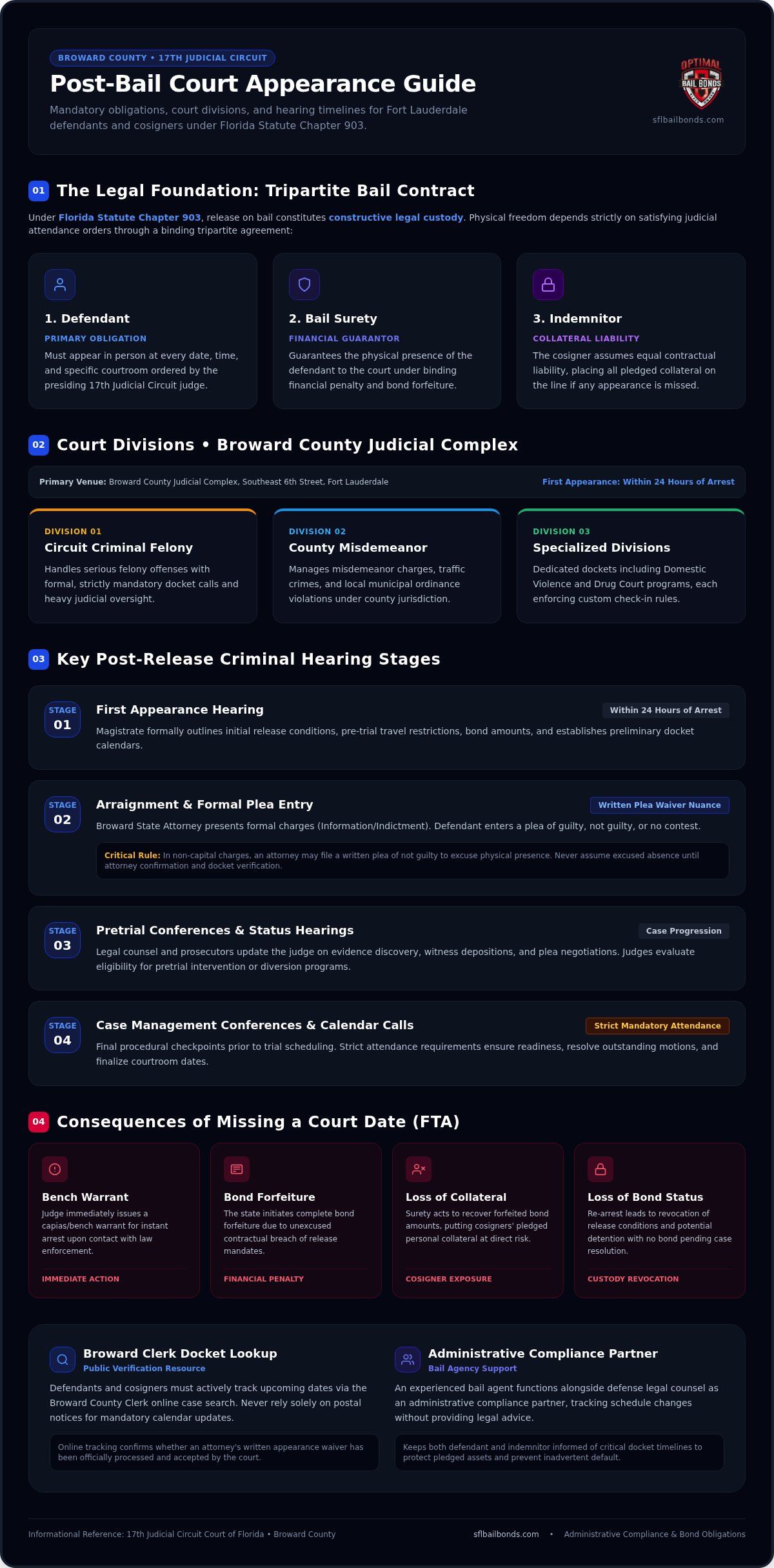
Under Florida Statute Chapter 903, an individual out on bail remains in constructive legal custody. For historical and legal context on these principles, Understanding Bail in the U.S. shows how modern release conditions balance personal liberty with institutional accountability. When you post a bond, you enter into a binding tripartite contract involving the court, the bail surety, and yourself as the defendant.
This statutory structure creates clear, shared obligations:
- Defendant appearance: You must appear at every date, time, and courtroom ordered by the presiding judge.
- Surety guarantee: The bail agency guarantees your presence to the court under financial penalty.
- Indemnitor liability: The cosigner assumes equal contractual responsibility for your appearances, placing their pledged collateral on the line if you fail to attend.
A single unexcused absence breaches that contract immediately. The state can forfeit the bond, and the surety must act to protect against loss.
The Role of the 17th Judicial Circuit Court
In Fort Lauderdale, all county and circuit criminal proceedings run through the 17th Judicial Circuit Court. Most hearings convene at the Broward County Judicial Complex on Southeast 6th Street. First appearance hearings typically occur within 24 hours of an arrest, where a magistrate formally outlines release conditions, pre-trial travel restrictions, and preliminary docket calendars.
The 17th Judicial Circuit operates through distinct divisions to manage case flow efficiently:
- Circuit Criminal Felony Division: Handles serious felony offenses with formal, mandatory docket calls.
- County Criminal Misdemeanor Division: Manages misdemeanor charges, traffic crimes, and local ordinance matters.
- Specialized Divisions: Oversees dedicated dockets such as domestic violence and drug court programs, each with distinct check-in rules.
Each division operates with strict procedural calendars. Following the exact court appearance requirements after bail Ft Lauderdale courts establish keeps you in good standing across every phase of your legal journey.
Key Post-Release Criminal Hearings in Broward County Explained
Every criminal proceeding in Broward County follows a structured timeline. Missing any scheduled phase immediately endangers your freedom and puts your cosigner's collateral at risk. Knowing the procedural purpose of each date, and whether the judge permits an attorney waiver, is essential to fulfilling the court appearance requirements after bail Ft Lauderdale courts impose.
Arraignment and Formal Plea Entry
The arraignment represents your first formal post-release proceeding. At this stage, the Broward State Attorney presents the charging document, known as an information or indictment. You enter an initial plea of guilty, not guilty, or no contest.
Many defendants assume they must attend, but Florida criminal rules permit your attorney to file a written plea of not guilty on your behalf for many non-capital charges. When properly filed, this waiver excuses your physical presence. Never assume you are excused until your attorney explicitly confirms that the judge accepted the written waiver. You can verify docket filings online through the Broward County Court Date Search to confirm your appearance status.
Pretrial Conferences and Status Hearings
Pretrial conferences and status hearings keep your case moving through the system. During these sessions, defense attorneys and prosecutors update the judge regarding evidence discovery, witness depositions, and plea negotiations. Judges also evaluate eligibility for pretrial intervention or diversion programs.
Physical attendance is usually mandatory. Some judges permit defense counsel to appear without the defendant for routine scheduling updates, but only if granted through an advance written order. Without that signed order, stepping foot into the courtroom remains your non-negotiable obligation. Cosigners should monitor these status updates closely, as any sudden absence prompts an immediate bond revocation.
Docket Sounding and Calendar Call
Docket sounding, often called calendar call, serves as the final checkpoint before trial. The court convenes this hearing to confirm witness availability, resolve pending constitutional motions, and assign an exact trial date. This hearing determines whether your case proceeds to a jury or resolves through a negotiated settlement.
Defendant attendance at docket sounding is strictly mandatory. Judges almost never waive physical presence at this late stage. Failing to show up will trigger an immediate bench warrant without bond. Staying aligned with the court appearance requirements after bail Ft Lauderdale mandates ensures your surety bond remains intact all the way to case disposition. If you need assistance tracking mandatory appearance dates or coordinating bond obligations across South Florida, consulting experienced teams like Bail Bonds Miami helps keep your paperwork fully organized.
How to Track, Verify, and Prepare for Broward County Court Dates
Staying organized is your strongest defense against an accidental arrest warrant. Courts rarely accept lost mail or calendar confusion as valid excuses for missing a docket. Taking proactive control of your schedule ensures you satisfy all court appearance requirements after bail Ft Lauderdale judges set for your release.
Navigating the Broward County Clerk of Courts Portal
You can verify active case records directly through the Broward County Clerk of Courts public search tool using your uniform case number or full legal name. The portal details upcoming hearing dates, assigned divisions, and courtroom numbers. Cross-reference these listings with the calendar reminders your licensed bail agent provides to prevent scheduling conflicts.
Reviewing statutory rules under the Florida Statutes on Bail highlights how strictly courts enforce these dates. If you manage complex family schedules across county lines, checking resources like this guide on professional bail bond guidance in Miami helps clarify regional docket procedures.
In-Person Attendance Logistics at the Judicial Complex
Most Fort Lauderdale criminal proceedings take place at the Broward County Judicial Complex at 201 SE 6th Street. Plan your morning carefully so unexpected traffic on Broward Boulevard doesn't cause a missed roll call.
- Arrival time: Arrive at the building at least 45 to 60 minutes early to clear security checkpoints.
- Security screening: Expect metal detectors, bag checks, and restrictions on prohibited items like pocketknives or liquids.
- Dress code: Wear clean, conservative business attire. Avoid flip-flops, tank tops, hats, or shorts, which can result in a bailiff denying you entry.
- Electronics: Silence your cell phone completely before entering any assigned courtroom gallery.
Handling Virtual and Remote Zoom Hearings
Certain routine misdemeanor calls or pretrial status updates permit remote attendance via Zoom. You cannot simply assume your hearing is virtual, however; your attorney must confirm that the presiding judge allows remote appearances for that specific docket.
When attending remotely, log in at least fifteen minutes before your scheduled block. Change your display name to your legal first and last name so the clerk can identify you in the virtual waiting room. Sit in a quiet, well-lit room, dress professionally, and treat the video feed with the same formal respect you would show inside a physical Fort Lauderdale courtroom. These disciplined habits ensure you meet every court appearance requirements after bail Ft Lauderdale mandate without unnecessary friction.
Consequences of Missing a Court Date: Forfeiture, Warrants, and Penalties
Failing to appear in court changes your legal standing in an instant. The moment the clerk calls your case and hears no response, the presiding judge issues a failure to appear (FTA) finding. An alias capias or bench warrant issues immediately for your arrest, stripping away your freedom and exposing your cosigner to devastating financial losses.
Understanding Bond Estreature and Financial Forfeiture
When you miss a mandatory appearance, the court initiates bond estreature under Florida Statute Chapter 903. This administrative step starts a strict statutory countdown toward final judgment. If the surety cannot surrender the defendant back into custody or resolve the warrant within that statutory window, the bond forfeits entirely.
Cosigners bear the brunt of this financial catastrophe. Indemnitors risk losing homes, vehicles, bank accounts, or whatever collateral they pledged to secure the surety bond. Reviewing the contractual relationships explained in bail bonds Miami helps cosigners realize that securing release creates deep financial exposure if court dates are ignored.
Legal Repercussions: New Charges and Bond Revocation
The criminal fallout from skipping court extends far beyond forfeiting money. Under Florida Statutes Chapter 843, Section 15, willfully failing to appear for a felony charge is an independent third-degree felony, punishable by up to five years in prison and a fine of up to $5,000. If your underlying charge was a misdemeanor, willful non-appearance becomes a first-degree misdemeanor, carrying up to one year in jail and a $1,000 fine.
Judges rarely restore pre-trial release after an intentional failure to appear. They routinely revoke bond altogether, ordering that you remain detained without bond until your case concludes. Outstanding bench warrants enter state databases instantly, meaning any routine traffic stop anywhere in Florida will end in handcuffs.
Immediate Steps to Take If You Miss a Court Date
Acting fast can mean the difference between an orderly resolution and immediate arrest. If you miss a docket call due to an emergency, take these exact steps:
- Call your bail agent immediately: Inform your bonding company right away so they can coordinate with you rather than dispatching recovery agents.
- Notify your defense counsel: Your attorney must draft and file an emergency motion to quash the alias capias or vacate the bond forfeiture.
- Gather documentary proof: Secure written evidence of genuine emergencies, such as hospital admission paperwork, police accident reports, or involuntary institutional holds.
Staying diligent with every single court appearance requirements after bail Ft Lauderdale courts order keeps your bond active, protects family collateral, and avoids new felony charges.
How a Professional Bail Agency Keeps You Compliant in Fort Lauderdale
Facing criminal charges is deeply stressful, but you don't have to manage the procedural pressure alone. A dedicated bail agency acts as an administrative anchor throughout your case. While defense attorneys handle legal strategy in the courtroom, licensed bail bondsmen focus on logistical compliance. This steady partnership helps you meet every single court appearance requirements after bail Ft Lauderdale judges establish, shielding your family from sudden bond estreatures and unexpected warrants.
Proactive Notification Systems and Routine Check-Ins
Reliable bail agencies prevent missed dates by running structured check-in protocols. Modern agencies pair direct phone check-ins with automated text alerts so you never overlook a docket call. They monitor the Broward County Clerk database continuously, catching unexpected calendar updates, room changes, or judicial reassortments before you do.
These routine check-ins create a documented history of your accountability. If a scheduling misunderstanding ever arises with the court, an established record of consistent agency contact demonstrates your ongoing good faith and dedication to fulfilling release conditions.
The Value of Educated, Licensed Bail Professionals
Not all bail bond companies operate with the same standard of diligence. Premier professionals invest deeply in regulatory mastery through the 120 Hours Bail Bonds Course Pre Licensing under Florida Department of Financial Services guidelines.
Rigorous education teaches agents how to interpret court notices properly and act within strict ethical boundaries. A well-trained bondsman understands exact statutory timelines under Florida law, protecting both defendants and cosigners from costly administrative errors.
Moving Forward with Confidence and Legal Support
Protecting your freedom requires a clear division of responsibilities. Bail agents manage administrative compliance and calendar accountability, but they never provide legal advice or courtroom representation. That vital role belongs entirely to your defense attorney.
When you maintain open communication with both your lawyer and your bonding company, you create an effective support network around your case. If you need steady, compassionate guidance through the local justice system, connect with Optimal Bail Bonds to keep your bond secure and fulfill all court appearance requirements after bail Ft Lauderdale courts mandate.
Take Control of Your Freedom and Protect Your Bond
Staying ahead of your case requires personal diligence, thorough preparation, and open communication. Fulfilling every court appearance requirements after bail Ft Lauderdale judges assign is the most reliable way to keep your surety bond intact, protect your family's pledged collateral, and avoid bench warrants. From verifying official dockets on the Broward Clerk portal to attending mandatory calendar calls in proper attire, each procedural step directly safeguards your liberty. Backed by decades of combined South Florida experience and state-approved education standards, our dedicated team provides proactive check-in support to keep you informed while your defense lawyer manages courtroom strategy.
You don't have to carry the emotional weight of a criminal charge alone. With structured administrative guidance, dependable family support, and steady personal commitment, you can navigate the 17th Judicial Circuit with total confidence and move forward toward a secure future.
Frequently Asked Questions
Can my attorney appear in court on my behalf in Fort Lauderdale without me being there?
Yes, but only for specific procedural hearings and only when permitted by law. For many misdemeanor and non-capital felony arraignments or routine case management conferences, Florida rules allow defense attorneys to file a written plea or motion waiving your presence. However, your attendance remains strictly mandatory for docket soundings, evidentiary hearings, and trial calls unless the judge enters an explicit written order excusing you.
What should I do immediately if I realize I missed a court date in Broward County?
Contact your defense attorney and your bail bond agency immediately. Do not hide or wait for police contact. Your attorney can file an emergency motion to quash the bench warrant and reschedule your appearance, while your bail agent can help coordinate surrender terms to protect your bond. Addressing the issue within hours demonstrates good faith, significantly improving your chances of avoiding immediate jail detention or permanent bond forfeiture.
How do I check the scheduled date and courtroom for my Fort Lauderdale case?
Check your docket through the Broward County Clerk of Courts public case search portal using your uniform case number or legal name. This tool displays your assigned judge, division, courtroom number, and scheduled hearing times. Verifying your schedule online helps you satisfy all court appearance requirements after bail Ft Lauderdale judges order, while cross-referencing these dates with your bail bondsman's reminders prevents unexpected scheduling oversights.
Will my bail bond collateral be seized instantly if I miss a court hearing?
No, collateral is not seized instantly, but the forfeiture process begins immediately. When you miss court, the judge enters a bond estreature order. Florida law provides a statutory grace period before this estreature converts into a final, payable judgment against the surety. If your attorney and bail agent can surrender you or quash the warrant within that legal window, your cosigner's collateral assets remain protected from seizure.
Does a licensed bail bondsman provide legal representation during court appearances?
No, licensed bail bond agents never provide legal representation, legal advice, or courtroom defense. Their professional responsibility focuses on administrative compliance, reminders, and guaranteeing your appearance to the state. Your legal defense rests entirely with your retained criminal attorney or public defender. Experienced South Florida agencies, including teams serving regional clients from Miami to Fort Lauderdale, work strictly alongside legal counsel as compliance partners to keep your bond secure.
What happens if an unforeseen medical emergency prevents me from attending my hearing?
If a genuine medical crisis prevents your appearance, alert your defense counsel and bail bond agency before your hearing begins. You must collect formal medical documentation, including hospital admission paperwork, physician discharge instructions, and emergency room records. Your attorney will file these records alongside an emergency motion for a continuance, proving to the judge that your absence wasn't willful and preventing the court from issuing a bench warrant.
Are Zoom and remote court appearances permitted for all criminal hearings in Broward County?
No, remote appearances are not allowed for every criminal docket. While some Broward County judges permit Zoom for initial arraignments, discovery updates, or status conferences, major hearings demand in-person attendance. Critical events like docket soundings, suppression hearings, plea colloquies, and jury trials require your physical presence in the courtroom. Understanding which format applies to your docket is essential to meeting the court appearance requirements after bail Ft Lauderdale courts establish.


