
What if the most difficult hurdle in bringing your family member home after an arrest isn't the bail amount itself, but the heightened legal scrutiny attached to felony bonds? Hearing that your loved one faces a felony charge is terrifying. Between unfamiliar bond schedules, mandatory first-appearance hearings within 24 hours, and intimidating financial reviews like Nebbia holds, it's completely natural to feel anxious and unsure of where to turn.
You don't have to carry this burden alone or wonder who to trust. With clear knowledge and supportive, non-judgmental guidance, you can cut through the confusion and take charge of the situation. This comprehensive guide gives you direct, reliable answers about Florida felony bond classifications, state-regulated fee structures, and the exact requirements needed to secure a prompt release.
Ahead, you'll learn how South Florida courts evaluate serious offenses, what happens before a judge, and the precise steps you need to take right now to bring your loved one home safely.
Key Takeaways
- Understand the exact hierarchy of Florida charge classifications and how they dictate initial eligibility for felony bonds.
- Discover why certain serious offenses require an appearance before a judge before any bond schedule can apply.
- Learn how to prepare the necessary financial documentation to clear a Nebbia hold without avoidable delays.
- Follow a clear, step-by-step roadmap for navigating county detention facilities across Miami-Dade, Broward, and Palm Beach counties.
- Find out how working with a licensed bail education specialist protects your family from common procedural pitfalls.
What is a Felony Bond and How Does It Function in Florida?
Facing a felony accusation is an overwhelming experience for any family. Under Florida law, a felony bond is a formal financial guarantee submitted to the criminal court to secure an individual's release from custody while their charges remain pending. It legally ensures that the defendant will attend every scheduled court appearance, ranging from the initial arraignment to the final sentencing hearing. Because felony charges carry potential state prison time, courts treat felony bonds with heightened scrutiny compared to minor misdemeanor infractions.
At its core, a felony bond is a legal contract between the court, the bail bond agent, and the indemnitor who agrees to take financial responsibility for the defendant. This mechanism balances individual constitutional rights with community protection, functioning as an essential component of pretrial release and bail procedures in the United States.
To better understand the legal procedures and release rules governing Florida courts, watch this helpful overview:
The Legal Definition of a Felony Bond
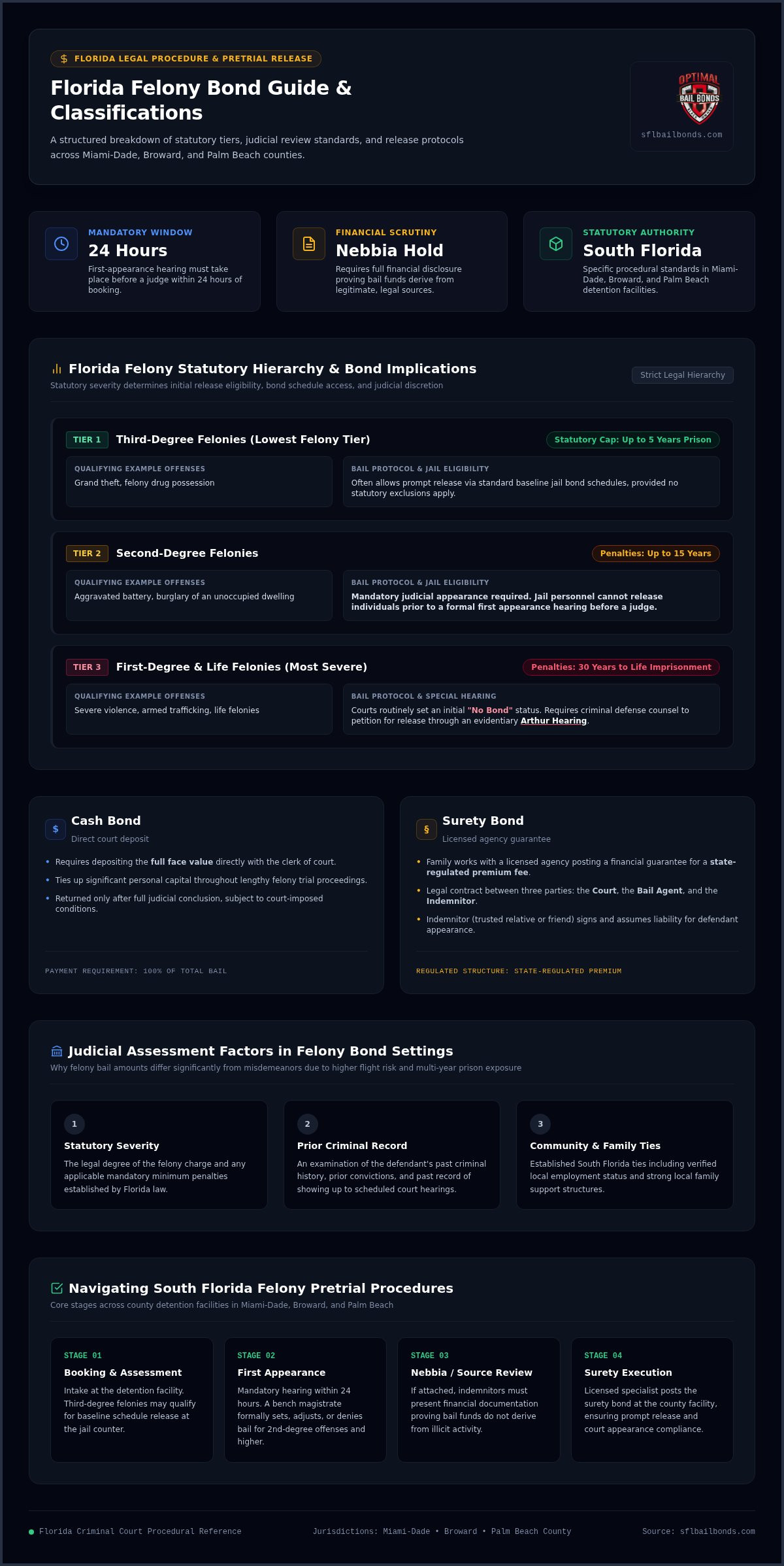
Defendants typically face two primary paths for release: cash bonds or surety bonds. A cash bond requires depositing the full face value directly with the clerk of court. In contrast, a surety bond allows families to work with a licensed agency that posts the financial guarantee in exchange for a state-regulated premium fee. The indemnitor, usually a trusted relative or friend, signs the agreement and assumes financial liability if the defendant fails to appear. Florida courts rely on these agreements to safeguard judicial integrity and maintain community safety throughout the legal process.
Why Felony Bail Amounts Differ from Misdemeanors
Bail schedules and judicial determinations reflect the potential consequences of the alleged offense. Because felony charges carry multi-year prison sentences, Florida judges assess a significantly higher flight risk than they would for minor misdemeanor offenses. Factors influencing bond settings include:
- The statutory severity of the charge and potential mandatory minimum penalties.
- The defendant's prior criminal record and history of court appearances.
- Established community ties, employment status, and local family support.
Florida Felony Classifications and Their Impact on Bail
Florida establishes a rigid statutory hierarchy for criminal offenses. Every degree carries distinct sentencing exposure and bond implications. While local jail facilities consult preset bond schedules immediately following booking, those guidelines only apply to specific eligible offenses. Third-degree felonies are the least severe classification under Florida law, yet they still carry significant bond requirements and potential state prison exposure. For higher-level allegations, booking officers cannot grant release at the jail counter. In those instances, judges hold exclusive authority to adjust, raise, or deny bail during an individual's initial court appearance.
From Third-Degree to Life Felonies: A Breakdown
Understanding the statutory tier of an offense provides immediate clarity on what lies ahead in the release process:
- Third-Degree Felonies: Charges such as grand theft or felony drug possession carry statutory caps of five years in prison. These represent the lowest felony tier and often allow release via standard baseline schedules if no statutory exclusions apply.
- Second-Degree Felonies: Offenses like aggravated battery or burglary of an unoccupied dwelling bring penalties up to 15 years. Under recent statutory updates, jail personnel cannot release individuals charged with second-degree offenses prior to a formal first appearance hearing.
- First-Degree and Life Felonies: Allegations involving severe violence, armed trafficking, or life felonies carry penalties ranging from 30 years to life imprisonment. Courts routinely set an initial "No Bond" status, requiring criminal defense counsel to petition for release through an evidentiary Arthur hearing.
The Role of the Miami-Dade and Broward Bond Schedules
Standardized bond schedules in Miami-Dade and Broward counties establish temporary release amounts for qualifying charges before a defendant faces a bench magistrate. However, standard schedules do not apply across the board. If an arrest involves domestic violence, an alleged violation of probation, or an offense categorized as a statutory dangerous crime, standard release is suspended entirely. The defendant must remain detained until a magistrate evaluates the case during first appearance.
Florida Rule of Criminal Procedure 3.130 mandates that this first appearance take place within 24 hours of booking. This hearing represents the earliest judicial window to determine pretrial conditions, set monetary bail, or address state-regulated premiums governed by the Florida Department of Financial Services bail bond guide. When sudden charges leave your family searching for dependable clarity, consulting the licensed professionals at Optimal Bail Bonds helps you prepare for courtroom proceedings without delay.
The Nebbia Hearing: A Critical Hurdle in Felony Bonding
Securing release in high-level criminal cases often involves an extra layer of judicial oversight. Prosecutors frequently attach a Nebbia requirement, commonly referred to as a "Nebbia hold," to serious felony charges. This condition obligates the defense to prove that all funds used for bail originate from legitimate, lawful earnings rather than criminal activities. A Nebbia hold must be lifted by a judge before the bond can be posted at the detention facility.
Financial Scrutiny and the Burden of Proof
The burden falls entirely on the defense and the indemnitor to demonstrate clean financial origins. Courts examine the paper trail behind both the state-regulated premium and any pledged collateral. Understanding the legal structure of a surety bail bond clarifies why judges scrutinize every party entering the contract. To satisfy this requirement, families typically compile verifiable records, including:
- Recent bank account statements and verified wire transfer slips.
- Personal and business federal tax returns covering recent fiscal years.
- Pay stubs, employment verifications, or certified loan documentation.
An experienced bail specialist works directly alongside defense counsel during this phase. The agent prepares sworn affidavits and detailed collateral receipts, enabling attorneys to submit a comprehensive Nebbia motion to the court without administrative errors.
Release Conditions Beyond the Financial Bond
Judicial release orders for serious felony bonds often include strict non-monetary requirements designed to manage risk. Posting the financial guarantee is simply the initial step in satisfying the court. Magistrates routinely impose specific pretrial supervision rules to ensure judicial compliance:
- Electronic Monitoring: Defendants may be placed on mandatory GPS tracking or 24-hour house arrest.
- Geographic Restrictions: Standard bond conditions generally bar individuals from leaving South Florida without prior written permission from the judge.
- Mandatory Agency Check-Ins: Indemnitors and defendants must establish regular communication schedules with their bail bondsman. Consistent telephonic or in-person check-ins maintain full compliance with the surety contract until the final disposition of the case.
Step-by-Step: Securing a Felony Bond in South Florida
Securing prompt release across Miami, Fort Lauderdale, and West Palm Beach requires localized knowledge of regional detention centers. The moment law enforcement transports an individual to a facility, the intake clock begins ticking. Before you take any other action, gather the defendant's full legal name, date of birth, and current jail location so your bail agent can locate them immediately.
Timing plays a massive role in minimizing detention time. Knowing whether an individual is eligible for standard processing or must await a formal hearing prevents hours of agonizing uncertainty for families trying to navigate felony bonds.
The Booking and First Appearance Process
Intake procedures at large county facilities, such as the Turner Guilford Knight Correctional Center (TGK) in Miami-Dade or the Broward County Main Jail, involve extensive biometric fingerprinting, background checks, and administrative cataloging. This intake sequence often takes several hours during peak processing times.
If the charge requires judicial review, the defendant appears before a magistrate during the daily first appearance calendar. The judge reviews probable cause affidavits, hears recommendations from pretrial services, and formally determines release conditions. Having a licensed bail bond agent ready before this hearing begins ensures that paperwork moves swiftly the moment the judge enters an order.
Working with a Licensed Florida Bail Agent
Families encountering the justice system often face a choice between posting a full cash bond directly at the jail window or working through a surety agency. For major charges, posting the entire face value in cash ties up critical financial capital that could otherwise support household stability or private legal defense counsel. Opting for a surety bond through a licensed professional requires only a state-regulated premium, making it the practical choice for most households managing high felony bonds.
Always verify that your chosen agent holds an active license in good standing with the Florida Department of Financial Services. A credentialed bondsman understands county-specific intake logistics, maintains proper collateral receipts, and coordinates directly with facility intake clerks to prevent administrative bottlenecks.
Why Optimal Bail Bonds is Your Ally in Felony Cases
Facing the criminal justice system after a serious arrest can leave you feeling isolated and overwhelmed. When managing complex felony bonds, you need more than a transactional bond agent. You need a dedicated ally who treats your situation with empathy, urgency, and discretion. At Optimal Bail Bonds, our goal is to guide you through every phase of the release process, removing fear through transparent communication and steady, reliable support.
Compassionate Support for South Florida Families
Our agency operates on a non-judgmental foundation. We don't dwell on the allegations or judge the circumstances of an arrest; our team focuses entirely on constructive solutions. Securing release under serious felony bonds requires clear heads and swift coordination, which is why we take the time to explain every procedural step to worried loved ones.
We demystify the indemnitor's role from day one. Many co-signers worry about losing their assets or misunderstanding their legal liabilities. We explain exactly how state-regulated premiums work, outline appearance obligations, and ensure you feel secure in your decisions. Families facing overlapping jurisdictional issues also benefit from our deep proficiency in managing both standard criminal charges and immigration bail matters across Miami-Dade, Broward, and Palm Beach counties.
Expertise You Can Trust
What truly sets our team apart is our deep commitment to professional education. Beyond posting bonds, we operate a state-approved Bail Bond Education Center. Because we actively train future licensed agents in Florida regulatory compliance and statutory procedures, we maintain an intricate grasp of courtroom requirements and detention protocols. This educator mindset guarantees that your paperwork is processed accurately, avoiding costly administrative delays.
We bring steady reliability to an unpredictable situation. From your initial call through the final judicial discharge of liability, we keep you informed of every legal milestone. Contact Optimal Bail Bonds for professional guidance in Miami and beyond to consult with a licensed specialist who will handle your case with the diligence and respect you deserve.
Securing Release and Rebuilding Peace of Mind
Navigating the Florida criminal justice system after a serious arrest is undeniably stressful, but clarity restores your control. Understanding charge classifications, preparing for mandatory first appearance hearings, and proactively addressing financial scrutiny like Nebbia requirements protects your loved one from prolonged detention.
You don't have to manage these intricate steps alone. As licensed Florida bail specialists serving Miami-Dade, Broward, and Palm Beach counties, we pair prompt action with our foundation as a state-approved Bail Bond Education Center. We focus on practical solutions for complex felony bonds and immigration bail, ensuring your rights as an indemnitor remain protected every step of the way.
Take a deep breath and remember that this challenge is manageable. With an experienced, non-judgmental team walking beside you, you can take decisive action and bring your loved one home.
Frequently Asked Questions
What is the difference between a felony bond and a misdemeanor bond in Florida?
The primary difference lies in financial magnitude and pretrial restrictions. Misdemeanors involve minor infractions with lower monetary schedules, often qualifying for rapid release directly through county booking desks. In contrast, felony bonds involve serious statutory crimes carrying state prison sentences. Florida law frequently requires defendants facing felony accusations to remain detained until an individualized first-appearance hearing before a presiding magistrate.
How much does a felony bail bond cost in Miami-Dade?
Bail bond costs in Miami-Dade depend entirely on the total bail amount established by the county schedule or the judge. Florida law strictly mandates that licensed surety agents charge a state-regulated premium rate on all state appearance bonds. Agencies cannot discount or inflate this legal standard. You pay this regulated percentage fee directly to the licensed bondsman rather than fronting the entire cash amount.
Can a judge deny bond for a felony charge in Florida?
Yes, Florida judges possess statutory authority to order pretrial detention or issue a "No Bond" status. Under Florida law, individuals accused of capital crimes, life felonies, or offenses categorized as statutory dangerous crimes can be denied monetary release at first appearance. In these situations, defense counsel must formally petition the court through an evidentiary hearing to seek release conditions.
What happens if a defendant with a felony bond misses their court date?
Failing to appear triggers immediate legal and financial consequences. The presiding judge issues a bench warrant for the defendant's arrest and orders the bond forfeited. The bail agency must locate and surrender the defendant back into custody within statutory deadlines. If the individual cannot be returned, the indemnitor becomes liable for the full face value of the financial bond.
Is the bail bond premium refundable if the felony charges are dropped?
No, the surety premium is non-refundable. The fee paid to a licensed agency represents earned compensation for underwriting the contractual risk and securing the defendant's release from jail. Even if prosecutors dismiss the case, decline formal charges, or resolve the matter favorably at arraignment, the bond company has already fulfilled its operational obligation to the court.
How long does it take to get someone out of jail on a felony bond in Ft. Lauderdale?
Discharge times typically range from several hours to over half a day depending on facility volume. At facilities like the Broward County Main Jail, staff must complete biometric verification, process administrative paperwork, and clear warrant checks before release. Engaging an agent early helps ensure bond documentation enters the intake queue the moment the defendant clears judicial review.
What is a Nebbia hearing and do I need one for a felony bond?
A Nebbia hearing is an evidentiary proceeding where the defense must prove that bail funds and collateral stem from legitimate, lawful sources. You only face this requirement if prosecutors or judges place a specific Nebbia hold on the case. This restriction is standard in major drug trafficking, white-collar allegations, and high-value grand theft cases across South Florida.
Can I travel out of Florida while out on a felony bond?
Generally, you cannot leave the jurisdiction without express authorization. Standard pretrial conditions and surety contract terms restrict defendants to the immediate geographic area. If you need to travel out of Florida for work or urgent family obligations, you must obtain formal permission from both the court and your bail bond agency before leaving the state.


